
How to Visit Kanazawa Castle Park: A 2026 Guide
Learn how to visit Kanazawa Castle Park with our 2026 guide. Find transport routes, ticket prices, opening hours, photo spots, and the best tips for your trip to Kanazawa, Japan.
On this page
How to Visit Kanazawa Castle Park: A 2026 Guide
Kanazawa Castle Park stands as the most enduring symbol of the city's feudal history and samurai heritage, and in 2026 it remains one of Ishikawa Prefecture's premier sightseeing destinations.
The park's sprawling grounds house restored turrets, a 90-metre-long warehouse, the iconic Ishikawa-mon Gate, and immaculate gardens — all accessible within a short walk of Kanazawa Station.
Learning how to visit Kanazawa Castle Park before you arrive saves time, avoids the busiest windows, and ensures you don't miss the paid buildings that hold the castle's best architectural secrets.
This 2026 guide covers every practical detail: transport, ticket prices in JPY, opening hours across seasons, the best entrance, top photo spots, accessibility, and how to combine your visit with nearby Kenrokuen Garden.
Opening Hours and Entry Fees for 2026
In 2026, Kanazawa Castle Park is open year-round and free to enter at the park grounds level. The paid structures — Hishi Yagura turret, Gojukken Nagaya warehouse, and Hashizume-mon Tsuzuki Yagura — require a separate ticket and have their own hours. Here are the exact details confirmed for 2026 (sources: official Ishikawa prefectural site, visitkanazawa.jp):
- Park grounds (free): 7:00 AM – 6:00 PM (March 1 – October 15) / 8:00 AM – 5:00 PM (October 16 – February 28)
- Paid structures (Hishi Yagura / Gojukken Nagaya / Hashizume-mon Tsuzuki Yagura): 9:00 AM – 4:30 PM; last entry 4:00 PM, every day
Admission fees (2026):
- Adults: ¥320
- Children (ages 6–17): ¥100
- Seniors (65+): Free with valid ID
- Combined ticket with Kenrokuen Garden: ¥500 (saves ¥130 vs buying separately)
The combined ticket is the smartest purchase for most visitors — Kenrokuen Garden sits directly adjacent to the castle and the two sites together take a full morning. Buy the combo at either venue's ticket window. Cash and IC cards are accepted; credit card acceptance is expanding but not universal at all windows as of 2026.
Plan to spend 1.5–2.5 hours on the castle grounds alone, plus another 1.5–2 hours in Kenrokuen. Build in buffer time; the paid interiors close promptly at 4:00 PM for last entry.
How to Get to Kanazawa Castle Park from JR Kanazawa Station
The fastest public transport option from JR Kanazawa Station is the Kanazawa Loop Bus (¥210/ride, ~10 minutes). Board at Bus Stop 7 on the East Exit and alight at the "Kenroku-en/Kanazawa Castle" stop — you'll emerge directly in front of the Ishikawa-mon Gate. A one-day pass costs ¥600 and pays for itself after three rides, which is easy if you're also visiting Higashi Chaya District and Omicho Market. Full route schedules and the latest fare updates are on the Kanazawa transport guide.
Walking from Kanazawa Station is also very viable and recommended in good weather. The route via Korinbo — the city's main shopping boulevard — takes about 20–25 minutes on flat, signposted pavements. English wayfinding signs are reliable throughout the central district. This walk lets you pass the Tsuzumi-mon Gate at the station, a striking modern structure shaped like traditional drum frames.
Taxis are available from the East and West exits at all hours. The fare to the main gate is typically ¥1,000–¥1,500 depending on traffic. Groups of three or four will find a taxi cheaper per person than individual Loop Bus fares for a single trip.
If you're arriving by rental car, the nearest pay car park is the Kenroku-en underground car park (400m walk; ¥200/30 min, ~¥1,200 for a 3-hour visit). Do not attempt street parking — enforcement is strict in this zone.
For a full breakdown of bus passes, IC card top-up, and day-trip logistics, see the Kanazawa transport guide.
Best Entrance and Recommended Route Through the Grounds
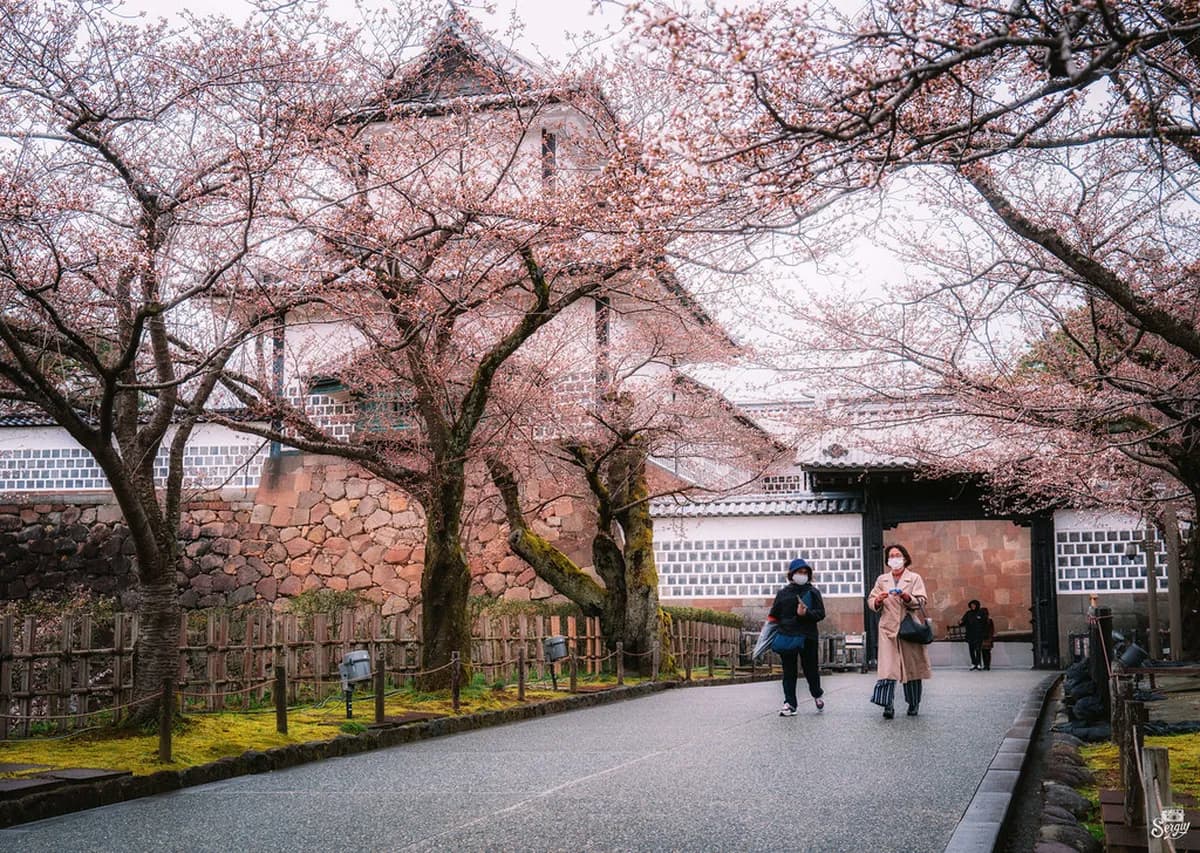
Enter via Ishikawa-mon Gate (east side) — this is the best entrance for first-time visitors. The gate is the most photogenic structure on the grounds and sets the architectural tone for the entire visit. Walking through its massive timber doors and beneath the white lead-tile roof immediately conveys the defensive scale the Maeda clan intended.
From Ishikawa-mon, the recommended circuit for a 2-hour visit runs: Ishikawa-mon → Ninomaru Plaza (central open lawn) → Hishi Yagura and Gojukken Nagaya interior (paid; ~45 min) → Hashizume-mon Tsuzuki Yagura → Gyokusen-inmaru Garden → Nezumitamon Gate (western exit).
The Nezumitamon Gate on the western side is under-visited and worth the detour. The newly restored entrance connects to Oyama Shrine via a short wooden bridge that provides a unique vantage point over the castle's massive stone foundations. Most tour groups never reach this side, so it stays quiet even on peak days.
If you only have 45–60 minutes, skip the paid interiors and walk the outer circuit: Ishikawa-mon → Ninomaru Plaza → Gyokusen-inmaru Garden → exit via Hashizume-mon. This loop is entirely free and still covers the park's most striking views.
Top Highlights and Photo Spots Inside Kanazawa Castle Park
The paid structures are the architectural centrepiece of the visit and worth the ¥320 admission in 2026. All three — Hishi Yagura, Gojukken Nagaya, and Hashizume-mon Tsuzuki Yagura — have barrier-free (step-free) access, confirmed by the Ishikawa prefectural parks authority.
The Gojukken Nagaya is a 90-metre-long (roughly 50-bay) storehouse that served as an arsenal for the Maeda clan. Walking the full length of the interior reveals how the building was assembled using traditional Japanese joinery — no metal nails or fasteners — with scale models at the far end explaining the key techniques. Allow 20–30 minutes inside. This is the single best photo spot for architectural detail. For architectural documentation and historical background on the Maeda clan's construction techniques, japan-guide.com provides detailed coverage of Kanazawa Castle's restoration history.
The Hishi Yagura turret sits at the corner junction of Gojukken Nagaya and offers a view across Ninomaru Plaza that is especially dramatic at golden hour. The interior displays reconstructed weapons storage and explains the communication role of corner turrets in the castle's defensive layout.
The Ishikawa-mon Gate (built 1788, designated Important Cultural Property) is the top photography location. The white lead tiles were deliberately chosen by the Maeda clan to double as a bullet supply in wartime. The best shot: stand in Kenrokuen Garden and frame the gate through the cherry trees (spring) or yellowed ginkgo leaves (late November). Morning light hits the white tiles from the east, so arrive before 10:00 AM for glare-free photography.
The Gyokusen-inmaru Garden was restored in 2015 to match its Edo-period layout and features a koi pond, a small tea house, and stone lanterns reflected in still water. This is the quietest corner of the park at any hour and the best spot for contemplative photography. Evening light shows operate here during selected winter nights — check the castle's official schedule for 2026 dates.
- Ishikawa-mon Gate — best light before 10:00 AM; morning only for glare-free shots
- Gojukken Nagaya interior — architectural detail; 20–30 min; barrier-free
- Hishi Yagura turret — Ninomaru Plaza views; golden hour
- Gyokusen-inmaru Garden — pond reflection shots; quietest in early morning
- Nezumitamon Gate (west) — foundation stonework; overlooked by most visitors
For a broader list of Kanazawa's historical sites in the same neighbourhood, see top historical landmarks in Kanazawa. To build a full day around the castle visit, the 2-day Kanazawa itinerary sequences the castle, Kenrokuen, Higashi Chaya, and Omicho Market with realistic walking times and meal breaks.
Combining Kanazawa Castle Park with Kenrokuen Garden
Kenrokuen Garden and Kanazawa Castle Park share a boundary wall — the combined ¥500 ticket is the standard way to visit both in a single half-day. The two sites are connected by a pedestrian underpass near the Kenroku-en Shimo Entrance (south side of the garden), making it easy to move between them without backtracking to the main road.
Most visitors do Kenrokuen first (open from 7:00 AM, best light for garden photography before 9:00 AM) then cross into the castle grounds before the paid structures open at 9:00 AM. This sequence means you hit the castle interiors exactly at opening, beating tour groups by 30–45 minutes.
The combined visit takes 3.5–4.5 hours at a relaxed pace. Budget more time during cherry blossom season (late March – mid-April) when both venues fill quickly after 10:00 AM. Our dedicated Kenrokuen Garden guide covers the garden's six attributes, seasonal highlights, and the best interior walking routes.
Best Seasons for Photography and Events in 2026
Spring (late March – mid-April) is the most popular and most crowded season. Hundreds of cherry trees line the outer castle walls and Ninomaru Plaza. The contrast between white lead-tile rooftops and pink blossoms makes this the signature Kanazawa image. Expect peak crowds on weekends: arrive before 9:00 AM or after 4:00 PM to avoid the densest tour groups. Entry remains free; paid structures follow normal hours.
Winter (late November – February) transforms the park completely. The famous yukizuri rope structures — cone-shaped frames draped over pine trees to prevent snow damage — appear from late November and are unique to Kanazawa's garden culture. The castle under snow is visually striking and the grounds are almost empty on weekday mornings. Night illumination events run on selected dates during the winter season; check visitkanazawa.jp for the 2026 calendar. Note: winter park hours are shorter (8:00 AM – 5:00 PM from October 16); dress in warm layers for extended outdoor exploration.
Autumn (mid-October – late November) offers rich colour with manageable crowds. The maple trees around Gyokusen-inmaru Garden peak in mid-to-late November, producing deep reds and oranges against the white castle walls. Autumn is the best season for photography if you want high-quality shots without spring crowds. Air quality is typically excellent after the summer rain season.
Summer (June – August) is the least recommended for comfort — heat and humidity are high — but extended park hours (until 6:00 PM) and lush green grounds make morning visits worthwhile. The Hyakumangoku Festival in early June draws large crowds citywide; see our Hyakumangoku Festival 2026 guide for the full schedule.
For more on what to do in Kanazawa across all seasons, see the Kanazawa attractions pillar.
Accessibility and Practical Tips
Kanazawa Castle Park has good accessibility for a historic site. The three paid structures (Hishi Yagura, Gojukken Nagaya, Hashizume-mon Tsuzuki Yagura) all have barrier-free (step-free) entrances. The main gravel paths throughout the park are firm-packed and manageable for wheelchairs and pushchairs, though some uneven sections exist near the stone foundations. The Nezumitamon Gate area on the western side has a narrower gravel path — not step-free.
The visitor centre near Ishikawa-mon Gate has accessible toilets and free luggage storage (coin lockers). English-language audio guides are available for hire at ¥300 and cover the paid structures in detail.
Practical checklist for 2026:
- Wear sturdy walking shoes — gravel paths cover several kilometres
- Bring yen for ticket windows (cash preferred at some booths; IC cards accepted at main windows)
- Carry an umbrella — sudden rain showers are common year-round in Kanazawa
- No drone photography permitted on the grounds
- Food and drink are not permitted inside the paid structures
- Dogs are permitted on leads in the free park areas; not permitted inside paid structures
For planning around the samurai and geisha districts nearby, see how to experience authentic Kanazawa samurai and geisha traditions.
Frequently Asked Questions
Is Kanazawa Castle Park free to enter in 2026?
Yes — the main park grounds are free to enter year-round. The three restored structures (Hishi Yagura, Gojukken Nagaya, Hashizume-mon Tsuzuki Yagura) charge ¥320 for adults and ¥100 for children aged 6–17. Seniors aged 65 and over enter the paid structures free with valid ID.
What are the opening hours for Kanazawa Castle Park in 2026?
The free park grounds are open 7:00 AM – 6:00 PM from March 1 to October 15, and 8:00 AM – 5:00 PM from October 16 to February 28. The paid interior structures open at 9:00 AM and have a last entry at 4:00 PM (closing 4:30 PM) every day of the year.
Is there a combined ticket for Kanazawa Castle and Kenrokuen Garden?
Yes. A combined ticket for the castle's paid structures and Kenrokuen Garden costs ¥500 in 2026 — a saving of ¥130 over buying both separately. It is available at the ticket windows of either venue. The two sites share a boundary and are connected by a pedestrian underpass, making them easy to visit together in a half-day.
How long does it take to visit Kanazawa Castle Park?
Allow 1.5–2.5 hours for the castle park alone, including the paid structures. If you combine the visit with Kenrokuen Garden next door, plan for 3.5–4.5 hours total. During cherry blossom season (late March – mid-April), add 30–60 minutes for crowds and photography stops.
How do I get from JR Kanazawa Station to Kanazawa Castle Park?
The Kanazawa Loop Bus (¥210, ~10 minutes) is the quickest option — board at Bus Stop 7 (East Exit) and alight at "Kenroku-en/Kanazawa Castle." Walking takes 20–25 minutes via Korinbo along well-signed flat streets. A taxi costs ¥1,000–¥1,500. For full transport options including day passes and IC card tips, see the Kanazawa transport guide.
Is Kanazawa Castle Park accessible for wheelchairs?
Yes — all three paid structures have barrier-free (step-free) entrances. The main gravel paths through the park are firm-packed and generally manageable, though some uneven sections exist near the stone foundations. The visitor centre near Ishikawa-mon Gate has accessible toilets. The western Nezumitamon Gate area has a narrower path that may be more challenging.
Kanazawa Castle Park combines free outdoor exploration with affordable paid interiors that reveal some of the finest traditional Japanese carpentry anywhere in the country.
In 2026, the combination ticket with Kenrokuen Garden (¥500) remains the best value in the city — two of Japan's most celebrated historic sites for less than a cup of specialty coffee.
Use the Loop Bus from JR Kanazawa Station, enter through Ishikawa-mon Gate, and follow the circuit through the paid structures before crossing into Kenrokuen while the morning light is still low.
For everything else the city has to offer, start with the Kanazawa attractions guide and the 2-day Kanazawa itinerary.
 Nara Park Visitor Guide Travel GuideMay 18, 2026