How to Use Fukuoka Public Transport for Attractions: A Complete 2026 Guide
The complete 2026 guide to Fukuoka public transport: subway lines, bus routes, IC cards, day passes with prices, and step-by-step directions to every major attraction.
On this page
Fukuoka public transport is one of the easiest transit systems to use in all of Japan. The city's three subway lines, extensive Nishitetsu bus network, and regional trains connect every major attraction within minutes of Hakata and Tenjin stations. This 2026 guide gives you the exact routes, fares, and passes you need to reach shrines, parks, museums, and day trip destinations without wasting time or money. The system also provides convenient connections to nearby cities like Nagasaki for regional exploration. Travelers often compare Fukuoka's transit infrastructure favorably to that of Tokyo in terms of ease of use and cost-effectiveness.
Whether you have just landed at Fukuoka Airport or you are planning a full week of sightseeing, choosing the right combination of transport modes makes a real difference. Below you will find a quick-reference cheat sheet, detailed breakdowns of every transport option, a pass comparison table with 2026 prices, and step-by-step directions to the most popular attractions in the city.
Quick Reference: Fukuoka Transport Cheat Sheet
If you only have 30 seconds, here is everything you need to know about getting around Fukuoka in 2026:
| What You Need | Best Option | Cost (2026) |
|---|---|---|
| Airport to Hakata Station | Kuko Subway Line | 260 yen, 5 minutes |
| Airport to Tenjin | Kuko Subway Line | 260 yen, 11 minutes |
| Payment method | Contactless Visa/Mastercard or IC card (Hayakaken, Suica, Pasmo) | IC card deposit: 500 yen |
| Unlimited subway rides | Subway 1-Day Pass | 640 yen (adult) / 320 yen (child) |
| Subway + bus + Dazaifu train | Fukuoka Tourist City Pass (wide) | 1,820 yen |
| Hakata to Tenjin | Kuko Subway Line | 210 yen, 6 minutes |
| Tenjin to Dazaifu Tenmangu | Nishitetsu train | 410 yen, 30 minutes |
| Hakata to Fukuoka Tower | Nishitetsu Bus #306 | 240 yen, 20 minutes |
| Late night (after midnight) | Taxi or GO app | Base fare ~750 yen |
| Bike sharing | Charichari app | 4 yen per minute (standard bike) |
Bookmark this table before your trip. For detailed breakdowns of each option, read on.
Fukuoka Airport to City Center: The Fastest Connection in Japan
Fukuoka Airport is located just 5 minutes by subway from Hakata Station, making it the most convenient major airport-to-city connection in Japan. As of 2026, the Kuko (Airport) Subway Line runs directly from the domestic terminal underground station to both Hakata (260 yen, 5 minutes) and Tenjin (260 yen, 11 minutes) with trains departing every 4 to 8 minutes throughout the day.
If you are arriving at the international terminal, a free shuttle bus runs every 5 to 10 minutes between the international and domestic terminals. The shuttle ride takes approximately 10 minutes. Once you reach the domestic terminal, follow the signs marked "Subway" to the underground ticket gates.
You can enter the subway using a contactless credit card (Visa, JCB, American Express, Diners Club), an IC card such as Suica or Hayakaken, or a paper ticket from the vending machines. The vending machines have English language options. For the smoothest experience, tap your credit card or IC card on the reader at entry and again at your destination station.
If you are arriving late at night after the last subway at approximately 11:45 PM, taxis are available outside both terminals. The taxi fare from the airport to Hakata Station costs roughly 1,500 to 2,000 yen, while a ride to Tenjin runs about 2,500 to 3,000 yen.
Essential Payment Methods: IC Cards and Contactless Tap
Fukuoka is a pioneer in Japan for contactless credit card transit payments. Since 2022, all 36 Fukuoka City Subway stations accept tap-to-pay with international Visa, JCB, American Express, Diners Club, and UnionPay cards. You tap your card on the blue reader at entry and again at exit, and the fare is charged automatically. As of 2026, the daily cap for contactless credit card users is 640 yen on the subway, meaning you effectively get unlimited subway rides once you hit that ceiling.
If you prefer a dedicated transit card, three local IC cards are available in Fukuoka: Hayakaken (issued by Fukuoka City Subway), SUGOCA (issued by JR Kyushu), and Nimoca (issued by Nishitetsu). All three require a refundable 500 yen deposit plus a minimum 1,000 yen charge when purchased from station vending machines. These cards work identically to the Suica or Pasmo cards used in Tokyo.
Your existing Suica, Pasmo, Icoca, or any other Japanese IC card works on all Fukuoka subways, buses, and trains. There is no need to buy a local card if you already have one from another city. For a deeper comparison of IC card options, see our Fukuoka Subway Day Pass vs Nimoca IC Card guide.
One important tip: Nishitetsu buses require you to tap your IC card both when boarding (middle door) and when exiting (front door). If you forget to tap at either end, you may be charged the maximum fare for that route.
As of 2026, contactless Visa/Mastercard/Amex tap-to-pay works on all Fukuoka City Subway gates but not yet on Nishitetsu buses. For buses, use an IC card (Hayakaken, Suica, Pasmo) or exact cash. The daily contactless credit-card cap on the subway is 640 yen — effectively unlimited subway rides once hit.
Fukuoka City Subway: Three Lines to Every Major Hub
The Fukuoka City Subway is the backbone of the city's transport network and the fastest way to reach most tourist attractions. It operates three color-coded lines with trains running every 4 to 8 minutes from approximately 5:30 AM to 11:45 PM daily.
Kuko (Airport) Line — Orange
This is the line you will use most. It runs from Fukuoka Airport through Hakata Station, Nakasu-Kawabata, and Tenjin, continuing west to Meinohama. The Kuko Line connects the airport, the two main city centers, and the western coastal area. Most single rides cost between 210 and 310 yen.
Hakozaki Line — Light Blue
The Hakozaki Line branches northeast from Nakasu-Kawabata toward Kaizuka. It serves the Hakozaki Shrine area and Kyushu University campuses. Tourists use this line less frequently, but it connects to the Nishitetsu Kaizuka Line for destinations along the eastern coast.
Nanakuma Line — Green
Extended to Hakata Station in 2023, the Nanakuma Line now runs from Hashimoto in the southwest through Tenjin-Minami and directly to Hakata. This extension was a major upgrade for tourists, connecting Hakata to the old temple district and residential neighborhoods. The Nanakuma Line is essential for reaching Kushida Shrine via the Kushida-jinja-mae Station.
Step-by-Step Subway Directions to Top Attractions
| Attraction | Line | Station | Exit | Fare from Hakata | Walk Time |
|---|---|---|---|---|---|
| Ohori Park and Art Museum | Kuko (orange) | Ohorikoen | Exit 3 or 6 | 260 yen | 3 min |
| Kushida Shrine | Nanakuma (green) | Kushida-jinja-mae | Exit 4 | 210 yen | 2 min |
| Canal City Hakata | Nanakuma (green) | Kushida-jinja-mae | Exit 8 | 210 yen | 5 min |
| Fukuoka Asian Art Museum | Kuko (orange) | Nakasu-Kawabata | Exit 6 | 210 yen | 1 min |
| Tenjin Shopping District | Kuko (orange) | Tenjin | Exit 1 | 210 yen | Immediate |
| Fukuoka Castle Ruins | Kuko (orange) | Akasaka | Exit 2 | 260 yen | 8 min |
| Hakata Machiya Folk Museum | Nanakuma (green) | Gion | Exit 2 | 210 yen | 5 min |
Subway stations feature clear English signage, platform screen doors, and color-coded wayfinding for each line. Pay close attention to exit numbers, as using the correct exit can save you from crossing busy intersections or walking around large buildings. For a full itinerary built around these subway stops, check our one-day Fukuoka itinerary.
Nishitetsu Bus Network: Reaching Every Corner of the City
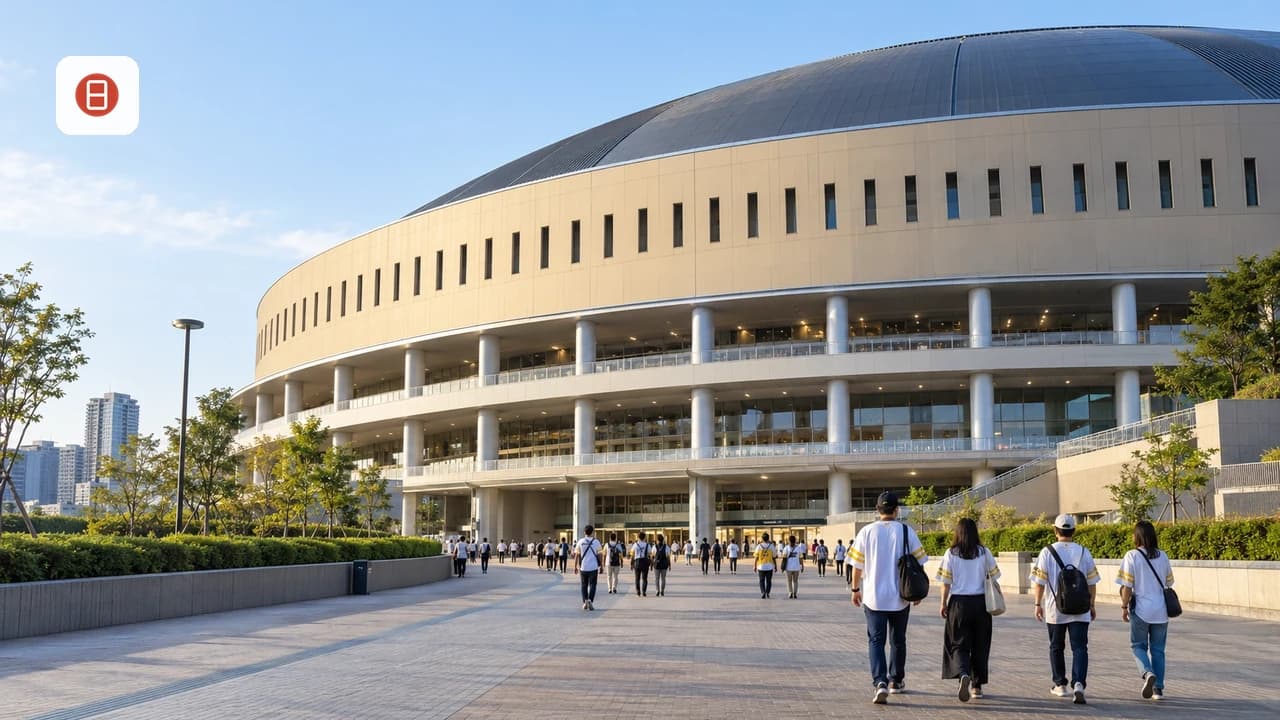
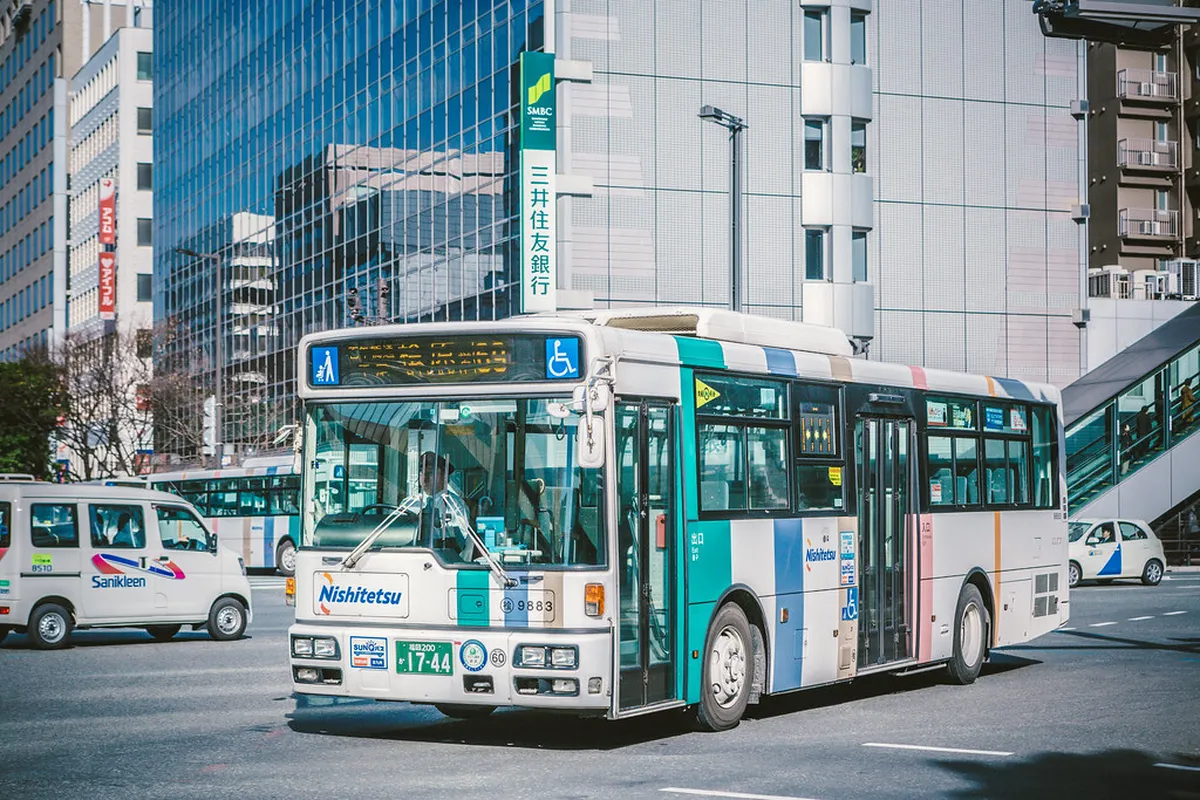
The Nishitetsu Bus network covers areas the subway cannot reach, including the Momochi seaside district, Fukuoka Tower, the Yahoo Auction Dome area, and neighborhoods in the hills. In 2026, Nishitetsu operates over 100 bus routes across the city, making it the most extensive surface transit option.
How to Ride a Fukuoka City Bus: Step by Step
- Board through the middle door. If paying cash, take a numbered ticket from the machine near the entrance. If using an IC card, tap the reader by the middle door when you board.
- Watch the fare display. A digital screen above the driver shows the current fare for each ticket number. Fares increase as you travel farther.
- Press the stop button before your stop is announced. Announcements are in Japanese and English on major routes.
- Exit through the front door. If paying cash, drop your ticket and exact change into the fare box next to the driver. If using an IC card, tap the front reader as you exit.
Most city bus fares range from 100 to 340 yen depending on distance. The flat-fare "100 yen Bus" loop circulates through central Hakata and Tenjin during the daytime, making it an excellent budget option for short hops between those two districts.
Key Bus Routes for Tourists
| Route | From | To | Fare | Time |
|---|---|---|---|---|
| #306 | Hakata Station | Fukuoka Tower | 240 yen | 20 min |
| #306 | Tenjin | Fukuoka Tower | 190 yen | 15 min |
| 100 yen loop | Hakata | Tenjin | 100 yen | 15 min |
| Tabito bus | Hakata Bus Terminal | Dazaifu | 610 yen | 40 min |
Avoid riding buses during the 7:30-9:00 AM and 5:30-7:00 PM weekday rush hours when routes through Tenjin and Hakata get extremely crowded. Late morning and early afternoon offer the most comfortable rides.
JR and Nishitetsu Trains: Day Trips to Dazaifu, Nanzoin, and Yanagawa
Regional trains open up historical sites and natural attractions outside the city center. Two operators serve the Fukuoka region: JR Kyushu and the private Nishitetsu Railway. Choosing the right operator depends on your destination.
Dazaifu Tenmangu Shrine (Nishitetsu)
Start at Nishitetsu Fukuoka (Tenjin) Station. Take the Nishitetsu Tenjin Omuta Line to Futsukaichi Station (15 minutes, express), transfer to the Dazaifu Line, and arrive at Dazaifu Station in another 5 minutes. Total journey: approximately 25 to 35 minutes, 410 yen one way. The shrine is a 5-minute walk from the station along a famous shopping street. For a full day trip combining Dazaifu with Yanagawa, see our Fukuoka day trips itinerary.
Nanzoin Temple Reclining Buddha (JR)
Take the JR Sasaguri Line from Hakata Station to Kido-Nanzoin-mae Station. The ride takes about 20 minutes and costs 280 yen. The temple entrance is a 3-minute walk from the station. JR trains are covered by the Japan Rail Pass. Learn more in our guide to visiting Nanzoin Temple from Hakata.
Yanagawa Canal Cruises (Nishitetsu)
Take the Nishitetsu Tenjin Omuta Line express from Tenjin to Yanagawa Station. The journey takes about 50 minutes and costs 860 yen one way. Nishitetsu offers a combined sightseeing ticket that bundles the round-trip train fare with a canal cruise for approximately 5,150 yen, saving roughly 1,000 yen compared to buying everything separately.
Both JR and Nishitetsu trains accept IC cards. Always check the departure boards for express services, as they can cut travel times significantly compared to local stopping trains.
Traveling from Fukuoka to Other Kyushu Cities by Shinkansen and Bus
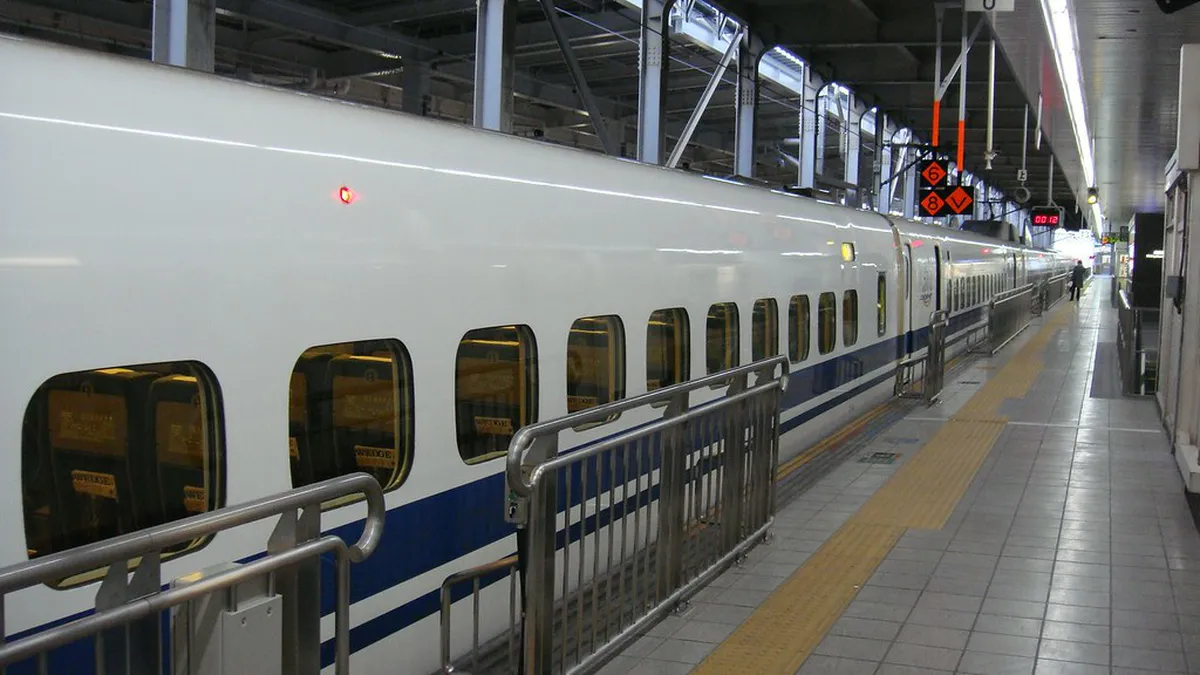
Hakata Station is Kyushu's main transport hub, with direct rail and bus connections to every major city on the island. For visitors extending their trip beyond Fukuoka, the fastest option is the Kyushu Shinkansen, which departs from Hakata roughly every 15 minutes.
- Kumamoto: Kyushu Shinkansen, about 33 minutes, around 4,700 yen one-way
- Kagoshima-Chuo: Kyushu Shinkansen, about 1 hour 17 minutes, around 10,000 yen one-way
- Nagasaki: Kamome limited express plus a same-platform transfer to the Nishi-Kyushu Shinkansen at Takeo-Onsen, about 1 hour 20 minutes total, around 6,050 yen one-way
- Beppu/Oita: JR Sonic limited express, about 2 hours, around 5,690 yen one-way
Nishitetsu highway buses depart from the Tenjin Highway Bus Terminal and Hakata Bus Terminal and cost roughly half the Shinkansen fare, though journeys take longer. A Fukuoka-Nagasaki bus runs about 2 hours 30 minutes for around 2,700 yen, Fukuoka-Kumamoto about 2 hours for around 2,500 yen, and Fukuoka-Beppu about 2 hours 40 minutes for around 3,250 yen. Reserve highway bus seats online or at the terminal counter at least a day ahead during peak seasons such as Golden Week and Obon.
Travelers combining Fukuoka with two or more other Kyushu cities within a short window should compare the cost of individual tickets against a JR Kyushu Rail Pass, which covers unlimited Shinkansen and limited express rides across the island for a fixed number of days.
Scenic Routes: Using Ferries to Reach Coastal Attractions
Taking a ferry across Hakata Bay provides a refreshing break from trains and buses while offering panoramic views of the Fukuoka skyline. The most popular tourist route runs from the Marizon pier near Fukuoka Tower to Uminonakamichi Seaside Park. This crossing takes approximately 20 minutes and costs 1,030 yen for adults one way as of 2026.
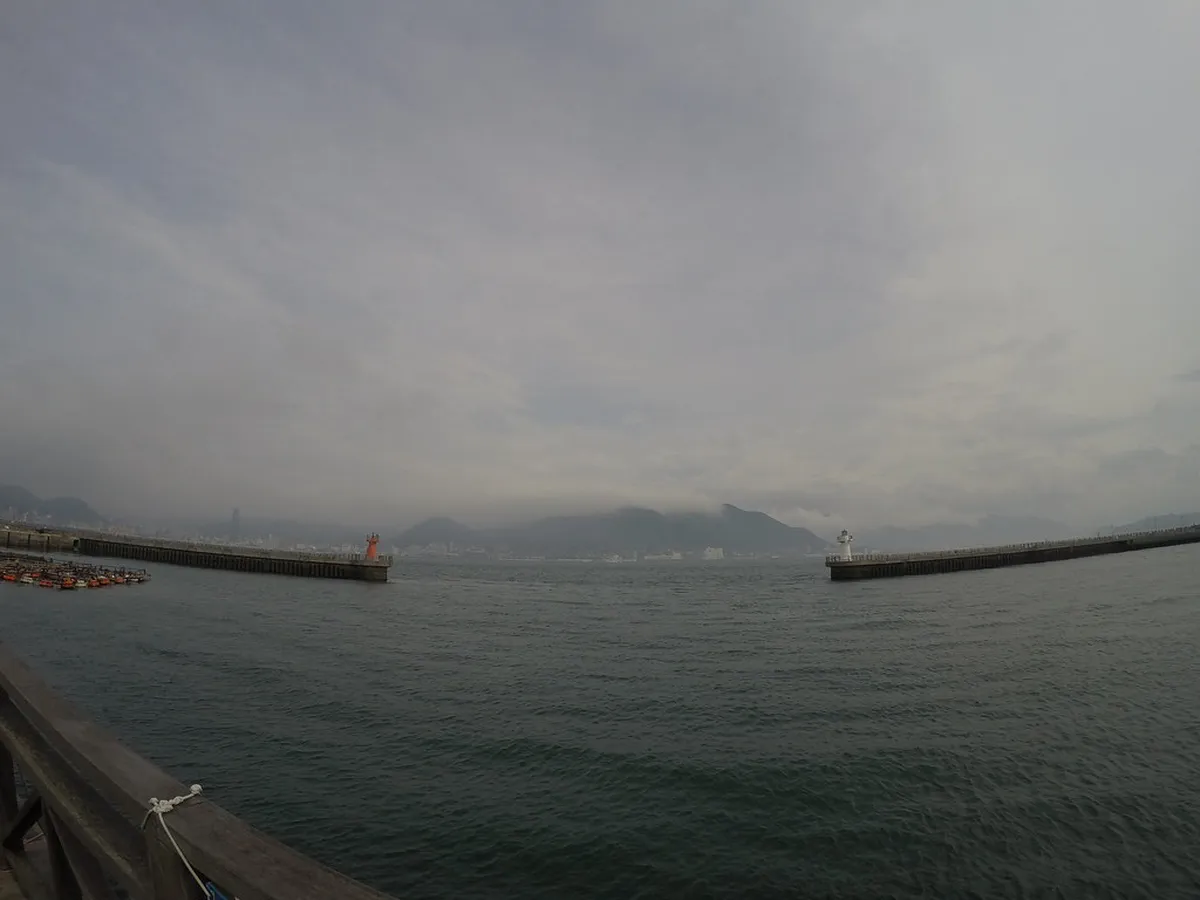
Ferries depart from Marizon pier at Momochihama throughout the day, with roughly one departure per hour during peak season. You can purchase tickets at vending machines near the boarding gate. This route is dramatically faster than the 60-minute bus or train journey around the entire bay to reach the same destination.
Uminonakamichi is a massive seaside park perfect for families, with flower gardens, a marine park, and cycling paths. It is especially beautiful during spring cherry blossom season. Check the Fukuoka cherry blossom and festival calendar to see if any events coincide with your visit.
Ferry services may be canceled during strong winds or storms. Always have a backup plan: the JR Kashii Line runs from Hakata to Uminonakamichi via Kashii Station (about 40 minutes, 480 yen).
The last subway trains on all Fukuoka City lines run around 11:45 PM. After midnight, taxis (base fare ~750 yen) or the GO app are your only options. Plan your yatai or nightlife evenings with an eye on the last train time.
Walking and Cycling: Exploring Fukuoka at a Local Pace
Fukuoka is one of Japan's most walkable cities. The main tourist corridor between Hakata Station and Tenjin is a flat 20-minute walk through Canal City Hakata and the Nakasu entertainment district. Along the way you pass riverside yatai (food stalls) that open each evening, hidden shrines, and covered shopping arcades. You can find many cheap and free things to do in Fukuoka simply by walking this route.
For longer distances, the Charichari bike-sharing program is the best budget option in 2026. Red standard bicycles cost 4 yen per minute (roughly 70 yen for a 15-minute ride), and electric-assist bikes cost 15 yen per minute. Download the Charichari app, scan the QR code on any bike at one of the 700+ ports across the city, and ride to your next destination. Always return bikes to an official port to avoid penalty charges.
Cycling is particularly pleasant around Ohori Park, where a flat 2 km loop circles the lake with views of Fukuoka Castle ruins. The seaside promenade from Momochi Beach to Marizon pier is another scenic cycling route with minimal car traffic.
Taxis and Ridesharing: When to Skip Public Transit
Taxis become the practical choice in three situations: traveling after midnight when subways and buses stop running, carrying heavy luggage between your hotel and a station, or splitting a short ride among three or four people. The base fare in Fukuoka as of 2026 is approximately 750 yen for the first 1.5 km, with each additional 255 meters costing 60 yen.
You can hail taxis on the street (a red light on the roof means available), find them at designated stands near Hakata and Tenjin stations, or book via the GO taxi app which supports English destination input. Most taxis accept credit cards and IC cards, though carrying some cash is advisable for older vehicles.
Uber operates in Fukuoka but functions as a taxi dispatch service rather than a private rideshare. You will be picked up by a licensed taxi driver. Fares are comparable to standard metered taxi rates.
Best Transport Passes: 2026 Price Comparison
Choosing the right transit pass can save you 30 to 50 percent on transport costs during a full day of sightseeing across multiple Fukuoka landmarks and cultural sites. Here is a direct comparison of every pass available to tourists in 2026:
| Pass | Adult Price | Coverage | Best For | Where to Buy |
|---|---|---|---|---|
| Subway 1-Day Pass | 640 yen | All 3 subway lines, unlimited | City center sightseeing (3+ rides) | Subway station machines, tourist info |
| Fukuoka Tourist City Pass (city) | 1,500 yen | Subway + Nishitetsu buses + JR (city zone) | Full-day city exploration with buses | Hakata/Tenjin info centers (passport required) |
| Fukuoka Tourist City Pass (wide) | 1,820 yen | City pass + Nishitetsu train to Dazaifu | City + Dazaifu day trip | Hakata/Tenjin info centers (passport required) |
| Contactless credit card daily cap | 640 yen max | Subway only | Casual riders with Visa/JCB/Amex | Automatic (just tap your card) |
| IC card (pay as you go) | Varies | All transit types | 1-2 rides per day | Station machines (500 yen deposit) |
The Tourist City Pass is exclusively for foreign visitors and requires passport verification at purchase. Both Tourist City Pass versions include discount coupons for Fukuoka Tower, Fukuoka City Museum, the Asian Art Museum, and other attractions. The Subway 1-Day Pass also offers group-rate discounts at select museums when shown at the ticket counter.
For a detailed breakdown of which pass saves the most money based on your itinerary, see our Fukuoka Subway Pass vs Tourist City Pass budget guide.
How to Navigate Fukuoka Subway Stations Like a Local
Every Fukuoka subway station uses a simple alphanumeric code system: K for Kuko Line (orange), H for Hakozaki Line (blue), and N for Nanakuma Line (green), followed by a number. Hakata Station is K11 on the Kuko Line and N16 on the Nanakuma Line. When asking for directions or checking maps, these codes are faster than remembering Japanese station names.
Platform screen doors are installed at all stations, so there is no risk of accidentally stepping off the platform edge. Digital displays above the platform show the next train's arrival time, destination, and whether it is a local or express service. All announcements are made in Japanese and English.
At major transfer stations like Tenjin (where the Kuko Line meets the Nanakuma Line one stop away at Tenjin-Minami), follow the colored floor arrows to switch lines. The transfer walk between Tenjin and Tenjin-Minami takes about 3 minutes through an underground passage and requires passing through a transfer gate. Keep your IC card or ticket handy.
Most stations have coin lockers near the ticket gates ranging from 300 yen (small) to 700 yen (large) per use. Hakata Station has the largest selection of lockers, making it a convenient base for day trips when you want to store luggage.
Accessibility and Luggage Storage: Elevators, Lockers, and Ramps
Fukuoka's transport network is well equipped for travelers with luggage, strollers, or mobility needs. All 36 Fukuoka City Subway stations have elevators connecting the street to the platform, so step-free travel is possible on every line without pre-planning.
Coin lockers are available at Hakata Station (several sizes, roughly 300 to 700 yen per day), Tenjin Station, and the domestic terminal at Fukuoka Airport, making it easy to store bags for a day trip to Dazaifu or Nanzoin before collecting them on the way back. Larger lockers near the Shinkansen gates at Hakata Station fit standard check-in suitcases.
Nishitetsu buses use low-floor vehicles on most central routes, with a fold-down ramp the driver can deploy for wheelchair users; boarding through the middle door leaves enough space near the priority seating area for a folded stroller or large suitcase. On the subway, priority seating and wider gates marked with a wheelchair symbol are located at the end of each platform, closest to the elevator.
For step-free assistance on JR Kyushu trains, including the airport line and limited express services to Nagasaki or Beppu, station staff can arrange a ramp for level boarding if you check in at the ticket office at least 20 minutes before departure. This is worth doing at Hakata Station if you are traveling with a wheelchair, heavy luggage, or a stroller and want to avoid stairs entirely.
Planning Your Routes: Sample Transport Itineraries
Here are three practical route plans showing how to combine transport modes for a full day of sightseeing:
City Center Loop (Subway 1-Day Pass Recommended)
- Hakata Station to Ohori Park via Kuko Line (Ohorikoen Station, 260 yen) — morning walk around the park and art museum
- Ohorikoen to Tenjin via Kuko Line (210 yen) — lunch and shopping in Tenjin underground city
- Tenjin-Minami to Kushida-jinja-mae via Nanakuma Line (210 yen) — visit Kushida Shrine and Canal City
- Walk from Canal City back to Hakata Station (15 minutes) — evening yatai food stalls along the Naka River
- Total without pass: 680 yen. With Subway 1-Day Pass: 640 yen (saves 40 yen + freedom for extra rides)
Dazaifu Day Trip (Tourist City Pass Wide Recommended)
- Hakata Station to Tenjin via subway (210 yen)
- Nishitetsu Tenjin to Dazaifu via train (410 yen) — visit Tenmangu Shrine and National Museum
- Dazaifu to Tenjin return (410 yen)
- Tenjin to Fukuoka Tower via bus #306 (190 yen)
- Fukuoka Tower to Hakata via bus (240 yen)
- Total without pass: 1,460 yen. With Tourist City Pass Wide: 1,820 yen (worth it for added flexibility + museum discounts)
Eastern Fukuoka Explorer (IC Card Recommended)
- Hakata to Kido-Nanzoin-mae via JR Sasaguri Line (280 yen) — visit Nanzoin Temple reclining Buddha
- Return to Hakata (280 yen)
- Hakata to Nakasu-Kawabata via subway (210 yen) — Asian Art Museum and Nakasu evening walk
- Total: 770 yen. IC card is the best value for this light-use day
Essential Tips for First-Time Visitors
- Last trains run around 11:45 PM on all subway lines. The first trains start at approximately 5:30 AM. Plan your evening return accordingly.
- Google Maps works accurately for Fukuoka transit routing, including real-time subway and bus schedules. The Nishitetsu Bus app provides English route maps and live tracking.
- Priority seats are marked on every subway car and bus. These are reserved for elderly, pregnant, and disabled passengers even when the vehicle is crowded.
- Eating and drinking is not permitted on Fukuoka city buses and subways. You may eat on long-distance JR trains.
- Luggage storage: If your hotel does not offer early check-in, use coin lockers at Hakata Station (300 to 700 yen) or the Hakata Station baggage storage counter.
- Free Wi-Fi is available at all Fukuoka subway stations and inside trains under the network name "Fukuoka_City_Wi-Fi." Connection lasts 30 minutes per session with unlimited reconnections.
- Children aged 6 to 11 pay half fare on all transit. Children under 6 ride free when accompanied by a paying adult (limit of 2 free children per adult).
Frequently Asked Questions
Is Fukuoka easy to get around without a car?
Yes, Fukuoka is one of the easiest cities in Japan to navigate without a car. The subway connects the airport, Hakata Station, and Tenjin within minutes. Nishitetsu buses reach every neighborhood the subway misses, including the seaside Momochi district. Most visitors never need anything beyond an IC card or contactless credit card to explore the entire city and its surrounding day trip destinations.
Can I use my Suica card in Fukuoka?
Yes, Suica, Pasmo, Icoca, and all other Japanese IC cards are fully compatible with Fukuoka's subways, Nishitetsu buses, JR trains, and Nishitetsu trains. Simply tap your card at the ticket gates or bus readers exactly as you would in Tokyo or Osaka. No separate local card is needed.
What is the fastest way from Fukuoka Airport to Tenjin?
The Fukuoka City Subway Kuko Line takes just 11 minutes from the airport domestic terminal to Tenjin Station and costs 260 yen as of 2026. If arriving at the international terminal, take the free shuttle bus (10 minutes) to the domestic terminal first, then follow signs to the subway. Trains depart every 4 to 8 minutes throughout the day.
How do I get to Dazaifu from Hakata Station?
Take the subway to Tenjin (6 minutes, 210 yen), walk to Nishitetsu Fukuoka (Tenjin) Station, and ride the Nishitetsu Tenjin Omuta Line to Futsukaichi. Transfer to the Dazaifu Line for one more stop. Total travel time is 35 to 40 minutes, costing 620 yen. Alternatively, the direct Tabito bus departs from the Hakata Bus Terminal and reaches Dazaifu in 40 minutes for 610 yen with no transfers required.
Which Fukuoka transport pass should I buy?
If you plan to make 3 or more subway rides in a day, buy the Subway 1-Day Pass for 640 yen. If you also want to use buses and visit Dazaifu, the Fukuoka Tourist City Pass Wide (1,820 yen) covers subway, buses, and the Nishitetsu train to Dazaifu. For light use of 1 to 2 rides, just tap an IC card or contactless credit card and pay as you go.
Can I use a contactless credit card on Fukuoka buses?
As of 2026, contactless credit card tap-to-pay is accepted on all Fukuoka City Subway stations but not yet on Nishitetsu buses. For buses, you need an IC card (Hayakaken, Suica, Pasmo, or similar) or cash with exact change. If you only have a credit card, purchase an IC card at any subway station vending machine for 1,500 yen (500 yen deposit plus 1,000 yen balance).
How do I get from Hakata Station to Fukuoka Tower?
The most direct route is Nishitetsu Bus #306 from Hakata Station Bus Terminal to the Fukuoka Tower Minami-guchi stop. The ride takes about 20 minutes and costs 240 yen. You can also take the subway to Nishijin Station and walk 15 minutes, but the bus is more convenient as it drops you right at the tower entrance.
Fukuoka's public transport system is compact, affordable, and genuinely easy to use for international visitors in 2026. The combination of a three-line subway, Nishitetsu buses, regional trains, and Japan's most tourist-friendly contactless payment system means you can reach every major attraction without ever needing a car or a complex rail pass.
Start by deciding whether a day pass or IC card suits your itinerary, grab your payment method at the airport station, and you are ready to explore. From the ancient shrines of Dazaifu to the modern Momochi seaside district, every destination is a short, affordable ride away. Use the route tables and sample itineraries in this guide to plan each day and make the most of your time in Kyushu's largest city.
Free: The Fukuoka Essentials guide
Top things to do, where to stay, a perfect day plan, getting around, and the best time to go — a Fukuoka mini-guide you can take offline.
You might also like


Continue reading
More guides you'll find useful