Shuri Castle Naha Guide: 10 Essential Sights and Planning Tips
Discover the best of Shuri Castle in Naha with our guide to 10 essential sights, walking maps, night illumination tips, and local cultural highlights.
On this page
Shuri Castle is the symbolic heart of the former Ryukyu Kingdom and the single most important cultural site in Naha. The hilltop complex, a UNESCO World Heritage component since 2000, layers limestone ramparts, ceremonial gates, and royal gardens across a compact district you can walk in a morning. Even with the Seiden main hall still under post-fire reconstruction in 2026, the surrounding park, mausoleum, and stone path remain fully open and rich with detail.
This guide maps ten essential sights, the current status of the rebuild, and the practical choices that decide whether you spend two relaxed hours here or a full day. Expect specific gate names, opening times, free-versus-paid trade-offs, and notes on the illumination that runs every night until midnight.
Must-See Shuri Attractions
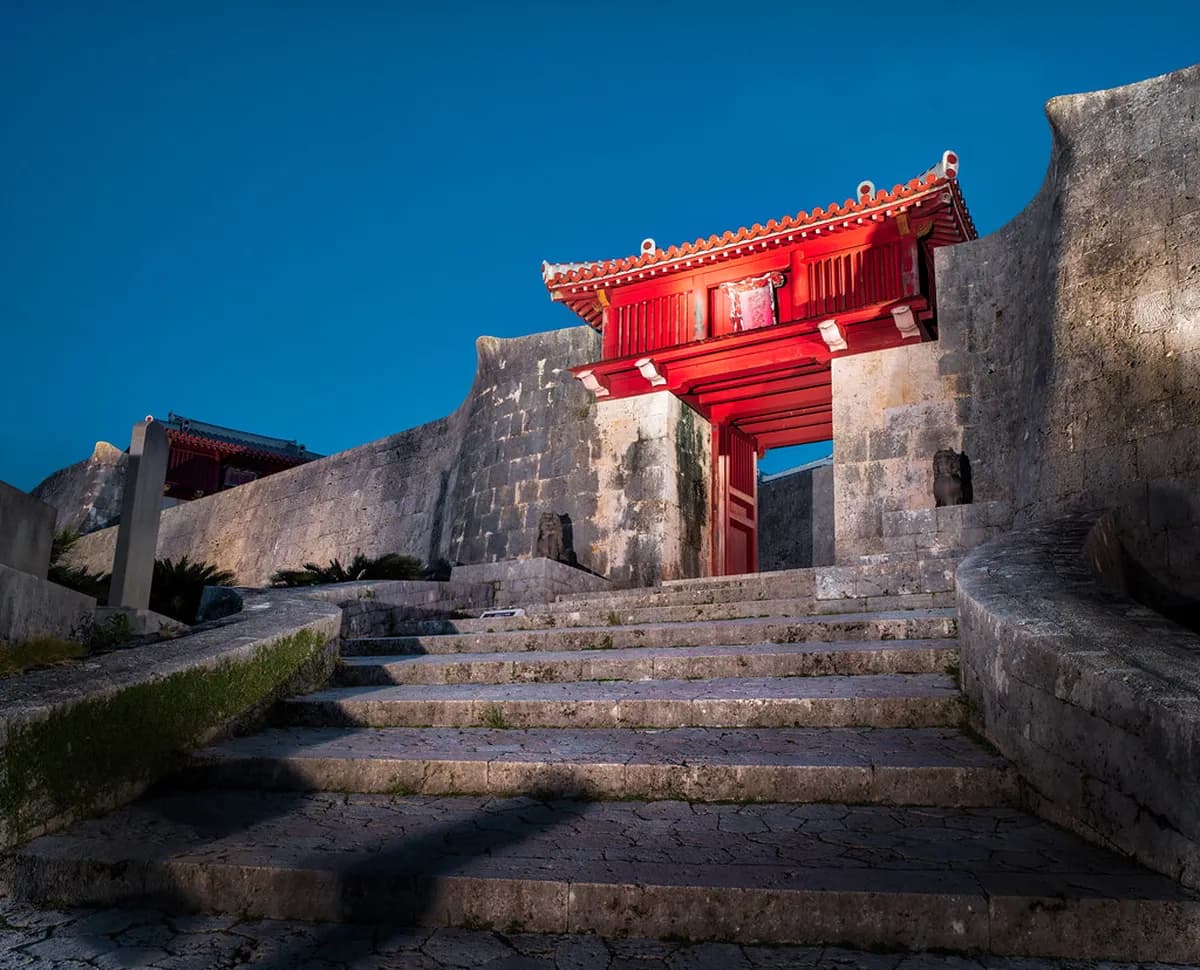
Shureimon Gate is the ceremonial entrance and the image printed on the 2,000 yen note. The vermilion-and-tile structure sits in the free zone, so first-time visitors can photograph it without a ticket. From here a paved path climbs toward Kankaimon, the first stone gate of the inner walls, flanked by a pair of shisa lion-dogs that have guarded the approach since the 16th century.
The curving limestone walls are the castle's most underrated feature. Built using Ryukyuan dry-stone techniques that distinguish Shuri from any mainland Japanese castle, they survived World War II shelling and the 2019 fire largely intact. Walk the rampart loop near Iri-no-Azana for an unobstructed sweep across Naha to the East China Sea, and look for the rounded bastions that follow the natural ridge line rather than fighting it.
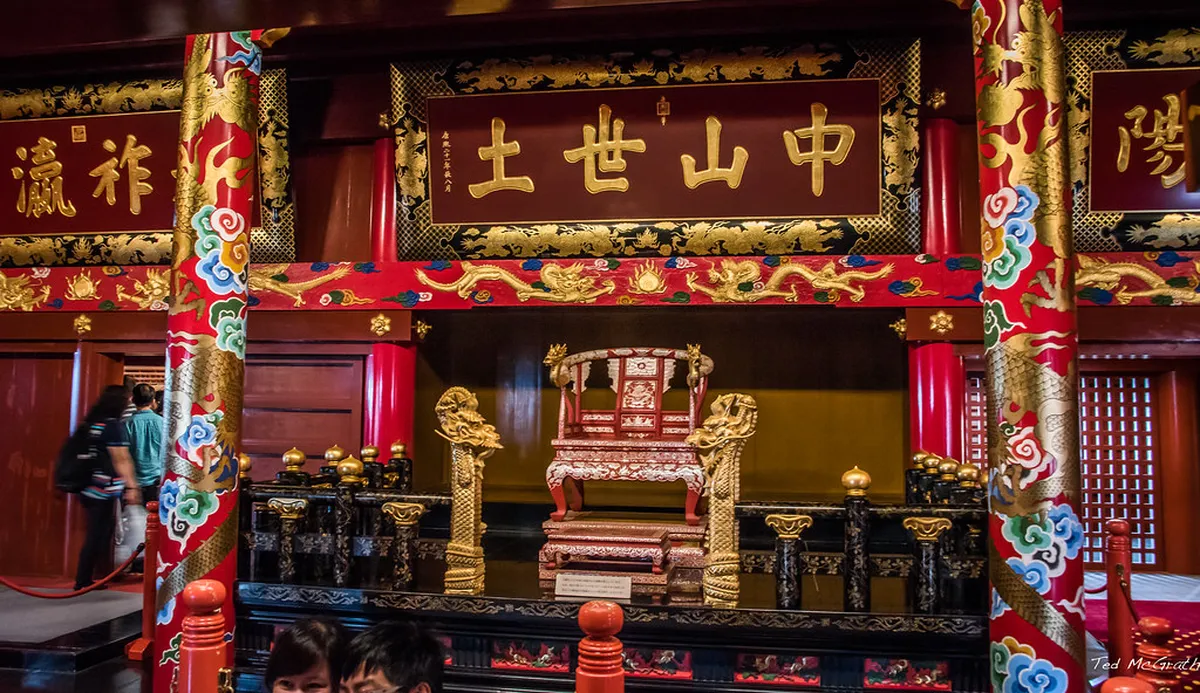
The Seiden reconstruction zone is the focal point of any 2026 visit. A glass-walled viewing corridor lets you watch carpenters cut joinery and lacquerers apply Ryukyu vermilion in real time, with bilingual panels explaining each stage. This is the only major Japanese castle where you can currently see traditional crafts performed live, and it transforms what would otherwise be a closed building site into the most memorable part of the route.
Reconstruction Status: What You Can Actually See in 2026
Five years on from the October 2019 fire, the rebuild is in its visible phase. The structural framework of the Seiden was raised in 2024, and through 2026 the focus has shifted to roof tiling, lacquer finishing, and the ornate dragon pillars at the front facade. The official Shuri Castle Park published target for full completion is autumn 2026, though the surrounding Hokuden and Nanden halls will follow on a later schedule.
For visitors this means three practical things. The viewing corridor is open daily and included with the inner-zone ticket, the Seiden exterior is partially clad in scaffolding but the front gable is regularly unwrapped for photo windows, and a free preview gallery near Hoshinmon Gate displays salvaged charred timbers alongside replacement components. Check the official park notice board on arrival for the day's craft demonstration schedule, which usually runs between 10:00 and 15:00.
Museums, Art, and Culture in Shuri
The Tamaudun Mausoleum, a separate UNESCO-listed site five minutes on foot from Shureimon, holds the remains of the Second Sho Dynasty kings. Three stone chambers carved into a single coral-limestone face sit behind a small museum that explains royal funerary rites. Entrance is 300 yen and the site is rarely crowded, making it the quietest cultural stop in the district.
For deeper context, the Okinawa Prefectural Museum and Art Museum sits twenty minutes downhill and ties Shuri's royal story into broader Ryukyuan history, from the 1372 tribute relationship with Ming China through the 1879 Japanese annexation. Pair it with a stop on Kokusai Dori for lunch and you have a logical half-day pivot from history into the modern city. Local lacquerware ateliers along the Shuri approach roads still work in tsuikin and chinkin techniques and most welcome short, unannounced visits.
Parks, Gardens, and Outdoor Spots in Shuri
Shikinaen Royal Garden, the kings' second residence, sits about fifteen minutes south of the castle and costs 400 yen. Its hexagonal pavilion on a Chinese-style pond is the iconic shot, but the real value is the garden's stone-arched bridge and the sculpted hilltop view back toward the castle ramparts. Plan ninety minutes here if you want to walk the full circuit without rushing.
The Kinjo-cho Stone Path is the surviving 300-metre section of the 16th-century royal road that once linked Shuri to the port at Naha. Polished limestone slabs lead past tile-roofed houses, an old well, and a 200-year-old akagi tree at the lower shrine. The path is steep and slick in rain, but it is free, almost always uncrowded, and the most atmospheric walk in the district.
Ryutan Pond, at the base of the castle hill, once hosted royal dragon-boat races for Chinese investiture envoys. It is a good rest stop with shaded benches and the best free angle on the outer walls. Several small shrines and the Bezaitendo temple sit on its small island, accessible via a short stone bridge.
Family-Friendly and Budget-Friendly Options in Shuri
Roughly two-thirds of the Shuri Castle Park, including Shureimon, Kankaimon, the rampart walks, and Ryutan Pond, is free to enter. The paid inner zone, which covers the Seiden viewing corridor and Hoshinmon, costs 400 yen for adults and 160 yen for elementary-school children, with under-sixes free. A combined ticket bundling Tamaudun and Shikinaen brings the day's total entry cost to under 1,000 yen per adult.
| Sight | Entry cost | Free or paid zone |
|---|---|---|
| Shureimon Gate | Free | Free outer zone |
| Kankaimon Gate + rampart walks | Free | Free outer zone |
| Ryutan Pond | Free | Free outer zone |
| Inner zone (Seiden corridor, Hoshinmon) | 400 yen adults / 160 yen children | Paid inner zone |
| Tamaudun Mausoleum | 300 yen | Separate site, 5 min walk |
| Shikinaen Royal Garden | 400 yen | Separate site, ~15 min south |
| Evening illumination (sunset–midnight) | Free | Outer walls only |
Families with younger kids should pick up the park's free stamp-rally sheet at the visitor centre. Children collect ink stamps at six gates and exchange a completed sheet for a sticker, which keeps the climb interesting. Stroller access is good across the lower park but the inner zone has multiple stair sections; baby carriers are easier above Kankaimon. Picnicking is allowed in designated areas near Ryutan Pond, and a Lawson convenience store at Shuri Station sells the cheapest drinks in the area.
How to Plan a Smooth Shuri Attractions Day
The Seiden reconstruction has reshaped the visitor flow — older blog maps and many Google Maps inset paths are now incorrect. Follow the blue-arrow pavement markings and trust park staff at every junction over GPS apps, which can drift by 10–20 metres near the eastern walls. Also download an offline map tile before arrival as mobile coverage is thin on the Shuri ridge.
The Yui Rail monorail from central Naha is the simplest approach: ride to Shuri Station, the eastern terminus, for about 340 yen from Kencho-mae. From the station it is a fifteen-minute uphill walk to Shureimon, or a five-minute ride on bus 7 or 8. For travellers staying near Kokusai Dori, see our notes on getting around Naha for monorail passes and bus options.
Arrive at 08:30 when the free outer gates open to photograph Shureimon and Kankaimon in soft side-light before tour coaches start at 09:30. The illumination runs from sunset to midnight and is free from outside the paid walls — a back-to-back daytime visit followed by the evening illumination is the best single-day use of the Shuri district.
Time of day matters more than season here. Aim to arrive at 8:30 when the free outer gates open, before tour coaches start at 9:30, and you will photograph Shureimon and Kankaimon in soft side-light without crowds. The inner paid zone opens at 8:30 (April–June and October–November), 8:00 in summer, and 8:30 in winter, with last entry thirty minutes before the published 18:00 / 19:00 / 20:00 closing times that rotate by season.
For sunset, position yourself on the Iri-no-Azana viewpoint about thirty minutes before the published sunset time. The illumination switches on at sunset and runs to midnight; you can stay outside the paid walls for free during this window even though the inner zone has closed. This back-to-back daytime-then-illuminated visit is the single best use of a half-day in the Shuri district.
Shuri District Walking Tour Map
The reconstruction has reshaped the visitor flow inside the inner zone, and several older blog maps and Google Maps inset paths are now wrong. The current one-way route runs Shureimon → Kankaimon → Zuisenmon → Hoshinmon → viewing corridor → Iri-no-Azana → exit via Kyukeimon, marked with blue arrows on the pavement. Park staff are stationed at every junction; trust their signage over GPS apps in the narrow upper section, where positioning frequently drifts by ten or twenty metres.
A practical full district loop takes about three hours: Shuri Station → Shureimon → inner zone → Tamaudun → lunch on the approach road → Kinjo-cho Stone Path → end at Kanagusuku-cho bus stop. Wear shoes with grip; the limestone polishes glassy after rain, and the Kinjo-cho descent has caught many visitors out. Download an offline map tile of the district before you arrive, since the Shuri ridge has thin mobile coverage near the eastern walls.
Customize Your Own Shuri Walk
A rigid guided tour suits travellers who want narrative continuity from a licensed historian; a flexible self-built route suits photographers, families with variable energy, and anyone slotting Shuri into a longer day. The trade-off is roughly one hour of context against ninety minutes of personal pacing, plus a guide fee in the 3,000–6,000 yen range.
For a self-built two-hour version, skip Shikinaen and focus on Shureimon, the inner zone, and Kinjo-cho. For a four-hour version, add Tamaudun and Shikinaen and break for lunch at one of the soba shops on the Shuri approach road. If you are putting together a longer stay, our Naha 3-day itinerary places Shuri on day two, paired with the Tsuboya pottery quarter and a Kokusai Dori dinner.
How Shuri Compares to Other Castle Districts
Shuri does not look or feel like a mainland Japanese castle. There is no white-plastered keep, no moat in the Edo sense, and no samurai residences. Instead the architecture borrows heavily from Ming Chinese palace planning, with vermilion lacquer, ceramic-tile roofs, and a south-facing throne hall. Compared to Kanazawa, where the surviving Maeda-clan landscape is dominated by Kenrokuen garden, Shuri puts ceremony and diplomacy at the centre and keeps gardens (Shikinaen) deliberately offstage.
Against Himeji, the comparison is even sharper: Himeji is a defensive fortress whose appeal is structural perfection, while Shuri is a working diplomatic capital whose appeal is cultural distinctness. Visitors who have already done the mainland castle circuit often rate Shuri the most surprising of the lot precisely because it refuses the standard template. For a base nearby, see where to stay in Naha; the Shuri neighbourhood itself has only a handful of small inns, so most travellers commute up from Kokusai Dori or Asahibashi.
Sights Featured in This Walk
The ten stops below cover the highest-value sights in the district, ordered along the standard one-way route. Free sights are accessible during illumination hours; paid sights close in the early evening. Build any custom walk around this list and you will not miss anything that matters.
- Shureimon Gate — the iconic vermilion entrance gate at the foot of the approach, free, best photographed before 09:30.
- Tamaudun Mausoleum — UNESCO-listed royal tomb five minutes west of Shureimon, 300 yen, rarely busy.
- Kinjo-cho Stone Path — preserved 300-metre section of the 16th-century royal road, free, slippery in rain.
- Shikinaen Royal Garden — Chinese-influenced second residence with hexagonal pavilion, 400 yen, allow ninety minutes.
- Seiden Reconstruction Viewing Corridor — live carpentry and lacquer work behind glass, included in the 400 yen inner-zone ticket.
- Bezaitendo Temple — small island shrine on Enkan-chi pond, free, good rest stop.
- Ryutan Pond — former dragon-boat racing pond at the hill base, free, best free angle on the outer walls.
- Kankaimon Gate — first stone gate with shisa guardians, free, marks the inner-zone boundary.
- Zuisenmon Gate — middle stone gate beside the Ryuhi spring, included with inner-zone ticket.
- Shuri-Kannondo Temple — active Buddhist temple on the Shuri ridge with quiet panoramic views, free.
For the wider neighbourhood context, our Naha attractions guide places Shuri alongside the Tsuboya pottery district, Fukushuen Garden, and the Makishi Public Market, while day trips from Naha covers Katsuren Castle and the southern war memorials for travellers wanting more Ryukyuan history beyond the city.
Frequently Asked Questions
What is the current status of the Shuri Castle reconstruction?
The Seiden (Main Hall) is currently being rebuilt following the 2019 fire with a target completion date in 2026. Visitors can access a special glass-walled viewing corridor to watch craftsmen work on the structure. This update is part of a larger Naha itinerary focused on cultural preservation.
How much time should you plan for Shuri Castle?
Most visitors should plan for two to three hours to explore the main castle grounds and gates. If you add the Tamaudun Mausoleum and the Kinjo-cho Stone Path, a half-day visit is more appropriate. This allows for a relaxed pace and time for photos at the various scenic viewpoints.
Can you see Shuri Castle for free?
Yes, many of the most famous areas including the Shureimon Gate and the outer walls are free to the public. You only need to pay an entrance fee to access the inner courtyard where the reconstruction is taking place. This makes it an excellent budget-friendly activity for all travelers.
What are the best night views in Naha?
The castle walls offer some of the best night views in Naha as the fortress is illuminated until midnight. From the ramparts, you can see the city lights stretching all the way to the harbor and Kokusai Dori. The glowing limestone walls create a magical atmosphere that is perfect for evening walks.
Shuri rewards visitors who plan around two specific decisions: when to arrive (early morning beats coach groups) and whether to stay for sunset (the free illumination is the strongest evening experience in Naha). With the 2026 reconstruction now in its visible finishing phase, this is arguably the most interesting year to visit in a generation.
Pair the district with a downhill walk to Kokusai Dori for dinner, or use the broader Naha attractions guide to slot Shuri into a longer Okinawa trip. Either way, the limestone walls, the rebuilt Seiden, and the Kinjo-cho stone path will give you a clearer picture of the Ryukyu Kingdom than any single museum can.
Free: The Naha Essentials guide
Top things to do, where to stay, a perfect day plan, getting around, and the best time to go — a Naha mini-guide you can take offline.
You might also like

Continue reading
More guides you'll find useful