Kanazawa Transport Guide: 10 Ways to Navigate the City
Master the Kanazawa transport guide with local tips on the Loop Bus, walking routes, taxi costs, and regional train access for a seamless Japan trip.
On this page
Navigating Kanazawa is remarkably easy because the city center is very compact.
Most major landmarks sit within a two-kilometer radius of the historic castle grounds.
This kanazawa transport guide will help you choose between buses, bikes, and walking.
Understanding the local systems ensures you spend more time exploring and less time waiting.
Getting to Kanazawa by Shinkansen
Kanazawa Station is served by the JR Hokuriku Shinkansen, making it one of the easiest regional cities to reach from Tokyo. The fastest service, the Kagayaki, covers the Tokyo–Kanazawa route in around 2 hours 30 minutes with no intermediate stops. The slower Hakutaka takes about 3 hours but costs slightly less — around 13,600 yen one-way versus 14,680 yen for Kagayaki. Both services are covered by a standard JR Pass.
From Kyoto, take the JR Thunderbird limited express. The journey runs roughly 75 minutes and trains depart approximately every hour. Local train options exist but take 4–5 hours and are not worth the saving. Once you arrive at Kanazawa Station, the Tourist Information Center in the East Exit concourse stocks bus maps, timetables, and One-Day Pass tickets — collect everything here before stepping outside.
The East Exit is the starting point for nearly all tourist bus services and taxis. The West Exit serves the port area, the Ishikawa Prefectural Government Office, and a few residential districts. For most visitors, the East Exit rotary is where every journey into the city begins.
Kanazawa Local Buses & Loop Bus (Hokutetsu)
The Hokutetsu Bus company operates the most important transit network for tourists in the city. The Castle downtown Kanazawa tour bus is the most popular choice for first-time visitors. It follows a circular route that hits every major cultural landmark in a convenient loop, departing from Bus Stop 7 at the East Exit.
Understanding the difference between the Right Loop and Left Loop is crucial for saving time. The Right Loop (clockwise, red bus) runs every 15 minutes from 08:30 to 18:00, connecting Omicho Market → Higashi Chaya → Kenrokuen → 21st Century Museum → Nagamachi. The Left Loop (counter-clockwise, green bus) runs every 20 minutes from 08:38 to 17:58 and passes through Katamachi and Nishi Chaya before reaching the museum and garden. Choosing the wrong direction can turn a five-minute hop into a thirty-minute circumnavigation.
The flat fare on the Loop Bus is 220 yen per ride. If you plan four or more bus rides in a day, the One-Day Pass at 800 yen pays for itself immediately. Buy it at the Tourist Information Center inside Kanazawa Station's East Exit or via the NORIMASSHI Kanazawa smartphone app — it is not sold on the bus itself.
The flat fare is 220 yen per ride for adults, 110 yen for children. All loop buses accept IC cards (Suica, Pasmo, ICOCA), contactless credit cards, and the One-Day Pass. For evening sightseeing, look for the Kanazawa Light Up Bus, which departs Bus Stop 7 from 19:00 to 21:40 every 20 minutes on Saturday nights, hitting 16 illuminated spots across the city.
Beyond the loop, four types of bus operate in the city: the Loop Bus, local Hokutetsu route buses, the Kanazawa Flat Bus (community minibus, 100 yen flat fare, navigates alleys the larger coaches cannot reach), and the Light Up Bus. The Flat Bus is particularly useful for the Nagamachi samurai district and narrow streets around Kazuemachi.
How to Ride a Kanazawa Bus: Step by Step
All Kanazawa buses use a rear-boarding, front-exit system. Board from the rear door and pay when you exit at the front door. On the Loop Bus the fare is flat, so no ticket is needed. On local route buses, take a numbered fare ticket from the machine at the rear door as you board — the display at the front shows your running fare by ticket number.
To pay with cash: press the stop-request button when your stop is announced, confirm your fare on the front display, then deposit the exact fare plus your numbered ticket into the fare box next to the driver. The bus can break a 1,000-yen note but not 5,000- or 10,000-yen bills, so carry small change.
To pay with an IC card (tap-to-ride): tap the reader at the rear door on entry, press the stop button when ready, then tap the reader at the front door on exit. IC cards and contactless credit cards (Visa, Mastercard, JCB, Amex, UnionPay) work on the Loop Bus and most Hokutetsu local lines. The Flat Bus accepts cash and prepaid discount ticket books only — keep coins handy if you plan to use it.
The One-Day Pass: The Detail Most Visitors Miss
The One-Day Free Ride Pass costs 800 yen for adults and 400 yen for children and covers unlimited rides on the Loop Bus, Flat Bus, Kanazawa Shopping Bus, local Hokutetsu buses within the designated downtown zone, and designated sections of the Asanogawa and Ishikawa rail lines. If you take four or more bus rides in a day — which is easy if you visit Kenrokuen, Higashi Chaya, the 21st Century Museum, and Nagamachi — the pass pays for itself immediately.
The critical detail that catches many visitors off guard: the One-Day Pass is not sold on the bus. You must buy it in advance. Pick it up at the Kanazawa Station Tourist Information Center, the Hokutetsu Ekimae Center (West Exit bus terminal), major hotels in the city, or via the NORIMASSHI Kanazawa smartphone app using a credit card. The app version works by showing a digital screen to the driver — no paper required.
The pass also unlocks discounted admission at around 27 attractions, including the 21st Century Museum of Contemporary Art, Kenrokuen Garden, and the Nomura Family Samurai Residence in Nagamachi. Show your pass at each ticket window. This discount alone can save several hundred yen per site, making the 800-yen pass genuinely excellent value for a full sightseeing day.
Walking Around Kanazawa: The 2km Radius Rule
Many travelers find that walking is the most rewarding way to experience Kanazawa's historic atmosphere. The city is famous for its "2km radius rule," meaning most sights are within a 25-minute walk of each other. This compact layout allows you to discover hidden temples and local shops that buses often bypass.
These are the key walking times from the official Visit Kanazawa data: Kanazawa Station to Omicho Market takes about 15 minutes. Omicho Market to Kanazawa Castle (Otemon Gate) is about 9 minutes. Kenrokuen (Mayumizaka Gate) to the 21st Century Museum is only 3 minutes. Kenrokuen to Nishi Chaya or Nagamachi takes around 15–20 minutes each. Walking from the garden to Higashi Chaya via the Katsurazaka Gate runs about 20 minutes.
The terrain is mostly flat through the central zones, making it accessible for most fitness levels. Some areas near the Utatsuyama foothills involve gentle inclines and traditional stone steps. Wear comfortable shoes, and note that pedestrian signage throughout the city includes English — directional pillars at major intersections point to the nearest big attraction, so getting lost is genuinely difficult.
You can find a full walkable route through our guide to top historical landmarks in Kanazawa. A practical rule: use the bus for station-to-center arrivals and for reaching the Chaya districts, and walk between the garden, castle, museum, and Nagamachi once you are already in the core.
Kanazawa Taxis & Ride-Hailing Services
Taxis are a reliable and comfortable option, especially if you are traveling with heavy luggage or in a small group. Two taxi stands serve Kanazawa Station. The East Exit (Kenrokuen Exit) stand is covered, dry in rain, and gives easy access to Kenrokuen, Omicho, Higashi Chaya, and Kanazawa Castle. The West Exit (Kanazawa Port Exit) stand is in the main rotary and serves the port, Kanaiwa, and Ono districts.
Estimated fares from the station to key sites: Omicho Market about 700 yen (5 min), Nagamachi about 1,000 yen (8 min), Higashi Chaya about 1,300 yen (10 min), Kenrokuen Garden about 1,400 yen (13 min), 21st Century Museum about 1,400 yen (12 min). Consult the Kanazawa Taxi Fare and Destination Chart for a full table. A 20% late-night surcharge applies from 22:00 to 05:00 — a detail most competitors omit.
| Destination | Approx. fare | Travel time |
|---|---|---|
| Omicho Market | ~700 yen | 5 min |
| Nagamachi | ~1,000 yen | 8 min |
| Higashi Chaya | ~1,300 yen | 10 min |
| Kenrokuen Garden | ~1,400 yen | 13 min |
| 21st Century Museum | ~1,400 yen | 12 min |
A 20% late-night surcharge applies to all Kanazawa taxis from 22:00 to 05:00. If you are returning from an evening out, factor this into your budget. Most taxis now accept IC cards and major credit cards, but agree on payment method before departure to avoid surprises.
For app-based booking, both Uber and the Go app operate in Kanazawa. Uber here connects you with licensed local taxi companies rather than private drivers, so the experience is the same as flagging one on the street. Go is the more widely used option locally and often finds a car faster. Both support digital payment, which removes the need for cash. Most taxis now accept IC cards and major credit cards at the meter too.
Machi-nori Bicycles and the BYUUN E-Bike System
The Machi-nori bike-share network has over 70 pick-up and drop-off cycle ports spread across the city center. All bikes are electric-assist, which makes the modest hills around the temple and river areas manageable. The pricing model rewards short hops: each 30-minute segment costs 165 yen, with an additional 110 yen for each subsequent 30 minutes, capped at 2,200 yen per day. If you know you will be cycling all day, buy a one-day rental IC card (1,650 yen) from the Machi-nori main office at Live 1 Building 1F, 3-2 Konohana-machi — about a 4-minute walk from Kanazawa Station.
Registration requires a credit card (Visa, Mastercard, Amex, JCB, or Diners Club) at any cycle port kiosk. The process takes roughly 5 minutes the first time. One practical note: the 30-minute free-return window is strict, so plan your route to a nearby port before you rent rather than after. The map in the Machi-nori app shows port availability in real time.
For longer excursions outside the central tourist zone, the BYUUN e-bike rental service offers power-assisted sport bicycles suited to the Kaga coast and Noto Peninsula routes. These cover more distance per charge than the Machi-nori bikes and are better for half-day or full-day scenic rides. Check the official BYUUN page at machi-nori.jp/en/byuun for current rates and availability in 2026.
Transport to Must-See Kanazawa Attractions
The primary gateway to the city is Kanazawa Station, which serves as the central transport hub. Most visitors start their journey at the East Exit, where the iconic Tsuzumi-mon drum gate stands. From here, you can access the most popular Kanazawa attractions via a short bus ride or walk.
Omicho Market is the closest major site to the station and is reachable in about 15 minutes on foot. If you prefer the bus, several local lines stop at the Musashigatsuji intersection directly outside the market. This area is often crowded, so arriving early in the morning helps you avoid peak transit times.
Reaching the Higashi Chaya District requires a bit more planning since it is further from the station. The Loop Bus drops you off just a short walk from the traditional wooden teahouses at the Hashibacho stop. Consult the English Bus Map of Kanazawa to confirm the correct stop for your specific destination, as the Right and Left loops serve the area from slightly different entry points.
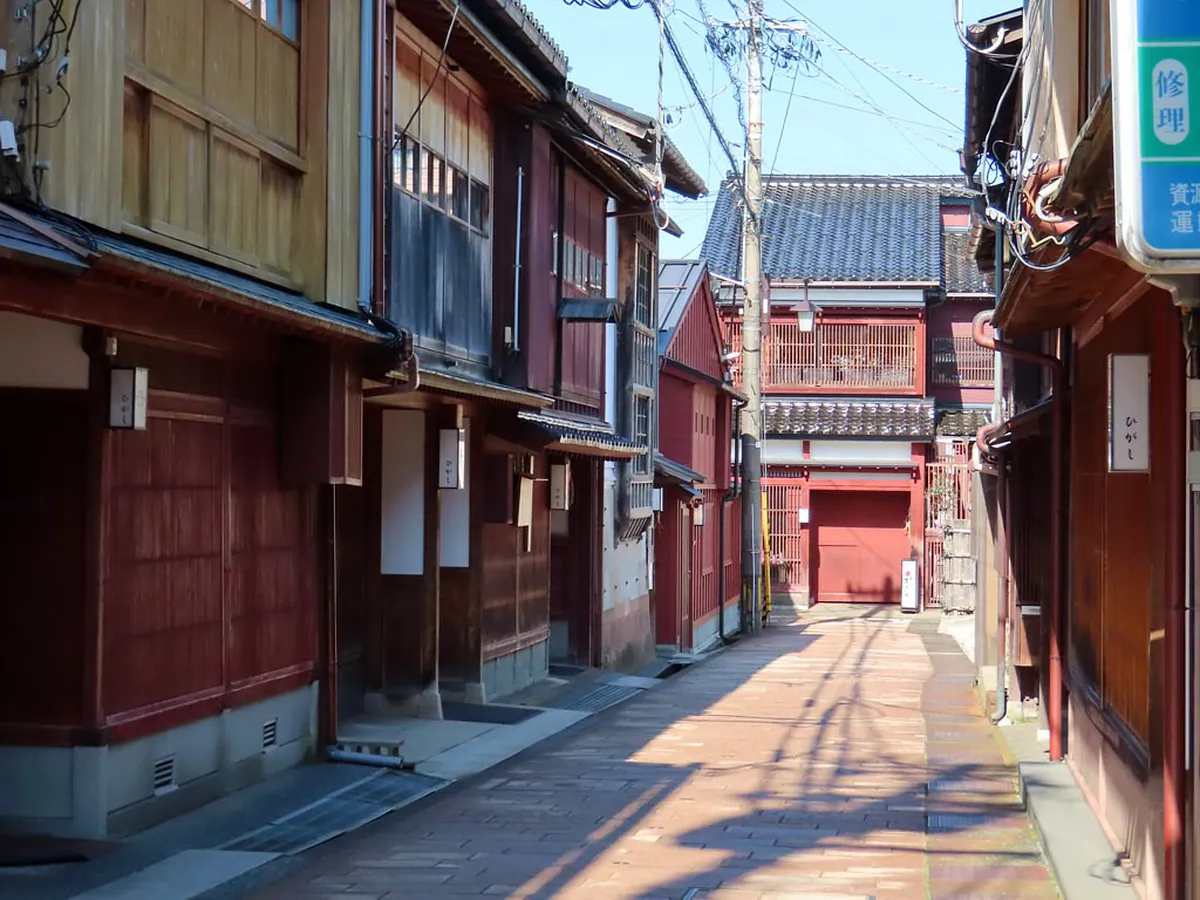
For the samurai district, Nagamachi is accessible via the Korinbo bus stop, which is a major junction for almost every city line. This central location makes it easy to pivot between different historical sites throughout your day. The Flat Bus also serves Nagamachi via the Nagamachi route for just 100 yen if you want a cheap alternative to the Loop Bus.
Day Trip Transport: Kanazawa to Shirakawa-go
Many visitors use Kanazawa as a base for a day trip to the UNESCO village of Shirakawa-go. This journey is handled by highway buses operated by the Nohi and Hokutetsu companies. The ride takes approximately 75 to 90 minutes and offers views of the Japanese Alps as the road climbs toward the valley.
Advance reservations are strongly recommended, especially during peak winter and summer seasons. Book online or at the bus terminal ticket office at Kanazawa Station. Our Kanazawa to Shirakawa-go day trip guide covers the full booking process and what to expect on arrival.
Buses depart from Platform 2 at the East Exit of Kanazawa Station. Arrive at least 10 minutes before your scheduled departure. In winter, heavy snowfall can cause delays or cancellations — always check the weather forecast and the operator's website before heading to the station. The mountain routes prioritize safety and services can be suspended with short notice.
How to Plan a Smooth Kanazawa Transport Day
Start every day at the Tourist Information Center inside the East Exit. Pick up a physical bus map, confirm One-Day Pass availability, and check if any seasonal services are running. The center also stocks the NORIMASSHI Kanazawa app flyer, which shows real-time bus positions — useful for reducing waits at busy stops during peak season.
Kanazawa is famous for frequent rain, and a rainy-day strategy matters. Loop buses and Flat Buses keep you dry between indoor attractions — the 21st Century Museum, D.T. Suzuki Museum, Omicho Market, and the Higashi Chaya teahouses all work well in wet weather. Bus stop 7 at the East Exit is covered, so even heavy rain does not disrupt your departure. Save outdoor sites (Kenrokuen, Castle Park, river walks) for clear spells.
Timing matters for avoiding the morning commuter rush. Try to start sightseeing before 08:30 or wait until after 09:30 for a more relaxed experience. Buses can be crowded on weekday mornings when students and local workers fill the same loop routes. On weekends the pattern reverses — tourist demand peaks from 10:00 onward, so early starters have a noticeably easier ride. You can integrate these timing tips directly into a Kanazawa itinerary to sequence your attractions efficiently.
Avoid the common mistake of taking the bus for very short distances in the city center. Between the garden, the museum, the castle, and Nagamachi, walking is usually faster than waiting. Use the bus for station-to-sights arrivals, the Chaya districts, and Shirakawa-go highway connections. Walk the core cultural loop and save your bus credits for meaningful distances.
Frequently Asked Questions
Which Kanazawa transport options fit first-time visitors?
First-time visitors should prioritize the Kanazawa Loop Bus. It connects all major landmarks like Kenrokuen and Higashi Chaya in a simple circular route. This makes navigation stress-free while you learn the city layout. You can integrate this into a Kanazawa itinerary for maximum efficiency.
Is the Kanazawa One-Day Bus Pass worth it?
Yes, the pass is worth it if you plan to take at least four bus rides in one day. It costs 800 yen for adults and provides unlimited travel on the loop buses and local lines. You can purchase it easily at the station's transport center.
Can I use my Suica card on Kanazawa buses?
Suica and other major IC cards are now accepted on most Hokutetsu buses in the city. Simply tap your card when entering and exiting the vehicle. However, keep some cash ready for the smaller community Flat Buses which may not support IC cards yet.
How much does a taxi cost from Kanazawa Station to Kenrokuen?
A taxi ride from Kanazawa Station to Kenrokuen Garden typically costs between 1,200 and 1,600 yen. The journey takes about 10 minutes depending on traffic. This is a great option for those with heavy luggage or limited time.
Is Kanazawa walkable in one day?
Kanazawa is very walkable because the main sights are clustered within a small area. You can walk between the market, castle, and garden in under 30 minutes total. However, using a bus for the longer stretches helps save your energy for the attractions.
Mastering the local transport system is the key to an enjoyable visit to this historic city.
Whether you choose the convenience of the loop bus or the freedom of walking, Kanazawa caters to every traveler.
Remember to check for the latest 2026 schedules and pass prices before you depart for your trip.
Safe travels and enjoy the incredible cultural heritage that Kanazawa has to offer.
Free: The Kanazawa Essentials guide
Top things to do, where to stay, a perfect day plan, getting around, and the best time to go — a Kanazawa mini-guide you can take offline.
You might also like

Continue reading
More guides you'll find useful