Nagasaki Atomic Bomb Museum Guide: 8 Essential Planning Tips
Plan your visit to the Nagasaki Atomic Bomb Museum and Peace Park. Includes exhibit highlights, transport tips, and a comparison with Hiroshima.
On this page
The Nagasaki Atomic Bomb Museum stands as a solemn reminder of the events on August 9, 1945. Located in the Urakami district, this facility offers a deep look into the history of nuclear warfare and its human cost. Visitors can explore four distinct gallery sections that trace the city from its pre-war life through the bombing and into the global peace movement. This guide helps you plan a respectful and well-organized visit, including what to expect inside the galleries, how to reach the site, and how to pace yourself across the adjacent Peace Park and Memorial Hall.
The museum opened in its current form in 1996 and sits mostly underground beneath a striking glass dome. It is compact but dense — budget at least two to three hours inside before adding the outdoor sites. Understanding what you will encounter before you arrive makes the experience more meaningful and less overwhelming. Read through these essential tips before adding the museum to your nagasaki landmarks itinerary.
Essential Visitor Information: Hours, Fees, and Location
The museum is open daily throughout most of the year, with standard hours from 08:30 to 17:30. Hours extend to 18:30 during summer months (roughly late July through August). Last entry is accepted 30 minutes before closing. The museum closes only during December 29–31 each year, so almost all travel windows are covered.
The museum is open 08:30–17:30 daily (until 18:30 in summer). Admission is 200 yen for adults, 100 yen for students. Arrive before 09:00 to walk through before large school groups begin arriving around 10:00 AM.
Admission is 200 yen for adults and 100 yen for students, making it one of the most affordable significant historical sites in Japan. Children under elementary school age typically enter free. Group rates are available for parties of ten or more; contact the museum in advance. Payment by cash or credit card is accepted at the entrance kiosk.
The museum address is 7-8 Hirano-machi, Nagasaki-shi. The building sits near the Hypocenter Park and Peace Park, so a single visit can cover all three sites in one morning. Refer to the Nagasaki Atomic Bomb Museum official site for updated hours and any temporary closures in 2026. Arrive by 09:00 to have the galleries largely to yourself before tour groups arrive around mid-morning.
Historical Context: The 1945 Atomic Bombing of Nagasaki
At 11:02 on August 9, 1945, a B-29 bomber named Bockscar released the "Fat Man" plutonium implosion bomb over the Urakami Valley. The detonation point was approximately 500 metres above the Urakami Cathedral. The blast killed an estimated 40,000 people instantly; by the end of 1945, total deaths including radiation sickness had reached 70,000–80,000. The surrounding hills partially contained the fireball, which is why the destruction was concentrated in the Urakami district rather than spread city-wide.
Nagasaki was a secondary target that day — Kokura was the primary, but cloud cover forced the crew to divert. The bomb's yield was 21 kilotons, larger than the uranium bomb dropped on Hiroshima three days earlier, yet the final death toll was lower because of the valley geography. Historians estimate that nearly 70 percent of victims were non-combatants: women, children, and elderly residents of the Urakami Catholic community that had made this district their home for generations.
The museum does not shy away from the political context. A section covers the Manhattan Project and the decisions behind target selection. Another traces the Sino-Japanese War of 1931–1945, including explicit mention of the Nanjing massacre — a level of frankness that distinguishes Nagasaki's museum from some comparable institutions. This broader framing helps visitors understand the bombing not as a single isolated event but as the culmination of years of escalating conflict.
Inside the Nagasaki Atomic Bomb Museum: Key Exhibits and Artifacts
The exhibition flows through four connected sections, starting with a brief view of pre-war Nagasaki and culminating in the global nuclear-abolition movement. The transition into the main gallery is marked by a clock frozen at 11:02 — a deliberate jolt before the heavier material begins. Nearly all panels are bilingual in Japanese and English, so non-Japanese speakers can read every exhibit without a guide.
The first large hall is dominated by a reconstruction of the front facade of Urakami Cathedral, scorched and partially shattered by the blast. Around it you will find twisted steel beams, bent water-tower structures, half-melted rosary beads recovered from the cathedral ruins, and roof tiles with bubbled surfaces caused by the extreme heat. One exhibit that stops almost every visitor: a clump of melted glass with the bones of a human hand fused inside it. In the same room, a helmet contains the partial remains of a skull on its interior surface.
The second section presents a full-scale replica of the Fat Man bomb, opened at the back to expose its plutonium core and the complex implosion-lens assembly surrounding it. A detailed diagram explains the physics of how the implosion compresses the core to critical mass — this is where Nagasaki's museum goes further than Hiroshima's in explaining the science. An interactive diorama of the city lights up in sequence to show the fireball, heat rays, blast radius, fires, and radiation spread.
Later sections cover the relief effort, including the story of Takashi Nagai — a Nagasaki medical professor who directed early radiation research while himself dying of radiation-induced leukemia. The final gallery is the most comprehensive section on post-war nuclear history available in any Japanese museum, covering Cold War proliferation, atmospheric testing at Bikini Atoll, the Semipalatinsk test site in Kazakhstan, and the global disarmament movement up to the present day. A quiet cinema upstairs shows two short films, including a 20-minute documentary titled "The A-bombing of Nagasaki." The last exhibit before the exit — a photograph called "Boy Standing at a Crematory" taken by Joe O'Donnell — is the one that many visitors say stays with them longest.
The Western POW Testimonies: A Perspective No Other Museum Offers
One section of the museum receives little attention in most visitor guides, yet it provides one of the most striking perspectives on the bombing. Nagasaki had an active POW camp in 1945, holding roughly 200 Western prisoners — primarily Dutch and Australian, with some British and American men — who were working in the Mitsubishi armaments factories when the bomb fell. Unlike Hiroshima, which had no equivalent POW population at the time, Nagasaki preserved testimonies from this specific group.
Their accounts are profoundly conflicted. Several survivors describe the horror of the blast, the burns, and the chaos in terms identical to Japanese civilian testimonies. But they also describe the bomb as a sign that the war would end — some believed they would not have survived another six months of forced labor and malnutrition. One documented account describes a man who was relieved at the bomb's meaning while simultaneously witnessing the deaths of the guards who had been his captors. This dual experience — the bomb as liberation and catastrophe at once — is unique to this section of the Nagasaki museum.
The video testimonies in this wing are subtitled in English, and several are originally in Dutch, German, or Russian with English subtitles. If you have time, budget 20 extra minutes here. This corner of the museum is rarely crowded and offers a window into the bombing that no competitor publication covers in depth.
Exploring the Nagasaki Peace Park and Hypocenter
The Hypocenter Park sits directly below the point where the bomb detonated — a simple black monolith marks the exact spot. Next to the monolith stands a broken pillar fragment from the original Urakami Cathedral, retrieved from the rubble. The atmosphere here is quieter and more intimate than the larger Peace Park uphill. Visitors often leave flowers, water, or paper cranes at the base of the monolith.
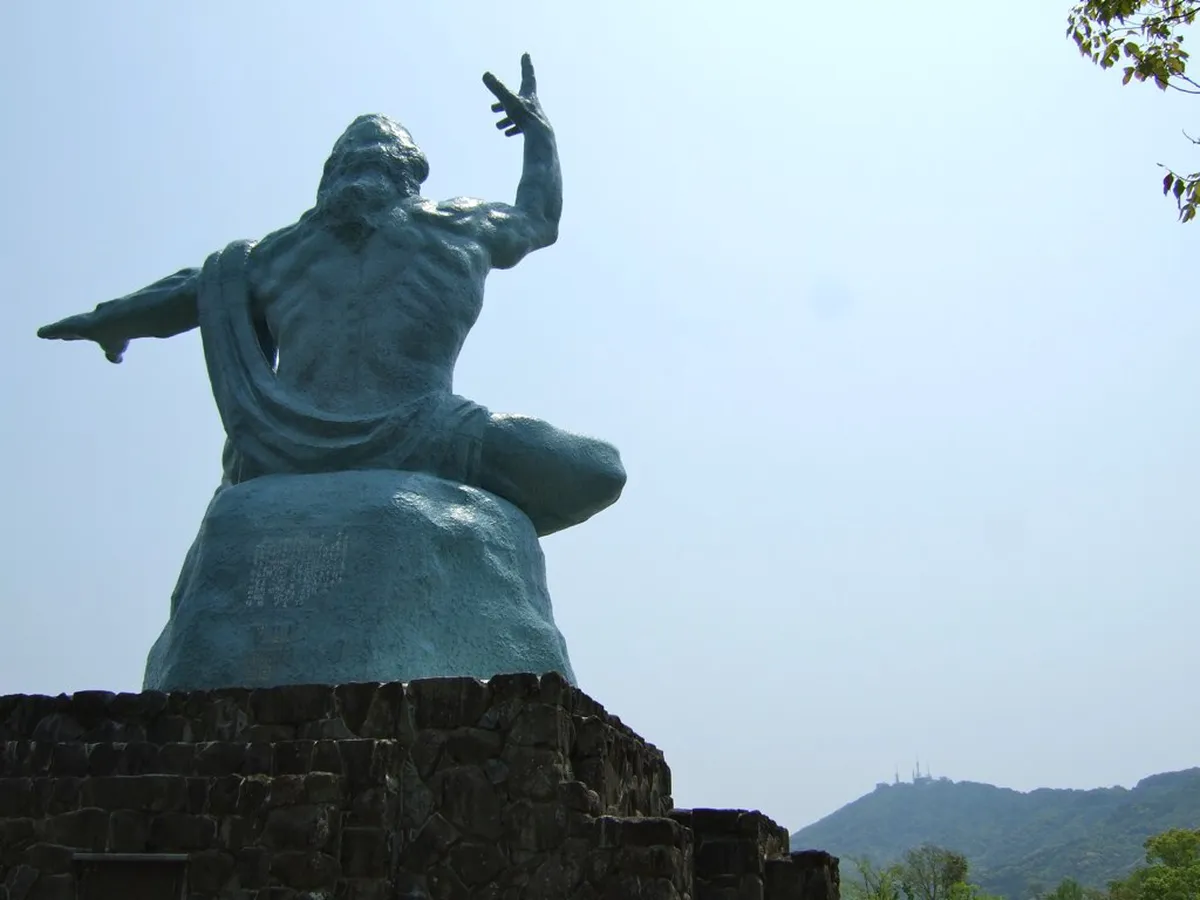
A short walk uphill from the Hypocenter brings you to the main Peace Park. The Peace Statue at the north end was designed by sculptor Seibo Kitamura and unveiled in 1955. Its symbolism is specific: the raised right arm points toward the sky where the bomb fell, as a warning against nuclear weapons; the extended left arm gestures toward eternal peace; the closed eyes are in prayer. Every year on August 9, a memorial ceremony takes place at the statue's base, and at 11:02 each morning a bell rings across the park.
The Fountain of Peace at the park's southern end was built in memory of victims who desperately searched for water after the blast. Its inscription reads: "I was thirsty. And water tasted of oil. There in the shadow of the smoke were my friends, weeping." Dozens of monuments from countries around the world dot the park grounds. You can find more details about the full circuit in our nagasaki peace park visiting guide. The Nagasaki Peace Park Wikipedia page covers the history of each monument's donation.
Nagasaki National Peace Memorial Hall for the Atomic Bomb Victims
The National Peace Memorial Hall sits adjacent to the museum, mostly underground. It was designed around water and light as its primary motifs — a long row of illuminated glass columns descends to a subterranean Remembrance Hall where the names of identified victims are recorded. The columns glow eerily at night and are visible from the surface garden above.
Entry is free and the space functions differently from the museum: it is for quiet contemplation rather than historical education. There is no narrated exhibit, no timeline of events. Instead, digital stations provide access to a large archive of survivor testimonies, personal photographs, and historical documents. Visitors can also leave written messages in the hall's register.
Many travelers find it best to visit the Memorial Hall last, after the museum's dense exhibits and the Peace Park's outdoor monuments. The transition from fact-heavy galleries to this spare, silent space provides a natural emotional close to the experience. Check the Nagasaki National Peace Memorial Hall site for current hours, as they sometimes differ slightly from the museum next door.
Nagasaki vs. Hiroshima: Comparing the Two Atomic Bomb Museums
Travelers frequently ask whether to visit one museum or both. The short answer: if you can make time for both cities, go to both — they genuinely complement rather than repeat each other. The Hiroshima Peace Memorial Museum is stronger on the lead-up to the bombing, on WWII political history, and on the city-wide scale of destruction. It also contains more internationally recognized artifacts, including the famous shadow of a man burned onto a bank doorstep. Nagasaki's museum is more compact and more focused on the physics of the bomb, the specific Urakami community, and post-war nuclear proliferation.
The emotional register differs too. Hiroshima feels broad and civic — it covers a wide city and a large population. Nagasaki feels more concentrated and intimate, because the destruction was confined to the Urakami Valley and centered on a tight-knit Catholic community. The museum's graphic footage from immediately after the blast is more raw than anything in Hiroshima's comparable collection. If you visit only one, Hiroshima is more accessible from most Japan itineraries; if you visit Nagasaki specifically for the museum, the experience repays the extra travel.
Here is a direct comparison across the dimensions most travelers ask about:
| Feature | Nagasaki Museum | Hiroshima Museum |
|---|---|---|
| Bomb type covered | Plutonium implosion (Fat Man) | Uranium gun-type (Little Boy) |
| Primary focus | Physics of the bomb + post-war nuclear history | Medical effects + city-wide destruction |
| Emotional tone | Intimate, community-focused | Civic, large-scale |
| Post-war nuclear coverage | More comprehensive | Less detailed |
| Time required inside | 2–3 hours | 2–3 hours |
| Admission (adults) | 200 yen | 200 yen |
- Primary bomb type: Nagasaki — plutonium implosion (Fat Man); Hiroshima — uranium gun-type (Little Boy)
- Museum focus: Nagasaki — physics of the bomb and post-war nuclear history; Hiroshima — medical effects and city-wide destruction
- Emotional tone: Nagasaki — intimate, community-focused; Hiroshima — civic, large-scale
- Post-war nuclear coverage: Nagasaki is more comprehensive, covering proliferation, Cold War testing, and global disarmament
- Time required inside: Nagasaki museum — 2 to 3 hours; Hiroshima Peace Memorial Museum — 2 to 3 hours
- Combined site visit (museum + park + memorial hall): both cities require 4 to 5 hours for a thorough visit
Fitting both into one trip is easiest if you travel between the cities by Shinkansen. From Nagasaki Station, take the express to Shin-Tosu, then the Kyushu Shinkansen to Hiroshima — total journey around four hours. This makes a two-city itinerary realistic for anyone planning a longer trip. If you are designing a longer stay in Kyushu, add this leg to a nagasaki 1 day itinerary before continuing north.
Logistics: Getting Around Nagasaki and Transport Tips
The vintage streetcar network is the most practical way to reach the museum. From JR Nagasaki Station, take tram line 1 (blue) or line 3 (red) and ride to the Hamaguchi-machi stop, which is signed in English as "Atomic Bomb Museum." The fare is a flat 130 yen per ride, paid by dropping coins into the box beside the driver when you exit. Journey time from Nagasaki Station is approximately 13 minutes.
If you are arriving from the cruise terminal at Nagasaki Port, take tram line 1 from the Ohato stop — the same line serves both the station and the port area. Ride to Hamaguchi-machi, same stop as above. From the stop, cross the main road and walk uphill for about 200 metres to the museum entrance. The building is mostly underground beneath a glass dome; do not confuse it with the large red-brick building visible from the road, which is a separate institution.
A day pass (ichi-nichi joshaken) costs 600 yen for adults and covers unlimited tram rides. It pays for itself after five single rides and is worthwhile if you plan to combine the museum with other city sites. Purchase it at the tourist information center inside JR Nagasaki Station. The museum, Hypocenter Park, and Peace Park are all within 10 minutes' walk of each other once you alight — no additional transport needed between them. If you are arriving from Fukuoka, see our nagasaki to fukuoka transport guide for the full journey breakdown.
Tips for a Respectful and Meaningful Visit
A recommended order: start at the museum when it opens at 08:30, move to the Hypocenter Park around mid-morning, then walk uphill to the Peace Park, and finish at the Memorial Hall. This sequence moves from historical information to outdoor reflection to quiet contemplation — a natural emotional arc that most visitors find easier to process than visiting the sites in random order.
Photography is permitted in most of the museum, but some sections restrict it — look for signs at each room entrance and follow them. The graphic artifacts in the main gallery, including the fused glass and human remains, deserve particular restraint. Maintain a low speaking volume throughout; many visitors are here to pay respects to family members, and the space warrants the same quiet you would offer a place of worship.
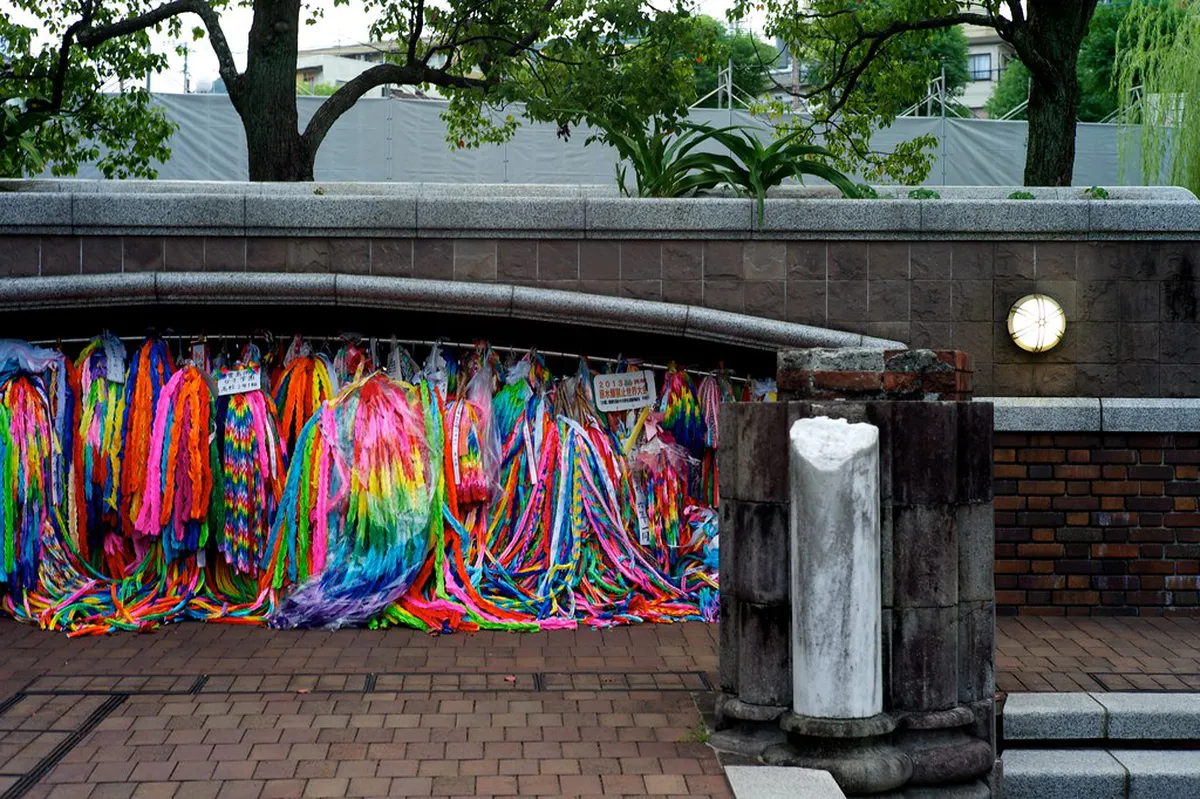
The origami paper cranes and peace doves displayed throughout the park are sent by schools and organizations from around the world. The tradition traces back to Sadako Sasaki, a young survivor of the Hiroshima bombing who folded cranes as long as she was physically able before dying of leukemia. Thousands of crane bundles arrive in Nagasaki and Hiroshima each year as a living symbol of hope. If you wish to participate, you can fold a crane and leave it at one of the designated offering points throughout the park. Connecting with this practice is one of the most direct ways to engage with the local nagasaki culture of peace that defines the Urakami district.
Photography is permitted in most of the museum, but some sections restrict it — look for signs at each room entrance. The graphic artifacts in the main gallery, including the fused glass, deserve particular restraint. There are no cafes immediately inside the complex, so carry water and a snack.
The museum visit is emotionally draining for most people regardless of age or prior knowledge. Build in a 20-minute break in the foyer or the garden between the museum and the Memorial Hall. Carry water and a snack, as there are no cafes immediately inside the complex. Children older than ten generally engage well with the exhibits; parents of younger children may want to focus on the outdoor Peace Park monuments and origami displays, which are vivid and age-appropriate without the graphic artifacts.
Frequently Asked Questions
Should I visit the Nagasaki or Hiroshima Atomic Bomb Museum?
Both museums offer unique perspectives on the tragedy. Nagasaki focuses more on the physics and scientific aspects of the plutonium bomb. Hiroshima provides a broader look at the medical consequences and city-wide destruction. If time permits, visiting both is the best way to understand the full history of nagasaki attractions and peace efforts.
How much time should you plan for the Nagasaki Atomic Bomb Museum?
You should plan for at least two to three hours inside the museum itself. This allows enough time to read the detailed English descriptions and view the video testimonies. If you include the Peace Park and the Memorial Hall, set aside a total of four to five hours for the entire area.
What is the best way to get to the Peace Park in Nagasaki?
The city streetcar is the most efficient and popular method for travelers. Take line 1 or 3 and get off at the Atomic Bomb Museum stop. From there, the museum and the main park are just a few minutes away on foot. The route is clearly marked with signs in multiple languages.
Is the Nagasaki Atomic Bomb Museum suitable for children?
The museum is educational but contains graphic images and artifacts that might be intense for younger children. Parents should use their discretion and perhaps focus on the outdoor Peace Park and the origami displays. Most older children and teenagers find the historical and scientific exhibits very engaging and informative.
Visiting the Nagasaki Atomic Bomb Museum is a powerful experience that stays with you long after you leave. It offers a unique blend of scientific education and human storytelling that is rarely found elsewhere. By following this guide, you can ensure your visit is both organized and deeply respectful of the city's history. Consider adding this site to a broader nagasaki 3 day itinerary to see all the city has to offer.
The message of peace championed by Nagasaki is more relevant today than ever before. Taking the time to learn about these events is a vital step toward a more peaceful future. We hope this guide helps you plan a meaningful journey to one of Japan's most significant landmarks. Safe travels as you explore the resilient and beautiful city of Nagasaki in 2026.
Pair this with our broader Nagasaki tourism attractions guide for the full city overview.
For related Nagasaki deep-dives, see our 7 Essential Tips for Your Nagasaki Peace Park Visiting Guide and Nagasaki Dejima History Guide: A Complete Visitor's Manual guides.
Free: The Nagasaki Essentials guide
Top things to do, where to stay, a perfect day plan, getting around, and the best time to go — a Nagasaki mini-guide you can take offline.
You might also like

Continue reading
More guides you'll find useful