
Nagasaki Day Trip From Fukuoka: 1-Day Itinerary Guide
Plan your Nagasaki day trip from Fukuoka with this 1-day itinerary. Includes Shinkansen tips, WWII history sites, Gunkanjima booking advice, and local food picks.
On this page
A Nagasaki day trip from Fukuoka is one of the most rewarding excursions in Kyushu. The city sits roughly 150 km from Fukuoka, and the new Nishi Kyushu Shinkansen cuts that distance to about 90 minutes of travel time. You get WWII memorials, Dutch colonial history, European-influenced gardens, and excellent food — all reachable in a single day from Hakata Station.
Nagasaki remained Japan's only open port during the two centuries of isolation under the Tokugawa Shogunate. That singular position left a permanent mark on the city's architecture, cuisine, and religious history. The result is a place unlike anywhere else in Japan — compact enough for a day trip, layered enough that every return visit reveals something new.
This guide walks you through getting there, getting around, and squeezing the most out of roughly 10 hours on the ground. All prices and transport details reflect 2026 schedules.
Transport Guide: Shinkansen vs. Highway Bus
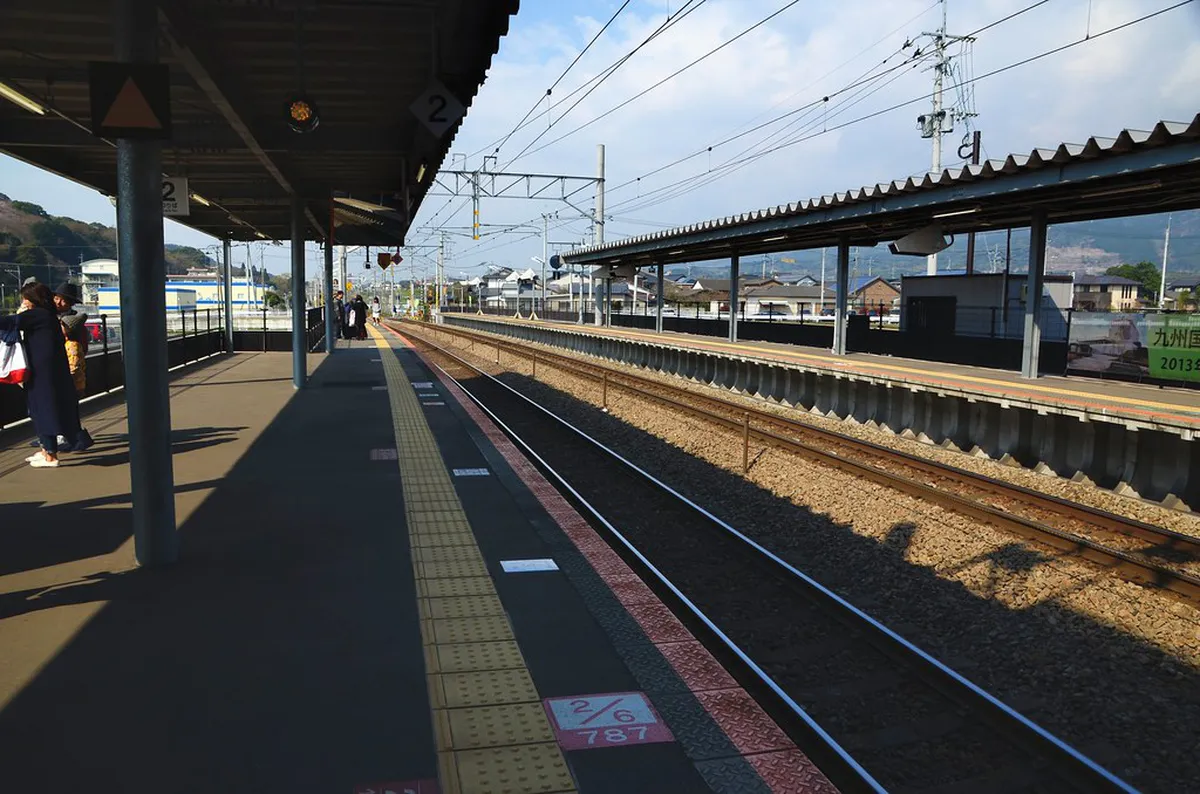
The fastest option is the combined Limited Express Relay Kamome + Nishi Kyushu Shinkansen from Hakata Station. The first leg runs from Hakata to Takeo-Onsen (about 70 minutes). At Takeo-Onsen, you step off and cross to the opposite side of the same platform — the Kamome Shinkansen is already waiting. The second leg from Takeo-Onsen to Nagasaki takes about 23 minutes. Total journey: roughly 1 hour 30 minutes. A one-way unreserved ticket costs approximately ¥8,400. This route is fully covered by the national JR Pass, the North Kyushu Area Pass, and the All Kyushu Area Pass.
The highway bus is slower but significantly cheaper. Nishitetsu buses depart Tenjin Bus Center and Hakata Station roughly every 30 minutes and reach Nagasaki Station in about 2 hours 30 minutes. A one-way ticket costs approximately ¥2,900. The JR Pass does not cover this service. For a day trip where time is your main constraint, the train wins clearly — you gain an extra hour of sightseeing each way.
Here is a quick comparison to help you decide:
| Option | Time | One-Way Cost | JR Pass |
|---|---|---|---|
| Relay Kamome + Shinkansen | ~90 min | ~¥8,400 | Eligible |
| Nishitetsu Highway Bus | ~150 min | ~¥2,900 | Not valid |
- Relay Kamome + Shinkansen: ~90 minutes, ~¥8,400 one-way, JR Pass eligible, transfer at Takeo-Onsen
- Nishitetsu Highway Bus: ~150 minutes, ~¥2,900 one-way, JR Pass not valid, no transfer needed
Trains run once or twice per hour throughout the day. For a day trip, aim to board the 07:00–07:30 departure from Hakata to arrive in Nagasaki by 09:00. Reserved seats are available and cost a small supplement — worth it on busy holiday weekends.
The Combo Ticket That Saves You Money
If you don't have a JR Pass, ask at Hakata Station for the Nagasaki Enjoy Eco Kippu — a bundled ticket covering your round-trip fare plus a Nagasaki 1-day tram pass, roughly 20–30% cheaper than buying each component separately.
If you do not have a JR Pass, ask at the JR Kyushu ticket counters in Hakata Station for the Nagasaki Enjoy Eco Kippu (also marketed as a "Nagasaki Day Trip Set"). This bundled ticket covers your round-trip Limited Express fare plus a Nagasaki 1-day tram pass in a single purchase. In 2025 the set was priced around ¥9,000–¥9,500 depending on the season — roughly 20–30% cheaper than buying each component separately at the standard unreserved fare.
The tram pass component is key. Without it, each tram ride costs ¥160 per boarding, and a full day of sightseeing typically involves 6–8 tram legs. The bundled pass eliminates all those micro-purchases and comes printed as a single pass you show to the driver. Not every ticket window advertises it proactively — you may need to ask specifically for "Nagasaki set ticket" (ながさきセット切符) at the counter.
Travelers with an active JR Pass should skip this combo and simply buy a standalone Nagasaki 1-day tram pass (¥500) at Nagasaki Station or from the driver on first boarding. The tram pass includes a city map marking every stop — essential for navigating efficiently.
Getting Around Nagasaki: The Tram System
Nagasaki operates one of the most tourist-friendly tram (streetcar) networks in Japan. Five lines cover virtually every major attraction, and trams arrive every 5–8 minutes at the busiest stops. A single-ride fare is ¥160; a 1-day pass costs ¥500 and is sold at Nagasaki Station and on the tram itself. Buy the day pass on your first boarding if you did not get the combo ticket at Hakata.
The most useful lines for a day trip are Line 1 (Akasako–Shōkakuji-shita) and Line 3 (Hotarujaya–Akasako). Line 1 stops near Dejima and Glover Garden; Line 3 reaches the Atomic Bomb Museum area (board at Nagasaki-eki-mae and alight at Matsuyama-machi). Most tram stops are signposted in English, and the tram display boards announce stops in both Japanese and English.
Your first stop after leaving the tram on arrival should be the Nagasaki Station Tourism Office, located inside the station concourse. Staff there speak English, stock free English maps, and can point you to coin lockers — essential for day-trippers who want to stow luggage before heading out. Lockers range from ¥300 (small) to ¥700 (large) per day.
WWII History: Peace Park and Atomic Bomb Museum
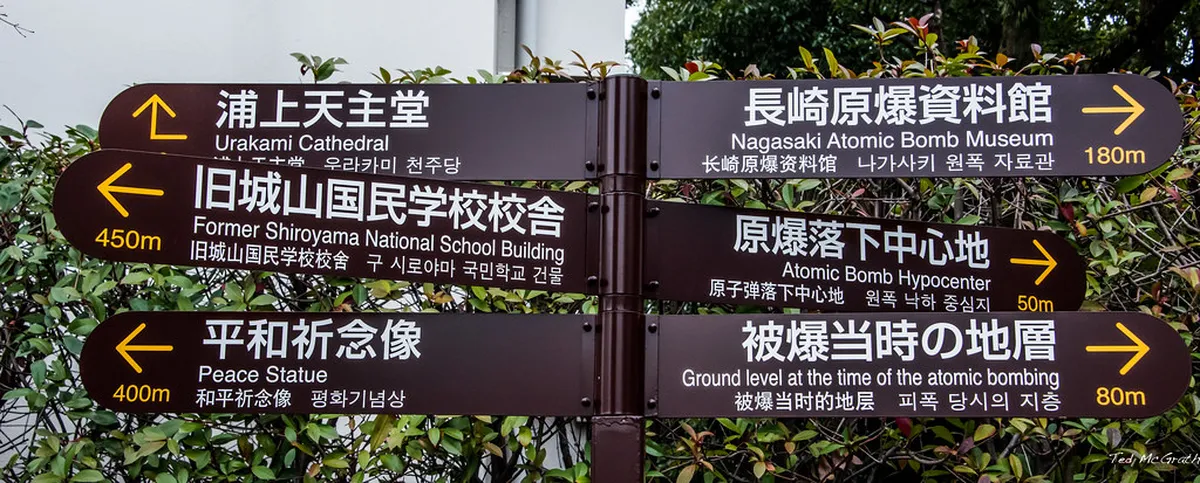
The Peace Park complex is spread across three interconnected sites within walking distance of each other. Start at the Hypocenter Park — a black monolith marks the exact point above which the Fat Man bomb detonated on 9 August 1945 at 11:02 AM. The ruins of an Urakami Cathedral pillar stand nearby, a deliberate reminder of what the blast destroyed. Admission is free; the park is open 24 hours.
Walk uphill to reach the Nagasaki Peace Park, dominated by the 10-metre Peace Statue by Seibo Kitamura. Its raised right hand points to the atomic threat; its horizontal left arm symbolises peace. On 9 August each year, the Peace Memorial Ceremony is held here before the Peace Statue. Arrive early on that date if you are visiting in August — crowds are significant.
The Nagasaki Atomic Bomb Museum sits a short walk from the hypocenter. Admission is ¥200 for adults. Opening hours are 08:30–18:30 (May–August) and 08:30–17:30 (September–April), closed 29–31 December. The exhibits include physical remnants of the blast — a melted church bell, a charred lunchbox — alongside photographs and survivor testimonies. Allow 60–90 minutes. The museum handles this history with restraint; there is nothing gratuitous, but it is deeply affecting.
Colonial Heritage: Dejima Dutch Trading Post
Dejima was an artificial island built in the 1630s to quarantine foreign traders — first the Portuguese, then exclusively the Dutch East India Company (VOC) — while the rest of Japan remained closed to the outside world. For over 200 years it was Japan's sole window to Western knowledge, science, and medicine. Today the site has been substantially restored, with period warehouses, merchant residences, and a reconstructed gate all open to visitors.
Admission is ¥520 for adults (students ¥100–200). Opening hours are 08:00–21:00 daily. The nearest tram stop is Dejima Station on Line 1. Allow 45–60 minutes. The English-language explanatory panels are thorough, and the scale models inside the main building help visualise what the original island looked like before land reclamation merged it with the surrounding city.
If you want to read more about the site's history before visiting, our full Nagasaki 1-day itinerary covers Dejima in detail alongside the other major stops.
Western Influence: Glover Garden and Oura Church
Glover Garden is a hillside open-air museum housing seven 19th-century Western-style residences, including the home of Scottish merchant Thomas Blake Glover, who played a significant role in modernising Japan's shipbuilding and coal industries. The garden sits on a slope overlooking Nagasaki harbour, and the views are among the best in the city. Admission is ¥620 for adults. Opening hours run 08:00–18:00 (extended to 21:30 during certain seasons). The garden is about a 10-minute walk from Oura Tenshudo-shita tram stop.
A short walk downhill from Glover Garden brings you to Oura Church (Oura Cathedral), the only Gothic stone church in Japan and a National Treasure. Built in 1864 by French missionaries, it is dedicated to the 26 Martyrs of Japan — Christians crucified on Nishizaka Hill in 1597. The church gained UNESCO World Heritage status in 2018 as part of the "Hidden Christian Sites in the Nagasaki Region" group, which documents the remarkable story of Japanese believers who secretly maintained their faith for 250 years of prohibition. Admission is ¥1,000 for adults. Those interested in the "Hidden Christian" story will find the attached museum essential context.
The nearby Site of the Martyrdom of the 26 Saints of Japan, on Nishizaka Hill (5 minutes' walk from Nagasaki Station), is another Christian-history stop worth 20 minutes if your schedule allows. Fans of Shusaku Endo's novel Silence — which dramatises the persecution of Jesuit missionaries in 17th-century Japan — will find Nagasaki's Christian geography deeply resonant. The novel was adapted into a film by Martin Scorsese in 2016 and many of its locations are based on real Nagasaki sites.
Panoramic Views: The Mount Inasa Ropeway
Mount Inasa (333 m) is reached by ropeway from the Fuchi Jinja ropeway station. A round-trip ticket costs approximately ¥1,250 for adults. The ropeway runs 09:00–22:00 (last ascent 21:30). The summit observation deck offers a 360-degree panorama of the city, harbour, and surrounding islands. At night, the lights of Nagasaki spread across the basin — the view is frequently ranked among Japan's top three night views, alongside Kobe and Sapporo.
For Gunkanjima, most tours depart around 09:00 or 13:00. Taking a 07:00 Relay Kamome from Hakata to catch the 09:00 boat means sacrificing the Peace Park and Glover Garden. Consider making Gunkanjima a dedicated goal rather than squeezing it into a full sightseeing day, and book 3–4 weeks ahead.
For a day trip, timing is a choice between sunset (around 19:00 in summer) and the fully lit night view (after 20:00). Sunset gives colour and drama; the full night view is the classic postcard. If you can stretch your departure to the 21:00 or 22:00 train from Nagasaki, the night view is worth the later return. Check the Mount Inasa ropeway guide for current operating hours, which vary by season.
Offshore Adventure: Gunkanjima (Battleship Island) Tours
Hashima Island — universally known as Gunkanjima ("Battleship Island") because its silhouette resembles a warship — is a UNESCO World Heritage site and one of the most photogenic ruins in Asia. The abandoned coal-mining facility was home to over 5,000 residents at its peak in the 1960s. It was deserted when the mine closed in 1974 and has been decaying dramatically ever since.
Tours depart from Nagasaki Port Terminal (about 15 minutes by tram from Nagasaki Station). The boat ride takes 40–50 minutes each way. Tour operators include Yamasa Kaiun and Gunkanjima Concierge; prices run approximately ¥4,000–¥5,000 per adult including the landing permit fee. Critically: landing on the island is weather-dependent. If seas are rough, the boat circles the island but cannot dock. Check the operator's website or call on the morning of your visit — cancellation rates are highest in typhoon season (July–September) and winter.
For a day trip from Fukuoka, the logistics are tight. Most tours depart around 09:00 or 13:00. If you take the 07:00 Relay Kamome from Hakata and arrive by 08:30, you can make the 09:00 departure — but you will sacrifice the Peace Park and Glover Garden. The better approach: book Gunkanjima on a day when it is your primary goal, rather than squeezing it into an already full sightseeing day. Book at least 3–4 weeks in advance; popular tour slots fill months ahead in peak season. See our full Gunkanjima tour guide for booking links and what to expect on landing.
Local Flavours: Nagasaki Champon and Castella Cake
Nagasaki has two foods you should eat before leaving. Champon is a thick noodle soup loaded with seafood, pork, and vegetables, developed in the late 1800s by a Chinese restaurant owner catering to Chinese students in Nagasaki. It is nothing like the instant noodle product sold under the same name in Japanese convenience stores. The best champon is found at restaurants around Nagasaki Chinatown (Shinchi Chinatown), a five-minute walk from Dejima. Lunch at a sit-down champon restaurant typically costs ¥900–¥1,500.
Castella (kasutera) is a Portuguese-origin sponge cake that arrived in Nagasaki via 16th-century trade. Nagasaki castella is denser and moister than the versions sold elsewhere in Japan, baked in wooden moulds that give the bottom a distinctive sugary crust. The most famous producer is Fukusaya, with a shop near Nagasaki Station and another near Glover Garden. A standard loaf (roughly 30 cm) runs ¥1,500–¥2,000 and keeps for several days — ideal as a souvenir. Buy it at the end of your day so it does not get crushed in your bag.
For a quick lunch between the museum and Dejima, the covered shopping arcades near Hamanomachi tram stop have several champon and sara udon restaurants with picture menus. Sara udon (crispy noodles with the same champon toppings) is a good alternative if you prefer something lighter.
Sample 1-Day Itinerary and Budget Breakdown
This timeline is based on a 07:17 Relay Kamome departure from Hakata Station, arriving Nagasaki around 08:50. Adjust departure time based on your hotel location and the current timetable.
- 07:17 — Depart Hakata Station on Relay Kamome (transfer at Takeo-Onsen)
- 08:50 — Arrive Nagasaki Station. Store luggage in coin locker. Pick up tram day pass and city map at Tourism Office.
- 09:10 — Take tram Line 1 or 3 to Matsuyama-machi. Walk to Hypocenter Park and Peace Park (free). 30 minutes.
- 09:45 — Atomic Bomb Museum (¥200, allow 75 minutes)
- 11:00 — Tram to Dejima Station. Visit Dejima (¥520, allow 50 minutes)
- 12:00 — Lunch at Nagasaki Chinatown: champon or sara udon (¥900–¥1,500)
- 13:30 — Tram to Oura Tenshudo-shita. Oura Church and Hidden Christian Museum (¥1,000, 30 minutes)
- 14:15 — Walk uphill to Glover Garden (¥620, allow 60 minutes)
- 15:30 — Free time in Hamanomachi shopping arcade. Buy castella at Fukusaya (¥1,500–¥2,000)
- 17:00 — Return to Nagasaki Station. Collect luggage.
- 18:30 — Tram to Fuchi Jinja ropeway station. Ride up Mount Inasa for sunset or night view (¥1,250 round-trip)
- 20:30 — Return to Nagasaki Station. Depart on Relay Kamome / Shinkansen back to Hakata.
- 22:00 — Arrive Hakata Station
Estimated costs per person without JR Pass: transport ¥9,000–¥9,500 (Enjoy Eco Kippu combo), admissions roughly ¥2,400, lunch and castella ¥2,500–¥3,500. Total: approximately ¥14,000–¥15,000. With a JR Pass, replace the transport cost with ¥500 for the standalone tram day pass, reducing the total to roughly ¥6,000–¥7,000 for the day.
Is One Day Enough for Nagasaki?
One day covers the core four — Peace Park, Dejima, Glover Garden, and Mount Inasa — without feeling rushed, provided you start early and follow the tram efficiently. The itinerary above is tighter than it looks on paper; if you spend longer than planned at the Atomic Bomb Museum (which is easy to do), you will need to trim the shopping or the Oura Church stop.
If your interests lean heavily toward WWII history, budget a full day for just the Peace Park complex and the museum, and treat the rest as secondary. If you want to add Gunkanjima, it needs its own dedicated half-day and ideally an overnight stay in Nagasaki. The city rewards a second visit — the Goto Islands, the Kunchi Festival in October, and the hidden-Christian pilgrimage routes are all richer experiences than a single day allows.
Frequently Asked Questions
Is one day enough to see Nagasaki from Fukuoka?
Yes, one day is enough to see the major historic sites. You can visit the Peace Park, Dejima, and Glover Garden easily. However, you will need more time for offshore island tours.
What is the fastest way to get from Fukuoka to Nagasaki?
The Nishi Kyushu Shinkansen is the fastest option available. It takes about 90 minutes with a quick transfer at Takeo-Onsen. This route is covered by the JR Kyushu Pass.
Can you visit Gunkanjima on a day trip from Fukuoka?
You can visit Gunkanjima if you take an early train from Fukuoka. Most tours depart in the morning or early afternoon from the port. Advance booking is essential for these tours.
Nagasaki is a city of resilience and beautiful international culture. Your day trip will leave you with many lasting memories. I hope this itinerary helps you plan a smooth journey. Kyushu is a wonderful region with so much to discover.
Remember to wear comfortable walking shoes for the hilly streets. The tram system will be your best friend during the visit. Safe travels as you explore this historic Japanese gem.
Combine this with our main Nagasaki attractions guide for a fuller itinerary.
Free: The Nagasaki Essentials guide
Top things to do, where to stay, a perfect day plan, getting around, and the best time to go — a Nagasaki mini-guide you can take offline.
You might also like


Continue reading
More guides you'll find useful


