How to Fold Orizuru Paper Cranes at Hiroshima Peace Memorial (2026 Guide)
Learn how to fold orizuru paper cranes for the Hiroshima Peace Memorial in 2026. 9-step folding diagram, Sadako Sasaki's story, donation rules, and where to fold cranes near the park.
On this page
Quick answer: To fold an orizuru for the Hiroshima Peace Memorial, start with a 15cm square of origami paper, work through the 9 traditional steps from the bird base to the finished crane, then string finished cranes in sets of 50 to 100 and donate them to the glass display booths at the Children's Peace Monument in Peace Memorial Park. Donation is free, year-round, and open to anyone.
Visitors to Hiroshima often feel a deep connection to the city through the simple act of folding paper. Colorful strings of cranes hang like rainbows around the monuments in the Peace Memorial Park. Learning how to fold orizuru paper cranes at Hiroshima Peace Memorial allows you to participate in a global prayer for peace that receives roughly 10 million cranes from around the world every year.
This tradition stems from a powerful history of resilience and hope following the events of 1945. Millions of these paper birds arrive in the city every year from every corner of the globe. You can join this movement by creating your own crane during your visit to this historic site in 2026.
Whether you are a beginner or an origami expert, the process is both meditative and meaningful. This guide walks you through the 9 folding steps, explains the story behind the tradition, shows you exactly where to donate, and answers the practical questions most travelers have before they arrive.
The Significance of Orizuru at Hiroshima Peace Memorial
In Japanese culture, the crane is a mystical creature that represents longevity and good fortune. People believe that folding one thousand cranes, known as Senbazuru, can make a special wish come true. At the memorial, this tradition focuses specifically on the wish for a world without nuclear weapons.
The city maintains a strong connection to its hiroshima culture through these delicate paper offerings. Local residents and visitors use the orizuru to honor the memory of the Hibakusha, or atomic bomb survivors. Each fold represents a quiet moment of reflection on the value of human life.
You will see these cranes displayed in large transparent booths near the monuments to protect them from the rain. These displays are vibrant and constantly updated as new donations arrive from schools and individuals — the city receives an estimated 10 tonnes of cranes per year. The sheer volume of paper birds serves as a visual reminder of the world's collective desire for harmony.
Participating in this activity helps travelers connect with the somber yet hopeful atmosphere of the park. It transforms a standard sightseeing trip into a personal contribution to the city's ongoing peace mission. Taking the time to fold a crane shows respect for the local history and the people who live there.
Step-by-Step Guide: How to Fold a Paper Crane (Orizuru) in 9 Folds
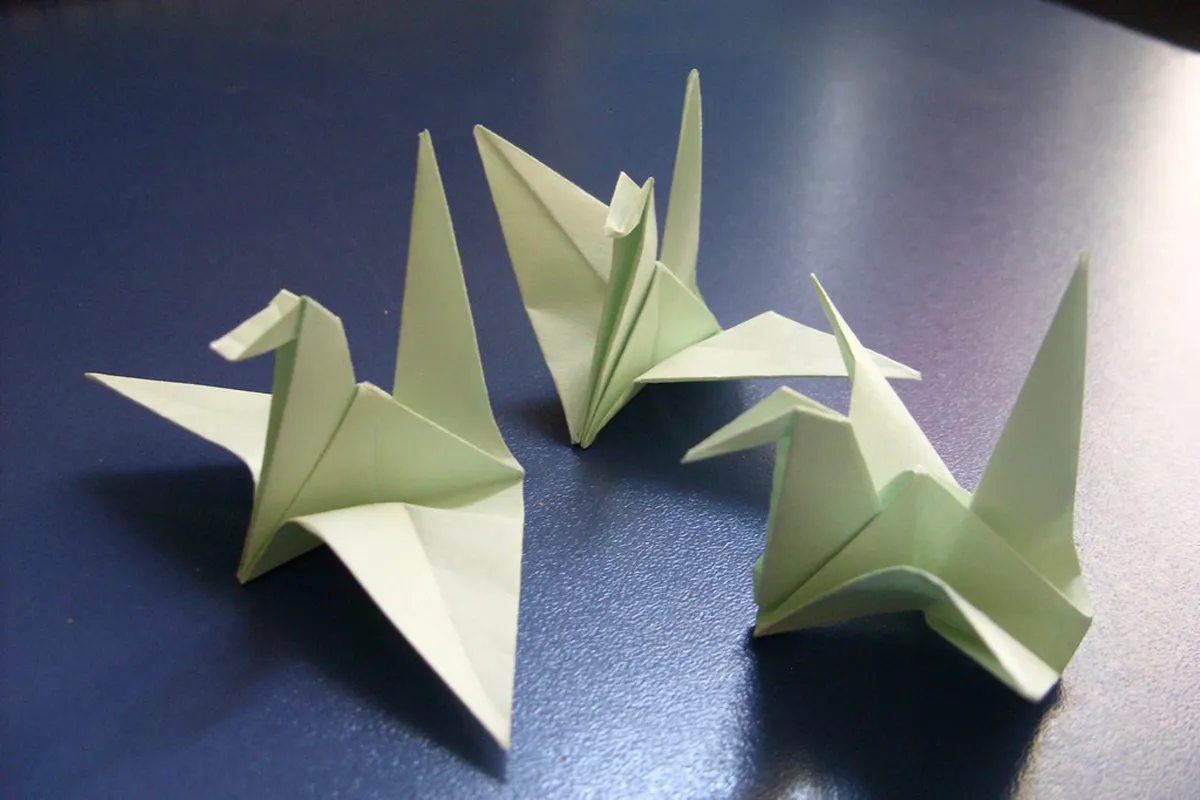
The traditional orizuru takes 9 distinct folding stages, moving from a flat square through the preliminary base, then the bird base, and finally to the recognizable crane silhouette. Each step builds the geometry needed for the next, so accuracy in the early creases matters far more than speed. Beginners typically finish their first crane in 8 to 12 minutes; with practice it drops to under 3 minutes.
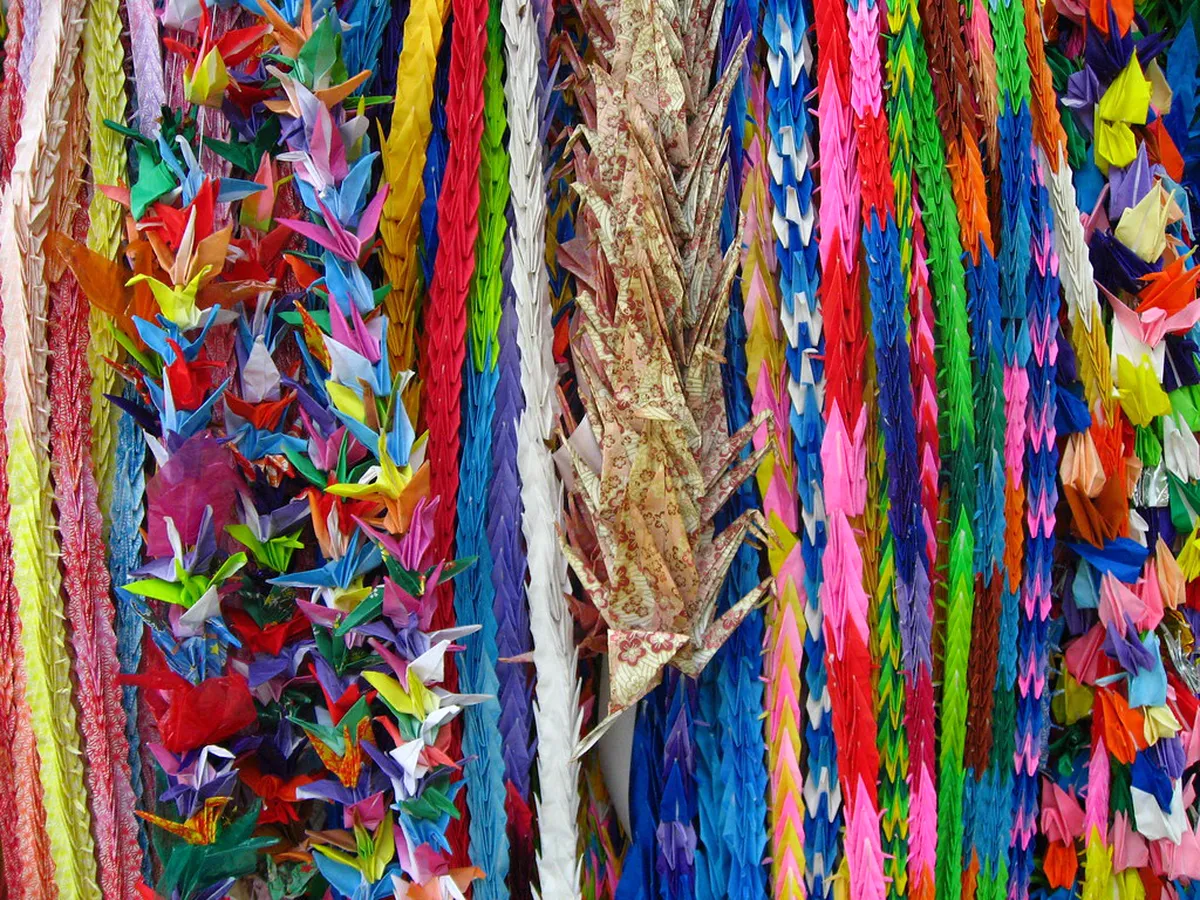
Use a 15cm x 15cm square of origami paper, ideally with a coloured side and a white side. Work on a hard, flat surface and press every crease firmly with a fingernail. The walkthrough below describes each fold in plain words so you can follow along without a video.
- Step 1 — Diagonal creases. Place the paper coloured-side down. Fold corner to opposite corner, unfold. Repeat with the other diagonal. You should now see an X-shaped crease through the centre.
- Step 2 — Horizontal and vertical creases. Flip the paper coloured-side up. Fold in half left to right, unfold. Fold in half top to bottom, unfold. The paper now has a + crease layered over the X, dividing it into 8 equal triangles.
- Step 3 — Preliminary base (square base). Lift the paper, push the four sides inward along the existing creases, and collapse it into a small square with the open flaps at the bottom. This is the preliminary base.
- Step 4 — Kite folds. With the open end pointing down, fold the lower-left and lower-right edges in toward the centre vertical crease so they meet. Fold the small triangle at the top down to lock the creases. Unfold all three folds — the creases are the guide for the next move.
- Step 5 — Petal fold (front). Lift the bottom point of the top layer upward, opening the paper like a tulip. Use the creases from Step 4 to flatten the layer into a long diamond. Repeat the petal fold on the back side. You now have the bird base — a tall diamond with two skinny legs at the bottom.
- Step 6 — Narrow the legs. With the legs pointing down, fold the lower edges of the front layer in toward the centre crease so the diamond narrows. Repeat on the back. The two legs now look like long, thin spears.
- Step 7 — Inside reverse fold for neck and tail. Lift one leg up between the two layers and crease it at an angle of about 30 degrees so it points outward and upward. Repeat with the other leg in the opposite direction. One leg becomes the neck, the other the tail.
- Step 8 — Form the head. Make a second small inside reverse fold at the tip of the neck to create the beak. About 1cm of paper bent forward is enough.
- Step 9 — Open the wings. Gently pull the two wings outward and downward. Press lightly on the body to puff it open so the crane can stand. Your orizuru is complete.
Use a 15 cm × 15 cm square of standard kami paper at 60–70 gsm for your first attempt. Avoid foil or wax-coated sheets — the metallic layer cracks at sharp folds and the paper cannot be recycled, which is required for donation at the Children's Peace Monument.
If a step refuses to lie flat, the issue is almost always in Step 1 or Step 2 — the diagonal and straight creases must be exact for the preliminary base in Step 3 to collapse cleanly. The second most common failure point is Step 5: if the petal fold tears, you pulled the bottom point up before pre-creasing the kite folds in Step 4, so the paper had no guideline to follow. Re-crease and try again with slightly thicker paper if your sheet feels delicate.
Paper, Tools, and Senbazuru Kits
Standard kami origami paper at 15cm x 15cm and 60–70 gsm is the easiest weight for beginners — thick enough to hold a crease, thin enough that the bird base in Step 5 collapses without splitting. Avoid foil paper for your first attempts; the metallic layer cracks at sharp folds. Washi paper is beautiful but tears at the petal fold unless you size up to 18cm and slow your creases.
For a full Senbazuru of 1,000 cranes, plan on 8 to 12 hours of folding spread across several sittings, plus thread and beads for stringing. Pre-cut Senbazuru kits sold inside the Peace Memorial Museum gift shop and at Hands Hiroshima in the Pacela building include 1,000 sheets, a needle, cotton thread, and 10 beads for around JPY 1,500 to JPY 2,500 in 2026. Daiso 100-yen stores around Hondori and Kamiyacho stock cheaper 80-sheet packs if you only plan to fold a few.
| Paper / Kit Option | Where to Buy | Approx. Price (2026) | Best For |
|---|---|---|---|
| Standard kami (80-sheet pack) | Daiso near Hondori / Kamiyacho | ¥100 | Folding a few cranes |
| Senbazuru kit (1,000 sheets + thread + beads) | Peace Memorial Museum gift shop / Hands Hiroshima | ¥1,500–¥2,500 | Full 1,000-crane donation |
| Washi paper (18 cm sheets) | Stationery shops in Hiroshima | Varies | Beautiful finish; fold slowly |
You do not need any tool other than your hands, but a bone folder or the back of a butter knife sharpens the creases on heavier paper. A small ruler helps you check that your starting square is genuinely square — many cheap notebook pages are 1–2mm off, and that drift compounds by Step 3 into a lopsided base.
Where to Fold and Donate Cranes in Hiroshima Peace Memorial Park
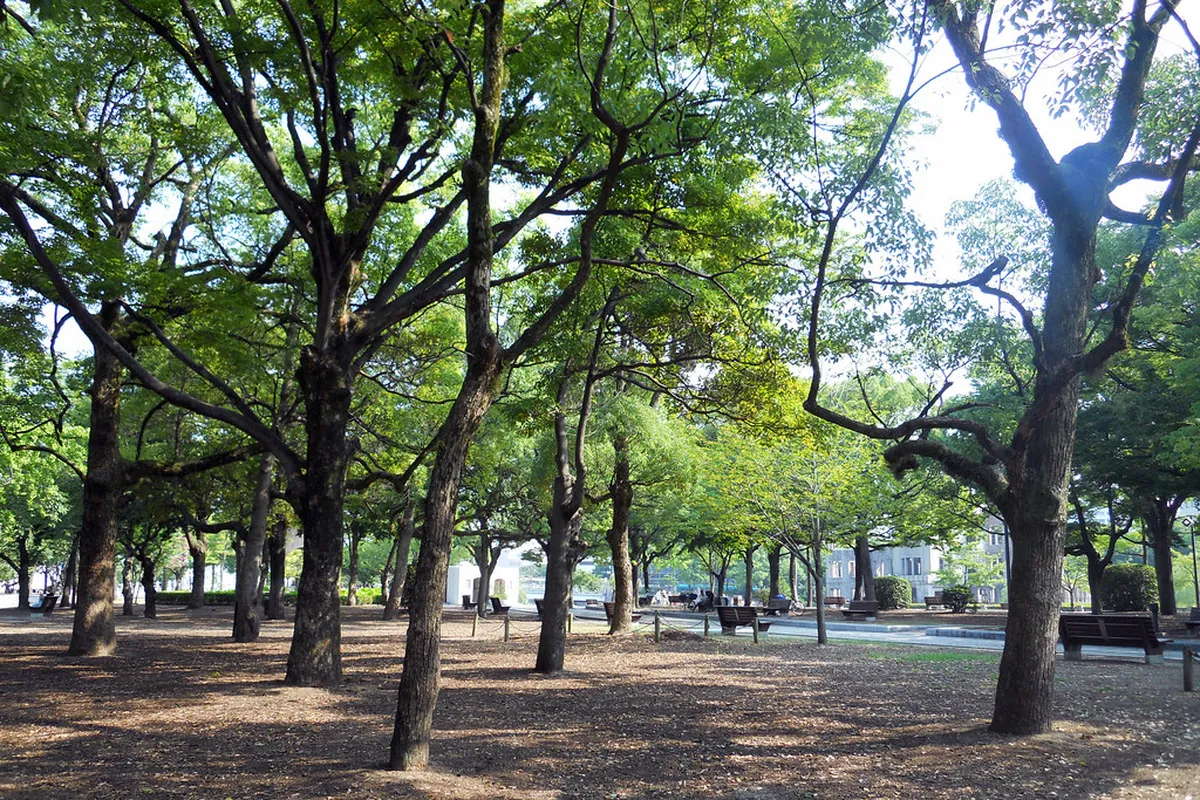
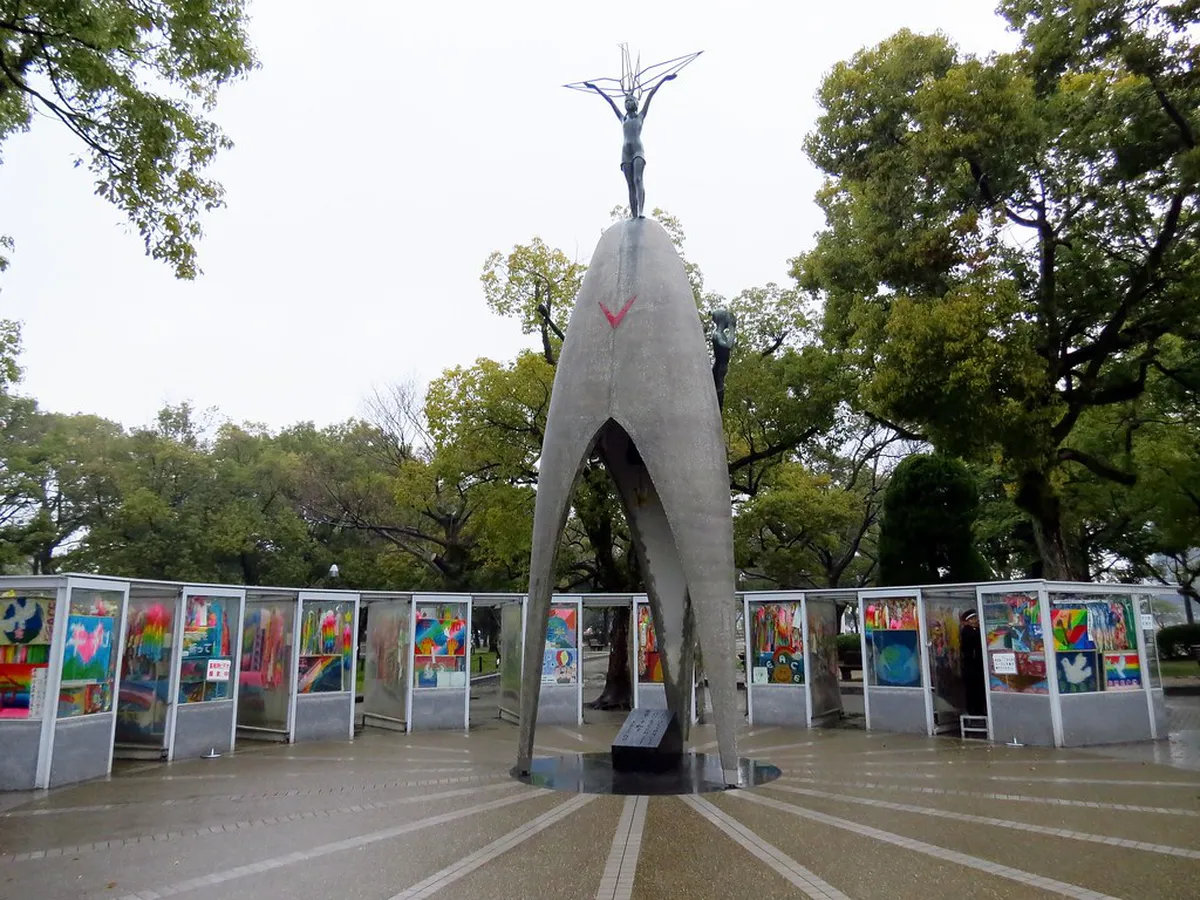
The most popular spot to leave your cranes is the Children's Peace Monument located in the centre of the park. You will find ten large glass cases surrounding the statue that are specifically designed to hold thousands of cranes. These cases keep the paper dry while allowing everyone to see the beautiful colours from the outside.
If you want a dedicated folding space, walk five minutes east to the Hiroshima Orizuru Tower just outside the park. The 12th-floor "Orizuru Plaza" provides free folding tables, instructional cards in English and Japanese, and an iconic 50-metre "Orizuru Wall" — a glass-fronted shaft running through the building where you can release your finished crane and watch it drift downward to join thousands of others. Entry to Orizuru Tower in 2026 is around JPY 2,200 for adults and the activity fits naturally into a hiroshima cultural landmarks 2-day itinerary.
Some museum areas and rest houses within the park also provide paper and instructions for visitors who arrive empty-handed. These public stations are free to use and provide a quiet space for reflection while you work. Look for signs near the Rest House on the south end of the park or near the Peace Memorial Museum entrance for these designated areas.
The Peace Promotion Division only accepts cranes made from plain paper — no plastic, foil-laminated, or wax-coated material. Commercial branding and advertising are not permitted. String finished cranes in sets of 50 to 100 on simple cotton thread before donating to make handling easier for park staff.
Donating your cranes at the Children's Peace Monument is free, requires no permission, and is open year-round during park hours (the park itself never closes; the museum runs roughly 8:30 to 17:00). Approach any of the glass booths and look for the small openings or designated hooks for hanging your strings. Park staff rotate the displays regularly and forward older cranes to a recycling-and-reuse program described in the next section.
The Story of Sadako Sasaki and the Children's Peace Monument
The tradition of folding cranes in Hiroshima is inseparable from the story of a young girl named Sadako Sasaki. She was only two years old when the atomic bomb fell on 6 August 1945, and her home stood about 1.7km from the hypocentre. Ten years later, in 1955, she was diagnosed with leukemia caused by the radiation exposure.
While in the Hiroshima Red Cross Hospital, Sadako began folding cranes in hopes of recovering her health and finding strength. Inspired by the Senbazuru legend that one thousand cranes grants a wish, she folded throughout her treatment using whatever paper she could find, including medicine wrappers and gift labels from other patients. According to the Shrine of Remembrance - Sadako Sasaki Context, her determination inspired her classmates and people around the world. She passed away on 25 October 1955 at age 12, having folded well over 1,300 cranes.
Her classmates campaigned to build a monument in her honour, and the Children's Peace Monument was unveiled in Peace Memorial Park on 5 May 1958 — Children's Day in Japan. The bronze statue stands 9 metres tall and depicts Sadako holding a golden crane outstretched above her head. Beneath it are inscribed the words: "This is our cry. This is our prayer. Peace in the world."
Today, children from every prefecture in Japan and from over 60 countries send cranes to this monument to continue her wish for peace. It has become a site of education where students learn about the human impact of war through a child's eyes. Reading about Sadako before your visit — her biography is sold in the museum gift shop and is widely available in English — adds a layer of emotional depth to the folding process.
What Happens to Your Crane After You Donate It
Most guides stop at the donation booth, but the cranes you leave have a documented second life that few visitors hear about. Hiroshima City processes roughly 10 tonnes of donated cranes every year, and storing all of them indefinitely is physically impossible. Since 2012 the Peace Promotion Division has run an official recycling and reuse programme called "Origami Cranes Reborn" (orizuru saisei), which routes older or weather-damaged cranes into a network of partner mills and workshops rather than the bin.
Cranes are first photographed and catalogued so the donor's name and country are recorded in the city's archives. They then enter a rotation of public display lasting roughly six months to a year depending on arrival volume. After display, cranes are pulped and pressed into commemorative paper goods — notebooks, business cards, postcards, and the iconic crane-pulp greeting cards sold inside the Peace Memorial Museum gift shop. Proceeds fund park upkeep and educational programmes.
A small share of cranes — particularly those tied to specific anniversaries or sent by survivor groups — is preserved in the museum's permanent archive. If you want your cranes preserved rather than recycled, attach a clearly labelled note in Japanese or English requesting archival; the staff cannot guarantee it, but flagged donations are reviewed by the curators. This lifecycle is the unspoken answer to the question every thoughtful donor eventually asks: yes, the cranes are honoured, then they become something new.
Timing Your Visit Around August 6 and Peak Donation Windows
The single busiest day of the year for crane donations is 6 August, the anniversary of the bombing. School groups from across Japan arrive in chartered buses from late July onward, and the booths at the Children's Peace Monument can be visibly stuffed by the time the 8:15 morning ceremony begins. If you want photographs of the booths in their fullest, most colourful state, visit between 1 and 5 August. If you prefer space and silence to leave your own crane in peace, come in mid-September or any weekday in February — the booths still hold thousands of cranes but the crowds drop sharply.
Donations are accepted around the clock because the park itself never closes, but the practical sweet spot is between 7:00 and 9:00 in the morning. Park cleaning staff have just finished their early rotation, the booths are tidy, and tour buses have not yet arrived. Sunset between 17:30 and 19:00 is the second-best window, when the lanterns near the cenotaph are lit and the light is best for photography without crowds in frame.
If your trip overlaps with 6 August, plan to attend the Hiroshima Peace Memorial Ceremony in 2026 in the morning, then donate your cranes in the afternoon once the formal ceremony has cleared. Trying to push through the crowd at the booths during the ceremony itself is discouraged by stewards.
Practical Tips for Bringing or Sending Cranes to Hiroshima
If you plan to bring a large number of cranes, string them together in groups of 50 or 100 using a sturdy needle and cotton thread. Place a small bead at the bottom of each string to prevent the cranes from slipping off. This makes it much easier for the park staff to manage the donations and display them neatly inside the glass booths.
For those who cannot visit in person, mail your cranes directly to the Hiroshima Peace Memorial Museum or the Peace Promotion Division of Hiroshima City Hall. The official mailing address is 1-5 Nakajima-cho, Naka-ku, Hiroshima 730-0811, Japan. Include a note in the package with your name, country, and the year so the museum can record the origin of the donation. Hiroshima also runs an online "Virtual Crane" submission form on its peace portal where you can dedicate a digital crane and receive a confirmation message.
The Peace Promotion Division asks that donated cranes be made from paper only — no plastic, foil-laminated, or wax-coated material that cannot be recycled. Avoid attaching commercial branding, sponsor logos, or advertising. School names, country labels, dedications to lost loved ones, and religious symbols of any tradition are explicitly welcome; the booths regularly carry crosses, crescents, Stars of David, and Buddhist motifs side by side. If you fold as part of a group, a single shared note with all participants' names is preferred over individual labels on every crane.
Check the weather forecast before heading to the park, as the outdoor monuments are exposed to the elements. While the crane booths are covered, walking between them can be difficult during heavy rain or summer heat. Planning your visit for a clear day will allow you to take better photos and link this stop into the broader hiroshima attractions circuit.
Frequently Asked Questions
Where can I fold paper cranes in Hiroshima?
You can fold cranes at the Hiroshima Orizuru Tower's 12th-floor Orizuru Plaza or at designated rest areas inside Peace Memorial Park. Many visitors also fold them at their hotels before heading to the Children's Peace Monument. Look for free budget friendly hiroshima cultural experiences that include origami workshops for tourists.
What is the story of the girl who folded 1,000 cranes?
Sadako Sasaki was a young girl who developed leukemia in 1955 after the atomic bombing of Hiroshima exposed her to radiation as a 2-year-old. She attempted to fold 1,000 cranes following the Senbazuru legend to wish for her recovery and for world peace. She died at age 12 having folded over 1,300 cranes, and her story inspired the Children's Peace Monument unveiled in 1958.
Can I donate paper cranes to the Hiroshima Peace Memorial?
Yes. Donation is free, year-round, and open to anyone. Place strung cranes in the transparent glass booths at the Children's Peace Monument during park hours. If you have a large number, string them in sets of 50 or 100 first. International donors can mail packages to the Peace Promotion Division at 1-5 Nakajima-cho, Naka-ku, Hiroshima 730-0811, Japan, or submit a virtual crane through the official online portal.
Is there a specific size of paper required for Hiroshima cranes?
There is no strict rule, but most donors use 15cm x 15cm or 7.5cm x 7.5cm square origami paper. The key requirement is that the paper must be a perfect square. Standard sizes help park staff organise the displays neatly inside the glass cases at the Children's Peace Monument.
Are there rules for donating cranes — colours, religious symbols, messages?
The Peace Promotion Division asks that cranes be made from paper only (no plastic or laminated material), strung on simple thread, and free of advertising or commercial branding. Personal messages, school names, country labels, and religious symbols are welcome. Cranes are rotated through display, archive, and an official recycling programme that turns older paper into commemorative goods sold for the park's upkeep.
Can I submit cranes online instead of folding physical ones?
Yes. Hiroshima City runs an official virtual crane submission portal where anyone can dedicate a digital crane with a name, country, and short message. The submission is free, takes under two minutes, and you receive a confirmation. The virtual cranes are displayed on a rolling digital wall inside the Orizuru Tower and on the city's peace website throughout 2026.
Folding orizuru paper cranes is a powerful way to engage with the history of Hiroshima and the hope for peace. This simple activity connects you to millions of others who have shared the same wish for a better world. By leaving your crane at the memorial — physically or virtually — you contribute a small but real piece of that ongoing message.
The process of learning how to fold orizuru paper cranes at Hiroshima Peace Memorial is a journey of both skill and spirit. Whether you visit the Orizuru Tower, the Children's Peace Monument, or fold one at home and mail it in 2026, the experience will stay with you long after you leave Japan.
As you walk through the park, the sight of millions of colourful cranes — roughly 10 million arrive each year — will remind you of the power of collective action. Your single crane might seem small, but it is an essential part of a global message. Enjoy this meaningful cultural experience and the peace it brings to your travels.
Free: The Hiroshima Essentials guide
Top things to do, where to stay, a perfect day plan, getting around, and the best time to go — a Hiroshima mini-guide you can take offline.
You might also like

Continue reading
More guides you'll find useful