

How to Eat Hiroshima Style Okonomiyaki Like a Local: 8 Essential Tips (2026 Guide)
Master Hiroshima-style okonomiyaki in 2026. Learn the layering technique, the kotegaeshi flip, the local non-tourist stalls, addresses, prices, and the counter etiquette every Hiroshima regular follows.
On this page
Hiroshima style okonomiyaki is more than a meal — it is a symbol of post-war resilience served on hundreds of teppan counters across the city. Learning the local way to eat it is what separates a tourist visit from an authentic one.
Locals eat directly from the hot iron griddle using the small metal spatula called a kote (or hera) — not chopsticks. Cut a 3 cm square, slide the kote underneath, and lift it straight to your mouth. This keeps the layers intact and the bottom crust crispy until the last bite.
How do locals eat Hiroshima okonomiyaki? Locals sit at the teppan counter, never the table seat, and eat directly off the hot iron griddle using the small metal spatula called a kote (or hera). They cut a 3 cm square, slide the kote underneath, and lift each bite straight to the mouth. Chopsticks are reserved for side dishes, and one okonomiyaki per person is the unspoken rule.
Hiroshima vs. Osaka Style: Understanding the Layers
Hiroshima and Osaka styles differ in how chefs assemble the ingredients. In Osaka, batter and fillings are mixed together before hitting the grill; Hiroshima chefs layer each component on the teppan so you can taste cabbage, pork, and noodles separately. The Hiroshima version is also taller and heavier — it almost always includes a fried soba or udon disc as a built-in base, which the Osaka version does not.
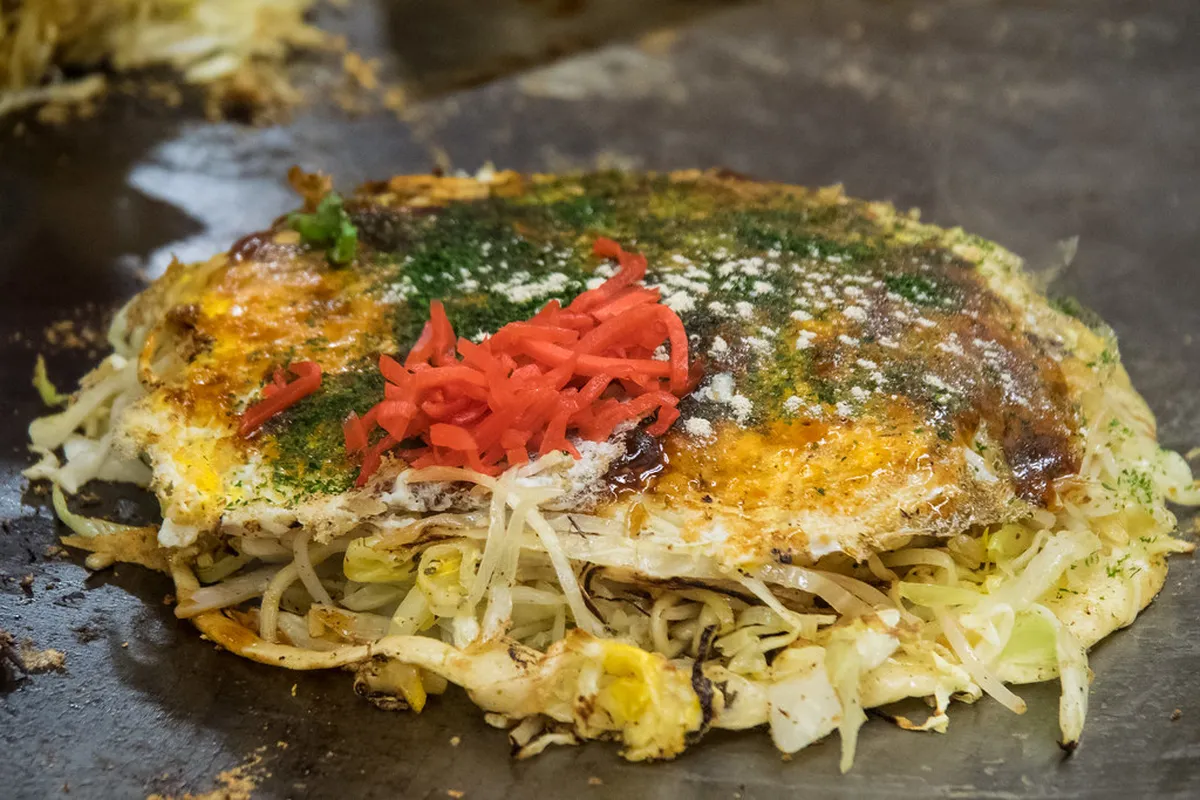
Key differences at a glance
- Construction: Hiroshima layers each ingredient on the grill; Osaka mixes everything into a single batter bowl before pouring.
- Noodles: Hiroshima always includes soba or udon as a built-in layer; Osaka does not (modan-yaki is the only Osaka exception).
- Cabbage volume: Hiroshima uses roughly 200–250 g of shredded cabbage per portion — about double the Osaka version — and steams it under the batter lid.
- Egg: Hiroshima cracks the egg separately on the teppan and uses it as a sealing layer on top; Osaka folds the egg into the batter.
- Sauce: Hiroshima uses Otafuku Hiroshima-yaki sauce, which is thinner and slightly fruitier than the thicker Osaka okonomi sauce.
- Service: Hiroshima is almost always served on the teppan in front of you; Osaka is plated more often.
How Okonomiyaki Became Hiroshima's Soul Food
The dish became a symbol of recovery after the atomic bombing in 1945. People used cheap ingredients like flour and cabbage to create filling meals during food shortages. Early versions were known as Issen Yoshoku ("one-penny Western food"), and stalls were often run by women who had lost their husbands during the war. These small shops became community hubs where neighbours could gather and eat affordably, and they remain a deeply personal part of Hiroshima culture and identity.
The Layering Technique: Step by Step (and the Kotegaeshi Flip)
Watching a Hiroshima chef build okonomiyaki is a 12-minute performance, and once you know the order, you can follow every move from your counter seat. Each layer goes down in a specific sequence, the stack is flipped exactly once with the famous kotegaeshi manoeuvre, and the whole thing finishes with sauce painted on the egg-sealed top.
- Crepe base. The chef ladles a thin disc of dashi-loosened batter (about 18–20 cm wide) onto the 200 °C teppan and dusts it with bonito flakes (tenkasu) and dried shrimp.
- Cabbage mountain. A handful (200–250 g) of finely shredded cabbage is piled on top, followed by bean sprouts, more tenkasu, and a pinch of salt and pepper.
- Pork belly. Two to three thin slices of pork belly drape across the cabbage. The fat will render down through the stack as it cooks.
- Batter drizzle. A second drizzle of batter binds the top of the cabbage tower so it does not collapse during the flip.
- Kotegaeshi flip. Using two large kote (the chef's spatulas), the entire tower is flipped in a single confident motion. This is where the cabbage starts to steam under its own weight — locals call it kotegaeshi, literally "spatula turn." A bad flip is a broken okonomiyaki, and chefs train for years to nail it.
- Noodles. Separately, soba or udon noodles are stir-fried on a clear section of the teppan with a splash of sauce, then shaped into a disc the same size as the cabbage tower. The okonomiyaki is lifted on top of the noodles.
- Egg seal. An egg is cracked on the teppan, broken with the kote, and spread into a thin disc. The whole stack is moved on top of the egg, then flipped one final time so the egg becomes the top sealing layer.
- Sauce and finish. The chef brushes Otafuku Hiroshima-yaki sauce, sprinkles aonori (green seaweed) and katsuobushi (bonito flakes), and slides the whole thing toward your seat. Total time from raw to serve: around 10–12 minutes.
If you want to watch the kotegaeshi from the best angle, sit at the corner of the L-shaped counter rather than the long side — you see the chef in three-quarter profile and the flip happens directly in front of you.
What is Okonomimura? (The Okonomiyaki Village)
Okonomimura is a legendary food building in the Shintenchi district housing over twenty individual stalls, each with its own sauce and style. The narrow counters sit directly in front of the iron griddles, so you can watch the chef's knife work and the kotegaeshi flip up close. Locals tend to look for the stall with the most residents rather than tourists; prices are consistent across the building, so you can pick on vibe alone. For a deeper floor-by-floor walk-through, see our companion guide on how to eat Hiroshima okonomiyaki at Okonomimura, or include it in your Hiroshima cultural landmarks 2-day itinerary.
How to Order: Common Menu Terms and Phrases
The default order is nikutama soba — pork, egg, and noodles — and most locals pick soba over udon for the crispier texture. Common upgrades are negi (green onions), ika-ten (fried squid bits), cheese, and seasonal Hiroshima oysters in winter. Most menus have pictures; pointing and saying "onegaishimasu" is enough. Confirm cash-only before sitting down — many traditional Naka-ku stalls still do not accept cards in 2026.
- Nikutama Soba (standard local choice) — pork, egg, noodles. Cost (2026): 1,000–1,400 yen.
- Ika-ten topping (crunchy squid bits). Cost (2026): 150–250 yen extra.
- Udon-iri (thick noodle variation). Cost (2026): same as soba, sometimes +100 yen.
How to Eat Okonomiyaki Properly: The "Hera" Technique
Eating directly from the iron griddle is the ultimate way to enjoy this meal. Use your small hera (also called kote) to cut a 3 cm square, slide the tool underneath, and lift it straight to your mouth. The kote keeps the layers intact and the bottom crust crispy until the last bite. Chopsticks pull the layers apart and ruin the texture, so save them for side dishes. If the heat is too much, ask for a plate — locals do this when dining with children or in formal clothes — but eating from the teppan is the authentic experience. Be careful not to touch the hot metal surface.
Essential Etiquette and Local Pro-Tips
Small stalls run a one-okonomiyaki-per-person rule because seating is tight; sharing is read as rude when others are waiting. Locals also prefer the natural sweetness of the cabbage and savory Otafuku sauce — heavy mayonnaise masks those flavors, and many traditional shops do not even keep a mayo bottle on the counter. Asking for "kata-men" gets you crispier noodles, the local default. Expect serious crowds during the Hiroshima Tokasan Yukata Festival 2026.
Counter etiquette in 60 seconds: sit at the teppan counter (not the table seats); eat with the kote, not chopsticks; do not photograph the chef's hands without a small nod first; finish before the okonomiyaki cools; pay cash on the way out, and a quiet "gochisousama deshita" is enough thanks.
- Use the kote, not chopsticks. Keeps the layers intact and the bite hot.
- One okonomiyaki per person. Respects the shop's tiny economy.
- Taste before mayo. The Otafuku sauce is doing the work; mayo is a finishing touch on a single bite, not a flood.
- Counter seat over table. You get the hot bottom layer and a front-row view of the kotegaeshi flip.
Local Non-Tourist Spots: 2026 Prices and Addresses
Most travel guides funnel visitors straight to Okonomimura, but the stalls Hiroshima residents actually queue at sit on quiet side streets in Naka-ku and Hatchobori. Here are four counters where you will see more locals than tourists, with current 2026 pricing and addresses you can drop straight into Google Maps.
- Lopez Hiroshima (ロペス). Run by Honduran-born chef Lopez since 1991, famous for the jalapeño-spiked "Lopez special." Address: 1-7-13 Senda-machi, Naka-ku, Hiroshima 730-0052. Hours: 17:00–22:30, closed Sundays. Standard nikutama soba: 1,150 yen (2026). Lopez special: 1,500 yen. Cash only. 8-minute walk from Hiroden Hatchobori stop.
- Hassei (八誠). A 30-year-old counter beloved by Carp baseball staff, with extra-crispy noodles and a generous double-egg option. Address: 4-17 Fujimi-cho, Naka-ku, Hiroshima 730-0043. Hours: 11:30–14:00 and 17:00–22:00, closed Mondays. Nikutama soba: 1,200 yen (2026). Add double egg: +200 yen. Card accepted from 2025 onward. 6-minute walk from Chuden-mae streetcar stop.
- Nagataya (長田屋). The closest "real local" counter to the Atomic Bomb Dome, but locals rate it for the seasonal oyster (kaki-iri) version November–February. Address: 1-7-19 Otemachi, Naka-ku, Hiroshima 730-0051. Hours: 11:00–14:30 and 17:00–20:30, closed Wednesdays. Standard: 1,250 yen (2026). Oyster version (winter only): 1,800 yen. Cash and IC cards. 4-minute walk from Genbaku Dome-mae.
- Mitchan Honten Hatchobori (みっちゃん総本店 八丁堀店). The original 1950 founding shop of the layered Hiroshima style, still pulling locals on lunch breaks despite the fame. Address: 6-7 Hatchobori, Naka-ku, Hiroshima 730-0013, New Ueno Bldg 2F. Hours: 11:30–14:30 and 17:30–21:00, closed Tuesdays. Nikutama soba: 1,300 yen (2026). Card and IC accepted. Directly above Hatchobori station — go upstairs, do not queue at the famous Ekimae-Hiroba branch full of tourists.
| Stall | Standard Price (2026) | Hours | Nearest Tram Stop |
|---|---|---|---|
| Lopez Hiroshima | ¥1,150 | 17:00–22:30, closed Sun | Hatchobori (8 min walk) |
| Hassei | ¥1,200 | 11:30–14:00 & 17:00–22:00, closed Mon | Chuden-mae (6 min walk) |
| Nagataya | ¥1,250 | 11:00–14:30 & 17:00–20:30, closed Wed | Genbaku Dome-mae (4 min walk) |
| Mitchan Honten Hatchobori | ¥1,300 | 11:30–14:30 & 17:30–21:00, closed Tue | Hatchobori (direct above station) |
If you want to combine an okonomiyaki crawl with sightseeing, pair Nagataya with the Peace Memorial Park, then walk 15 minutes east toward Hatchobori for Mitchan Honten — the route covers two neighbourhoods locals consider the spiritual home of the dish. The full pillar guide on Hiroshima attractions maps the rest of the day.
What to Drink With Okonomiyaki: Local Pairings
Locals almost never drink water with okonomiyaki — the dish is rich, salty, and built for cold draft beer. The default at every counter is a chilled nama biru (draft beer), usually Asahi Super Dry or Kirin Ichiban for around 550–650 yen in 2026. Hatchobori stalls more often pour Sapporo, while Naka-ku counters lean Asahi.
If you want to drink like a Hiroshima resident, ask for Hiroshima lemon sour (remon sawā) made with Setouchi-region lemons — it cuts the Otafuku sauce richness better than beer, runs about 500 yen, and is poured at most counters in Naka-ku. For sake fans, look for the small Hiroshima-prefecture brewery Kamotsuru on the menu; a 180 ml tokkuri runs 700–900 yen and the soft mineral water profile of Saijo sake suits the cabbage-heavy stack. Avoid red wine — chefs will pour it, but the iron and sulphites clash with the seaweed finish.
Soft alternatives include Mitsuya Cider (the Japanese lemon-lime soda) and a cold barley tea (mugicha) which most counters pour free. Tap water exists but you have to ask: "o-mizu kudasai."
Cook-It-Yourself Teppan Stalls: A Different Hiroshima Experience
A small but growing segment of Hiroshima okonomiyaki shops give you a built-in teppan at your table and let you assemble the dish yourself with the chef's coaching. This is rare for the layered Hiroshima style — the kotegaeshi flip is genuinely hard — but a handful of shops have streamlined the process for confident home cooks and curious tourists.
Chinchikurin Hondori-ten in Naka-ku runs a "chef-assisted" lunch where the staff builds the base layers and hands you the kote for the final flip and sauce. Reserve via the in-store iPad on arrival; expect to pay 1,400–1,600 yen and to wait a full 20 minutes per okonomiyaki. Hassho Sogo on the 6th floor of Sogo department store offers a similar table-teppan setup with a clearer English menu, useful for first-time visitors. The cook-yourself experience is not the local default — most residents would rather watch a pro do it — but it is one of the better hands-on souvenirs you can take home from Hiroshima.
First-Timer Mistakes and Allergen Notes Most Guides Skip
Five mistakes mark out a first-timer to a Hiroshima counter, and avoiding them earns more goodwill than any phrasebook politeness. Photographing the chef's hands or the flip without a small bow first reads as intrusive — a quick nod and they will usually pause for the camera. Splitting one okonomiyaki between two adults is the second tell; the sauce-soaked corner cools fast and tiny shops lose a seat. Asking for ketchup, sriracha, or extra mayonnaise after the chef has finished sauce-painting is a quiet insult to the kitchen — wait until you have tried two bites first. Pulling the layers apart with chopsticks defeats the structural point of the dish. And ordering "okonomiyaki" without specifying soba/udon and topping forces the chef to guess; the safe default phrase is "nikutama soba onegaishimasu."
The standard batter contains wheat — the dish is not gluten-free even without soba noodles. The default dashi is bonito-fish stock, the teppan is seasoned with lard, and Otafuku sauce contains soy, wheat, and apple. Severe shellfish allergy visitors should avoid Okonomimura entirely due to cross-contact from oyster toppings across shared kote.
Allergens almost no Hiroshima guide flags clearly: the standard batter is wheat-based, so the dish is not gluten-free even with no soba — the crepe layer alone disqualifies it. Otafuku Hiroshima-yaki sauce contains soy, wheat, and apple. The dashi loosening the batter is bonito-fish-stock by default, so a "vegetarian" version is rare unless the counter advertises kombu-only stock. The teppan is also seasoned with lard at most traditional shops, which means even the cabbage layer is not strictly vegetarian. Severe shellfish allergies need to skip Okonomimura entirely — the same kote moves between stalls and oyster-trace cross-contact is real in winter. The clearest allergen-friendly counters in 2026 are Okonomiyaki Teppan-yaki Kemuri in Naka-ku (advertises gluten-free batter on request, 24-hour notice) and Hassho Sogo (lists allergens on the printed menu in English).
Seasonality of Toppings: When to Order What
Hiroshima okonomiyaki is built around seasonal ingredients, and ordering with the calendar in mind is one of the clearest tells of a returning visitor. Stalls quietly rotate their topping board four times a year.
- Winter (November–February): oysters (kaki). Hiroshima Bay produces around 60 % of Japan's farmed oysters, and from late November the kaki-iri version (oysters layered into the cabbage) appears at almost every counter. Peak month is January.
- Spring (March–May): scallops and spring cabbage. The new-season cabbage is sweeter and more tender — chefs pile slightly more of it. Asari clams sometimes appear as a March topping in Hatchobori.
- Summer (June–August): sweet corn, shiso, and Setouchi conger eel (anago). The shiso-anago combo is a Hatchobori specialty and pairs well with a cold draft. Skip the heavier cheese versions in this heat.
- Autumn (September–October): mushrooms (matsutake at premium counters), mochi, and fresh squid. Squid-and-mochi is the local autumn classic — chewy, savory, and built for the cooler evenings around the Hiroshima autumn colour season.
If a stall does not list these seasonally, it is usually a sign the chef sources fresh and rotates by hand — a good rather than a bad signal.
Map and Logistics: Getting Around the Stalls
Most top-rated stalls are within walking distance of the Hatchobori tram stop, and the streetcar lines 1, 2, and 6 cover all four counters listed above. A one-day streetcar pass (700 yen, 2026) is the most cost-effective way to do an okonomiyaki crawl. Many shops break between lunch and dinner service, so the mid-afternoon shoulder is the quietest window. For maps and transit updates, see the Visit Hiroshima Official Tourism Guide. Pair a late-night stop with Hiroshima's best ramen and tsukemen shops for a second-meal night.
Frequently Asked Questions
What is the difference between Hiroshima and Osaka okonomiyaki?
Hiroshima style is layered with a base of crepe, cabbage mountain, pork, egg seal, and a built-in noodle disc, while Osaka style mixes all ingredients into a single batter before cooking. The Hiroshima version results in a taller, more textured dish with roughly twice the cabbage and noodles always included. Osaka relies on a thicker, sweeter sauce, and Hiroshima uses a thinner Otafuku Hiroshima-yaki sauce. Both are delicious, but locals take great pride in their specific regional techniques.
Do I need a reservation for Okonomimura?
Most stalls in Okonomimura do not accept reservations and operate on a first-come, first-served basis. If a stall is full, you can simply move to the next one in the building. During peak hours, you might need to wait 15–30 minutes for a seat at popular spots. The full floor-by-floor breakdown is in our Okonomimura guide.
Is it rude to eat okonomiyaki with chopsticks?
It is not strictly rude, but using the kote (hera) spatula is the authentic local way to eat. Most shops will provide chopsticks if you ask, especially for beginners. The kote keeps the layers intact, lets you cut a precise 3 cm bite, and protects the bottom crust from going soggy. Try at least three bites with the kote before falling back to chopsticks.
What is the kotegaeshi flip and why does it matter?
Kotegaeshi means "spatula turn" — the single, decisive flip a Hiroshima chef performs after the cabbage tower is built. The cabbage steams under its own weight after the flip, which is what makes the vegetable taste sweet rather than raw. A clean flip keeps the layers intact and the noodle disc unbroken, and it is widely considered the technical signature of the style. Sit at the corner of the L-shaped counter to watch it from the best angle.
How much should an okonomiyaki cost in 2026?
Expect 1,000–1,400 yen for a standard nikutama soba at a neighbourhood counter, 1,200–1,500 yen at a recognized stall like Hassei or Mitchan Honten, and 1,600–1,900 yen for a winter oyster version. Beer adds 500–700 yen. Most local counters are still cash-only or cash-and-IC; only the larger Hatchobori shops accept international credit cards in 2026.
Can I get vegetarian okonomiyaki in Hiroshima?
Truly vegetarian options can be difficult to find because the batter often contains dashi and the grill uses lard. Some modern stalls in the downtown area are starting to offer meat-free versions, and a couple of Naka-ku counters now use a kombu-only dashi on request. Always check with the chef about specific ingredients before ordering your meal.
When is the best season to order oyster okonomiyaki?
The Hiroshima oyster season runs roughly November to February, with peak quality in January. Stalls like Nagataya add a kaki-iri (oyster-layered) version to the menu during these months, typically priced 400–600 yen above the standard nikutama soba. If you visit outside winter, skip the oyster topping — it will be frozen rather than fresh.
Eating okonomiyaki like a local is one of the best ways to connect with Hiroshima's history.
Mastering the kote technique, knowing the kotegaeshi flip when you see it, and following counter etiquette show respect for the city's culture.
Whether you choose Mitchan Honten, Lopez, Hassei, Nagataya, or a hidden gem in your hotel's neighbourhood, the experience will be unforgettable.
Enjoy every layered bite of this iconic Japanese soul food during your visit.
Free: The Hiroshima Essentials guide
Top things to do, where to stay, a perfect day plan, getting around, and the best time to go — a Hiroshima mini-guide you can take offline.
You might also like


Continue reading
More guides you'll find useful


