Hiroshima Attractions: The Complete 2026 Pillar Guide
The complete 2026 guide to Hiroshima attractions: Peace Memorial Park, Miyajima's floating torii, Hiroshima Castle, day trips to Kure & Onomichi, neighborhoods, plus 2026 hours, prices, and FAQs.
On this page
Hiroshima is best understood as four overlapping experiences in one compact city: a peace-and-memory pilgrimage in the central Naka ward, a UNESCO island day trip across the bay to Miyajima, a feudal-castle and garden circuit east of the river delta, and a Seto Inland Sea gateway to day-trip towns like Kure, Onomichi, and Saijo. This 2026 pillar guide pulls all four threads together — what to see, how long it takes, current opening hours and prices in JPY, and which neighborhoods make the smartest base — so you can plan a trip that fits two days or a full week.
Below you will find the 20 individual landmarks that anchor most Hiroshima itineraries, plus four new structural sections added for 2026: why Hiroshima matters right now, which neighborhood to stay in, a Peace Memorial Park deep dive, and a side-by-side day-trip matrix covering Miyajima, Kure, Saijo, Onomichi, and Iwakuni. For sample routes, pair this with our Hiroshima and Miyajima 1-day itinerary, the Hiroshima 2-day itinerary, or the 1-day itinerary from Osaka or Kyoto. To get here, see how to reach Hiroshima from Tokyo and Osaka; once you arrive, our streetcar and bus guide covers local transit.
Why Hiroshima Matters in 2026
Hiroshima in 2026 is one of Japan's most concentrated heritage destinations: a single 4-square-kilometer footprint contains two UNESCO World Heritage sites (the Atomic Bomb Dome and Itsukushima Shrine), a reconstructed feudal castle, an Edo-period garden, and the country's most-visited peace memorial — all reachable by streetcar in under 30 minutes. No other Japanese city packs this density of heritage into so small an area, which is why Hiroshima now ranks among the top 5 most-visited prefectures by international travelers.
The 2026 visitor profile has shifted in three important ways. First, the Peace Memorial Museum's renovated East Building (reopened 2019, programming refreshed for the bombing's 80th anniversary on August 6, 2025) draws roughly 1.5 million visitors a year — book the timed entry. Second, Miyajima's visitor tax of JPY 100 per person (introduced October 2023) is now collected at Miyajimaguchi ferry terminals; budget for it. Third, the Shimanami Kaido cycling route, finishing in Onomichi just east of Hiroshima, is increasingly used as a multi-day add-on — see our Shimanami Kaido cycling guide and the 2-day Shimanami Kaido itinerary.
Bottom line for 2026: two full days is the realistic minimum (one for the city core, one for Miyajima), three days unlocks a Kure or Onomichi day trip, and four-plus days lets you cycle Shimanami or hike Mt. Misen at a relaxed pace.
The Peace Memorial Museum requires pre-booked timed entry in 2026 — walk-up tickets are not guaranteed during peak season (March–May, October–November). Book at least one week ahead at the official museum site for the 09:30 slot that suits most morning itineraries.
Best Neighborhoods to Stay In
For first-time visitors in 2026, three neighborhoods cover 95% of use cases: Kamiyacho/Hatchobori for sightseeing access, Hiroshima Station area for transit convenience and day trips, and Nagarekawa for nightlife and food. All three are within a 15-minute streetcar ride of Peace Memorial Park, so the choice comes down to whether you prioritize the museum walk, the bullet train, or izakaya hopping.
Kamiyacho and Hatchobori — best for sightseeing
The central downtown grid around Hondori arcade puts you a 10-minute walk from Peace Memorial Park, the Atomic Bomb Dome, Hiroshima Castle, and Shukkei-en Garden. Streetcar lines 1, 2, 3, 6, and 7 all stop here. Mid-range hotels (Sheraton, Mitsui Garden, Hotel Granvia annexes) cluster between Hatchobori and Kamiyacho streetcar stops. Best if your trip is mostly memorial-park focused.
Hiroshima Station area — best for transit and day trips
Staying within a 5-minute walk of JR Hiroshima Station means zero hassle for shinkansen arrivals, JR ferries to Miyajima (via the JR Sanyo Line), and day trips to Kure, Onomichi, or Iwakuni. The Granvia, Sheraton Grand, and a cluster of business hotels sit directly above or beside the station. Slight downside: it's a 15–20 minute streetcar ride from Peace Park.
Nagarekawa and Ekinishi — best for food and nightlife
Nagarekawa is Hiroshima's main entertainment district — okonomiyaki shops, izakaya alleys, jazz bars — while Ekinishi (just west of the station) has become the local favorite for craft cocktails and standing bars. See our Nagarekawa and Ekinishi bar-hopping guide for the route. Best for travelers who want to walk home from dinner.
Budget guidance for 2026: business hotels run JPY 9,000–14,000 per night, mid-range JPY 16,000–25,000, and the city's handful of higher-end options (Sheraton Grand, Rihga Royal) sit at JPY 28,000–45,000. Book Miyajima's ryokan stays (JPY 25,000–60,000 per person with two meals) at least three months ahead for autumn and cherry blossom season.
As of October 2023, all visitors to Miyajima Island aged 13 and above pay a ¥100 per-trip visitor tax collected at the Miyajimaguchi ferry terminal. This applies even with a JR Pass and cannot be waived — budget for it in your day-trip costs.
Peace Memorial Park Deep Dive — How to Visit in 2026
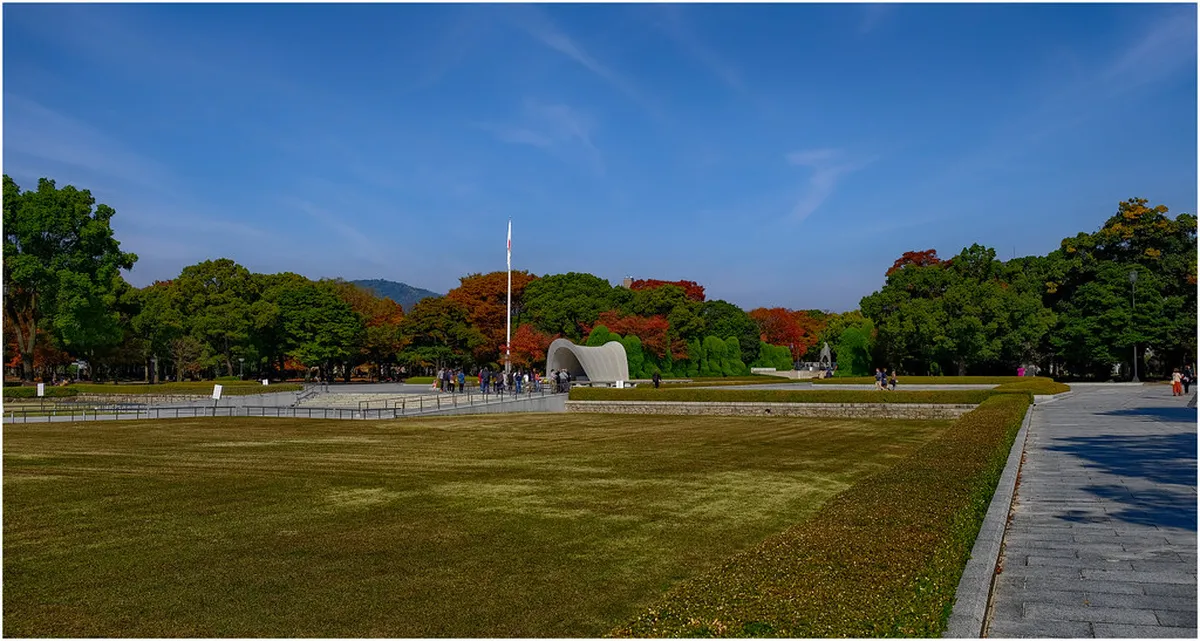
Hiroshima Peace Memorial Park is a 12.2-hectare grounds at the river delta hypocenter, comprising the Peace Memorial Museum, the Atomic Bomb Dome (UNESCO World Heritage), the Cenotaph, the Children's Peace Monument, and the National Peace Memorial Hall — and a thorough visit takes 3 to 4 hours, not the 60 minutes most itineraries allocate. Plan a half-day, ideally in the morning before tour-bus crowds peak between 11:00 and 14:00.
The recommended 2026 walking order: enter from the Atomic Bomb Dome end (a 12-minute walk from Hatchobori streetcar stop), cross Aioi Bridge, walk south past the Children's Peace Monument and Cenotaph, then end at the Peace Memorial Museum so you can sit afterwards. Allow 90–120 minutes inside the museum alone — it is text-heavy and emotionally demanding.
2026 ticket and hours snapshot:
- Peace Memorial Museum: JPY 200 adults, JPY 100 high-school students, free for primary/junior-high; open 08:30–18:00 Mar–Jul, until 19:00 in Aug, until 18:00 Sep–Nov, 08:30–17:00 Dec–Feb. Closed Dec 30–31. Audio guide JPY 400.
- National Peace Memorial Hall: Free admission; open 08:30–18:00 (until 19:00 in Aug, 17:00 Dec–Feb).
- Atomic Bomb Dome and Cenotaph: Outdoor, 24/7, free.
- Volunteer English-language tours: Free, daily 10:00 and 13:30 (book 1 day ahead via the city tourism site).
If you are visiting around August 6, 2026, the annual Peace Memorial Ceremony begins at 08:00 at the Cenotaph; expect security perimeters, dawn arrivals for seating, and museum capacity caps — see our guide to attending the 2026 ceremony. For tickets and crowd timing inside the museum specifically, see our museum tickets and tips guide. Travelers with children often add the Orizuru-folding workshop at the Children's Peace Monument area — see how to fold orizuru paper cranes before you go.
Accessibility, Tide Timing, and First-Timer Logistics
Two practical details get skipped in almost every Hiroshima guide and shape your day more than which restaurant you book: wheelchair and stroller access at the memorial sites, and the tide table for the floating torii. Both are knowable in advance and both let you sequence the day around them rather than against them.
The Peace Memorial Museum, the National Peace Memorial Hall, Hiroshima Castle's keep, and Shukkei-en Garden's main loop are all step-free or have lift access. Wheelchairs are loaned free at the Peace Memorial Museum information desk (no reservation, but bring photo ID). The Atomic Bomb Dome itself cannot be entered, but the surrounding promenade is paved and flat. Miyajima is harder: the Itsukushima shrine boardwalks have shallow ramps, but Mt. Misen requires the ropeway — the ropeway car is wheelchair-accessible and the upper observatory has step-free pathways for the first 200 meters, though the actual summit is a rocky 30-minute scramble.
For the floating torii, check tide tables before you book your ferry. High tide above 250 cm makes the gate appear to float for the classic photograph; low tide below 100 cm lets you walk to the base. Both windows are valid trip experiences — and on most days you will catch one of each if you stay 5+ hours. The Hiroshima City tide forecast publishes daily figures three months ahead. A practical sequence: city core in the morning, ferry to Miyajima for the afternoon high tide, dinner back in Nagarekawa.
The 20 Hiroshima Attractions Worth Your Time in 2026
The list below ranks the city's anchor attractions by visitor pull and itinerary efficiency. Numbers 1–6 are the non-negotiable first-time core; 7–14 layer in cultural depth; 15–20 work for repeat visitors and longer stays.
1. Reflect at the Hiroshima Peace Memorial Park
Hiroshima Peace Memorial Park is the emotional and geographic heart of the city — built directly over the bombing hypocenter and home to the Cenotaph, Children's Peace Monument, Flame of Peace, and Peace Bell. Allow 60–90 minutes for the outdoor circuit alone, on top of the museum visit. Plan your route in our deep-dive section above; for a fuller landmark map, see our Hiroshima landmarks 1-day itinerary. The Children's Peace Monument, dedicated to Sadako Sasaki and the thousands of children killed by radiation sickness, draws the most prolonged crowds — visit early.
2. Visit the Iconic Atomic Bomb Dome
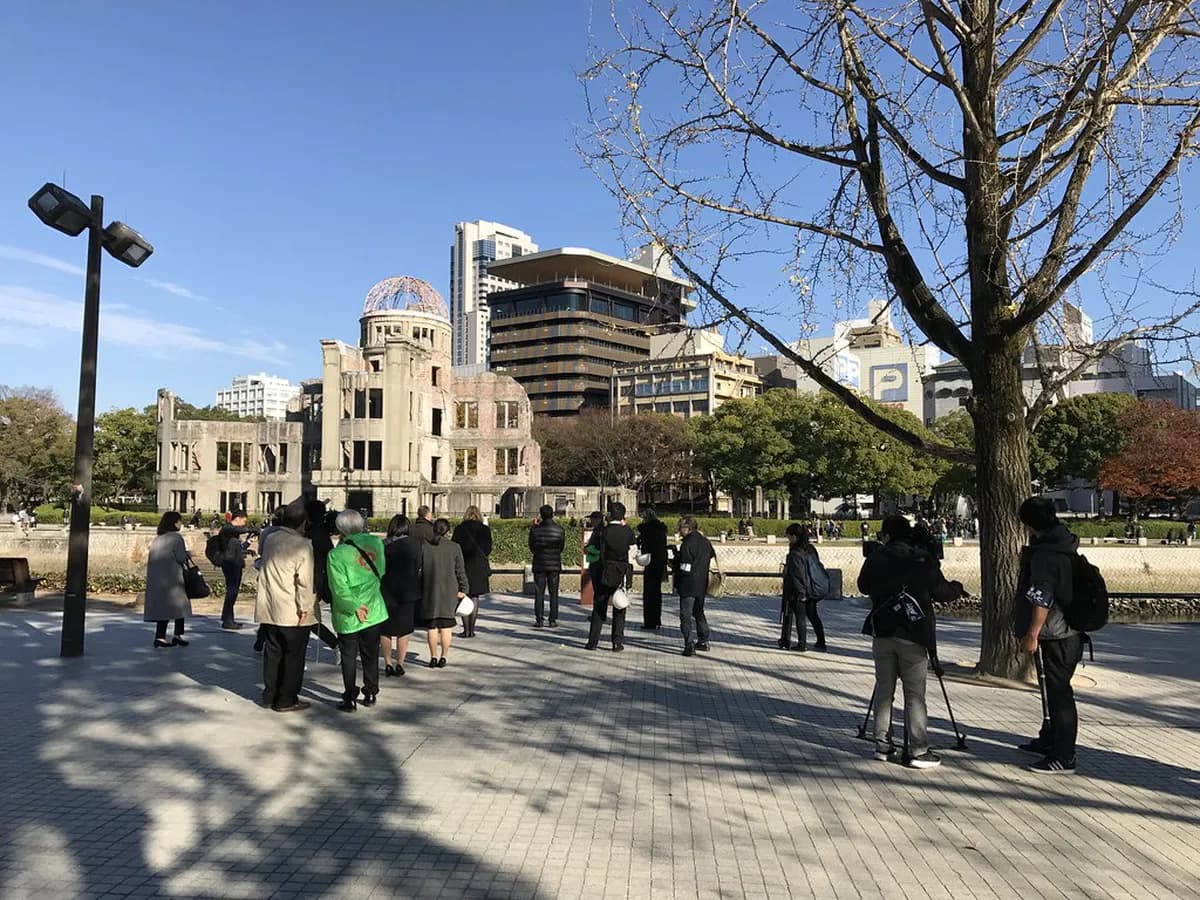
The Atomic Bomb Dome (Genbaku Dome) was the former Hiroshima Prefectural Industrial Promotion Hall, designed by Czech architect Jan Letzel and completed in 1915. It stands roughly 160 meters from the bombing's hypocenter — almost directly below the August 6, 1945 detonation point — and is one of the few structures that survived close to the blast. Added to the UNESCO World Heritage listing in 1996, the dome is an outdoor monument viewable 24/7 at no charge; the most photogenic angles are from Aioi Bridge (the original aiming point) and the riverside promenade across the water. A 5-minute walk from Genbaku-Dome-mae streetcar stop. Pair with the Peace Memorial Park circuit above.
3. Discover the Serene Beauty of Miyajima Island
Miyajima (officially Itsukushima) sits 1.6 km offshore in Hiroshima Bay; ferries run every 10–15 minutes from Miyajimaguchi (10-minute crossing, JPY 200 one-way for the JR ferry, plus the JPY 100 visitor tax introduced in 2023). The island combines a UNESCO shrine, a 535-meter sacred mountain, ancient temples, free-roaming sika deer, and an Edo-era shopping street into a compact day trip. Allow a minimum of 5 hours including ferry transit; an overnight stay unlocks the early-morning shrine before crowds and the night-illuminated torii.
For a comprehensive primer, see our complete Miyajima visitor guide; for a one-day plan from the city, see our Miyajima day trip. Don't miss grilled oysters (kaki) at Yamada-ya and momiji manju (maple-leaf cakes) at Iwamura, the original 1906 shop on Omotesando.
4. Marvel at the Floating Torii Gate of Itsukushima Shrine
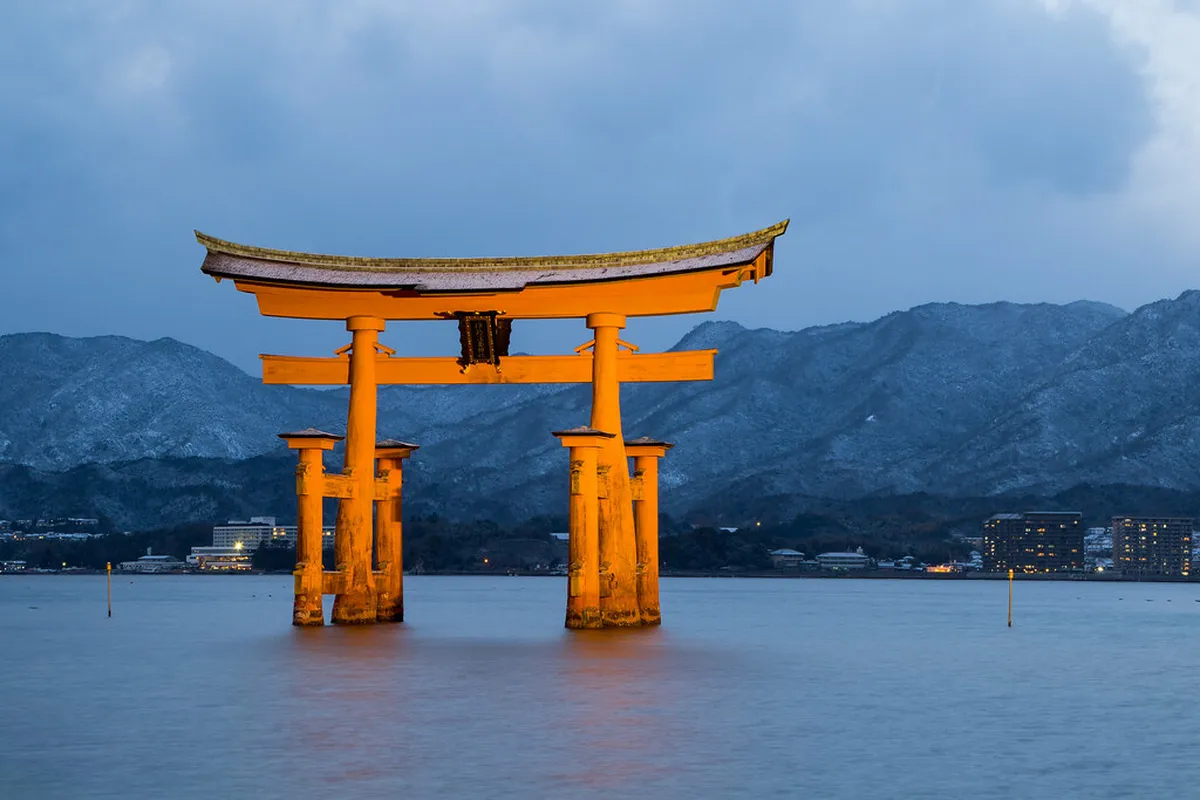
The vermilion-painted O-torii at Itsukushima Shrine is 16.6 meters tall, weighs 60 tons, and rests on the seabed under its own weight (it is not anchored). The current gate, the eighth since the year 1168, was rebuilt in 1875 and underwent a 3-year restoration completed in December 2022 — paint, roof tiles, and structural members are now in pristine 2026 condition. Itsukushima Shrine itself charges JPY 300 admission (JPY 500 combined with the Treasure Hall) and opens 06:30–18:00 in summer, 06:30–17:30 in winter. Tide timing is critical: high tide makes the gate appear to float; low tide lets you walk right up to it. See our tide-times guide for visiting the floating torii for daily tables and the best photo windows.
5. Explore Hiroshima Castle's Rich History
Hiroshima Castle (Rijo, "Carp Castle") was originally built by warlord Mori Terumoto in 1589 and served as the seat of the Asano clan for over 250 years. The original main keep was destroyed by the atomic bomb on August 6, 1945, and the current 5-story reconstruction dates to 1958. Inside is a samurai-history museum with armor, swords, and Edo-period documents; the top floor is an open observation deck offering 360-degree views over the city. 2026 admission JPY 370 adults, JPY 180 children; open 09:00–18:00 (until 17:00 Dec–Feb). Allow 60–90 minutes for the keep and grounds. Reconstruction of two original wooden buildings (the Ninomaru gate and turret) on the inner moat is free to enter. For the full backstory and tactical visit notes, see our Hiroshima Castle visitor guide.
6. Ascend the Orizuru Tower for Panoramic Views
Orizuru Tower opened in 2016 directly opposite the Atomic Bomb Dome and offers the only paid rooftop observation deck overlooking the Peace Memorial Park. The 50-meter open-air "Hiroshima Hill" deck on the 12th floor gives a clean line of sight from Mt. Misen on Miyajima to Hiroshima Castle in a single panorama. Inside, the "Orizuru Wall" lets visitors fold a paper crane and drop it into a 50-meter glass column; the cranes accumulate visibly over the years. 2026 admission JPY 2,200 adults, JPY 1,400 children, open 10:00–18:00 (last entry 17:00). Best at sunset for color and emptier elevators; the spiral wooden ramp on the way down is a 15-minute walk you should not skip.
7. Eat Layered Okonomiyaki at Okonomimura
Okonomimura ("Okonomiyaki Village") is a four-storey building in Nagarekawa stacked with 24 separate okonomiyaki stalls, each running its own teppan grill and family recipe — a Hiroshima-only institution that grew out of post-war street stalls in the 1950s. Hiroshima-style okonomiyaki layers thin batter, cabbage, pork, and noodles before being topped with egg; expect to pay JPY 950–1,400 per pancake and to sit at the counter watching it cooked in front of you. Open daily, most stalls 11:00–22:00, no reservations. See our Okonomimura ordering guide and the broader how to eat Hiroshima okonomiyaki like a local for which stall to pick on a first visit.
8. Wander Through the Tranquil Shukkei-en Garden
Shukkei-en ("contracted-scenery garden") was laid out in 1620 by Asano Nagaakira's tea master Ueda Soko and is a compact 4-hectare daimyo garden modeled in miniature on West Lake in Hangzhou, China. A central pond holds 10 islets, all crossed by stone or wooden bridges; tea houses overlook seasonal cherry, plum, and maple plantings. The garden was destroyed in 1945 and rebuilt in 1951; a small memorial near the back wall marks where survivors took refuge. 2026 admission JPY 260 adults, JPY 150 students; open 09:00–18:00 Apr–Sep, 09:00–17:00 Oct–Mar. See our Shukkei-en visitor guide for tea-house bookings.
9. See Sea Life at Miyajima Public Aquarium (Miyajimarine)
Miyajimarine, a 13-minute walk from Itsukushima Shrine on the back side of the island, is a midsize aquarium dedicated to Seto Inland Sea species — finless porpoises, oysters in various life stages, and a touch pool with the local oyster fauna. The Hiroshima oyster exhibit is the only one of its kind in Japan and explains why the prefecture produces roughly 60% of the country's oysters. 2026 admission JPY 1,420 adults, JPY 710 elementary/junior high; open 09:00–17:00 (last entry 16:00). A useful low-energy stop for families on a Miyajima overnight, or as a rainy-day backup when Mt. Misen is socked in.
10. Discover Modern Art at the Hiroshima Prefectural Art Museum
The Hiroshima Prefectural Art Museum sits directly next to Shukkei-en, sharing a side entrance, which makes it one of the easier garden-plus-museum pairings in the city. The permanent collection of about 5,000 works leans heavily on Hiroshima-born artists (notably Hirayama Ikuo and Kodama Kibo), pre-war Japanese yoga oil painting, and a small but high-quality European modernist holding including Salvador Dalí's "Dream of Venus." 2026 permanent collection JPY 510 adults, JPY 310 university students; open 09:00–17:00 (closed Mondays). Special exhibition pricing varies. The combined ticket with Shukkei-en saves about JPY 100.
11. Cuddle with Bunnies on Okunoshima (Rabbit Island)
Okunoshima is a small island in the Seto Inland Sea, reached by a 12-minute ferry from Tadanoumi Port (1 hour 20 minutes by JR from Hiroshima Station via the Kure Line). Roughly 500–700 European rabbits roam the island freely — descendants released after the island's secret WWII poison-gas factory was decommissioned. The half-day visit pairs rabbit-feeding with the sobering Poison Gas Museum (JPY 150) which documents the plant's role in producing chemical weapons used in mainland China. Bring leafy vegetables; pellets are sold near the ferry terminal but rabbits prefer cabbage. Pet-food is banned and dogs are not allowed on the island.
12. Visit the Mazda Museum and See Iconic Cars
Mazda's headquarters museum, on the company's Aki-ku factory site, walks visitors through the brand's history from 1920 cork-manufacturing through the rotary engine to the current MX-30 EV. The 90-minute guided tour includes a window onto the active Ujina assembly line — one of the few opportunities in Japan to watch cars roll off in real time. Free admission; tours run weekdays at 10:00 (English) and 13:30 (Japanese), advance reservation required via the Mazda website (book 1+ month ahead). The museum is closed weekends, public holidays, and during Mazda corporate breaks (early Aug, late Dec). Reach it via JR Mukainada Station (10 minutes from Hiroshima Station) plus a free shuttle bus.
13. Experience Authentic Japanese Culture at Mitaki-Dera Temple
Mitaki-Dera ("Three Waterfalls Temple") sits on a forested slope a 12-minute walk uphill from Mitaki Station (JR Kabe Line, 12 minutes from Hiroshima Station). Founded in 809 CE, the grounds layer a multi-storied pagoda (relocated from Wakayama in 1951 as a memorial), a vermilion-painted Kannon hall, three named waterfalls, and a teahouse serving warabimochi and matcha. Admission free; open 08:00–17:00 (until 16:30 Dec–Feb). The temple is the city's strongest autumn-foliage spot in mid-to-late November — see our autumn-colors guide for the precise window. Wear shoes with grip; the moss-covered stone steps are slick after rain.
14. Explore the History of Kure Maritime Museum
The Kure Maritime Museum (Yamato Museum) anchors a 30-minute JR ride east from Hiroshima Station to Kure, the Imperial Japanese Navy's main shipbuilding port. Its centerpiece is a 26.3-meter, 1/10-scale model of the battleship Yamato, accurate to the rivet, surrounded by salvaged artifacts including a Zero fighter, a kaiten human torpedo, and a 46-cm shell. 2026 admission JPY 500 adults, JPY 200 high-school, JPY 200 elementary/JHS; open 09:00–18:00 (last entry 17:30), closed Tuesdays. Across the street, the JMSDF Kure Museum (free) lets visitors walk through a decommissioned Yushio-class submarine. See our Kure day trip guide for combining both.
15. Enjoy the Nature at Sandankyo Gorge
Sandankyo Gorge is a 16-km river canyon in the Chugoku Mountains, an hour-and-fifteen by Hiroden bus from Hiroshima Bus Center to Sandankyo entrance. The full lower-trail walk (about 5.5 km, 2 hours one way) passes the named "three falls" — Sandan, Nidan, and Kurobuchi — with optional small ferry crossings (JPY 600 round-trip) at the most photogenic narrow stretch. Admission to the gorge is free; the trail is closed in winter (typically Dec–Mar) due to ice. Peak season is the second and third weeks of November when foliage matches the river spray; bring lunch as on-site dining is limited. Rated one of Japan's "five most beautiful gorges" since 1925.
16. Pay Respects at the National Peace Memorial Hall for the Atomic Bomb Victims
The National Peace Memorial Hall sits underground next to the Peace Memorial Museum and is often missed in a fast tour — a free, smaller, and more contemplative complement to the museum upstairs. The Hall of Remembrance presents a 360-degree panorama of the destroyed city built from 140,000 hand-set tiles (one per estimated 1945 fatality), with a still-water pool at its center. A separate room houses a searchable database of victim names, photographs, and donated personal accounts in Japanese, English, and Korean. Free admission; open 08:30–18:00 (until 19:00 Aug, 17:00 Dec–Feb). Allow 30–45 minutes; the silence here is intentional, and most visitors leave noticeably altered.
17. Stroll Through Peace Boulevard
Peace Boulevard (Heiwa Odori) is a 100-meter-wide, 4-km tree-lined avenue running east-west through central Hiroshima, designed during 1950s reconstruction as a literal firebreak and symbolic green axis of the rebuilt city. It hosts the Hiroshima Flower Festival over Golden Week (May 3–5), drawing 1.5 million attendees, and the Tokasan Yukata Festival (early June). On normal days, the southern row of zelkova trees lights up at dusk year-round; the segment between Chuden-mae and Chukasa-mae streetcar stops makes the most rewarding 20-minute walk. The boulevard intersects Peace Memorial Park at its western end, so the stroll naturally flows into either the museum or the river-front cafés along Motoyasu River.
18. Cycle Along the Scenic Rivers of Hiroshima
Hiroshima sits on a six-river delta and is genuinely flat, which makes it one of the most cycle-friendly cities in Japan. Peacecle, the city's red-bike share scheme, has 30+ docks across the central wards (JPY 165 for 30 minutes, JPY 1,650 day pass) and lets you string Peace Memorial Park, the Atomic Bomb Dome, Hiroshima Castle, Shukkei-en, and the river-mouth Hiroshima Port together in a 10-km loop. The riverside paths along Motoyasu, Honkawa, and Kyobashi rivers are mostly traffic-free. Cyclists planning the larger 70-km Shimanami Kaido island-hop ride should see our Shimanami Kaido cycling guide.
19. Take a Day Trip to Tomonoura, a Picturesque Port Town
Tomonoura is a tiny harbor village 1 hour 40 minutes east of Hiroshima (JR shinkansen to Fukuyama, then a 30-minute Tomotetsu bus to the port). The bay is one of the only places in Japan that still keeps its original Edo-era harbor furniture intact: the 1859 Joyato stone lighthouse, the 1811 Gangi stone steps, the kantori watchtower, and the funa-bansho ferryman's office. Studio Ghibli's Hayao Miyazaki rented a hilltop house here while drafting "Ponyo," and the village's Iroha Maru Museum tells the story of an 1867 shipwreck involving Sakamoto Ryoma. Half-day minimum, full day if you take the 5-minute ferry to Sensui-jima Island for the rust-colored "Tomo-no-ura" sand beach.
20. See Hiroshima Kagura — the City's Living Performance Tradition
Kagura is the masked, drum-driven Shinto theatre of the Aki-Takata region north of Hiroshima city, and it is the most overlooked authentic Hiroshima cultural experience in nearly every English-language guide. Each year-round Wednesday evening at the Hiroshima Prefectural Citizens Culture Center (a 5-minute walk from Atomic Bomb Dome streetcar stop), local troupes perform a 90-minute set of two stories — typically a hero-versus-demon confrontation in elaborate sequined costumes, with live taiko, flutes, and crash-cymbal accompaniment. 2026 tickets JPY 1,000 same-day at the door, performances 19:00–20:30 every Wednesday April through January. No Japanese needed — the plots are visually broad and English summaries are handed out at the door. For a deeper village-level experience, Kagura Monzen Tojimura in Akitakata (90 minutes by bus) hosts weekend performances inside reconstructed thatched-roof theatres.
Day-Trip Matrix: Hiroshima as a Hub
Hiroshima is a strong day-trip hub because the Sanyo Shinkansen, JR Sanyo Line, and ferry network put five distinct destinations within 30–90 minutes of central Hiroshima — Miyajima, Kure, Saijo, Onomichi, and Iwakuni — each offering a different angle on the region (sacred shrine, naval history, sake town, hill-temple harbor, samurai bridge). The matrix below summarizes 2026 logistics so you can pick which fits a half-day, full-day, or two-day extension.
| Destination | One-way time | Round-trip cost (JPY) | Time needed | Signature highlight | Best for |
|---|---|---|---|---|---|
| Miyajima | ~50 min (tram + ferry) | ~700 + JPY 100 visitor tax | Half-day to full day | Floating torii gate, Mt. Misen ropeway, sika deer | First-timers — non-negotiable |
| Kure | 30 min (JR Kure Line) | ~1,020 | Half-day | 1/10 scale battleship Yamato, JMSDF submarine museum | Naval and WWII history fans |
| Saijo (Higashi-Hiroshima) | 40 min (JR Sanyo Line) | ~1,160 | Half-day | Sake-brewery row — 7 working breweries within 1 km of the station | Sake lovers, foodies |
| Onomichi | ~70 min (JR Sanyo Line) | ~3,080 | Full day | Hillside temples, Senkoji Park views, Shimanami Kaido start | Cyclists, photo walkers |
| Iwakuni | ~50 min (JR Sanyo Line) | ~2,420 + JPY 310 bridge fee | Half-day | Kintaikyo wooden arch bridge (1673 design, last rebuilt 2004) | Architecture, samurai history |
How to combine them: a Miyajima half-day plus Kure half-day works as one packed day from Hiroshima Station. Saijo pairs naturally with an evening return to Hiroshima for okonomiyaki. Onomichi is best as a full day or as the gateway to the Shimanami Kaido cycle ride — see our Shimanami Kaido 2-day cycling itinerary if you have the legs for it. For a self-guided 1-day round trip from Osaka or Kyoto that hits both Hiroshima and Miyajima, see our Osaka to Hiroshima and Miyajima day trip. For travelers staying four or more days, a high-speed ferry across the Seto Inland Sea connects Hiroshima to Matsuyama (~70 min), opening a secondary castle-town hub with its own attractions and day trips.
Hiroshima Transport Passes: Which One to Buy in 2026
For most visitors the single best-value option is the Visit Hiroshima Tourist Pass (sometimes called the Tabi Pass), sold by Hiroshima Electric Railway in three tiers — 1-day ¥1,000, 2-day ¥1,500, and 3-day ¥2,000. Every tier covers all Hiroshima Electric Railway streetcar lines (including the Miyajima Line out to Miyajimaguchi), the central-route city buses, and the Miyajima ferry — both the Matsuda Kisen and JR West sailings — so a typical city-plus-Miyajima itinerary fits neatly onto one pass.
What the Tourist Pass does not cover matters just as much: it is not valid on JR West trains, express buses, or the airport limousine, and it does not include the ¥100 Miyajima visitor tax (age 13+) collected at the ferry terminal — budget those separately. To put the value in context, a single Hiroshima streetcar ride is a flat ¥220, so the 1-day pass roughly breaks even at around five streetcar rides plus one Miyajima round trip in a day; below that, paying per ride is cheaper. There is also a 3-day Middle Area pass at ¥4,500 that extends out to Kure, Takehara, and suburban express routes — only worth it if you are stringing together several day trips.
For visitors traveling on a JR Pass, the calculus flips: you can ride the JR Sanyo Line to Miyajimaguchi and take the JR West ferry to Miyajima, both covered by the JR Pass, so the Tourist Pass adds no ferry value for you — though the streetcar network is not a JR service, so factor in single fares or a separate pass for in-city hops (verify current JR Pass terms before relying on this). Two useful add-ons round out the options: the Meipuru-pu sightseeing loop bus at ¥400 per day for adults, and the Astram Line 1-Day Pass at ¥950 for adults. Prices here reflect the figures published on the official boards, but confirm current 2026 rates on hiroden.co.jp and the official Hiroshima ticket guide before you travel, since fares are periodically revised.
| Pass / option | Price (JPY) | Covers streetcar | Covers central bus | Covers Miyajima ferry | Covers JR trains | Best for |
|---|---|---|---|---|---|---|
| Visit Hiroshima Tourist Pass — 1-day | ¥1,000 | Yes | Yes | Yes | No | One busy city + Miyajima day |
| Tourist Pass — 2-day | ¥1,500 | Yes | Yes | Yes | No | Standard 2-day city + island trip |
| Tourist Pass — 3-day | ¥2,000 | Yes | Yes | Yes | No | 3-day stay with a city-area day trip |
| Tourist Pass — 3-day Middle Area | ¥4,500 | Yes | Yes | Yes | No | Adds Kure/Takehara & suburban express routes |
| Pay-per-ride | ¥220 flat / streetcar ride | n/a | Per fare | Per fare | No | Light users (break-even ~5 rides/day) |
| JR Pass holder | Included in JR Pass | No | No | JR West ferry only | Yes | JR-Pass travelers reaching Miyajima by JR |
| Meipuru-pu loop bus | ¥400 / day | No | Loop route only | No | No | Sightseeing add-on around central museums |
Note: none of these options cover the ¥100 Miyajima visitor tax, which is charged separately at the Miyajimaguchi ferry terminal. Confirm 2026 prices on the official sources before buying.
Sample Hiroshima Itineraries: 1, 2, and 3 Days at a Glance
If you have the time, the cleanest split is one day for the city core, one day for Miyajima, and a third day for a single day trip. Day 1 (roughly six to seven hours) starts with the Peace Memorial Park and Museum in the morning — allow three to four hours — then okonomiyaki for lunch at Okonomimura, Hiroshima Castle and Shukkei-en Garden in the afternoon, and dinner or bars in Nagarekawa. Day 2 is a full day on Miyajima: take an early ferry from Miyajimaguchi to beat the crowds, time Itsukushima Shrine to a high tide for the floating-torii photo, ride the Mt. Misen ropeway to the summit, and graze on grilled oysters and momiji manju along Omotesando, with the optional night illumination if you are staying over.
Day 3 is best kept to a single day trip rather than a rushed double: pick Kure for the Yamato Museum (about 30 minutes by JR), the Saijo sake row (around 40 minutes), or Onomichi and the start of the Shimanami Kaido (roughly 70 minutes). Visitors with only one day — for example arriving from Osaka or Kyoto — should do the Peace Park and Atomic Bomb Dome in the morning and Miyajima in the afternoon, and simply accept that it will feel rushed. One sequencing tip threads through all of these plans: check the Hiroshima tide table and slot Miyajima onto the half-day when high tide is above roughly 250 cm, which is when the gate appears to float for the classic shot.
| Day | Focus | Key sites | Hours needed |
|---|---|---|---|
| Day 1 | City core | Peace Memorial Park & Museum, Okonomimura lunch, Hiroshima Castle, Shukkei-en, Nagarekawa dinner | ~6–7 hrs |
| Day 2 | Miyajima (full day) | Itsukushima Shrine at high tide, Mt. Misen ropeway, Omotesando oysters & momiji manju | Full day |
| Day 3 | Pick one day trip | Kure (Yamato Museum) OR Saijo (sake row) OR Onomichi (Shimanami Kaido start) | Half to full day |
For full step-by-step routes, pair this skeleton with our detailed Hiroshima 2-day itinerary, the Hiroshima and Miyajima 1-day itinerary, and the 1-day itinerary from Osaka or Kyoto.
How Much Does a Hiroshima Trip Cost in 2026?
Excluding the intercity shinkansen, a day in Hiroshima typically runs around ¥8,000–8,600 per person on a budget, ¥18,600–21,000 mid-range, and ¥40,000 or more at the luxury end. The budget band assumes a hostel or business hotel, counter okonomiyaki, and a Tourist Pass; the mid-range band covers a 3–4 star hotel, sit-down meals, and paid attractions; and the luxury figure reflects a Sheraton Grand or Rihga Royal stay (or a Miyajima ryokan) plus private tours. Because USD conversions fluctuate, treat the yen figures as primary and any dollar estimate as approximate.
Attraction entry costs are genuinely low and rarely the deciding factor: the Peace Memorial Museum is ¥200, Hiroshima Castle ¥370, Shukkei-en ¥260, and Itsukushima Shrine ¥300, while the Atomic Bomb Dome, the Cenotaph, and the National Peace Memorial Hall are all free. Food is similarly affordable — counter okonomiyaki typically costs ¥950–1,400, and grilled Miyajima oysters run a few hundred yen each. The bigger line items are lodging (business hotels ¥9,000–14,000, mid-range ¥16,000–25,000, high-end ¥28,000–45,000, and Miyajima ryokan ¥25,000–60,000 per person with two meals) and a couple of mandatory extras: the ¥100 Miyajima visitor tax for ages 13 and up, and the ¥1,000–2,000 Tourist Pass.
The easiest ways to trim the daily total are to lean on the free memorial sites, buy the Tourist Pass instead of paying single fares once you expect more than about five rides in a day, and use the combined Shukkei-en plus Prefectural Art Museum ticket, which saves roughly ¥100. For an authoritative destination overview to anchor your planning, the Japan National Tourism Organization page on Hiroshima is a useful starting point.
Browse the Hiroshima attraction directory for individual visitor guides, access details, and practical tips.
Building the rest of the trip? Our Hiroshima attractions guide covers the sights, districts and logistics around this guide.
Frequently Asked Questions (2026)
How many days do you need to visit Hiroshima?
Two full days is the realistic minimum: one for the Peace Memorial Park, museum, Hiroshima Castle, and Shukkei-en Garden in the city core, plus a second full day on Miyajima Island. Add a third day to fit Kure, Saijo, or Onomichi. One-day visits from Osaka or Kyoto are possible but rushed — see our 1-day itinerary from Osaka or Kyoto for the tightest viable plan.
Is Hiroshima Peace Memorial Museum free in 2026?
No — admission is JPY 200 for adults and JPY 100 for high-school students; primary and junior-high students enter free. Audio guides are JPY 400. The surrounding Peace Memorial Park, Cenotaph, Atomic Bomb Dome, Children's Peace Monument, and the National Peace Memorial Hall (a separate building inside the park) are all free.
What is the best time of year to visit Hiroshima?
Late March to early April for cherry blossoms (Hiroshima Castle and Peace Park are prime viewing spots — see our 2026 hanami spots guide), and mid-November for autumn colors at Mt. Misen, Mitaki-Dera, and Shukkei-en (see best season to visit for autumn colors). Summer is hot and humid but coincides with the Peace Memorial Ceremony on August 6; winter is mild and uncrowded with occasional snow on Miyajima.
Is Hiroshima safe and easy for foreign tourists?
Yes — Hiroshima is one of the safest cities in Japan, with extremely low violent crime, English signage at all major attractions and the streetcar system, and free Wi-Fi at most public sites. ATMs at 7-Eleven, Lawson, and Japan Post accept foreign cards. Nearly all transit accepts ICOCA, Suica, or Pasmo IC cards.
Can you get to Hiroshima from Tokyo by bullet train in a day?
Yes — the Nozomi Shinkansen runs Tokyo to Hiroshima in about 4 hours direct (one-way roughly JPY 19,000 reserved). Hikari/Sakura services covered by the Japan Rail Pass take 4.5–5 hours. A same-day round trip is theoretically possible but leaves only 4 hours on the ground — overnight is strongly recommended. Full breakdown in our guide to reaching Hiroshima from Tokyo and Osaka.
Do I need to pay the Miyajima visitor tax?
Yes. As of October 2023, all visitors aged 13+ traveling to Miyajima pay a JPY 100 per-trip visitor tax (Miyajima Visitation Tax), collected automatically as part of your ferry ticket at Miyajimaguchi. Annual passes (JPY 500) are available for repeat visitors. The tax funds island infrastructure and conservation.
What food is Hiroshima famous for?
Hiroshima-style okonomiyaki (layered, not mixed — with noodles, cabbage, pork, and egg crepe), oysters from the Seto Inland Sea (the prefecture produces ~60% of Japan's oysters), momiji manju maple-leaf cakes from Miyajima, and tsukemen ramen. See our how to eat Hiroshima okonomiyaki like a local for ordering tips, or visit Okonomimura, the four-story building of okonomiyaki stalls in Nagarekawa.
What annual events are worth planning around in 2026?
The Peace Memorial Ceremony on August 6 is the most significant; the Hiroshima Flower Festival runs over Golden Week (early May) and draws ~1.5 million visitors to Peace Boulevard; the Onomichi Betcha Festival (early November) and Saijo Sake Festival (October) are major regional draws. Full schedule in our 2026 Hiroshima events calendar.
Explore More Hiroshima Guides
Deep-dive guides for every part of a Hiroshima trip — from itineraries and Miyajima logistics to day trips, food, seasonal events, and the practical transport details you'll want before booking.
Where to Stay
- Where to Stay in Hiroshima
- Best Areas & Neighborhoods to Stay
- Best Hotels in Hiroshima
- Budget Accommodation & Hostels
- Where to Stay Near the Peace Park
- Best Ryokan & Traditional Stays
Food & Drink
Best Time & Practical Tips
Things to Do by Interest
- Hiroshima with Kids
- Hidden Gems & Local Secrets
- Rainy Day Things to Do
- Romantic Things to Do for Couples
Itineraries
- Hiroshima 2-Day Itinerary
- Hiroshima and Miyajima 1-Day Itinerary
- 1-Day Hiroshima Itinerary from Osaka and Kyoto
- Hiroshima Landmarks 1-Day Itinerary
- Solo Traveler's Guide to Hiroshima in 1 Day
- day trip from Osaka
- Shimanami Kaido 2-Day Cycling Itinerary
Miyajima & Itsukushima
- complete Miyajima guide
- day trip to Miyajima
- Mt. Misen Cable Car and Hiking Routes
- Itsukushima Floating Torii Tide Times
- Miyajima Traditional Crafts and Shamoji Workshops
- Miyajima Deer Guide: Feeding Rules and Safety
- Where to Stay in Miyajima: Best Ryokan and Hotels
- Miyajima Aquarium Visitor Guide
- Miyajima Oysters: Where to Eat
- Miyajima Onsen Guide
- Daisho-in Temple Visitor Guide
- Momiji Manju: Maple Leaf Cake Guide
- Autumn Foliage at Momijidani Park
- Miyajima Sake Brewery Tasting Guide
- Miyajima Night Light-Up and Illumination
- Omotesando Shopping Street and Street Food
Landmarks & Peace Memorial
- Hiroshima Castle history
- Peace Memorial Museum Tickets and Tips
- Shukkei-en Garden Visitor Guide
- How to Attend the 2026 Peace Memorial Ceremony
- How to Fold Orizuru Paper Cranes
Day Trips Beyond Hiroshima
- Saijo Sake Town Day Trip
- Kure Day Trip — Yamato Museum and Naval History
- Onomichi Day Trip — Cat Alley and Temple Walk
- Kintaikyo Bridge Iwakuni Day Trip
- Shimanami Kaido Cycling — E-Bike vs Road Bike
Food & Drink
- best Hiroshima ramen shops
- Late-Night Dining and Bars Open After Midnight
- How to Eat Hiroshima-Style Okonomiyaki Like a Local
- Hiroshima Okonomiyaki at Okonomimura
- Nightlife — Nagarekawa and Ekinishi Bar Hopping
Seasonal, Events & Outdoors
- 2026 Events Month-by-Month Calendar
- Major Annual Events — 2026 Calendar
- Cherry Blossom and Hanami Viewing Spots 2026
- Best Season to Visit for Autumn Colors
- Hiking Trails — Mt. Misen, Mitaki Temple and More
- Chugoku Region Onsen Towns and Fall Foliage
- Hiroshima Carp Baseball at Mazda Stadium
Getting Around
Plan Your Japan Trip
- Japan Travel Guide: Itineraries, Transport, Money & Tips
- Getting Around Japan: Trains, Buses & IC Cards
- Japan Money & IC Card Guide
More guides in this cluster
- 10 Best Outdoor Adventures in Hiroshima for Thrill-Seekers (2026)
- 15 Best Things to Do in Hiroshima (2026 Prices + 2-Day Plan)
- 3-Day Hiroshima Adventure Itinerary: Hike, Kayak & Cycle (2026)
- 3-Day Hiroshima Festival and Event Itinerary 2026: 11 Steps
- 7 Traditional Hiroshima Arts and Crafts to Discover (2026 Guide)
- 15 Best Things To Do In Hiroshima During Cherry Blossom Season (2026 Guide)
- Best Time for Hiroshima Adventures: 2026 Seasonal Activity Guide
- 13 Best Budget-Friendly Hiroshima Cultural Experiences and Free Festivals (2026 Guide)
- Budget Guide to Miyajima Oyster Festival and Hiroshima Pain Festa (2026 Guide)
- 10 Budget Hiroshima Adventures: Free Hiking Trails & Hidden Spots (2026 Guide)
- Bentenjima Fireworks 2026: Tomonoura Hanabi Dates & Tickets
- Hiroshima 1 Day Itinerary for Emotional Pacing (2026 Guide)
- Hiroshima 1 Day Itinerary: 10 Essential Planning Steps
- Best Hiroshima Activities 2026
- Hiroshima Outdoor Adventures: Hiking, Cycling & Kayaking Guide (2026)
- Hiroshima and Miyajima 2-Day Itinerary with Map (2026 Guide)
- Hiroshima Budget Travel Guide 2026: Free Sights and Cheap Eats
- 2-Day Hiroshima Cultural Landmarks Itinerary: The Complete 2026 Guide
- Hiroshima Culture: A 2026 Guide to Peace, Crafts, Festivals & Food
- Hiroshima Events 2025
- Top Hiroshima Experiences
- Hiroshima: Top Highlights
- Hiroshima Itinerary 2026: Choose 1, 2, or 3 Days (Hub Guide)
- Hiroshima Historical Landmarks: A 2026 Architecture & Heritage Guide
- Hiroshima Nightlife 2026: Nagarekawa Bars, Jazz & Late Eats
- Tokasan Festival 2026: June 5-7 Hiroshima Yukata Guide
- Hiroshima Travel Budget: Solo vs Private Guided Tours (2026 Guide)
- Kayak to Miyajima: 9 Tips on Tides and Routes
- Participating in Tomonoura Tai-ami Sea Bream Net Fishing (2026 Guide)
- Top Things To Do in Hiroshima
- 12 Best Areas and Tips for Staying in Hiroshima
- 10 Best Hiroshima Ramen and Tsukemen Shops
- 14 Best Hotels in Hiroshima for Every Budget
- 15 Best Ryokan and Traditional Stays Near Hiroshima
- Best Season to Visit Hiroshima for Autumn Colors
- Best Time To Visit Hiroshima Month By Month Travel Guide
- Daisho-in Temple Miyajima Visitor Guide
- 8 Essential Stops for a 1-Day Trip From Osaka To Hiroshima And Miyajima
- Hiroshima 1-Day Itinerary from Osaka and Kyoto
- Hiroshima 2 Day Itinerary
- 11 Best Onsen Towns for Fall Foliage in Hiroshima and Chugoku
- Hiroshima and Miyajima 1 Day Itinerary
- Hiroshima Budget Accommodation and Hostels
- Hiroshima Carp Game Day Guide
- Hiroshima Castle History and Visitor Guide
- 11 Best Hiroshima Cherry Blossom and Hanami Viewing Spots 2026
- Hiroshima Events Month By Month 2026 Calendar
- Hiroshima Gokoku Shrine Guide
- 12 Hiroshima Hidden Gems and Local Secrets
- 9 Best Hiroshima Hiking Trails and Scenic Walks
- Hiroshima Landmarks 1-Day Itinerary
- Hiroshima Late Night Food
- Hiroshima Museum of Art
- Hiroshima Bar Hopping Itinerary
- 10 Essential Hiroshima Peace Memorial Museum Tickets and Tips
- 10 Essential Hiroshima Travel Tips
- 15 Best Things to Do in Hiroshima with Kids
- Hiroshima Travel Guide 2026
- Hiroshima Peace Memorial Ceremony 2026
- Hiroshima Okonomiyaki at Okonomimura 2026
- How to Eat Hiroshima Style Okonomiyaki Like a Local
- How to Fold Orizuru Paper Cranes at Hiroshima Peace Memorial
- How to Get Around Hiroshima
- How To Get To Hiroshima From Tokyo And Osaka
- Floating Torii Gate & Tide Times 2026
- Kansai-Hiroshima Area Pass Guide
- 8 Essential Tips & Stops for a Kintaikyo Bridge Iwakuni Day Trip
- Kure Day Trip Yamato Museum and Naval History Travel Guide
- Hiroshima Events 2026
- Miyajima Aquarium Visitor Guide
- Miyajima Autumn Foliage
- Miyajima Day Trip From Hiroshima
- Miyajima Deer Guide Feeding Rules And Safety Travel Guide
- Miyajima Island Complete Visitor Guide
- Miyajima Momiji Manju Maple Leaf Cake Guide
- Miyajima Night Light Up And Illumination Guide
- Miyajima Omotesando Shopping Street And Street Food Travel Guide
- Miyajima Onsen Guide
- Where to Eat in 2026 (10 Local Picks)
- Miyajima Sake Brewery Tasting Guide
- Miyajima Shamoji Rice Scoop Crafts
- Cat Alley and Temple Walk
- 10 Rainy Day Things to Do in Hiroshima (Indoor Picks)
- 11 Romantic Things to Do in Hiroshima for Couples
- 1-Day Saijo Sake Town Day Trip From Hiroshima Guide
- Shimanami Kaido 2-Day Cycling Itinerary
- E-bike vs Road Bike Logistics
- Shukkeien Garden Hiroshima Visitor Guide
- 7-Step Solo Traveler's 1-Day Hiroshima Itinerary
- Cable Car and Hiking Routes
- 8 Best Local Foods and Where to Eat Them in Hiroshima
- 7 Best Areas and Tips for Where to Stay in Hiroshima
- 12 Best Places Where to Stay in Miyajima
- 10 Best Tips and Places for Staying Near Hiroshima Peace Park
- Beaches in Hiroshima
- Hiroshima Station Guide
- Hiroshima to Matsuyama Ferry
- Hiroshima Attractions
Hiroshima in 2026 rewards careful planning more than most Japanese cities — the right neighborhood base, the right visit order at Peace Memorial Park, and the right day-trip pick can turn a rushed day into a meaningful three-day stay. From the solemn UNESCO weight of the Atomic Bomb Dome to the floating torii at Itsukushima, the sake cellars of Saijo, and the harbor temples of Onomichi, each site adds another layer to one of Japan's most concentrated heritage destinations. Use the structural sections above to set your scope, the 20-attraction list to fill the days, the day-trip matrix to extend your trip, and the FAQ to handle the practical questions before you go.
For the broader trip-planning view that ties these attractions to neighborhoods, transit passes, and budget windows, see our Hiroshima travel guide.
Explore attractions in other cities
Free: The Hiroshima Essentials guide
Top things to do, where to stay, a perfect day plan, getting around, and the best time to go — a Hiroshima mini-guide you can take offline.
You might also like


Continue reading
More guides you'll find useful