

Osaka Aquarium Kaiyukan is one of the world's largest aquariums and the most-visited attraction in the Tempozan harbour district. The facility recreates the Pacific Rim ecosystem across 14 themed zones, housing approximately 30,000 creatures from 620 species — headlined by two resident whale sharks in a 5,400-tonne central tank.
Travelers coming to Osaka in 2026 consistently rank Kaiyukan among their top priorities. This guide covers admission prices, the dynamic pricing system, the spiral layout, creature highlights, the night aquarium transition, and what to do in the surrounding Tempozan area. See our full things to do in Osaka for more activities.
Overview of Osaka Aquarium Kaiyukan
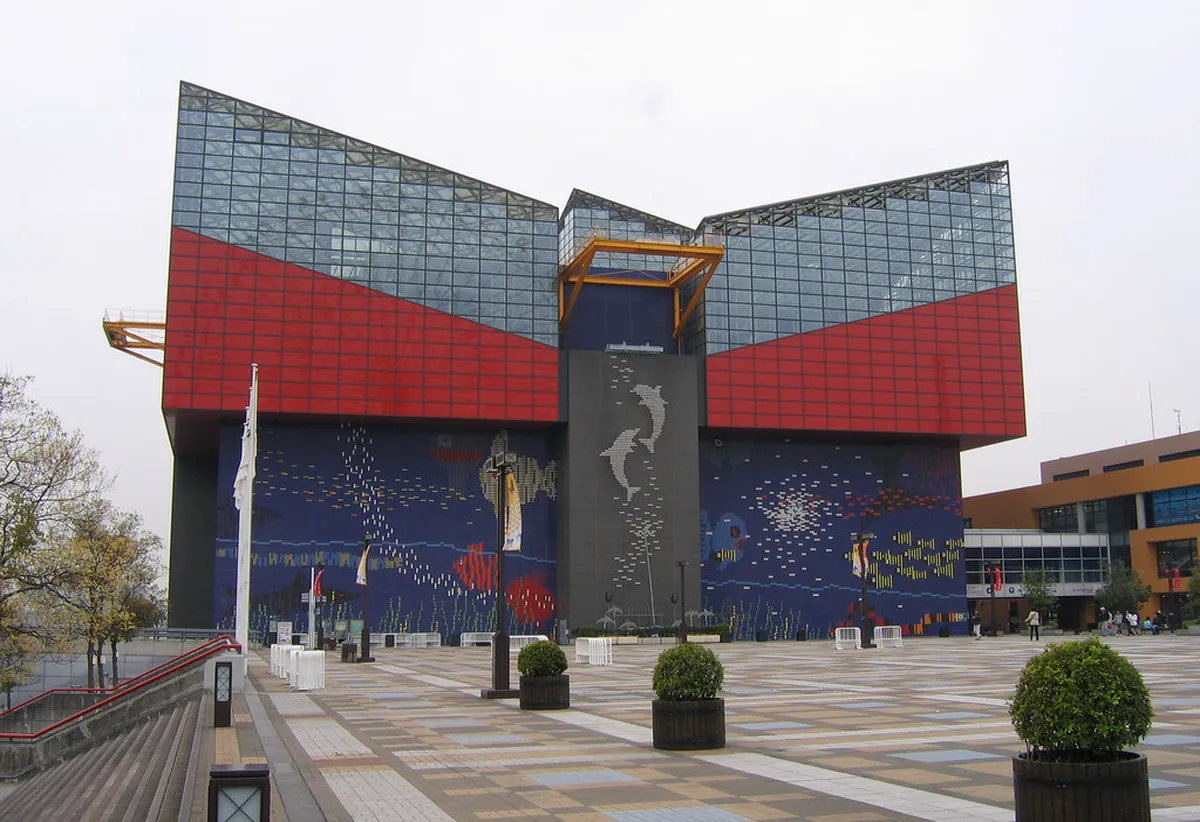
Kaiyukan opened in 1990 and has become the centrepiece of Tempozan Harbor Village in Osaka's Minato ward. The building's design is instantly recognisable: colourful panels on the exterior give way to a soaring atrium inside, where a single spiral ramp descends eight floors around the massive Pacific Ocean tank. That layout means every visitor follows the same one-way route, moving from the sunlit Japan Forest on floor 8 down to the deep-sea exhibits near the base.
The central Pacific Ocean tank is 9 metres deep and filled with whale sharks, manta rays, several species of shark, schools of tuna, and hammerhead sharks. You pass this tank at multiple floor levels as you descend — each angle reveals different behaviour and different companions. This is the architectural detail that separates Kaiyukan from most aquariums, where the headline species are confined to one viewing window.
Kaiyukan is also directly connected to the broader best attractions in Osaka circuit. The giant Ferris wheel, Tempozan Marketplace, and Santa Maria cruise are all within a five-minute walk. A full day here — aquarium in the morning, harbour in the afternoon — is one of the most efficient Osaka itineraries in the city.
- Quick facts: Address — 1-1-10 Kaigandori, Minato-ku, Osaka 552-0022
- Nearest station — Osakako Station, Osaka Metro Chuo Line (5 minutes on foot from Exit 1)
- Hours — 10:00–20:00 daily; last admission 19:00 (extended in summer and Golden Week)
- Time required — 2 to 3 hours for adults; allow 3 to 4 hours with young children or a cafe stop
- Closed — Irregular (two days in January); check the official calendar before visiting
Ticket Prices, Hours, and the Dynamic Pricing System
Kaiyukan uses a dynamic pricing model in 2026. The regular admission rates are ¥2,700 for adults (age 16 and over), ¥1,400 for children (elementary and junior high, age 7–15), and ¥700 for toddlers (age 4–6). Children aged 3 and under enter free. Seniors aged 60 and over pay ¥2,400. On busy weekends and public holidays, prices rise above the regular rate, so booking on a weekday typically saves money. Check the official Kaiyukan ticket page for the day-specific price before purchasing.
Kaiyukan uses dynamic pricing — the regular adult rate is ¥2,700 but rises on peak weekends. Book advance e-tickets online to lock in the standard rate and skip the ticket counter queue. Re-entry on the same day is permitted until one hour before closing.
There are two ticket types. Advance e-tickets go on sale 30 days before your visit and remain available until opening time on the day itself. Same-day tickets are sold online and at the counter from opening until the last admission at 19:00. When you buy an advance ticket, you choose an entry time slot — the time window during which you must pass through the gate. The slot system is particularly important on peak weekends when certain windows sell out. We recommend booking via the Klook Kaiyukan booking page or the official webket portal, both of which display remaining slot availability in real time.
Re-entry is permitted on the same day until one hour before closing. If you want to explore Tempozan Marketplace at midday and return for the night aquarium after 17:00, you can do so without buying a second ticket. Ask staff at the exit for a re-entry stamp before leaving the paid zone.
Operating hours are 10:00 to 20:00 daily, with last admission at 19:00. Hours can extend during the summer holiday period and Golden Week in late April and early May. Always verify the operating hours calendar for your specific date.
How to Get to Kaiyukan
The fastest and most reliable route from anywhere in central Osaka is the Osaka Metro Chuo Line to Osakako Station. From Exit 1, the aquarium entrance is a flat five-minute walk following English-language signage through the Tempozan promenade. There are no stairs on this route, making it fully stroller- and wheelchair-accessible.
From Namba, take the Midosuji Line to Hommachi and transfer to the Chuo Line for Osakako — total journey around 30 minutes. From Osaka Station (Umeda area), take the Loop Line to Bentencho and transfer to the Chuo Line — approximately 35 minutes. Arriving from Kansai International Airport, the Kaiyukan Limousine Bus departs from Terminal 1 and drops passengers at the Tempozan Kaiyukan stop, a two-minute walk from the entrance; journey time is roughly 60 minutes.
Coin lockers are available in three locations: inside the paid zone of Kaiyukan itself, in the Kaiyukan Entrance Building, and at Tempozan Marketplace. Sizes range from small (around ¥200) to large enough for a full-size suitcase (¥600–¥700). Storing bags before you enter is strongly recommended — the spiral ramp is narrow in peak periods and the path does not allow backtracking. For exact locker sizes and current fees, check the official FAQ page.
Free wheelchair rentals are available at the Information Desk next to the ticket counter. Advance contact is required; call the Kaiyukan Information Centre at 06-6576-5501 to reserve one. A baby care room with nursing booths, diaper-changing tables, and children's toilets is located inside the facility. Families with infants should note that strollers are permitted throughout the main route, though storage space at the top of the elevator is limited during busy sessions.
The Pacific Rim Journey: What to Expect Inside
Entering the main gate, the first thing you walk through is an immersive aquarium tunnel. Rays and large fish glide overhead as crowds filter in — it can be congested since every visitor passes through here first. Move through at a steady pace and save lingering time for the upper levels, where crowds are lighter early in the day. Pairing the aquarium with other activities in Osaka is the best approach to a full itinerary.
After the tunnel, an elevator carries you to the eighth floor, where the experience resets into daylight. The Japan Forest exhibit greets you with trickling waterfalls and lush greenery. This is where the Asian small-clawed otters live — small, fast, and endlessly entertaining in the water. The Japan Forest flows into the Aleutian Islands zone and then into the Arctic, before the path begins its long descent alongside the Pacific Ocean tank. The official facility map shows all 14 zones and is useful for planning which feeding times to target.
Throughout the facility, each exhibit zone has a small stamp station with a character stamp for that animal. If you pick up a stamp book at the gift shop near the entrance, the stamp rally gives children (and adults) a structured way to engage with every zone. It is a low-key detail that makes the visit noticeably more fun for families and adds zero cost.
The route is strictly one-way and roughly one kilometre long from elevator to exit. Backtracking against the flow during peak weekend sessions is difficult. If you want to revisit a specific zone, the re-entry policy means you can exit, take a break, and re-enter — but you will need to repeat the full route from the top.
How to See the Whale Sharks: The Multi-Level Viewing Strategy
Two whale sharks currently live in the Pacific Ocean tank as of 2026. They share the 9-metre-deep space with manta rays, several species of reef and open-ocean shark, large schools of bluefin tuna, and other pelagic fish. The tank is the vertical spine of the entire building, and the spiral ramp passes it continuously from floor 7 down to floor 4 — meaning you see the same animals from at least four distinct height levels during a single visit.
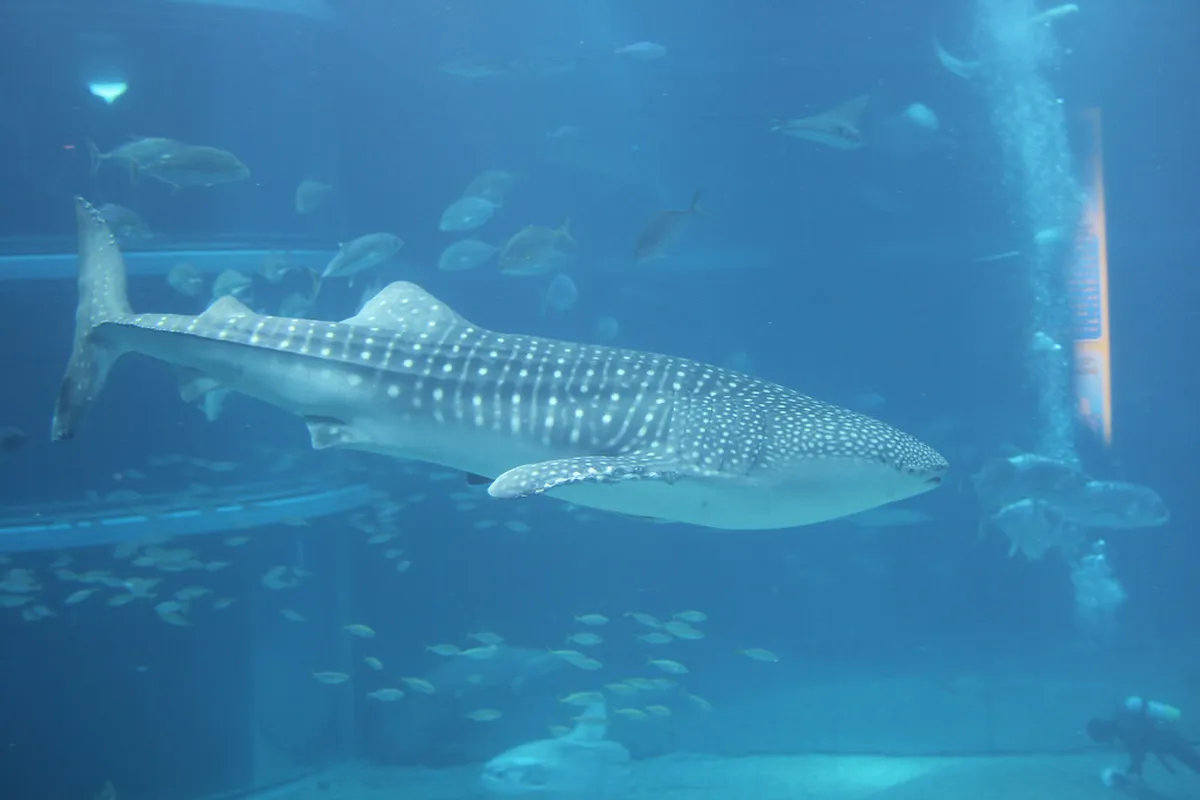
Most first-timers stop only at the first window they encounter on floor 7, which gives a top-down view of the whale sharks gliding beneath the surface. That view is spectacular, but the most dramatic perspective is floor 5, where the viewing window is at eye level with the mid-water column. At this level, you are looking directly into the shark's profile as it passes, and you can judge its true scale against the manta rays below. If you have children, floor 4 — the lowest panel — puts whale sharks directly overhead as they pass, which is reliably the most exciting viewpoint for kids.
Whale shark feeding sessions happen periodically and are announced on signage near the tank on the day of your visit. Staff feed from the surface, which causes the sharks to angle upward toward the light — visible from any floor. Arriving at the floor 5 window a few minutes before a scheduled feeding gives you the best position before crowds form.
Beyond the whale sharks, don't rush past the Pacific white-sided dolphins in the Tasman Sea tank, the spider crabs in the deep-sea zone (adult legspans can exceed 3 metres), or the sunfish — a species most visitors have never seen in person before. The spotted garden eel exhibit, located in a small offshoot of the main path near the children's section, is easy to miss. The eels poke upright from the sand and retract the moment they sense movement, so slow down and watch from a distance.
| Animal | Feeding times | Note |
|---|---|---|
| Whale sharks | Announced on-site | Check the board near the Pacific Ocean tank |
| Ringed seals | 10:20 and 15:05 daily | Verify on-site — times can change |
| Asian small-clawed otters | 11:30, 13:30, 15:30 daily | Japan Forest zone (floor 8) |
| Penguins | 10:20 and 14:30 daily | Verify on-site |
The Night Aquarium and Best Visiting Times
At 17:00 every day Kaiyukan transitions to the night aquarium — blue-purple lighting, ambient electronic music, and more active animals — at no extra cost. Enter around 16:00 to experience both the day and night atmosphere on a single admission.
At 17:00 every day, Kaiyukan transitions into the night aquarium. The daytime white lighting shifts to a deep blue-purple wash across the tanks. Background music changes from ambient nature sounds to something closer to ambient electronic. The effect is most striking around the Pacific Ocean tank and the Jellyfish Galaxy, where the luminescent quality of the water becomes significantly more pronounced. Animals also tend to be more active in the evening: whale sharks increase their circling pace, and the ringed seals become noticeably more playful.
There is no separate ticket or additional charge for the night aquarium. You do not need to exit and re-enter. If you enter at around 16:00, you experience about an hour of the day atmosphere and then the full evening transition — two experiences in a single admission. This is the recommended strategy for couples or anyone who finds the daytime crowds discouraging. Visitor density typically drops after 17:00 on weekdays.
For the quietest overall experience, a weekday opening (arrive before 10:30) gives you the lightest crowds on the upper floors and first access to the Japan Forest exhibit before tour groups arrive. Avoid Saturday and Sunday mornings during Golden Week, school holidays in July and August, and the New Year period — these are the heaviest attendance windows. If a weekend is unavoidable, entering after 16:00 for the night session is a reasonable alternative.
Dining and Souvenirs
Cafe R.O.F. is the only food and beverage outlet inside the paid zone. It sits at the rear of the Japan Trench exhibit, partway through the spiral route. Windows face Osaka Port, and a few seats have partial tank views. The menu is compact: the whale shark soft serve (¥440) is the signature item — a ramune-and-vanilla swirl coloured to match the animal's blue-and-white spotted pattern. The garden eel hot dog (¥800) is a 40-centimetre novelty sausage that references the slender shape of chin anago eels. The whale shark latte (¥530) has a cocoa powder art topping and photographs well. For a larger meal, exit and head to Naniwa Kuishinbo Yokocho in Tempozan Marketplace, which replicates 1960s Osaka street-food culture with vendors for takoyaki, okonomiyaki, and grilled squid.
The official souvenir shop is accessible once you enter the facility. Two additional shops are positioned near the exit. The whale shark plush toy with individually stitched gill slits is the bestselling item and is unique to Kaiyukan — not available in the general souvenir market. The shop also stocks exclusive collaboration items with Japanese stationery and tenugui brands that rotate seasonally. Budget around 30 minutes if you plan to browse seriously; queues at the exit shops can form on busy afternoons.
Photography Tips
The acrylic panels at Kaiyukan are very thick — necessary given the water pressure at depth — which introduces a noticeable warm-yellow tint in some areas. Shoot in manual white balance if your camera allows, targeting around 7,000K to counteract the tint in well-lit tank sections. Near the base of the Pacific Ocean tank, the light drops significantly and autofocus can struggle to lock onto fast-moving fish; set a wide aperture (f/1.8–f/2.8) and a shutter speed of at least 1/250s to freeze motion.
Flash is strictly prohibited throughout the facility and disturbs the animals. Use your free hand or a rubber lens hood pressed against the glass to eliminate reflections from the corridor lighting — this is especially useful on the middle floors of the Pacific Ocean tank where internal lighting is inconsistent. The Jellyfish Galaxy is a dark exhibit lit only by changing colour gels. Switch to ISO 3200–6400 and accept some grain; the slow drift of jellyfish means a shutter speed of 1/100s is usually adequate. The Arctic ringed seal tank overhead — where seals swim directly above visitors — produces a strong backlight; expose for the seals rather than the background water or faces will blow out.
What to Do Near Kaiyukan: Tempozan Harbor Village
The Tempozan Giant Ferris Wheel stands 112.5 metres tall immediately outside the aquarium. One rotation takes 17 minutes. Daytime views reach the mountains north of Osaka; after dark the wheel's LED display is visible from across the bay. It is operated by the same complex as the aquarium, and tickets are purchased separately at the base.
Families with younger children should factor in the Legoland Discovery Center, located inside the Tempozan Marketplace building. The Santa Maria sightseeing cruise departs from the harbour pier on a replica of Columbus's ship, circling Osaka Bay in about 45 minutes — a good option for the post-aquarium afternoon. Mount Tempozan, just behind the marketplace, is a grass mound of seven metres that carries the official distinction of Japan's lowest mountain; reaching the summit earns a certificate from the adjacent information point, which children enjoy.
For the evening, a Metro ride from Osakako brings you into the city centre in under 40 minutes. The neon circuit of Dotonbori is a natural follow-on, and the canal-front restaurants open late. Alternatively, head north to the Umeda Sky Building for the floating garden observatory, which closes at 22:30.
Frequently Asked Questions
How much are tickets for Osaka Aquarium Kaiyukan?
Adult tickets typically range from 2,700 to 3,500 yen depending on the date. Prices for children and seniors are lower, usually starting around 1,400 yen. It is best to check the Official Kaiyukan Ticket Info for the most accurate daily rates.
How long does it take to walk through Kaiyukan?
Most visitors spend between 2 and 3 hours exploring the various exhibit levels. If you stop for feeding times or a meal at the cafe, plan for 4 hours. The spiral path is roughly 1 kilometer long from top to bottom.
What is the best time to visit Osaka Aquarium?
The best time to visit is on a weekday morning right when the doors open. Alternatively, arriving after 5:00 PM for the Night Aquarium offers fewer crowds and a unique atmosphere. Avoid weekends and national holidays if you prefer a quieter experience.
Can you buy Kaiyukan tickets at the door?
Yes, you can buy tickets at the physical booths, but wait times can be long. During peak seasons, time-slot entries may sell out in advance. We recommend booking e-tickets online to guarantee your preferred entry time and skip the lines.
Is the Osaka Aquarium worth it?
The aquarium is widely considered one of the best in the world due to its scale and design. The chance to see whale sharks and diverse Pacific Rim wildlife makes it a high-value attraction. It is a must-visit for families and nature lovers visiting Japan.
Osaka Aquarium Kaiyukan offers an unforgettable journey through the Pacific Rim ecosystem. From the two resident whale sharks viewed across four floor levels to the meditative Jellyfish Galaxy and the surprise of the Arctic ringed seal tank overhead, the building is engineered to reveal something new with every descent.
Book your ticket in advance to lock in the weekday rate, arrive before 10:30 or after 16:00, and take the stamp book if you are visiting with children. The night aquarium transition at 17:00 is worth staying for at no extra cost.
Combine the aquarium with the Tempozan Ferris Wheel and Naniwa Kuishinbo Yokocho for a full harbour day, then continue into the city for dinner at Dotonbori or views from the Umeda Sky Building.


