
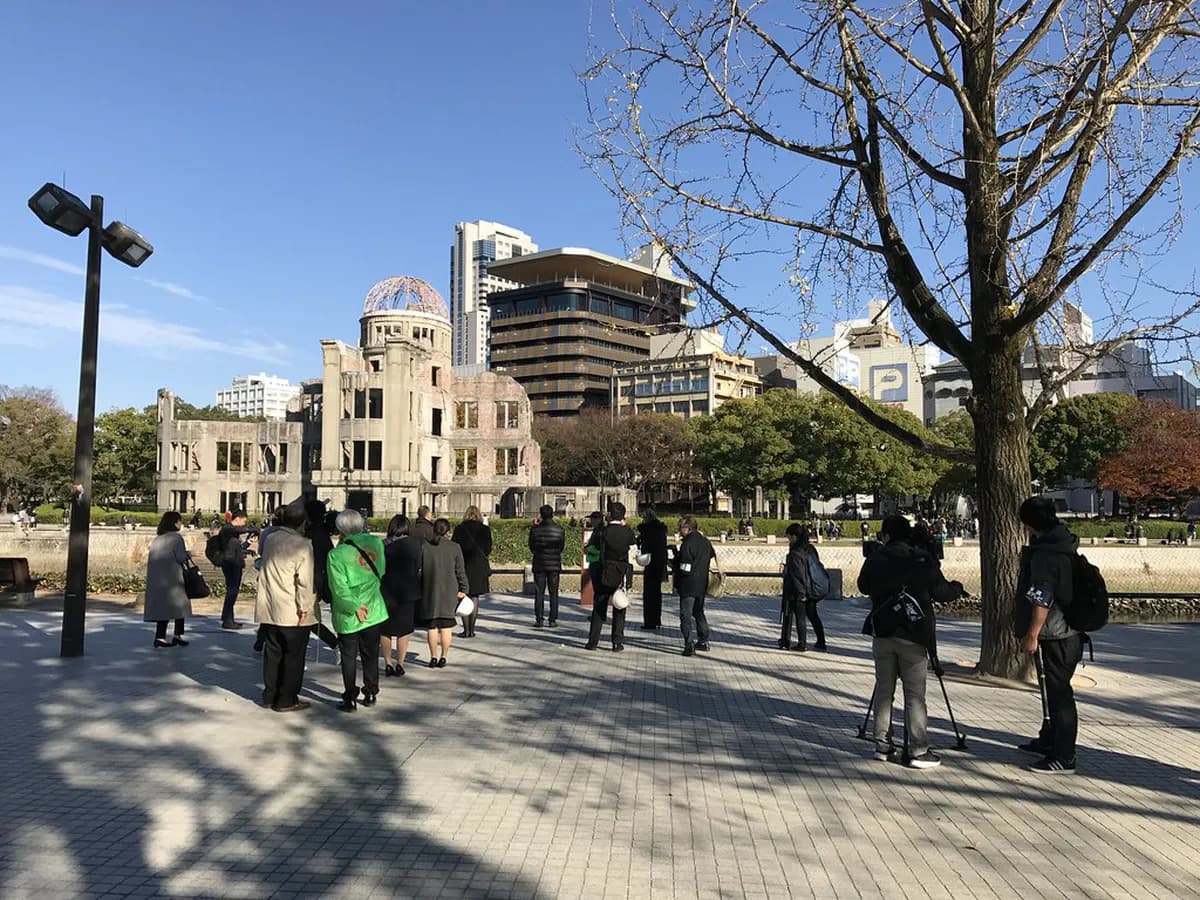
Hiroshima Peace Memorial Park is a 12-hectare green space in the center of Hiroshima, built on the ground zero of the 1945 atomic bombing. It draws over one million visitors each year and remains Japan's most powerful site for historical reflection.
The park is free to enter and open 24 hours. It contains the A-Bomb Dome, the Children's Peace Monument, the Cenotaph, the Flame of Peace, the Gates of Peace, and the entry point for the Peace Memorial Museum. Most visitors also want to know how to reach it, what to see first, and how long to allow.
This guide covers every major site inside the park, the surrounding peace attractions, practical transport details, and the timing choices that make a significant difference to your experience in 2026.
Background to the Hiroshima Peace Memorial Park
On 6 August 1945 at 08:15, the US B-29 bomber Enola Gay dropped the "Little Boy" atomic bomb above central Hiroshima. The bomb detonated at 580 meters altitude and immediately killed an estimated 70,000 to 80,000 people. By the end of 1945, the death toll reached between 90,000 and 166,000. About 69 percent of the city's buildings were destroyed.
The site where the bomb was aimed — the Aioi Bridge and the surrounding commercial district called Nakajima — was rebuilt as a memorial park. Designed by Japanese architect Kenzo Tange, the park opened in 1954. The Atomic Bomb Dome was added to the UNESCO World Heritage List in 1996, recognising the site as the preeminent monument to the dangers of nuclear warfare.
The park lies on a spit of land between the Motoyasu and Honkawa rivers, roughly 1.6 kilometers west of Hiroshima Station. Its layout is deliberate: the central axis runs from the A-Bomb Dome through the Cenotaph to the Peace Memorial Museum, so that standing at any of these three points, you look directly at the others.
What to See at Hiroshima Peace Park
The park covers 122,100 square meters and takes about 15 minutes to walk end to end without stopping. In practice, most visitors spend 90 minutes to two hours on the grounds before entering the museum. The major sites form a loose walking loop.
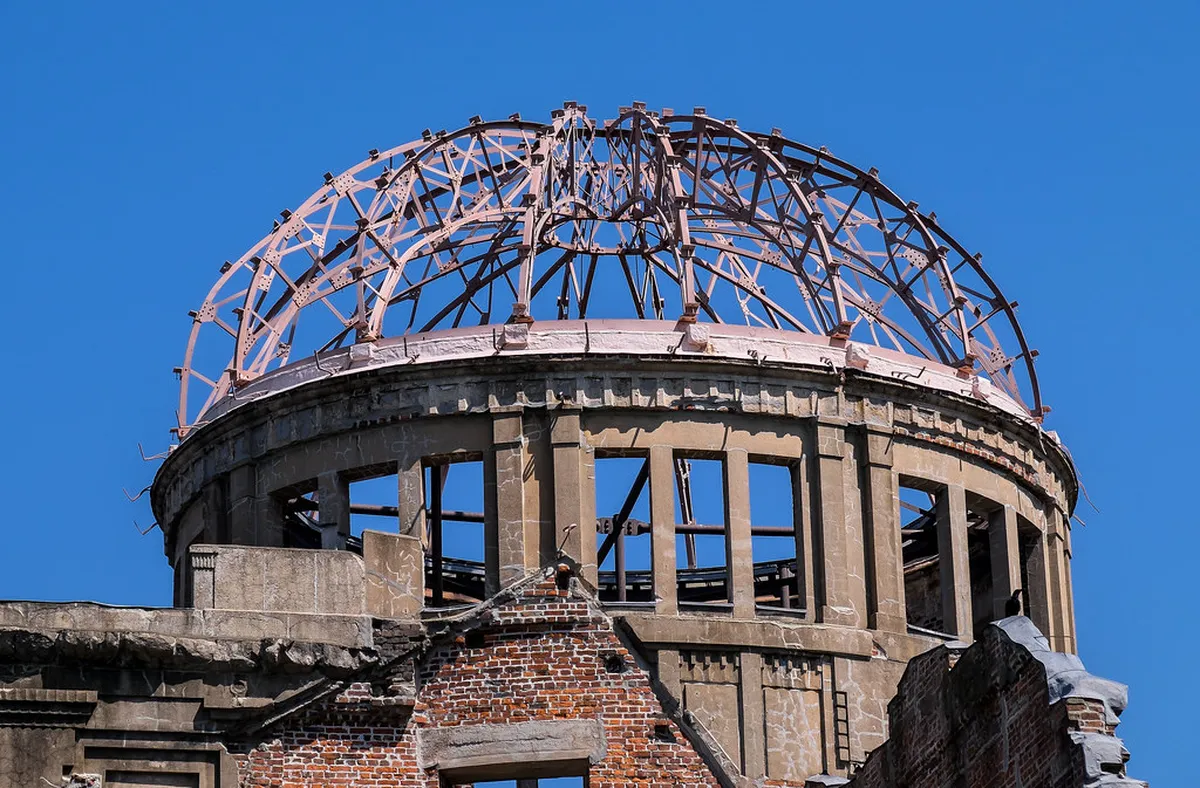
The Atomic Bomb Dome stands at the north end of the park, just across the Motoyasu River. It is the only structure near the hypocenter that survived with its framework largely intact, because the bomb detonated almost directly overhead, driving the blast force downward rather than outward. The building was the Prefectural Industrial Promotion Hall before the war, designed by Czech architect Jan Letzel in 1915. The ruins have been left exactly as they were after the bombing. After dark, the dome is illuminated and particularly striking from the riverside.
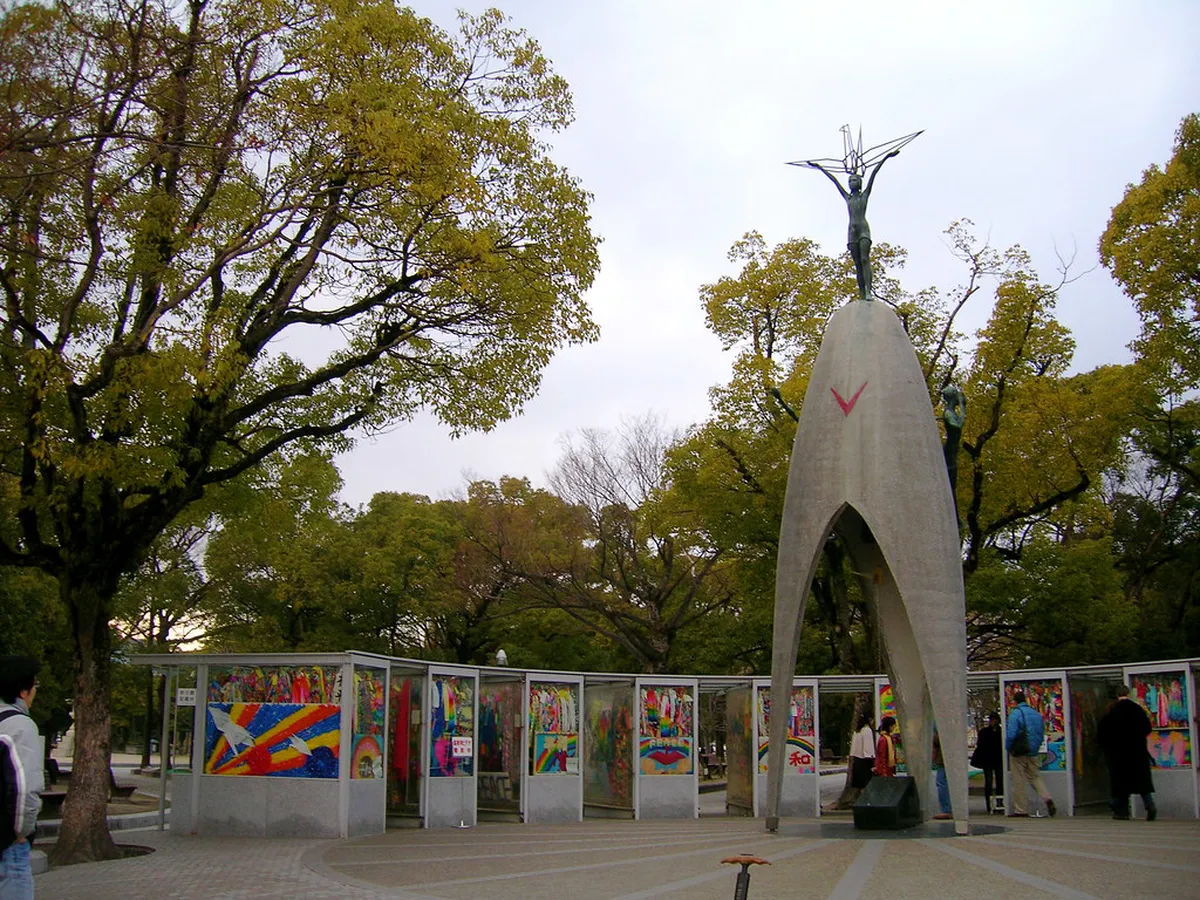
The Children's Peace Monument is a bronze statue of Sadako Sasaki holding a paper crane. Sadako was two years old when the bomb fell and died of leukemia in 1955, aged twelve, having folded over 1,000 paper cranes in the belief that doing so would grant a wish. Thousands of colorful crane chains are placed around the monument daily by visiting school groups and international travelers. If you bring your own folded cranes, you can add them to the collection — there is a designated area for donations.
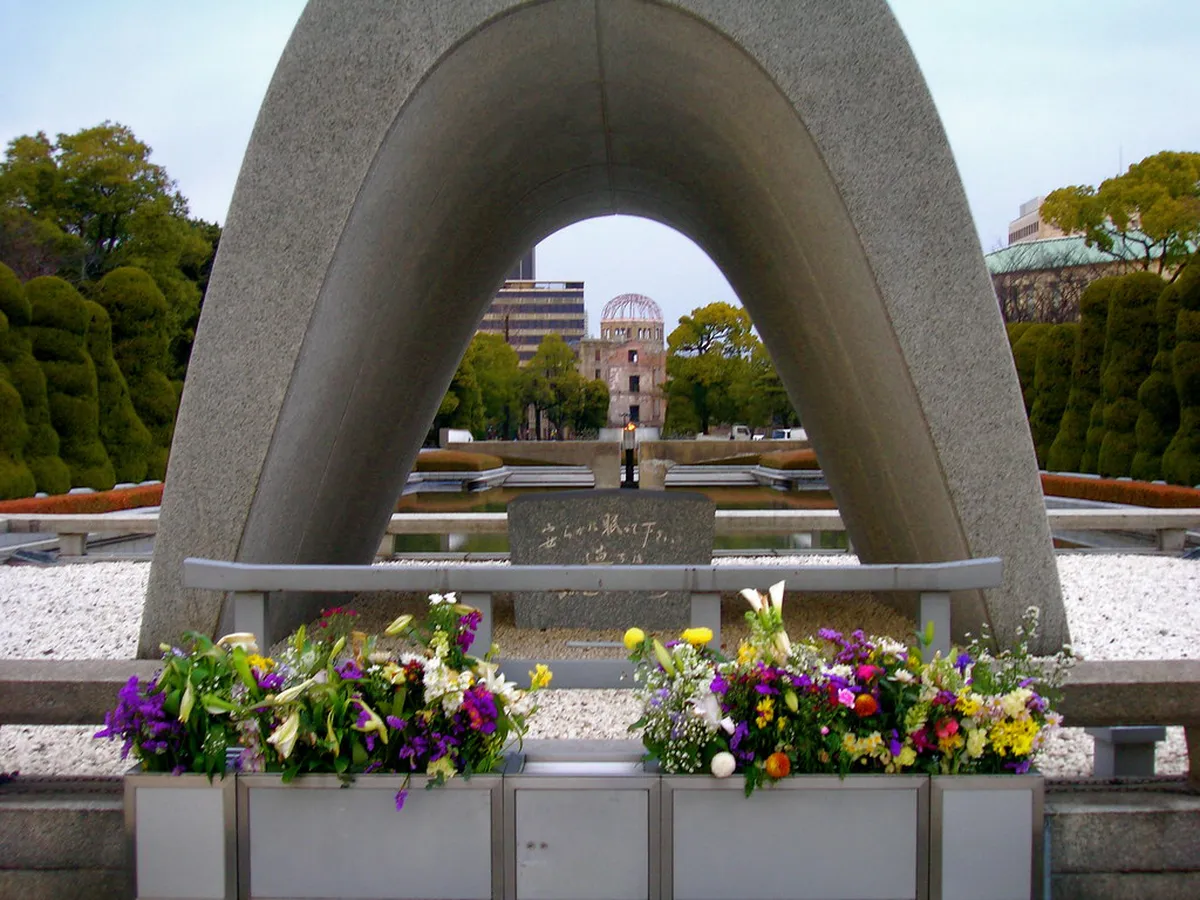
The Hiroshima Victims Memorial Cenotaph sits at the center of the park's main axis. The saddle-shaped arch shelters a stone chest containing the names of all confirmed victims of the bombing, now exceeding 330,000 names. New names are added each year. Looking through the arch, the Flame of Peace and the A-Bomb Dome align perfectly on the horizon — a view that is intentional in the park's design.
The Flame of Peace has burned continuously since it was lit in 1964 and will remain alight, according to the city's official pledge, until all nuclear weapons in the world are abolished. The Rest House, just south of the Cenotaph, is a pre-bombing survivor building. Its basement sheltered a supply clerk named Eizo Nomura, the only person known to have survived underground at such close range to the hypocenter. The basement is preserved as it was and is open to visitors — see the section below on lesser-known sites for details.
The Hiroshima Peace Memorial Museum
The Peace Memorial Museum spans two interconnected buildings at the south end of the park. The East Building covers Hiroshima's pre-war history and the political and military context for the bombing. The Main Building focuses on human impact: scorched clothing, melted lunch boxes, watches stopped at 08:15, photographs of victims, and survivor testimony.
Audio guides are available in fourteen languages including English, Korean, Chinese, French, Spanish, German, and Arabic. Renting one is strongly recommended — many of the most significant exhibits have minimal English signage without it. The museum shop on the first floor of the East Building sells books, origami paper, and peace-related souvenirs. The Aogiri Cafe on the same floor is a practical place to sit quietly for a few minutes after visiting the Main Building, which many visitors find emotionally intense.
Museum admission costs ¥200 for adults, ¥100 for high school students, and is free for children. Hours vary by season: March to November 07:30–19:00, August 07:30–20:00 (until 21:00 on 5 and 6 August), December to February 07:30–18:00. The museum closes only on 30 and 31 December. Last entry is 30 minutes before closing. Consult the Hiroshima Peace Memorial Museum's Official Webpage for any temporary closures or special exhibitions in 2026.
Allow at least 90 minutes inside the museum for a thorough visit. Many visitors allocate two to three hours. If you are visiting with children under ten, note that the Main Building contains graphic photographs and preserved human remains that some parents choose to skip; the East Building and the park grounds are suitable for all ages.
Peace Attractions In Hiroshima
Several significant peace sites cluster in and around the park. The Gates of Peace line the northern side of Peace Boulevard, just south of the park. Constructed in 2005 by French artist Clara Halter and architect Jean-Michel Wilmotte for the 60th anniversary of the bombing, the installation consists of ten glass and steel gates, each nine meters tall, with the word "Peace" inscribed in 49 languages and 18 different alphabets. The gates are part of a global Wall for Peace project. They are worth visiting after dark when the inscriptions are lit from within.
The Hiroshima Orizuru Tower stands immediately east of the A-Bomb Dome and offers a 50-meter observation deck with panoramic views of the park, the rivers, and on clear days, Miyajima Island. It is not a peace memorial in itself, but it provides useful orientation before your park walk. Opening hours are 10:00–18:00 (last entry 17:30); admission is ¥1,700 for adults.
The Hiroshima National Peace Memorial Hall for the Atomic Bomb Victims is located underground at the southwest edge of the park. It houses a registry of names and photographs of those killed, a Hall of Remembrance with a 360-degree panoramic photograph of the destroyed city taken from the hypocenter, and audio and video recordings of survivor testimony. Entry is free. Visit the Hiroshima National Peace Memorial Hall's Official Webpage for current opening times.
The Atomic Bomb Memorial Mound, near the northeast edge of the park, contains the ashes and unidentified remains of approximately 70,000 victims recovered from the rubble. The Korean Atomic Bomb Victims Cenotaph, located slightly outside the main park boundary, commemorates the estimated 20,000 Koreans — many of them forced laborers — who died in the bombing. Both are often missed by visitors who only follow the main walking axis.
The Rest House Basement and Honkawa Elementary School
Two sites near the park are frequently overlooked but offer some of the most personal encounters with the bombing's history. Neither charges admission, and both see far fewer visitors than the Peace Memorial Museum.
The Rest House basement is 170 meters from the hypocenter. On the morning of 6 August 1945, a supply company employee named Eizo Nomura was working in the basement. The floor above him was obliterated; he survived. The basement has been preserved in the condition it was found after the bombing and is accessible to visitors. The ground floor now functions as a tourist information and rest area. Most visitors walk past the Rest House without realising the basement is open — ask at the ground-floor counter to access it.
The Honkawa Elementary School Peace Museum is 410 meters from the hypocenter, along the Honkawa River north of the park. The school was in session when the bomb fell. About 400 children and 10 teachers were killed; two people survived. The original 1928 school building did not fully collapse and served as an emergency shelter and medical station in the days that followed. It was used as a school until 1988, then converted to a museum. The basement holds survivor interviews, personal artifacts, and documentary materials.
To enter, ring the bell at the gate and the museum director will admit you. Opening hours are 09:00–17:00 and entry is free. Because this museum receives far fewer visitors than the main Peace Memorial Museum, it offers a quiet and unusually personal experience. It is about a ten-minute walk north along the river from the A-Bomb Dome.
Tips for Visiting Hiroshima Peace Memorial Park
Arrive before 09:00 for near-silence and the best morning light on the A-Bomb Dome. The park is open 24 hours, so dawn visits are entirely possible and genuinely memorable. Tour groups begin arriving from mid-morning onwards.
Arrive before 09:00 if you can. Tour groups and school excursions arrive in large numbers from mid-morning onward, and the areas around the Cenotaph and Children's Monument become very crowded. The park is open around the clock, so early morning gives you near-silence and softer light for photographs near the A-Bomb Dome.
The August 6 Peace Memorial Ceremony draws tens of thousands of attendees and parts of the park close to the public. If you plan to attend, arrive by 07:00 to secure a viewing position and carry water — August temperatures regularly exceed 32°C with 80%+ humidity.
The August 6 Peace Memorial Ceremony takes place at 08:00 every year in the park, exactly at the time of the bombing. It is free and open to the public. Seating is limited and allocated early; the surrounding area fills with observers standing in the heat. If you plan to attend in 2026, arrive by 07:00 and bring water. The museum stays open until 21:00 on 5 and 6 August to accommodate the increased attendance.
On the question of behavior: the park is a functioning public space, but most visitors treat it with quiet respect. Eating and loud conversation are common on the benches near the riverside, but at the Cenotaph and Children's Monument, visitors typically speak softly. Photography is permitted everywhere in the park and museum except where posted otherwise. Some exhibits in the museum's Main Building feature photographs that visitors may want to prepare for.
If you are visiting with paper cranes to donate, fold them in advance. There are designated crane donation points at the Children's Peace Monument. The colorful crane chains are changed regularly by volunteers; the donated cranes are ultimately recycled into paper products or displayed at the museum.
How to Get to Peace Memorial Park from Hiroshima Station
| Route | Time | Cost | JR Pass? |
|---|---|---|---|
| Hiroden tram (lines 2 or 6) → Genbaku Dome-mae | ~15 min | ¥220 | No |
| Meipuru-pu loop bus (all routes) → stop 7 | Varies | ¥400 day pass | No |
| Taxi from Hiroshima Station | ~10 min | ¥1,000–1,500 | No |
| Walk from Hondori shopping street | ~15 min | Free | — |
The most direct route from Hiroshima Station is the Hiroden tram (Hiroshima Electric Railway), lines 2 or 6. Board at Hiroshima Station, ride to the Genbaku Dome-mae stop, and you exit directly in front of the A-Bomb Dome. The journey takes about 15 minutes and costs ¥220 each way. Trams run frequently from early morning to around midnight.
Alternatively, the Meipuru-pu sightseeing loop bus stops at Peace Memorial Park / Hiroshima Peace Memorial Museum (stop number 7). All four loop bus lines — orange, green, yellow, and blue — serve this stop. A day pass for the loop bus costs ¥400 and is useful if you plan to visit multiple attractions. Japan Rail Pass holders should note that the tram and loop bus are not covered by the JR Pass; they require a separate fare or the loop bus day pass.
The park is also walkable from the city center. From Hondori shopping street, it is about a 15-minute walk west. Taxis and rideshare apps are available from Hiroshima Station if you prefer a direct transfer, costing approximately ¥1,000–¥1,500 depending on traffic. Bicycle rental is available at several locations near the station and is a practical option for a full day that combines the park with Hiroshima Castle or Shukkeien Garden.
How to Plan a Full Hiroshima Attractions Day
Most visitors combine the Peace Memorial Park with one or two other Hiroshima sites in a single day. A practical sequence starting from Hiroshima Station: arrive at the park by 08:30, walk the park grounds and memorials (90 minutes), visit the Peace Memorial Museum (90 to 150 minutes), then walk to the Honkawa Elementary School Peace Museum for a quieter second perspective (30 to 45 minutes). This takes you to early afternoon with the major peace sites covered.
From there, the Hiroshima Castle is a 20-minute walk northeast and provides a contrasting look at the city's pre-war military history. The Mazda Museum requires a free advance reservation and is in the Fuchu district, a 15-minute tram ride from the city center — it works better as a standalone half-day visit rather than an add-on.
If you are heading to Miyajima Island (Itsukushima Shrine), the JR ferry departs from Miyajimaguchi Station. JR Pass holders can use the JR ferry from Miyajimaguchi to Miyajima at no additional cost. The journey from Hiroshima Station to Miyajimaguchi takes about 25 minutes on the JR Sanyo Line. Plan at least two hours on the island to walk to the shrine, see the floating torii gate, and return — a half-day minimum from central Hiroshima.
Most of the central attractions are within tram or walking distance of each other, making Hiroshima a manageable city for self-guided exploration. The park itself is the anchor; plan everything else around it and give it the time it deserves.
Frequently Asked Questions
How much time should you plan for a Hiroshima Peace Memorial Park visitor guide?
You should set aside at least three to four hours to explore the park and museum fully. This allows enough time for reflection and reading the detailed exhibits. If you plan to visit the castle or gardens, a full day is better. Learn more about the city at Hiroshima.
Is the Hiroshima Peace Memorial Museum suitable for young children?
The museum contains graphic images and intense historical accounts that might be difficult for very young children. Parents should use discretion when deciding to take kids through certain exhibit halls. The outdoor park area is very open and suitable for all ages to walk through. Many families focus on the Children's Peace Monument.
What is the best way to get around Hiroshima?
The city's tram system, known as Hiroden, is the most iconic and efficient way to travel. It connects the main station to the Peace Park and other major districts easily. Walking is also very practical within the central downtown area. JR Pass holders should utilise the free loop bus service for convenience.
Hiroshima Peace Memorial Park is the most important site in Hiroshima and one of the most significant historical landmarks in Japan. The park, the museum, and the surrounding peace attractions together form a complete picture of what happened in August 1945 and why it matters in 2026.
Arrive early, move slowly through the grounds, and leave time for the sites that most guided tours skip — the Rest House basement and the Honkawa Elementary School Peace Museum offer perspectives that the main museum cannot replicate. The park stays with you long after you leave.
Plan your wider Hiroshima trip: see our Hiroshima attractions guide, Hiroshima itinerary, Hiroshima culture guide for routing, pacing, and what to slot in alongside this stop.

