

Ginkaku-ji, the Silver Pavilion, sits at the foot of Kyoto's Higashiyama mountains in the Sakyo Ward at coordinates 35.027°N, 135.798°E. Built in 1482 as a retirement villa for Shogun Ashikaga Yoshimasa, the temple was converted into a Zen temple of the Rinzai sect after his death in 1490 and is now managed by the Shokoku-ji Group. Unlike its flashier counterpart Kinkaku-ji, Ginkaku-ji rewards visitors with understated elegance: meticulously raked sand gardens, a moss garden designed by Zen master Soami, a reflective pond, and a hillside lookout that frames the entire temple complex against the Kyoto skyline.
This guide covers every section of the one-way garden circuit, exact access details from Kyoto Station, 2026 admission prices, and practical timing advice that most competitor guides miss — including why the last hour before closing is one of the best times to arrive.
Hours & Admission
| Detail | Information |
|---|---|
| Opening hours (Mar–Nov) | 08:30–17:00 daily |
| Opening hours (Dec–Feb) | 09:00–16:30 daily |
| Adult admission | ¥500 |
| Children (primary/middle school) | ¥300 |
| Last entry | No fixed cutoff — enter up to closing time |
| Closed | Never (open all national holidays) |
Ginkaku-ji is open daily with no closing days, including national holidays. From March through November the gates are open 08:30–17:00. From December through February hours shorten to 09:00–16:30. Admission is 500 yen for adults and 300 yen for primary and middle school children. Your ticket includes a decorative paper ofuda (talisman) as a souvenir, and the small paper stub functions as a bookmark-sized keepsake many visitors keep.
One detail most guides overlook: unlike many Kyoto temples, Ginkaku-ji does not enforce a "last admission 30 minutes before closing" rule. You can enter at 16:59 in summer and still walk the full circuit before staff begin politely directing people toward the exit about 20 minutes after official closing time. Visiting in the final hour dramatically reduces crowds — the grounds feel almost empty compared to the midday rush.
Ginkaku-ji has no last-entry cutoff — you can enter right up to closing time and still complete the full garden circuit. The final hour before closing is one of the quietest windows of the day, with far fewer visitors than midday.
How to Get to Ginkaku-ji
There is no train or subway station within a 30-minute walk of the temple — bus is the only practical option from central Kyoto. From Kyoto Station take City Bus #5, #17, or #100 (the "Raku" tourist loop) to the Ginkakuji-michi stop. The ride takes approximately 35–40 minutes and costs 230 yen one way. From the stop, walk 10 minutes east along the shop-lined approach road to reach the ticket gate.
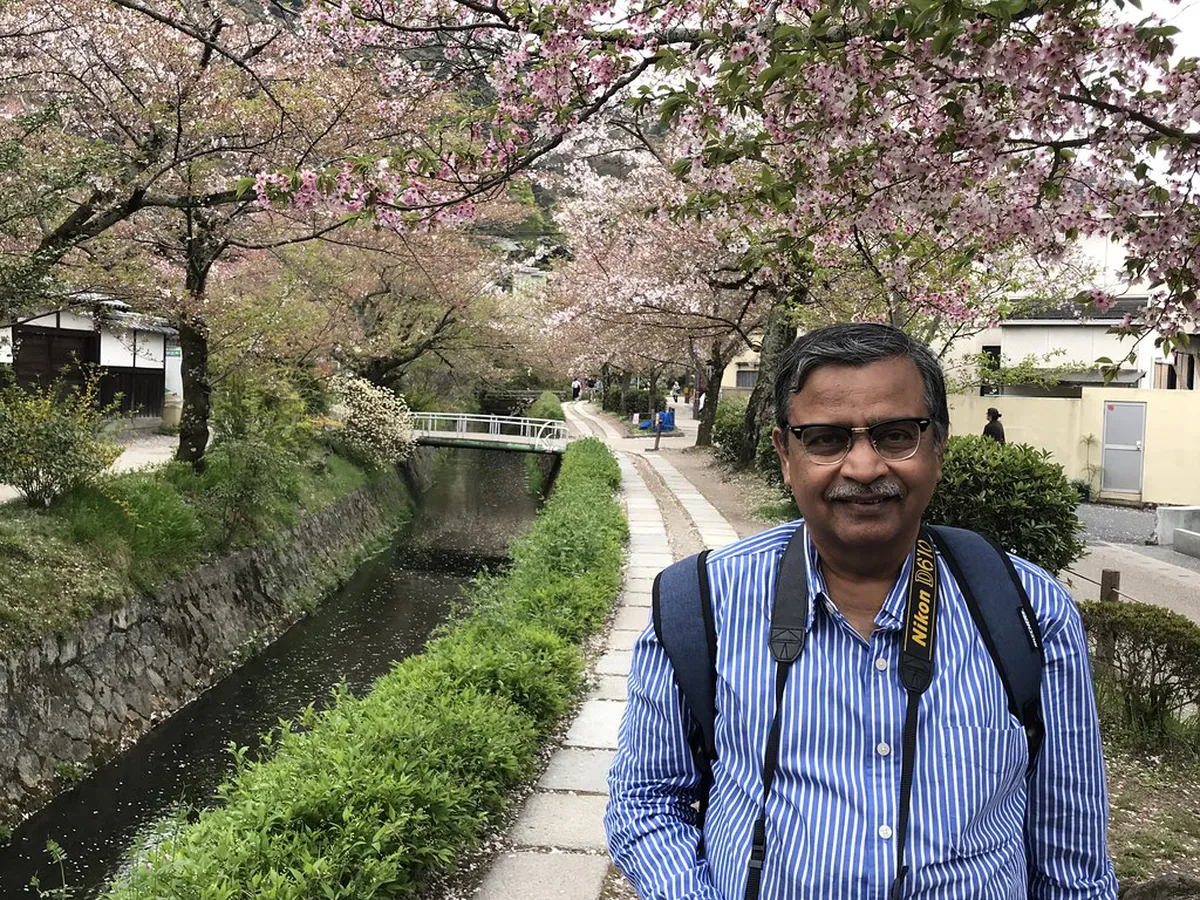
If you are coming from the Nanzen-ji area or Heian Shrine, Ginkaku-ji is a short 25-minute walk north along the Philosopher's Path canal — the most scenic approach to the temple. Start at the southern end of the Philosopher's Path near Nanzen-ji, follow the canal north past cherry trees and small cafes, and arrive directly at the Ginkaku-ji approach street. This route is strongly recommended in spring (late March to early April) and autumn (late October to mid-November) when foliage along the canal is at peak color.
The Sand Garden and Moon Viewing Platform
The first major feature you encounter after passing the ticket gate is the Sea of Silver Sand (Ginshadan) — a vast expanse of white gravel raked into precise parallel rows. In the center stands the Moon Viewing Platform (Kogetsudai), a truncated cone of sand approximately 1.8 meters tall that represents Mount Fuji. The cone is thought to reflect moonlight into the main pavilion hall, though its precise symbolic purpose is still debated by historians.
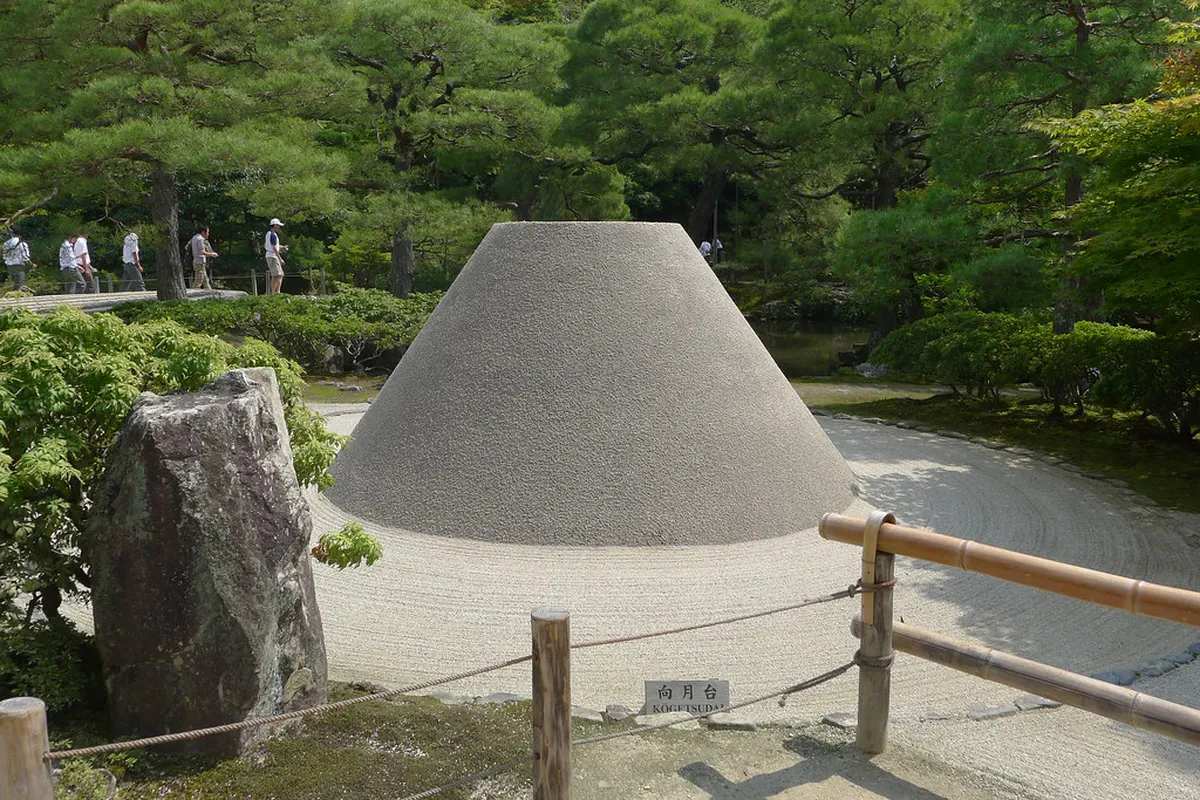
If you visit early in the morning, you will catch the groundskeepers methodically re-raking the rows and removing fallen leaves with small bamboo tools. The process takes over an hour and the geometric precision they achieve by hand is striking. The white gravel contrasts sharply with the dark wood of the pavilion facade during golden hour, making the sand garden the most-photographed section of the complex.
The Silver Pavilion: What You Can Actually See
The main pavilion building (Kannon-den) is the centerpiece of the complex and the first structure you see from the sand garden. It combines two architectural styles: the lower floor follows a shinden residential hall style, while the upper floor is built in Zen Buddhist temple style. Each roof shingle is made from Japanese cypress bark secured with bamboo nails rather than metal, which would rust and stain the wood over centuries.
You cannot enter the Silver Pavilion building — it is not open to the public. The visit is an exterior garden circuit. You walk around the pavilion and view it from multiple angles; the interior is glimpsed only through partially open doors. Managing this expectation prevents the most common visitor disappointment.
Here is a practical detail that surprises many first-time visitors: you cannot enter the Silver Pavilion. The building is not open to the public. You walk around it, view it from multiple angles along the circuit path, and can peer through partially open doors to glimpse the interior — including the statue of Kannon, the Buddhist goddess of mercy, to whom Yoshimasa prayed each evening. Managing expectations around this point prevents the disappointment some visitors report after expecting a walkable interior.
Adjacent to the pavilion is the Togudo, a National Treasure building that served as Yoshimasa's study. It contains Japan's oldest surviving dedicated tea ceremony room (a 4.5-tatami space called Dojinsai), which is credited as the prototype for all subsequent tearoom designs. Like the main pavilion, it is viewable only from the exterior during standard visits.
Moss Garden and Reflective Pond
From the Togudo the circuit path climbs slightly onto the hillside and enters the moss garden, attributed to the 15th-century Zen landscape designer Soami, who also created celebrated gardens at Ryoan-ji and Daisen-in. The moss here is a dense carpet of several dozen species maintained at near-constant humidity by the small stream that runs through the garden. Tiny arched bridges cross the stream, and the scale of the space — intimate and shaded — produces an immediate sense of enclosure that the open sand garden does not.
Just below the moss garden sits a reflective pond. Manicured pine and maple trees grow to its edge, their canopies mirrored in the still water. In autumn the maple reflections turn the pond surface deep red and orange. Early morning and late afternoon are ideal viewing times because direct midday sunlight destroys the reflection. The pond is also where you are most likely to see koi moving slowly in the shallows beneath overhanging branches.
Between the moss garden and the pond you will find the main hall (Hondo), where Yoshimasa refined the art of the tea ceremony during his retirement. Though the interior is closed, the sliding doors are sometimes left ajar enough to see painted wall panels. The design language of this building — plain unvarnished wood, asymmetric windows, and an absence of decorative excess — directly influenced the wabi aesthetic that defines traditional Japanese arts to this day. Exploring these origins helps connect the site to the wider Kyoto attractions scene, particularly tea houses and machiya townhouses throughout the city.
Lookout Point
The one-way circuit continues from the pond up a short steep path to a lookout at the crest of the hill behind the temple. The elevation gain is modest — around 30 meters — but the view is disproportionately rewarding. From the top you see the full temple complex laid out below: the silver-dark pavilion, the white geometry of the sand garden, and the green density of the moss garden, all framed by the residential rooftops of Northern Higashiyama extending toward Kyoto's basin.
The descent follows a different path back through the garden, looping past the pavilion one final time before returning to the exit. This second pass at the pavilion, now viewed from a different angle, often reveals architectural details missed on the first pass — the layered roof lines, the veranda proportions, and the way the building's dark lacquer absorbs rather than reflects the surrounding greenery.
Why Is It Called the "Silver" Pavilion
The building has never been clad in silver. The name was almost certainly assigned as a counterpart to Kinkaku-ji (the Golden Pavilion), built by Yoshimasa's grandfather Ashikaga Yoshimitsu. The most widely cited theory holds that Yoshimasa planned to coat the pavilion in silver leaf but depleted his treasury — a real possibility given that Kyoto was in the grip of the Onin War (1467–1477) during construction. The shogun's cultural spending came at enormous political cost.
A competing theory, noted by some scholars, is that the nickname was applied more than a century after construction to create a deliberate contrast with Kinkaku-ji for tourist and pilgrim purposes. Under this reading, the name was always metaphorical: the dark lacquered exterior reflects moonlight with a cool, silver-like luminescence on clear nights. Both theories are plausible and the question remains genuinely open — which is part of what makes the pavilion intellectually interesting beyond its visual appeal.
Planning Your Visit: Timing and Crowds
Ginkaku-ji draws large crowds year-round. The quietest windows in 2026 are the first 30 minutes after opening (08:30 March–November) and the final hour before closing. Midday visits, especially on weekends and during cherry blossom season (late March to early April) and autumn foliage (late October to mid-November), should be avoided if solitude matters to you. The temple sits at the northern end of Philosopher's Path, so a practical strategy is to walk the 2-kilometer canal path from Nanzen-ji north to Ginkaku-ji, arriving just as the gate opens.
The full garden circuit takes 45–60 minutes at a relaxed pace. Photography enthusiasts should budget an additional 30 minutes, particularly in the moss garden and at the pond. The approach street outside the gate has several shops selling matcha sweets and yatsuhashi (cinnamon rice crackers) — a short browse here before entering makes a useful warm-up activity while early-arriving crowds thin.
Families with young children will find the paths well-paved and manageable. The steepest section is the final climb to the lookout, which involves about 40 steps — strollers are not practical beyond the lower garden. Admission remains one of the most affordable among Kyoto's UNESCO-listed sites at 500 yen adult / 300 yen child, with no additional charges for any section of the garden.
Staying Near Ginkaku-ji
Northern Higashiyama is a quieter base than Kyoto Station or Gion, with the Philosopher's Path, Nanzen-ji, and Heian Shrine all within a 20–30 minute walk. The area has a concentration of traditional ryokan along small side streets, where rates typically run 12,000–25,000 yen per person per night with dinner and breakfast. Budget travelers can find business hotels closer to the Okazaki area, a 15-minute walk southwest, at 6,000–10,000 yen per night. Review your options in a Kyoto travel guide to match accommodation style with the rest of your itinerary.
Frequently Asked Questions
How much time should you plan for ginkaku-ji (silver pavilion) visitor guide?
Most visitors spend about 45 to 60 minutes exploring the temple grounds and gardens. This allows enough time to walk the hillside path and view the sand garden. If you enjoy photography, you might want to add an extra 30 minutes to your schedule.
Which ginkaku-ji (silver pavilion) visitor guide options fit first-time visitors?
First-time visitors should focus on the main pavilion and the Sea of Silver Sand garden. Taking the hillside path to the lookout point is also essential for the best views. Pairing the visit with the nearby Philosopher's Path creates a perfect half-day itinerary in Kyoto.
Is ginkaku-ji (silver pavilion) visitor guide worth including on a short itinerary?
Yes, it is highly recommended even for short trips due to its unique Zen atmosphere. It offers a more peaceful experience than the crowded Gion district. The temple showcases a different side of Kyoto's history that is very memorable.
Ginkaku-ji remains a vital part of any comprehensive Kyoto travel experience.
Its understated beauty provides a perfect balance to the city's more flamboyant sites.
We hope this ginkaku-ji (silver pavilion) visitor guide helps you plan a meaningful visit.
Enjoy the serene atmosphere and timeless architecture of this remarkable Zen temple.
For more Kyoto planning, see our Things to Do in Kyoto, Kyoto Itinerary, and Kyoto Culture guides.


