

Exploring the oldest wooden buildings in the world is a highlight for many travelers in Japan. This horyu-ji temple visitor guide helps you navigate one of the nation's most sacred sites, from the five-story pagoda to the quiet octagonal hall where Prince Shotoku once meditated. You will find incredible history and peaceful beauty just a short train ride from central Nara.
Founded over 1,300 years ago in the small town of Ikaruga, the temple complex is divided into two main precincts housing 48 buildings and hundreds of national treasures. Its UNESCO listing in 1993 recognised it as a site of global significance. Use this guide to make the most of your time here in 2026.
Horyu-ji Nara History: Birthplace of Japanese Buddhism
Emperor Yomei vowed to build a temple in the name of Buddha to pray for recovery from illness, but died before he could fulfill that wish. His son, Prince Shotoku, carried out the promise and completed the first Horyu-ji in 607 AD. The name means "Temple of the Flourishing Law," reflecting Shotoku's ambition to make Buddhism the spiritual foundation of the new Japanese state.
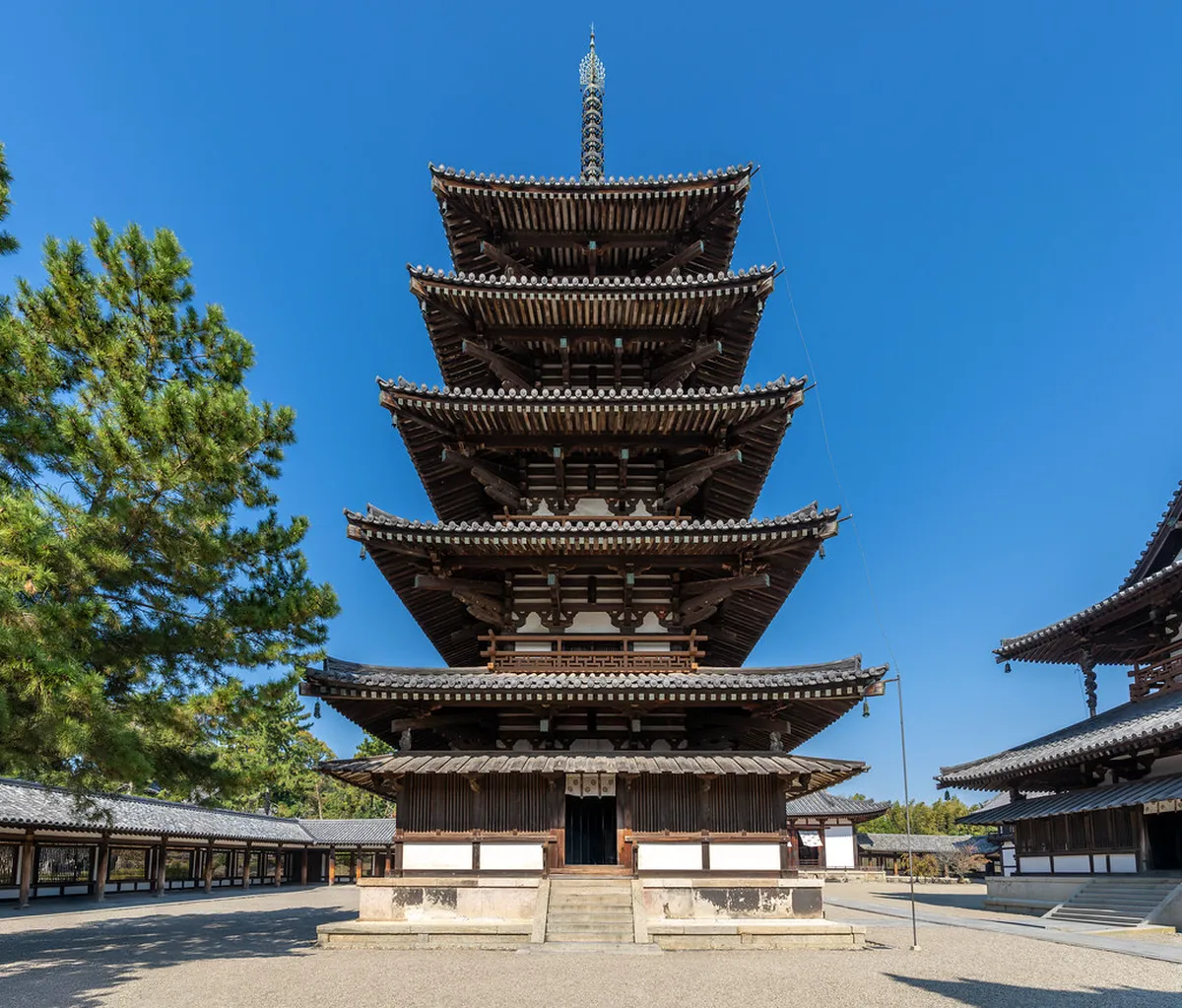
A fire destroyed the original buildings in 670, but reconstruction began almost immediately. The structures you see today date to the late 7th and early 8th centuries, making them some of the oldest surviving wooden buildings on Earth. The timber in parts of the Kondo has been dated to over 1,300 years old by dendrochronology.
UNESCO recognised the site in 1993 as Japan's first World Cultural Heritage listing, designating it the "Buddhist Monuments in the Horyu-ji Area." Unlike later Zen temples in Kyoto, Horyu-ji reflects the early continental influence from China and Korea that arrived during the Asuka period (593–710). Visiting here offers a rare look at Japanese Buddhism before it developed its distinctly local character.
What to See Inside Horyu-ji Temple
The Western Precinct (Saiin Garan) is where you enter after buying your ticket. Walk through the Central Gate (Chumon), flanked by two fearsome guardian statues called Nio, and you arrive in the main courtyard. Straight ahead stands the Five-Story Pagoda (Gojunoto), 32.5 metres tall and Japan's oldest surviving five-storied wooden pagoda. At the base of the pagoda, four clay relief tableaux depict scenes from the Buddha's life — these can be viewed through the latticed screens on each side.
To the right of the pagoda is the Kondo (Golden Hall), widely regarded as the world's oldest surviving wooden building. Inside you will find a 7th-century bronze Shaka Triad attributed to sculptor Tori Busshi, cast in honor of Prince Shotoku. The interior walls once held famous murals similar to those at Ajanta in India, though most were damaged in a 1949 fire; full-scale reproductions now hang in their place. Interior photography is not permitted inside the Kondo.
At the north end of the precinct, the Daihozoin (Great Treasure Gallery) is a modern climate-controlled museum holding the finest artifacts from both precincts. The highlight is the Kudara Kannon, a tall slender figure carved from a single piece of camphor wood that is considered a masterpiece of Asuka-period sculpture. The Tamamushi Shrine, decorated with the iridescent wings of jewel beetles, also lives here and gives a rare glimpse of 7th-century lacquerwork and decorative painting. Entrance to the museum is included in the general ticket.
The Eastern Precinct (Toin Garan) is a five-minute walk through the temple grounds. Its centrepiece is the Yumedono (Hall of Dreams or Hall of Visions), an octagonal building constructed in 739 on the exact site where Prince Shotoku is said to have meditated. Inside is the Kuse Kannon, a life-sized lacquered statue of Shotoku that was kept hidden for centuries and is only displayed during two short windows each year: April 11 to May 18 and October 22 to November 3. If your visit falls outside these dates you can still admire the hall's unusual architecture — it is the oldest octagonal building in Japan. Behind the Eastern Precinct is the small Chuguji nunnery, which charges a separate ¥600 admission and houses the celebrated Miroku Bosatsu half-figure, famous for its serene "thinking pose."
Horyu-ji Entrance Fee & Opening Hours
The combined ticket covering the Western Precinct, Daihozoin museum, and Eastern Precinct costs ¥1,500 for adults, ¥1,000 for junior-high and high-school students, and ¥750 for elementary-school children. There is no separate charge for the individual precincts; one ticket covers all three areas. Payment is cash only at the main ticket booth near the South Great Gate.
Opening hours run 08:00–17:00 from February 22 to November 3, and 08:00–16:30 from November 4 to February 21. Last admission is 30 minutes before closing. The grounds are open year-round with no days off. Keep your ticket stub, as staff check it at the entrance to each of the three paid areas.
| Visitor category | Admission fee |
|---|---|
| Adults | ¥1,500 |
| Junior high / high school students | ¥1,000 |
| Elementary school children | ¥750 |
| Chuguji nunnery (separate) | ¥600 |
| Open hours (22 Feb – 3 Nov) | 08:00 – 17:00 (last entry 16:30) |
| Open hours (4 Nov – 21 Feb) | 08:00 – 16:30 (last entry 16:00) |
The ticket booth is cash-only — no credit cards accepted. The nearest convenience store ATM is about a 10-minute walk back toward Horyuji Station. Plan your cash (¥1,500 per adult plus optional ¥600 for Chuguji) before you arrive.
Exterior photography is freely permitted across the grounds, courtyards, and garden paths. Interior photography is prohibited inside the Kondo, pagoda interior, and Daihozoin museum. The Chuguji nunnery next to the Eastern Precinct charges its own ¥600 admission if you want to see the Miroku Bosatsu.
Best Time to Visit Horyu-ji for Fewer Crowds
Horyu-ji is significantly quieter than the temples inside Nara Park because it requires a deliberate train journey. That said, tour buses from Osaka and Kyoto typically roll in between 09:30 and 11:30, and again after 13:00. Arriving when the gates open at 08:00 gives you roughly 90 minutes of near-solitude in the courtyards, which is the best time to appreciate the architectural proportions of the pagoda without groups blocking the view.
Weekdays are noticeably calmer than weekends. The shoulder seasons of late March to early April (cherry blossom on the approach path) and mid-October to mid-November (maple colour against the dark wooden eaves) offer the best combination of light, temperature, and manageable crowds. Summer in Ikaruga is hot and humid; the temple grounds offer little shade between the buildings, so budget extra time for water breaks. Winter visits are possible and the low-angle light is excellent for photography, but the closing time shifts 30 minutes earlier.
The Kuse Kannon display windows (April 11–May 18 and October 22–November 3) are the busiest periods of the year because visitors specifically plan trips around them. If you want to see the statue but avoid peak congestion, aim for a weekday during the first week of the display period rather than the final weekend.
Horyu-ji Temple Location
The temple sits in Ikaruga, a small rural town in Ikoma District, about 12 km southwest of central Nara. Its official address is 1-1 Horyuji Sannai, Ikaruga-cho, Ikoma-gun, Nara Prefecture 636-0115. Unlike the temples in Nara Park, there are no deer here — the setting is quieter and more rural, surrounded by farmland and traditional houses.
Getting here is straightforward. From JR Nara Station take the JR Yamatoji Line to Horyuji Station (11 minutes, ¥220). From the station exit on the north side, you can walk 20 minutes along a flat, well-signed route, or catch a Nara Kotsu bus (lines 72 or 97) eight minutes to the Horyuji-mae stop. From Kyoto Station, take the JR Miyakoji Rapid to Nara, then transfer to the Yamatoji Line; total journey time is around 60–75 minutes. From Osaka (Tennoji), the direct Yamatoji Line reaches Horyuji Station in about 25 minutes.
Parking is available at a lot about five minutes' walk from the South Gate. The fee is ¥500 per car. The surrounding streets have English signage directing visitors to the main entrance.
Horyu-ji Temple Map & Walking Route
A practical visit follows a simple west-to-east circuit. From the South Great Gate (Nandaimon), walk straight into the Western Precinct, spend 45–60 minutes at the pagoda, Kondo, and lecture hall (Daikodo), then pass through the northern exit to reach the Daihozoin museum (30 minutes). Continue east along the connecting path to the Eastern Precinct and the Yumedono (20 minutes). The total walking distance inside the paid areas is about 1.2 km. Allow 2–3 hours for a thorough visit, or 1.5 hours if you move at a moderate pace.
Free English-language brochures with a numbered map are available at the ticket booth. If you prefer a guided explanation, the English Goodwill Guide service at Horyu-ji offers free volunteer tours by retired local residents who speak functional English. You can find them near the Chumon (Central Gate) on most mornings. Contact the Ikaruga ICES group at ikaruga@kcn.ne.jp to arrange a guide in advance. This is a genuine community service: guides expect no payment and typically spend 90 minutes walking visitors through both precincts.
Buddhist Monuments in the Horyu-ji Area: Adding Hokki-ji
The UNESCO designation covers not just Horyu-ji but also Hokki-ji, a smaller temple about 2 km west of Horyuji Station. Hokki-ji was completed in 708, also built to honor Prince Shotoku's wishes, and it holds Japan's oldest three-storied pagoda, a 24-metre structure regarded as a textbook example of Asuka-period timber architecture. The pagoda has been untouched since the early 8th century and the proportions are widely studied by architectural historians.
The Hokki-ji grounds are much smaller than Horyu-ji and take about 30 minutes to see. Admission is a modest ¥300 donation. The pond in front of the pagoda creates a clean reflection that is a favourite among photographers. There are few facilities, but several vending machines on the route keep the walk manageable. If the weather is good, walking the 2 km between the two temples takes 25 minutes through flat countryside farmland — a complete contrast to temple-dense city tourism.
Including Hokki-ji adds roughly two hours to your day (walking time plus the visit), and is best suited for travelers with a genuine interest in Asuka-period architecture rather than those on a fast central Nara loop. Many people combine Horyu-ji with a visit to Yakushi-ji further along the JR line, making it a full-day itinerary across Nara Prefecture's ancient temple corridor.
Things to Know Before Visiting Horyu-ji
Bring cash. The ticket booth does not accept credit cards as of 2026, and there are no ATMs on the immediate grounds. The nearest convenience store (with an ATM) is about a 10-minute walk back toward the station. Plan your budget before you arrive: ¥1,500 per adult for Horyu-ji, ¥300 for Hokki-ji, ¥600 if you add Chuguji nunnery.
Wear comfortable, flat shoes. The paths inside the precincts are gravel and stone, and you will cover at least 1–2 km between the Western Precinct, museum, and Eastern Precinct. Footwear that slips easily on and off is not necessary here — unlike some Japanese sites, there is no shoe removal required for the outdoor structures. Interior halls that require shoes to be removed are signed clearly at the entrance.
Buddhist temple etiquette at Horyu-ji is similar to other Japanese temples. Bow before passing through the main gates. Speak quietly inside the enclosed precincts. Do not touch the wooden columns or statues. Smoking is not permitted anywhere on the grounds. Unlike Shinto shrines, you do not clap at Buddhist temples — a quiet bow is the appropriate gesture at each hall.
Food options inside the complex are minimal. There are a few small shops and a simple cafe near the South Gate selling drinks, soft-serve ice cream, and snacks. For a full meal, return to the area around Horyuji Station, which has a handful of small restaurants, or combine your visit with lunch back in central Nara or at one of the spots near Kofuku-ji.
Why Horyu-ji Is Worth Adding to Your Japan Itinerary
While Todai-ji draws visitors with its enormous bronze Buddha, Horyu-ji offers something different: architectural antiquity and an unhurried atmosphere. The buildings predate Todai-ji by nearly a century. If Todai-ji represents imperial power at its peak, Horyu-ji represents the moment Buddhism arrived in Japan and began to take shape.
For travelers interested in the technical history of building, Horyu-ji is a rare opportunity to examine 1,300-year-old timber joinery up close. The bracketing systems that hold the Kondo's roof without nails have informed Japanese carpentry for centuries and remain structurally intact. Modern architects and engineers still visit to study how the original builders managed wood expansion and ground movement.
The site is also genuinely manageable as a half-day trip from central Nara, Kyoto, or Osaka. It does not require a full day and it pairs naturally with the Asuka-period temple corridor along the JR Yamatoji Line. For first-time visitors to Japan who want depth beyond the obvious Kyoto circuit, Horyu-ji offers the kind of historical weight that is hard to find anywhere else in the world.
Tour buses from Osaka and Kyoto typically arrive between 09:30 and 11:30. Reaching the gates at 08:00 opening gives you roughly 90 minutes in near-solitude — the best way to appreciate the Five-Story Pagoda's proportions without groups blocking the view.
Pokémon Manhole Covers in Ikaruga
All five of Nara Prefecture's Pokémon manhole covers (Poke Lids) are located in Ikaruga town, within walking distance of the temple. None are in central Nara city. The covers feature Fletchinder and Deerling, Magby and Chimecho, Bellsprout and Growlithe, Bronzong and Simisear, and a standalone Entei cover near the temple approach. Searching for them adds a free, low-effort activity for families or Pokémon fans and naturally leads you through the quiet residential streets between the station and the temple.
You can find the exact GPS coordinates for each cover on the Poke Lids website. Walking all five in sequence from the station to the temple takes about 30 extra minutes one-way. The covers are permanent installations and have become a small but reliable draw for a certain type of traveler who pairs cultural heritage with modern pop culture on the same afternoon.
Frequently Asked Questions
How do I get to Horyu-ji from Kyoto?
Take the JR Miyakoji Rapid from Kyoto Station to Nara Station, then transfer to the JR Yamatoji Line. Get off at Horyuji Station and walk or take a bus to the temple. The total travel time is usually around 60 to 75 minutes. Learn more about nearby temples to visit on your way back.
Is Horyu-ji temple worth the 1,500 yen fee?
Yes, the fee is worth it because it includes access to the world's oldest wooden buildings and a massive museum. You see hundreds of national treasures that are not available anywhere else. Most travelers spend 2-3 hours exploring the three main paid areas included in the ticket.
What is the best time to visit Horyu-ji for fewer crowds?
Arrive right when the gates open at 8:00 AM to enjoy the grounds before the tour buses arrive. Weekdays are generally much quieter than weekends or national holidays. Visiting during the shoulder seasons of late autumn or early spring offers the best balance of weather and peace.
Can I see the temple in a half-day trip?
A half-day trip is perfect if you are coming from Nara or Osaka. You should allow about three hours for the temple itself and another hour for travel. This leaves you enough time to return to the city for lunch or to visit Nara Park in the afternoon.
Horyu-ji remains one of the most significant cultural landmarks in all of Japan. This horyu-ji temple visitor guide has shown you the best ways to experience its ancient wooden halls and priceless art, from the five-story pagoda to the rare seasonal display of the Kuse Kannon. Whether you are a history enthusiast or a first-time Japan traveler, the site offers a depth that is difficult to find anywhere else.
Plan your transport, bring cash, and time your arrival before 09:00 to get the most peaceful experience. Adding Hokki-ji or the Pokémon manhole covers turns the visit into a full and varied afternoon. You will leave with a genuine sense of having stood inside some of the oldest human-made structures still standing on Earth.
For more Nara planning, see our 20 Best Nara Attractions, and Nara Itinerary for First-Timers guide.


