

Sumiyoshi Taisha stands as one of the most significant Shinto shrines in all of Japan. Founded around the 3rd century, it serves as the head shrine for over 2,300 Sumiyoshi shrines nationwide and draws more than 2.3 million visitors during the New Year period alone. This sacred space offers a quiet retreat from the high-energy streets of Osaka city center, and its architecture predates Buddhist influence on Japanese design by several centuries. As one of the key things to do in Osaka, Sumiyoshi Taisha rewards careful exploration.
The shrine is famous for the dramatically arched Sorihashi Bridge, four National Treasure main halls built in the rare Sumiyoshi-zukuri style, and a layered set of ritual experiences that most visitors only scratch the surface of. This guide covers the history, sightseeing highlights, ritual customs, practical logistics, and the best seasonal timing for your 2026 visit.
Sumiyoshi Taisha Shrine
Sumiyoshi Taisha is dedicated to three sea deities — Sokotsutsu no Mikoto, Nakatsutsu no Mikoto, and Uwatsutsu no Mikoto — collectively known as the Three Sumiyoshi Deities (Sumiyoshi Sanjin). They were originally worshipped by sailors and fishermen as guardians of maritime navigation. When the shrine was founded, the coastline of Osaka Bay ran much closer to its current location; the land has since expanded westward, leaving the shrine landlocked but spiritually tethered to the sea.
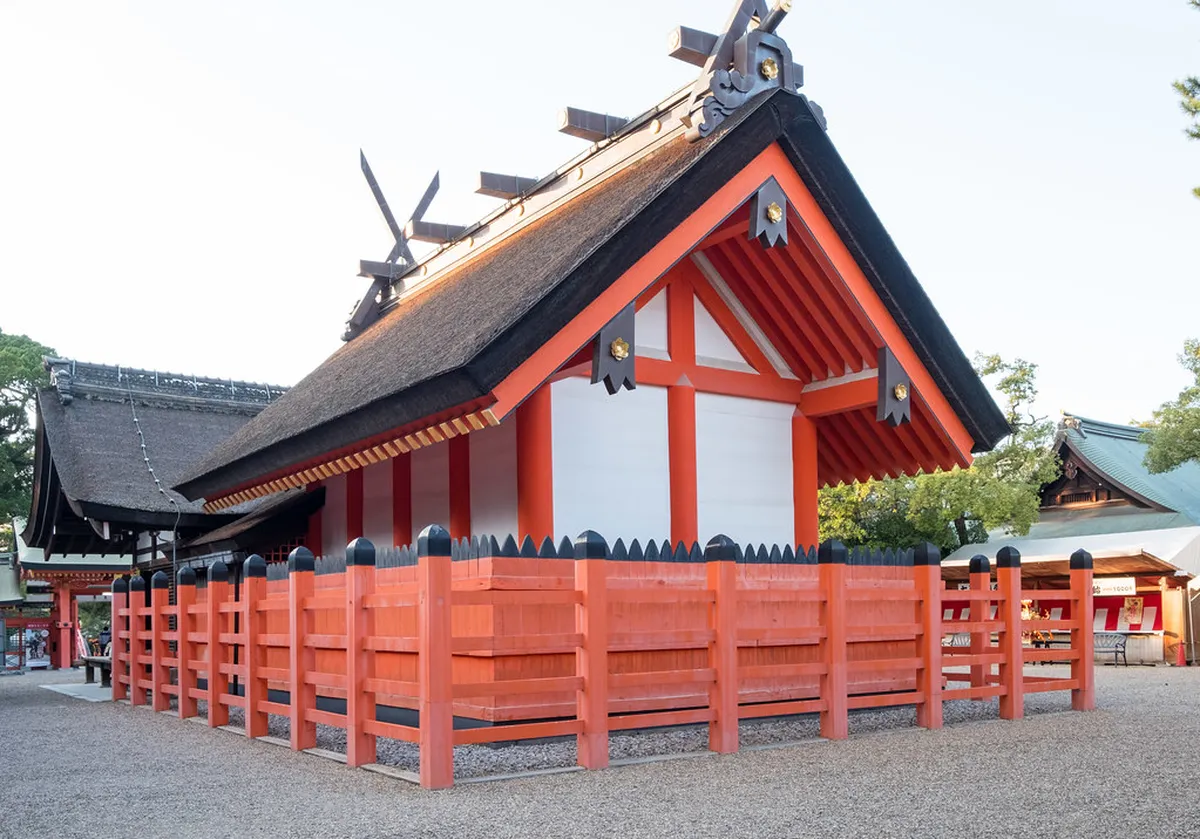
A fourth deity, the spirit of Empress Jingu, is enshrined in the fourth main hall. According to tradition, she personally ordered the shrine's construction after receiving divine guidance before a naval expedition to the Korean peninsula. That maritime connection explains why the four main halls face west — toward the sea — rather than the south or east orientation common at other shrines.
The shrine appears in major works of Japanese literature, including the world's oldest novel, the Tale of Genji, written in the early 11th century. Nobel Prize-winning author Yasunari Kawabata also referenced it in his work. This literary prominence reflects how deeply embedded Sumiyoshi Taisha is in Japan's cultural identity, not merely as a religious site but as a recurring symbol of arrival, departure, and safe passage.
Must-See Sumiyoshi Attractions
The Sorihashi Bridge is the most iconic landmark within the shrine grounds. Also called Taiko-bashi (drum bridge), it spans a pond near the main entrance with a strikingly steep arch — the incline reaches roughly 48 degrees at the peak. On calm mornings, the vermillion railings reflect in the water below to form a nearly perfect circle, which is how the bridge earned its "drum" nickname. Take your time on the descent; the surface becomes slippery in wet weather, and handrails are provided on both sides. Visitors with mobility limitations can bypass the bridge entirely via flat ground-level paths on either side.
The four main halls (Honden) arranged in a unique parallel-offset formation are all designated National Treasures. Three halls align in a row while the fourth sits slightly offset — an arrangement said to resemble a fleet of ships. These halls are the best place to appreciate Sumiyoshi-zukuri architecture in its original setting: look for the straight thatched roofline, forked chigi finials on the gables, and the red-and-white colour scheme that sets this style apart from Buddhist-influenced shrines like Shitenno-ji.
The Goshogozen is widely regarded as one of Japan's most powerful spiritual spots. Hidden within the decorative white pebbles are three small stones marked with the characters for five (五), great (大), and power (力). Searching for all three by hand is a tactile ritual unlike anything at comparable shrines. When your wish is granted, tradition asks that you return the stones and bring three new ones — a respectful exchange that creates a second reason to come back.
Near the main entrance, the giant Issunboshi Bowl references the Japanese fairy tale of a thumb-sized hero who set sail from this very spot in a rice bowl. Children can sit inside a large replica bowl for photos, making it a reliable hit for families.
Sumiyoshi-Zukuri Architecture and Cultural Heritage
Sumiyoshi-zukuri is one of Japan's oldest styles of shrine architecture and can only be seen in its full four-hall expression here. The style is defined by a linear roof shape — sometimes described as resembling an upturned book — with cypress-bark roofing (hiwadabuki), vermillion-painted pillars, and white gofun (ground-seashell) plaster walls. The rooflines stay straight rather than curving upward at the eaves, which gives the halls a grounded, austere quality compared to later shrine designs influenced by Tang-dynasty China.
Over 600 stone lanterns line the pathways throughout the grounds. Each was donated by wealthy merchants and sea captains who survived difficult voyages, making them material records of gratitude rather than mere decoration. Examining the carvings on the oldest lanterns reveals the artistic conventions of craftsmen from the Edo period — subtle floral motifs, calligraphic donor inscriptions, and small representations of the deity's symbols.
The shrine museum (Sumiyoshi Taisha Shiryokan), located behind the main compound, displays historical artifacts including ancient festival implements, scale models of the shrine's layout at different periods, and objects from the periodic ritual rebuilding (shikinen-sengu) of the main halls. The museum is often overlooked by first-time visitors who spend their time near the bridge; allow an additional 30 minutes if you want to see it.
Sumiyoshi Taisha also holds a long connection to Japanese poetry and classical literature. Several stone monuments inscribed with verses from the Man'yoshu poetry anthology stand near the garden areas. The shrine is one of the meisho (famous places) most referenced in classical waka poetry, a detail that rewards readers who come with some prior knowledge of Japanese literary tradition. This depth of Osaka culture and heritage runs deeper than typical shrine visits.
Hatsumode and the Best Times to Visit in 2026
Between January 1–3 (Hatsumode), over 2.3 million visitors pass through the grounds. A visit that normally takes 45 minutes can stretch to two hours. January 4–7 retains the festive atmosphere with a fraction of the crowd.
Hatsumode — the first shrine visit of the New Year — is Sumiyoshi Taisha's most intense period. Between January 1st and 3rd, more than 2.3 million people pass through the grounds, making this one of the busiest Hatsumode sites in western Japan. A visit that would normally take 45 minutes can stretch to two hours or more due to entry queues. If you want to experience the energy of Hatsumode without the extreme congestion, January 4th to 7th offers a practical window: New Year decorations and sacred shimenawa (straw ropes) remain in place until January 15th, and the atmosphere retains its festive character with a fraction of the crowd.
The Sumiyoshi Festival (Sumiyoshi Matsuri) runs from July 30th to August 1st and marks the ceremonial end of Osaka's summer festival season. On July 31st, the Nagoshi-no-Harae purification ritual takes place, during which elegantly dressed women and children — and any willing visitors — pass through a large ring woven from cogon grass (chinowa) to cleanse the sins and impurities of the first half of the year. The climactic moment falls on August 1st with a massive mikoshi (portable shrine) procession that crosses the Sorihashi Bridge and continues to the Yamato River for purification. The entire route fills with food stalls, drumming, and residents carrying the heavy structure through the streets. Plan for hot, humid weather: 34–37°C is common at this time of year, so light clothing and hydration are essential.
Dragon Days (Hattatsu Mairi) fall on the 12th, 24th, and 36th days of each 60-day traditional calendar cycle. On these days, business owners from across the Osaka region come specifically to the Nankun-sha lucky-cat shrine within the grounds to pray for steady prosperity. If you arrive on a Dragon Day without knowing it, expect congestion near that corner of the grounds that feels disproportionate to the rest of the shrine. Check in advance if you prefer a quieter visit.
Outside these peak periods, early morning from 06:00 is the most rewarding time. The gravel paths are quiet, the morning light hits the vermillion bridge railings at a flattering angle before 09:30, and you have the best chance of watching the resident priests complete their opening ceremonies undisturbed.
The Nankun-sha Lucky-Cat Pilgrimage Most Visitors Miss
Within the shrine grounds, the Nankun-sha (楠珺社) sub-shrine sits beneath a camphor tree said to be over 1,000 years old. Most foreign visitors walk past it after a brief glance at the rows of small cat figurines. What they miss is that each cat is actually a dated token in a long-running personal pilgrimage called Hattatsu Mairi, dedicated to gradual, compounding prosperity rather than a single wish.
The mechanics work as follows: on each Dragon Day visit, worshippers receive a small maneki-neko (lucky cat) amulet. In odd months of the traditional calendar, the cat raises its left paw to beckon more people; in even months, the right paw is raised to invite wealth. Over successive visits across years, pilgrims exchange their accumulated small cats for progressively larger ones — a physical representation of long-term growth that has no equivalent ritual at the main halls. The largest cats kept by long-term devotees can be 20–30 centimetres tall.
For travelers, this is not something you can replicate elsewhere in Osaka. Even if you are visiting just once, receiving the small cat amulet and understanding the system adds a dimension that elevates a standard sightseeing stop into a genuine encounter with a living local tradition. The amulet office near Nankun-sha is open during regular shrine hours; the cats cost a few hundred yen.
How to Pray and Ritual Etiquette
At the main hall, the standard Shinto approach is: bow twice, clap twice, make your wish silently, then bow once more. Toss a small offering coin into the wooden offering box before bowing — five-yen coins are considered lucky because the Japanese word for five yen (go-en) sounds like the word for "connection." Drop the coin gently rather than throwing it with force.
Near the main shrine buildings, look for the Omokaru-ishi — a stone whose apparent weight is said to change based on whether your wish will be granted. The ritual involves holding your wish clearly in mind, making a small offering, then lifting the stone twice. If it feels lighter on the second lift, tradition suggests your wish may come true. The stone is a modest palm-sized object, not a dramatic boulder, but the ritual draws a steady stream of visitors throughout the day.
The amulet office (omamori uriba) near the main hall complex offers distinctive charms including the Kakitsukehimo, which symbolises the shrine's sea-deity connection. When receiving any charm, accept it with both hands and avoid opening the packaging while still on the grounds. Photography inside the main halls is not permitted. Private ceremonies in progress should not be photographed, and flash should be avoided near any ritual area. For unobstructed exterior shots of the Taiko-bashi bridge, arrive before 09:30 before tour groups begin arriving.
Camphor Trees, Gardens, and Outdoor Spaces
The outdoor spaces at Sumiyoshi Taisha are arranged around four connected ponds. Wide paths covered in white sand lead through groves of tall pine trees, creating a buffer between the sacred ground and the modern city that becomes physically tangible the moment you pass through the outer torii gate. The Meotogusu (Couple Camphor) near the main compound is a pair of trees whose trunks merged together over their roughly 800-year lifespan; they stand 19.5 metres tall and are considered an omen of lasting partnership. The Sennengusu (Thousand-Year Camphor), with a trunk circumference of 9.8 metres and a height of 18.5 metres, has a small sub-shrine at its base and exerts a presence that photographs consistently fail to convey.
Seasonal changes bring entirely different moods to the grounds. Cherry blossoms appear in late March to early April. Late autumn brings maples to the garden areas near the secondary shrines. In winter, the bare camphor canopy and low-angle light give the stone lanterns a particularly striking quality that summer humidity obscures. Adjacent Sumiyoshi Park, a short walk from the outer torii, is a popular local picnic spot during cherry blossom season and provides a natural extension of a morning visit.
The primary rest area, Shokotei, offers bench seating in a garden setting on the eastern side of the compound. The Sumiyoshi Taisha Chaya tearoom on the same side serves matcha and seasonal Japanese sweets — a practical stop after spending time on the sand-covered paths in summer heat. Public restrooms are available at three locations across the grounds, which matters more than it sounds given the size of the site.
Family-Friendly and Budget-Friendly Options
Entry to Sumiyoshi Taisha is free year-round. There is no admission fee for the main grounds, all four National Treasure halls, the Sorihashi Bridge, the garden areas, or the Goshogozen stone-hunting ritual. You only spend money if you choose to purchase charms, talismans, or ema (wooden wishing plaques). This makes it one of the most cost-effective half-days available in Osaka, especially given its scale.
The Issunboshi Bowl installation near the entrance is reliably popular with children. The oversized rice bowl from the Japanese fairy tale about the one-inch hero gives kids a photo opportunity that feels genuinely playful rather than manufactured. The Nankun-sha lucky cat rows are another hit — children often want to count how many cats are lined up, which can easily occupy them for several minutes while adults look more carefully at the camphor trees.
The main paths are flat and well-maintained, making the grounds navigable with a stroller. The Sorihashi Bridge is not accessible for wheelchairs, but the flat bypass paths on either side cover the same ground without the incline. Benches are distributed throughout the site. The overall layout is compact enough that even young children who tire quickly can complete a circuit of the main highlights in under an hour without being carried far.
Admission Fees and Opening Hours
Entry to Sumiyoshi Taisha is free. The grounds open at 06:00 from April through September and at 06:30 from October through March. Closing time is 17:00 year-round. The Sorihashi Bridge is accessible during the same hours. The on-site museum keeps shorter hours and is sometimes closed on weekdays; check the official website (sumiyoshitaisha.net) before planning your visit around it.
The shrine address is 2-9-89 Sumiyoshi, Sumiyoshi-ku, Osaka 558-0045. The phone number for enquiries is 06-6672-0753. The shrine never closes entirely — even outside staffed hours, the outer torii and some outer paths remain accessible — but the main halls and amulet offices are only open during the hours above.
How to Get There and Plan Your Visit
The fastest route from central Osaka is the Nankai Main Line from Namba Station to Sumiyoshitaisha Station — about 10 minutes on a local train, fare approximately ¥250. The shrine is a 3-minute walk east from the station exit. A common mistake is boarding the subway to a station simply labelled "Sumiyoshi," which requires a 20-minute walk to reach the shrine rather than the 3-minute stroll from the Nankai line stop. The Hankai Tramway from Tennoji (transfer from the JR Loop Line at Tennoji Station) stops at Sumiyoshi Torii-mae Station, essentially at the outer torii gate — a slower but genuinely atmospheric option through residential southern Osaka. Note that none of these routes are covered by the JR Pass.
Most visitors spend 45 to 60 minutes on the main highlights: the Sorihashi Bridge, the four main halls, and the Goshogozen ritual. Allow 1.5 to 2 hours if you plan to visit the museum, participate in multiple rituals, or spend time at the Nankun-sha lucky-cat shrine. Budget travelers can easily combine this with a walk through Shinsekai, which is about 20 minutes north by tram, for a half-day that costs almost nothing outside food. For a more structured Osaka itinerary, build Sumiyoshi Taisha into a full-day cultural circuit.
The Sorihashi (Drum Bridge) incline reaches about 48 degrees at the peak and becomes slippery in wet weather. Visitors with limited mobility can bypass it entirely via flat ground-level paths on either side.
Wear comfortable shoes with grip. The gravel paths are manageable in most footwear, but the Sorihashi Bridge is steep and the wooden surface can be slick after rain. Bring water in summer — the open gravel areas between the main halls offer very little shade during midday, and July/August temperatures regularly reach 35°C. Vending machines are located near the entrance, but having your own supply is more convenient once you're inside the grounds.
If you are planning a wider Osaka itinerary, the Osaka Castle area and the shrines of southern Osaka connect well for a full cultural day. Check the Nankai and Hankai tram schedules before you leave to avoid long waits on the return journey.
Frequently Asked Questions
What is the Sumiyoshi Festival?
The Sumiyoshi Festival is a major Shinto event held in late July to celebrate the shrine's deities. It features a grand parade where a massive portable shrine is carried to the Yamato River for purification. You can see similar vibrant energy in the Dotonbori district during summer celebrations.
How long to spend at Sumiyoshi Taisha?
Most visitors find that 1.5 to 2 hours is sufficient to see the main halls and the arched bridge. If you plan to participate in the stone-hunting ritual at Goshogozen, add an extra 30 minutes. The peaceful grounds are perfect for a slow-paced morning walk.
Is Sumiyoshi Taisha worth visiting?
Yes, it is absolutely worth visiting for its unique architecture and deep historical roots. As one of Japan's oldest shrines, it offers a distinct aesthetic compared to later Buddhist-influenced structures. It provides a quiet, spiritual contrast to the modern hustle of central Osaka.
Which sumiyoshi taisha visitor guide options fit first-time visitors?
First-time visitors should focus on the Sorihashi Bridge and the four National Treasure main halls. Following a guided path that includes the lucky cat shrine and the ancient camphor trees ensures a complete experience. Using a digital map helps navigate the large grounds easily.
Sumiyoshi Taisha rewards visitors who come with some preparation. Its free entry, pre-Buddhist architecture, and layered ritual traditions — from the Goshogozen stone hunt to the Nankun-sha lucky-cat pilgrimage — offer more depth than a single visit can exhaust. Early mornings on a non-Dragon Day weekday outside the New Year period give you the grounds nearly to yourself. The combination of authentic Shinto atmosphere, practical accessibility, and zero admission cost makes it one of the most worthwhile stops in southern Osaka.
Whether you come for the summer festival procession, a quiet January morning, or simply to cross the arched bridge and understand why this shrine has appeared in Japanese poetry for over a thousand years, the experience holds. Plan for at least 90 minutes and build the Nankun-sha lucky-cat corner into your route.


