

Shitenno-ji Temple stands as a monumental landmark in the bustling city of Osaka. Founded in 593 AD, this sacred site remains the oldest officially administered temple in all of Japan. Prince Shotoku established the grounds to introduce Buddhist teachings to the nation during the Asuka period. Visitors can explore a serene complex that balances ancient history with vibrant local traditions.
Modern travelers often seek a comprehensive shitenno-ji temple visitor guide to navigate the sprawling grounds. The temple offers a peaceful escape from the neon lights of nearby shopping districts. You will find beautiful gardens, towering pagodas, and unique folklore hidden within the stone walls. For broader planning, see our guide to things to do in Osaka. Planning your trip correctly ensures you see the best spiritual highlights and seasonal events.
History and Significance of Japan's First State Temple
Prince Shotoku invited skilled Korean craftsmen to build the original structures in the late sixth century. He dedicated the temple to the Four Heavenly Kings (Shitenno), who are regarded as the protectors of the Buddhist faith — and from whom the temple takes its name. This act marked the first time the Japanese state officially sponsored the spread of Buddhism across Japan. The layout of the buildings reflects the traditional Shitennoji-style design, considered revolutionary for its era.
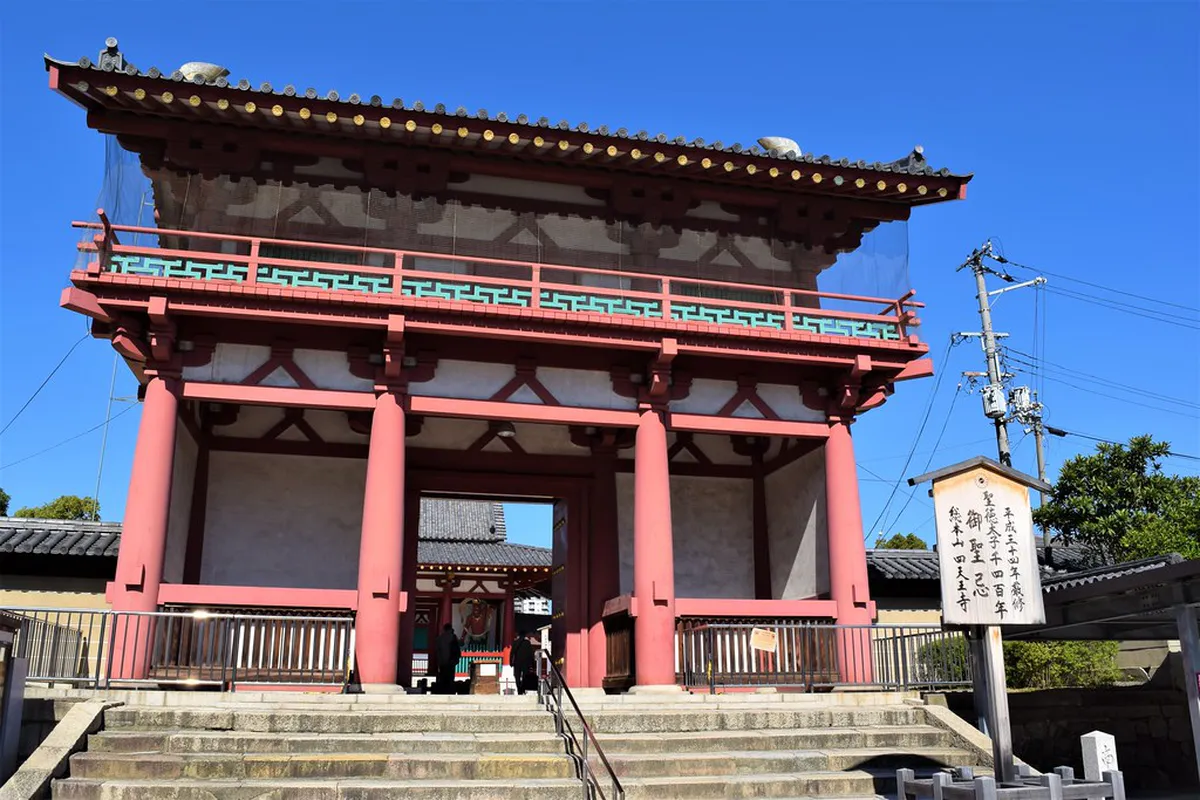
Fires and wars destroyed the wooden buildings multiple times throughout Japanese history. Faithful reconstructions have always followed the original 6th-century blueprints to maintain historical accuracy, which is why the current concrete-reinforced structures feel so precisely proportioned. The Asuka Period design — south gate, central pagoda, Kondo main hall, and lecture hall arranged on one straight axis — is preserved intact and is arguably the clearest surviving example of that architectural canon. Today, the site serves as headquarters for the independent Washu sect of Japanese Buddhism.
One fact that many visitors walk past without realizing: the stone torii gate on the western approach is counted among Japan's Three Great Torii (Nihon Sandai Torii) and is the oldest torii still standing in the country. The inscription on its frame reads "This is the East Gate to Gokuraku-jodo, where Gautama Buddha preaches" — meaning the land to the west is described as Buddhist paradise. Scholars regard this detail as evidence of the syncretic fusion of Shinto and Buddhism, a pivotal moment in Osaka culture and Japanese religious history. This spiritual legacy continues to define the site before the Meiji era and into the modern era.
Navigating the Central Garan (Inner Precinct)
The Central Garan (Chuo Garan) forms the spiritual heart of the entire temple complex. Visitors enter through the Chumon (Middle Gate) and pay ¥300 for adults to access this walled area containing the most sacred buildings. The ticket includes the Five-Story Pagoda climb and the Kondo (Main Hall), which houses a statue of Prince Shotoku as a Buddhist deity with intricate murals depicting the life of Buddha. The ticket booth is just inside the Chumon — staff accept Japanese yen cash only, so bring small denominations.
The central axis of the precinct aligns the gates, pagoda, and hall in a perfectly straight line from south to north. This symmetrical arrangement represents a classic Buddhist concept of order and harmony unique to Shitennoji-style temple layout. Quiet contemplation is encouraged as you walk across the pebble-covered ground between the structures. Many travelers find this area to be the most photogenic part of their visit to Osaka.
Behind the Main Hall you will find the Kodo (Lecture Hall), traditionally used by monks to study and discuss holy scriptures. Before you enter the Inner Precinct, spend a few minutes in the free outer grounds at the Rokujido — the hexagonal hall where the six forms of Buddha are enshrined — and the small turtle pond, where dozens of turtles bask on stones at the water's edge. These outer-grounds highlights require no ticket and are often quieter than the paid areas. Check the Osaka Temple Map to locate the exact entrance to the Central Garan.
Exploring the Honbo Garden
The Honbo Garden (also called Gokuraku-jodo Garden) offers a stunning representation of the Western Pure Land or Buddhist Paradise, designed around a central pond with stone bridges and seasonal plantings that frame views of the pagoda. Landscape architects shaped the space to evoke feelings of peace and spiritual enlightenment, with two streams representing the paths to the afterlife in Buddhist philosophy. The ticket is ¥300 for adults, purchased separately from the Inner Precinct at a booth in the northeast corner of the grounds — it is easy to miss if you do not walk past the Main Hall. Bring small denominations, as change for large notes is occasionally refused at busier moments.
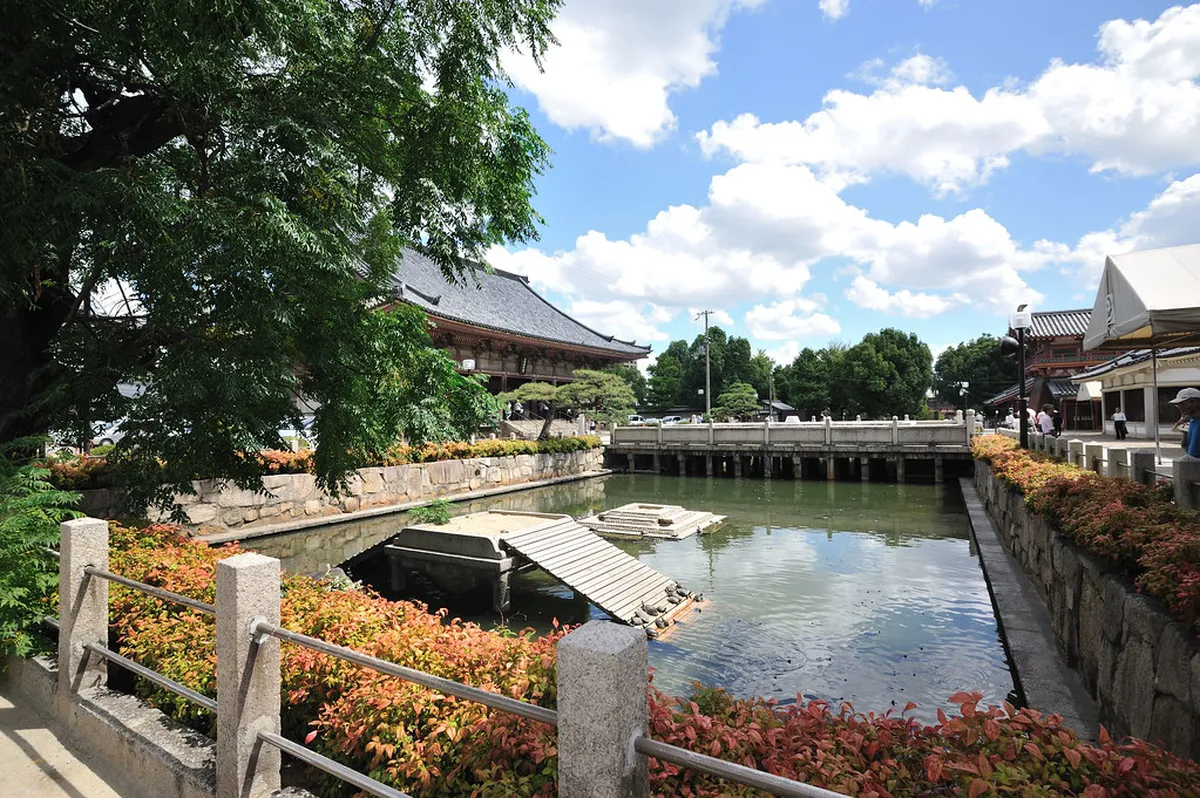
Seasonal changes make the garden a popular spot for nature lovers throughout the year. Cherry blossoms bloom beautifully in early April, with petals falling onto the pond surface, while maple trees turn vibrant red in mid-November. The garden is often less crowded than other famous parks like Osaka Castle during peak seasons. Winter visits offer crisp air, almost no crowds, and occasionally plum blossoms from early February onward.
Garden hours run 08:30 to 16:30 from April through September and 08:30 to 16:00 from October through March, with last entry 30 minutes before closing. On the 21st of each month — flea market day — the garden opens 30 minutes earlier at 08:00. The Hakkakutei, an octagonal gazebo originally from a national exhibition, adds a unique architectural touch to the greenery. Sitting by the central pond allows for a moment of silence that feels remarkably removed from the urban density of southern Osaka.
The Five-Story Pagoda and Treasure House
The towering Five-Story Pagoda is the most recognizable symbol of Shitennoji and one of the few pagodas in Japan that visitors are permitted to climb. The ¥300 Inner Precinct ticket covers the ascent. The narrow spiral staircase leads to a small upper-floor viewing area overlooking the surrounding Tennoji neighborhood. Remove your shoes before entering — plastic bags are provided at the threshold — and be ready for low ceilings and steep steps.
The Treasure House (Homotsukan) sits on the eastern side of the grounds and functions as a dedicated museum. It charges a separate ¥500 fee in 2026 and houses thousands of historical artifacts: ancient scrolls, ornate Buddhist statues, and objects designated as National Treasures or Important Cultural Properties tied directly to Prince Shotoku and early Kansai Buddhism. Photography is prohibited inside to protect the delicate materials, and the museum closes earlier than the outer grounds, so visit it first if you arrive after 15:00.
History enthusiasts will appreciate the detailed exhibits tracing how the temple was rebuilt over fourteen centuries and how Buddhist art evolved in the region. Plan to spend at least 30 to 45 minutes in the Treasure House to absorb the context rather than rushing through. The museum is closed on Mondays; if your visit falls on a Monday, check the official website before arriving, as holiday substitutions occasionally shift the closure day.
The Seven Wonders of Shitennoji
Local folklore assigns seven mysterious phenomena to the temple grounds, known in Japanese as nanafushigi. Searching for them adds an element of discovery to your visit that guidebooks rarely emphasize in detail. Each wonder has a specific location and a centuries-old story rooted in Osaka tradition. Some are easy to spot; others require a slow look around corners and up at rooflines.
The Pon Pon Stone sits beneath the western stone torii gate — itself one of Japan's Three Great Torii — and is the second of the seven wonders. Tapping inside the square hole in the stone pillar produces a faint hollow sound; legend holds that pressing your ear to the stone lets you hear the voices of ancestors in heaven. The Dragon's Well, located near the Kondo, is the fourth wonder: look into the water to see the ceiling dragon reflected below. It is said the well connects to a legendary pond in India protected by a dragon that removes calamities.
Three more wonders reward careful eyes higher up. The Onigawara (ogre ridge tile) on the northwest corner of the pagoda's first layer depicts three of the Seven Gods of Fortune — Daikokuten, Bishamonten, and Benzaiten — said to be visible from any angle, though you may need a few minutes to find it among the standard tiles. The Cat Gate (Neko-mon) features a carved sleeping cat by the sculptor Hidari Jingorou; legend says she meows on New Year's Day to her counterpart at Nikko Tosho-gu Shrine hundreds of kilometres away. The North Bell Tower's bell is the sixth wonder, its tone said to match the Oshikicho mode of ancient Gagaku court music and carry the sound to the world beyond ours.
- Wonder 1: Western Stone Torii (Ishinotorii) — one of Japan's Three Great Torii; equinox sun sets through its center
- Wonder 2: Pon Pon Stone — tap the square pillar beneath the torii; listen for ancestral voices
- Wonder 3: Cat Gate (Neko-mon) — sleeping cat carving said to cry on New Year's Day
- Wonder 4: Dragon's Well — dragon on ceiling reflects in water below; near the Kondo
- Wonder 5: Ogre Tile (Onigawara) — northwest corner of pagoda, first layer; three deity faces in one tile
- Wonder 6: North Bell Tower — bell tone matches ancient Gagaku court music scale
- Wonder 7: Stone Coffin Cover — Kofun-period coffin repurposed as a temple bridge; said to ease childbirth
Monthly Flea Market and 2026 Festivals
On the 21st and 22nd of every month, the temple transforms into a sprawling flea market with around 300 stalls selling vintage kimonos, antique ceramics, secondhand clothes, and handcrafted goods. This is one of the best places in Osaka to find unique souvenirs at affordable prices. The atmosphere is lively and provides a candid look at local community life that most tourist circuits miss. Arrive before 09:00 to get the best selection before the midday crowds take over.
Food stalls appear throughout market days, offering classic Osaka street snacks. You can try fresh takoyaki or yakisoba while browsing the vendor displays. The market is substantially larger than the ones found at Kuromon Market or other tourist-focused spots. On flea market mornings the garden also opens 30 minutes early — useful if you want to walk the grounds before the stalls crowd the paths.
Three major festivals mark the 2026 calendar. The Doyadoya fire festival falls on January 14, 2026: teams of young men in red and white loincloths compete in freezing temperatures to grab sacred talismans while cold water is poured over them — free to watch from the outer grounds, starting at approximately 14:30. The Shotoku-sai (Shoryoe) memorial ceremony on April 22, 2026 includes Bugaku ancient masked court dance in the Inner Precinct, with performances running mid-morning; your ¥300 ticket grants front-row standing access. Spring and Autumn equinox Higan-e ceremonies also draw large crowds, particularly at sunset when worshippers gather at the western stone torii to watch the sun set precisely through its center.
Practical Visitor Information: Hours and Fees
The outer temple grounds are free to enter and remain accessible around the clock. The three paid sections follow set hours: April through September, all paid areas open 08:30 and close 16:30. October through March, closing moves to 16:00. Last entry is 30 minutes before closing for the garden. The Treasure House closes on Mondays.
| Section | Adult fee | Hours (Apr–Sep) | Hours (Oct–Mar) | Notes |
|---|---|---|---|---|
| Outer grounds | Free | 24 hours | 24 hours | Turtle pond, stone torii, Rokujido included |
| Central Garan | ¥300 | 08:30–16:30 | 08:30–16:00 | Includes pagoda climb and Kondo; cash only |
| Honbo Garden | ¥300 | 08:30–16:30 (08:00 on 21st) | 08:30–16:00 | Separate ticket; last entry 30 min before close |
| Treasure House | ¥500 | 10:00–16:30 | 10:00–16:00 | Closed Mondays; no photography inside |
Tickets for the Central Garan and Honbo Garden are sold at separate booths and cash only — there is no on-site ATM. Children under elementary school age enter all paid sections free.
- Outer grounds: free, open 24 hours
- Central Garan (Inner Precinct) — ¥300 adults, includes pagoda climb and Kondo; open Apr–Sep 08:30–16:30, Oct–Mar 08:30–16:00
- Honbo Garden — ¥300 adults, separate ticket; same seasonal hours, opens 08:00 on the 21st of each month
- Treasure House (Homotsukan) — ¥500 adults; closed Mondays; photography prohibited inside
- Children under elementary school age: all paid sections free
- Tickets are cash only at the booth near the Chumon; no on-site ATM
Public restrooms and vending machines are available throughout the large complex. A small rest area near the South Gate is useful before entering the garden, as food is not permitted inside. Many visitors choose to stay at hotels near Shitennoji to enjoy early morning walks when the grounds are quietest.
Getting There: Tanimachi Line vs. JR Tennoji
Reaching the temple is straightforward. The Tanimachi Subway Line is the fastest option for most travelers. Alight at Shitennoji-mae Yuhigaoka Station and take Exit 4 — the South Gate is a flat five-minute walk away. The station has elevator access from platform to street level at Exit 4, making it the better choice for visitors with luggage or mobility needs. Coin lockers are available inside the paid zone for short-term bag storage.
Alternatively, JR Tennoji Station (Osaka Loop Line, Hanwa Line from Kansai Airport, Yamatoji Line from Nara) requires a 12-minute walk north past Tennoji Park. Use the station's North Exit and follow signs for Tennoji Park, then continue past Shitennoji Junior College. The Midosuji Subway Line also stops at Tennoji — useful if you are coming from Sumiyoshi Taisha or arriving from Shinsaibashi or Namba.
For the cost-conscious traveler, the Tanimachi Line from Umeda costs roughly ¥240 in 2026, while the JR Loop Line from Osaka Station is about ¥190. If you plan to visit three or more subway stops in a day, the Osaka Metro 1-Day Pass (¥820 in 2026) usually pays for itself by the third leg — and if you combine Shitennoji with Osaka Castle the same day, the Tanimachi Line connects both stops without any transfer, making it the clear practical winner. Taxis are plentiful in the Tennoji area and drivers recognize the temple name without needing a map.
Photography and Temple Etiquette
Photography is prohibited inside the Kondo (Main Hall) and Treasure House. Tripods and selfie sticks are banned within the Inner Precinct year-round. Walk on the sides of the central path — it is traditionally left clear for the deities.
Photography rules at Shitennoji are strict inside buildings but relaxed in the outdoor areas and garden. You can freely photograph the Five-Story Pagoda exterior, the Great South Gate, and the garden landscapes. No photos are permitted inside the Kondo (Main Hall), the Treasure House, or any worship space where ceremonies are taking place. Tripods and selfie sticks are banned within the Inner Precinct year-round.
When entering the Pagoda or Main Hall you must remove your shoes at the wooden step. Plastic bags are provided at the entrance for you to carry your footwear between buildings. Wearing slip-on shoes or simple sneakers saves several minutes per stop, and socks are mandatory — wooden floors are cold in winter. Walk on the sides of the main paths rather than directly down the center, which is traditionally left clear for the deities said to travel that line.
Donations and entrance fees are separate things at Shitennoji. The ¥300 ticket covers facility maintenance; the ¥5 to ¥100 coins tossed into wooden offering boxes near the altars are votive gifts tied to a prayer. Phones should be silenced before passing the Chumon gate. Keep your voice low inside the halls, and if a monk or attendant signals you to stop or move, comply immediately — most rules are enforced by quiet gesture rather than posted signs.
Nearby Attractions in the Tennoji Area
The Tennoji district offers many interesting sites within easy walking distance. Tennoji Park is located just to the south and features a zoo and the Osaka City Museum of Fine Arts. You can also visit the Tsutenkaku Tower for a nostalgic view of old Osaka — a short ten-minute walk southwest provides a gritty and authentic contrast to the polished temple grounds.
For a taste of local street food, head over to the Shinsekai neighborhood. It is famous for kushikatsu — deep-fried skewers of meat and vegetables — and the retro neon atmosphere makes it a favourite for evening photography. Abeno Harukas, currently Japan's tallest building, is only five minutes south and pairs a department store with a 300-metre observation deck for a modern counterpoint to the ancient grounds. Finish your evening with a walk toward Dotonbori for the famous canal-side sights of central Osaka.
Frequently Asked Questions
Is Shitennoji Temple worth visiting for tourists?
Yes, Shitennoji is highly worth visiting for its historical status as Japan's first state temple. It offers a unique look at 6th-century architecture and peaceful gardens. The monthly flea market provides a fantastic local experience that differs from standard tourist spots in Osaka city.
How much does it cost to enter Shitennoji Temple in 2026?
In 2026, the outer grounds remain free for all visitors. Entering the Inner Precinct costs 300 yen, while the Gokuraku-jodo Garden and Treasure House are 300 yen and 500 yen respectively. Most travelers find the combined experience very affordable compared to other major city attractions.
Can I climb the Five-Story Pagoda at Shitennoji?
Visitors are generally allowed to climb the internal spiral staircase of the Five-Story Pagoda. This is a rare opportunity in Japan, as many pagodas are closed to the public. You must remove your shoes before entering and be prepared for a narrow, steep climb to the top.
What is the best time to visit Shitennoji Temple?
The best time to visit is during the monthly flea market on the 21st or 22nd. For nature lovers, early April for cherry blossoms or late November for autumn colors is ideal. Early morning visits on weekdays offer the most peaceful atmosphere for spiritual reflection and photography.
Shitennoji Temple remains a vital part of Osaka's cultural landscape and spiritual history. From the ancient architecture to the hidden Seven Wonders and the equinox ritual at Japan's oldest stone torii, there is something for every traveler to discover. Using this shitenno-ji temple visitor guide helps you make the most of your time in Tennoji. Be sure to respect the local etiquette while exploring these sacred and beautiful grounds.
Whether you are hunting for bargains at the flea market or seeking peace in the Honbo Garden, the temple delivers a rare connection to the very beginnings of Japanese Buddhism. Add this historic destination to your 2026 itinerary for an unforgettable experience in Osaka. Enjoy the unique blend of ancient tradition and modern community spirit found here.
For more Osaka planning, see our Osaka itinerary and Osaka attractions guides.


