
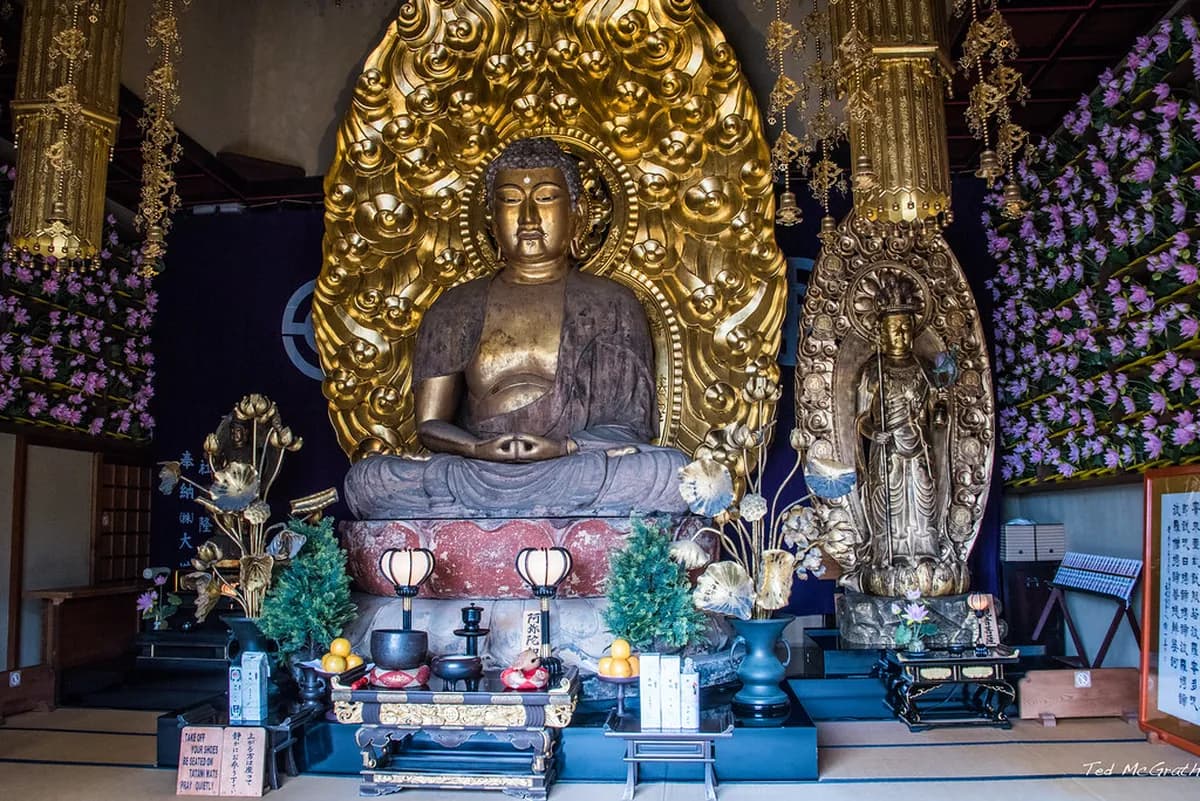
Hase-dera (長谷寺) is one of Kamakura's most rewarding temple complexes, sitting on a hillside above Yuigahama Beach with panoramic views across Sagami Bay. Entry costs ¥400 for adults and ¥200 for children. The temple opens daily at 08:00 — arriving close to opening time gives you the quietest experience before tour groups arrive from Tokyo. A 9.18-metre gilded wooden Kannon, a candlelit sea cave, and one of the best hydrangea gardens on Japan's Pacific coast are all within this single compound.
The site is distinct from the mountain temple of the same name in Nara's Sakurai City. Both share a founding legend but are separate destinations entirely. This guide covers the Kamakura location at 3-11-2 Hase, a five-minute walk north from Hase Station on the Enoden Line.
History and the Founding Legend
According to tradition, the monk Tokudo Shonin discovered a large camphor tree in the forests of Nara in 721 AD. He carved two statues of the eleven-headed Kannon from the same trunk. The upper half of the tree was fashioned into the statue now enshrined here in Kamakura; the lower half went to the Nara temple. The upper-half statue was thrown into the sea as an act of faith, and it reportedly washed ashore on the Miura Peninsula in 736 AD, prompting the founding of this temple to house it.
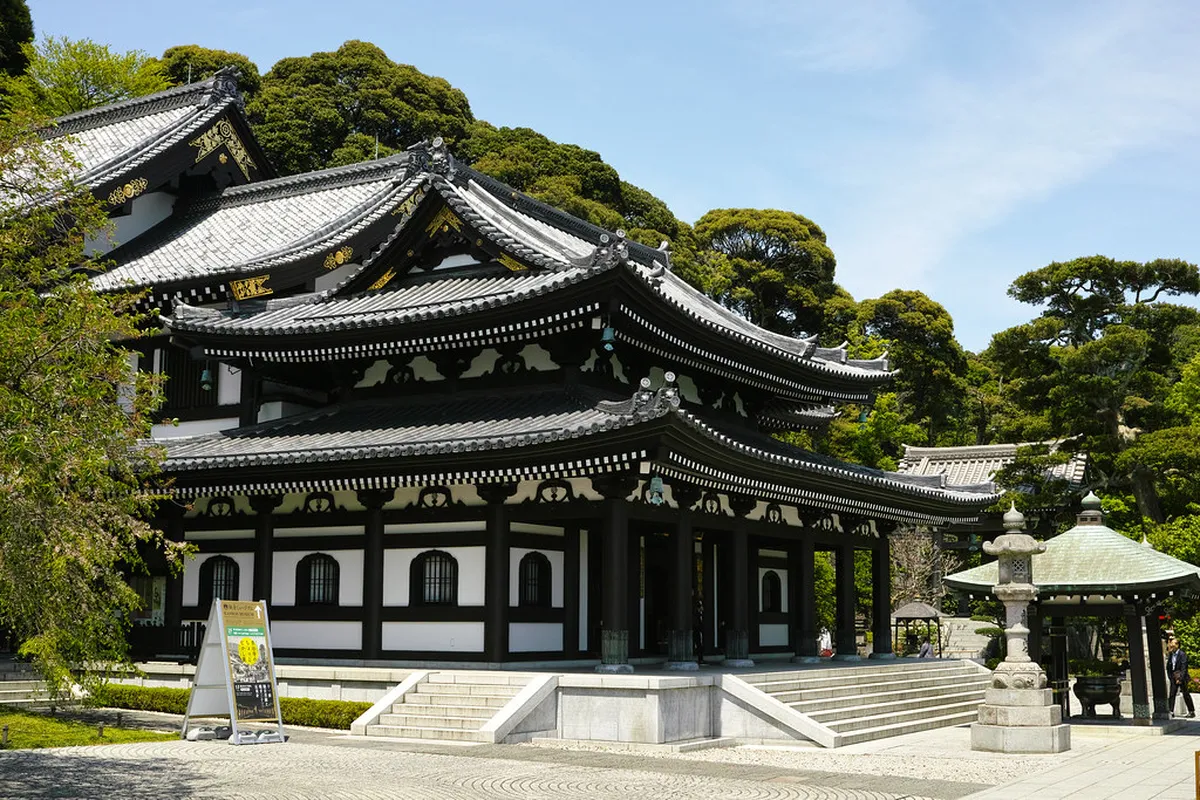
This origin story is partly legend, but it gives Kamakura's Hase-dera a meaningful connection to its Nara counterpart and to the sea that surrounds the Miura Peninsula. The temple is formally affiliated with the Jodo sect of Buddhism and has been a destination for pilgrims from across Japan for well over a thousand years. The current main hall dates from a later reconstruction, though the site itself has been continuously occupied since the 8th century.
The 11-Headed Kannon and Main Hall
The Kannon-do Hall houses the 9.18-metre gilded wooden statue of Juichimen Kannon — the eleven-headed Goddess of Mercy — making it one of the largest wooden sculptures in Japan. The ten smaller heads surrounding the central face are said to emanate compassion in all directions, or to represent the ten stages of enlightenment in the esoteric Buddhist tradition. The statue's scale is genuinely arresting; plan to stand quietly in front of it for a few minutes rather than moving straight through.
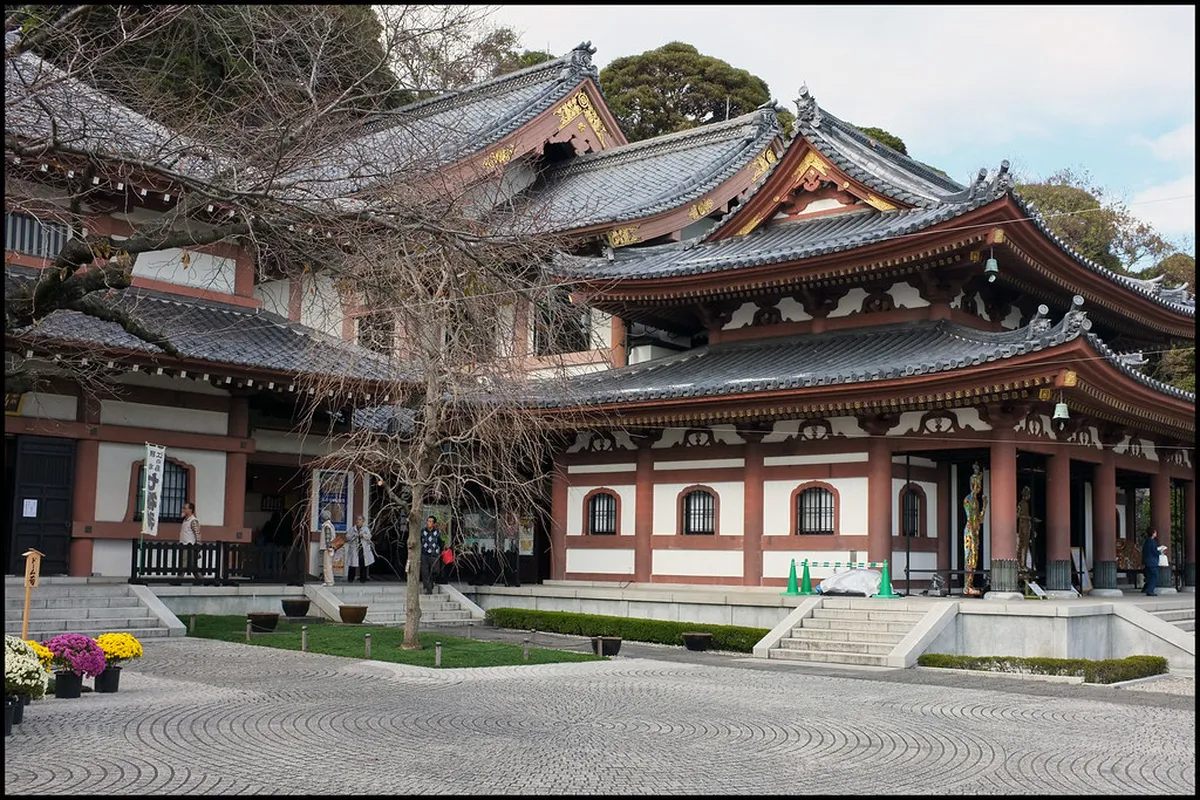
Photography inside the Kannon-do Hall is prohibited. Respectful silence is expected. The hall is flanked by two smaller buildings: one contains a statue of the Amida Buddha carved in 1189, commissioned for the birthday of Minamoto Yoritomo to ward off evil influences associated with ageing; the other houses Daikoku, one of the Seven Lucky Gods. Each building is small enough to explore thoroughly in a few minutes, and together they tell a compact story of Kamakura's medieval Buddhist culture.
From March to July, paying an additional fee allows access into the deity chamber for a closer look at the Kannon. An optional Kannon Museum on site charges ¥300 extra and displays an 11th-century temple bell, lacquered scrolls, and other Buddhist artefacts with English-language labels. Most visitors find it worth the surcharge.
The Benten-kutsu Cave
The Benten-kutsu Cave sits in the north corner of the compound, marked by a small red torii gate. Inside, the passage narrows to the point where taller visitors need to duck; some sections are low enough that stooping is unavoidable. The cave is lit only by candles and small electric lights, which gives it a genuinely atmospheric quality that sets it apart from anything else in Kamakura. At the cave's inner chamber stands a statue of Benten, the Buddhist deity of water, music, and fortune, surrounded by sixteen carved stone disciples around the walls.
For many repeat visitors to Japan — people who have seen dozens of temples and worry they are starting to blur together — the Benten-kutsu cave is the single most memorable feature of Hase-dera. The combination of the low ceiling, candlelight, and carved stone figures creates a sensory experience that the outdoor gardens and main hall cannot replicate. Allow 10–15 minutes for the cave alone and watch your step on the uneven floor.
Admission is ¥400 for adults and ¥200 for children (6–11), with an optional ¥300 for the on-site Kannon Museum. The temple opens daily at 08:00 — arriving close to opening time gives you the quietest experience before tour groups arrive from Tokyo.
Hydrangea Garden and Seasonal Flowers
Hase-dera's hillside garden is planted with approximately 2,500 hydrangea bushes that bloom along the Ajisai-michi (hydrangea path) in mid-June. The path winds above the main compound, and the combination of blue and purple flowers against the view of Sagami Bay below makes this one of the most photographed garden scenes in the Kanto region. Demand is high enough during peak bloom that the temple operates a timed-entry queuing system: you collect a numbered ticket at the entrance and wait your turn for the path, which typically means a 30–60 minute hold during the second and third weeks of June.
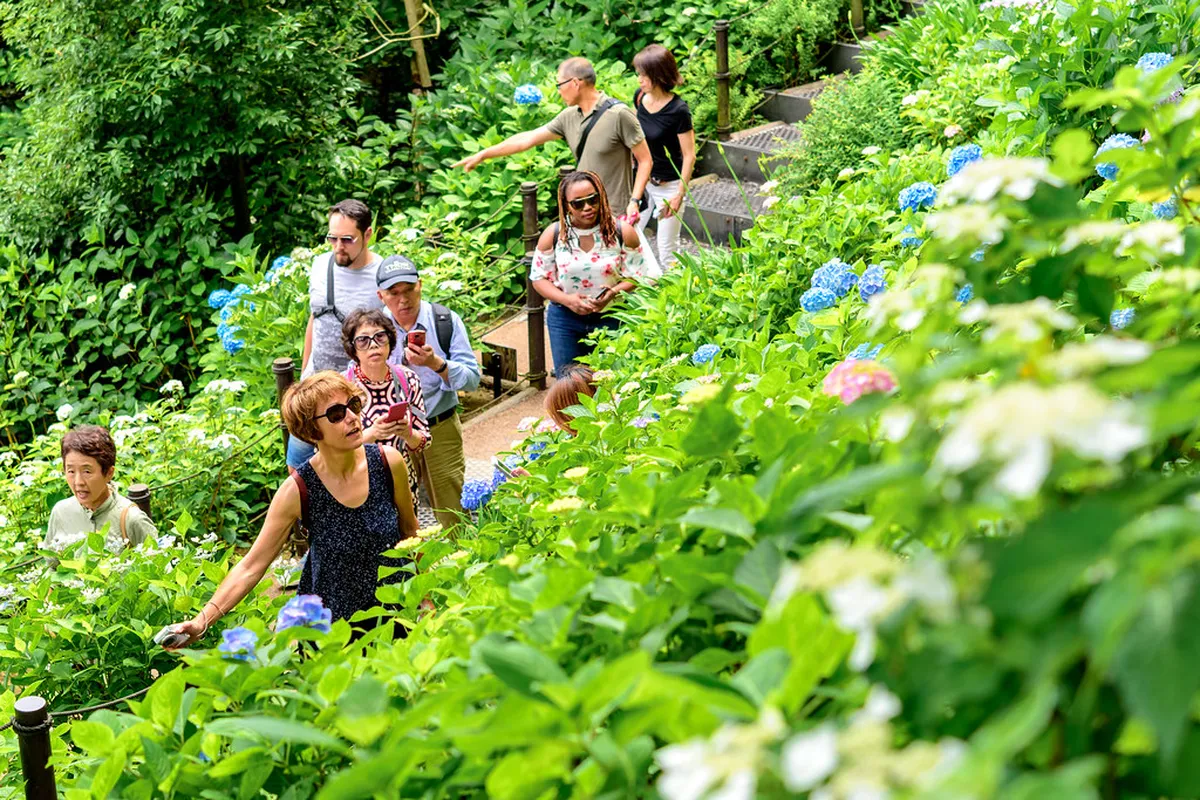
Seasonal highlights run through the year. Cherry blossoms appear in late March and early April around the compound. Wisteria follows in late April and early May. Lotus flowers bloom in the lower garden pond in July and August. Autumn maples bring red and orange colour through November. Even in winter the grounds stay green, and snowfall — though rare in Kamakura — creates an unusually atmospheric setting.
| Season | Highlight | Visitor note |
|---|---|---|
| Late March–mid-April | Cherry blossom | High crowds; arrive at 08:00 opening |
| Late April–mid-May | Wisteria | Moderate crowds; pleasant temperatures |
| Second and third weeks of June | Hydrangea (peak) | Timed-entry queuing system in effect; expect 30–60 min hold |
| July–August | Lotus flowers | Summer heat; school-holiday crowds |
| November | Autumn maple | Deep red and orange foliage; busy on weekends |
During peak hydrangea season (second and third weeks of June) the temple operates a timed-entry queuing system for the Ajisai-michi path. Collect a numbered ticket at the entrance and expect a 30–60 minute wait during the most popular midday window.
Jizo Statues and the Quiet Upper Garden
Scattered throughout the grounds are rows of small stone Jizo statues — the guardian deity of children. Historically, parents came to Hase-dera to place these figures in the hope that Jizo would watch over their children. Today they are primarily dedicated to children lost to miscarriage, stillbirth, or abortion, dressed in red bibs and caps by their grieving parents. The rows stretch across a terraced section of the garden and represent one of the most quietly moving aspects of any temple visit in Kamakura.
The upper garden terraces are where crowds thin out most noticeably. Most visitors spend the majority of their time in the main hall and cave, so the path that winds higher into the hillside behind the Kannon-do tends to be much calmer. This is also where the best elevated views over the roofline toward the ocean are found. Spending time in this area — rather than hurrying back to the entrance — turns a 45-minute visit into a genuinely satisfying 90-minute one.
Admission, Opening Hours, and Practical Details
Admission to Hase-dera is ¥400 for adults and ¥200 for children aged 6–11. The Kannon Museum costs an additional ¥300. The temple opens daily at 08:00. From April through June the temple closes at 17:00, with last entry at 16:30. From July through March closing time is 16:30, with last entry at 16:00. The temple has no regular closing days, though access may be restricted during special ceremonies.
A small restaurant and souvenir shop operate near the entrance. The restaurant serves simple Japanese food and is a reasonable place to rest after exploring the grounds. Coin-operated lockers are not available inside; leave large bags at Kamakura Station's coin lockers before travelling to Hase. Restrooms are available near the entrance gate. The grounds involve moderate inclines and many stone steps — flat walking shoes are recommended. Wheelchair access is limited to the lower courtyard area.
For drivers: the on-site car park charges ¥350 per 30 minutes for passenger cars and ¥1,000 per 30 minutes for large vehicles. No reservation is accepted and motorcycles cannot park on site. In practice, public transport from Kamakura Station is faster and eliminates parking uncertainty entirely.
How to Get to Hase-dera
The most direct route is the Enoden (Enoshima Electric Railway) Line from Kamakura Station. Board any Enoden service toward Fujisawa and alight at Hase Station — the second stop, approximately four minutes by train. The temple entrance is a five-minute walk north uphill from the station exit. Enoden trains run frequently, and a single ride costs ¥200. IC cards (Suica, Pasmo) are accepted.
From Tokyo, the standard approach is JR Yokosuka Line or Shonan-Shinjuku Line from Tokyo, Shinjuku, or Shibuya to Kamakura Station (50–70 minutes depending on origin), then the Enoden connection above. A Japan Rail Pass covers the JR leg but not the Enoden. Hase Station is also within comfortable walking distance of the Great Buddha at Kotokuin — roughly 5–10 minutes on foot — making it natural to combine both in a single half-day loop.
Combining Hase-dera with Other Kamakura Temples
Hase-dera pairs naturally with the Great Buddha at Kotokuin, which is roughly 500 metres away. Most visitors walk between the two in under 10 minutes. Both sites share a similar entry price and can be covered in a relaxed three hours. Doing Hase-dera first — arriving at 08:00 — and then walking to Kotokuin once the crowds build is the smoothest sequence.
Further afield, Tsurugaoka Hachimangu is Kamakura's central Shinto shrine, accessible by bus or a 30-minute walk from Hase. Hokokuji, known for its bamboo grove, is on the eastern side of town and requires a separate bus ride. A full day covering Hase-dera, the Great Buddha, and Tsurugaoka Hachimangu is a realistic and satisfying Kamakura itinerary without feeling rushed.
One detail that many first-time visitors miss: the Enoden Line itself is worth slowing down for. Between Hase and Kamakura the train passes close enough to residential streets that you can see into local gardens. The four-station stretch between Kamakura and Enoshima is one of the most scenic commuter rail rides in the Kanto region, and a day pass (¥800) covering unlimited Enoden travel is worth buying if you plan to visit Enoshima in the same day.
Frequently Asked Questions
Is Hase-dera Temple in Nara or Kamakura?
There are two famous Hase-dera temples in Japan. This guide focuses on the mountain temple in Nara, known for its 11-headed Kannon. The other is a seaside temple in Kamakura. Both share a similar history but are in different cities.
How much is the admission fee for Hase-dera?
The standard admission fee for adults is 500 yen. Children and students usually receive a discounted rate. Access to the specialized Kannon Museum requires an additional fee of 300 yen. Prices are subject to change during special night illuminations or festivals.
What is the best time of year to visit Hase-dera for flowers?
Spring and early summer are the best times for floral displays. Peonies bloom beautifully in late April and May. Hydrangeas follow in June during the rainy season. November is also popular for viewing the vibrant autumn maple leaves across the mountainside.
How do I get to Hase-dera from Osaka or Kyoto?
From Osaka, take the Kintetsu Railway from Namba to Hasedera Station. From Kyoto, take the Kintetsu line and transfer at Yamato-Yagi Station. The journey takes approximately 60 to 90 minutes. A 15-minute walk from the station leads you directly to the temple entrance.
Hase-dera rewards visitors who give it time. The Kannon statue, the Benten-kutsu cave, the hydrangea path, and the Sagami Bay panorama are each memorable on their own; together in a single compound they make this one of the most complete temple visits in Kamakura. Arriving at 08:00 on a weekday in 2026 — before the Enoden trains fill with day-trippers from Tokyo — gives you the quietest experience the site can offer.
For more Kamakura planning, see our Things to do in Kamakura and Kamakura day trip from Tokyo guides.


