

Kencho-ji is the oldest Zen training monastery in Japan and the top-ranked temple among the Kamakura Gozan, the five great Zen temples established during the Kamakura period. Founded in 1253 by the regent Hojo Tokiyori and the Chinese monk Rankei Doryu, the complex spans over seven hectares of wooded hillside and remains an active Rinzai Zen training ground today. This 2026 visitor guide covers the main halls, the Dragon ceiling, the Hojo garden, and the hike up to Hansobo Shrine with everything you need for a well-planned visit.
Essential Visitor Information: Hours, Fees, and Access
Kencho-ji opens daily from 08:30 to 16:30, with last entry at 16:00. Admission is ¥500 for adults and ¥200 for children. There are no separate charges for the Hojo garden or the Hansobo Shrine hike — your entry ticket covers the entire precinct. The temple shop sells goshuin (temple stamps) and protective charms; bring cash, as the shop does not reliably accept cards.
The nearest station is Kita-Kamakura on the JR Yokosuka Line, a 55 to 65-minute ride from Tokyo Station (¥940, or covered by JR Pass). Exit Kita-Kamakura and walk about 10 minutes south along the main road. Engakuji is directly at the station exit if you want to start there and walk downhill to Kencho-ji. You can also walk 30 minutes north from Kamakura Station, though that route is noisier.
Arriving at opening time on a weekday gives you the Sanmon gate and Hatto largely to yourself. Tour buses begin to arrive after 10:00, especially on weekends. Weekday mornings also offer the best light for the juniper courtyard and the dragon ceiling before the midday sun flattens the contrasts.
- Opening hours: 08:30 to 16:30 daily (last entry 16:00)
- Adult admission: ¥500 | Children: ¥200
- Nearest station: Kita-Kamakura (JR Yokosuka Line, 10-min walk)
- Address: 8 Yamanouchi, Kamakura, Kanagawa 247-8525
Sanmon Gate and the National Treasure Bonsho Bell
The route into the precinct begins at the Somon, the outer gate relocated here from Hanju-Sanmaiin Temple in Kyoto in 1940. It sets a quiet, contemplative mood before you reach the inner complex. The Sanmon, the two-story wooden gate built in 1775, is the grander of the two. Walking under it is said to cleanse three worldly desires — wealth, sensuality, and status — as you cross into temple grounds.
To the right of the Sanmon stands the Bonsho bell in an open pavilion. Cast in 1255, just two years after the temple's founding, it is registered as a National Treasure of Japan. The bronze surface shows centuries of weathering from rain and ritual use. If you visit on New Year's Eve, the bell is struck 108 times in a ceremony open to the public — each strike is said to dissolve one of the 108 human afflictions recognized in Buddhist teaching.
The Somon gate that stands at the outer entrance was not part of Kencho-ji's original construction. Its origin from a different temple is worth noting: it is a reminder that Kamakura's medieval temples have survived through centuries of fire, earthquake, and rebuilding, borrowing and preserving pieces of each other's history.
The Sacred Halls: Butsuden, Hatto, and the Dragon Ceiling
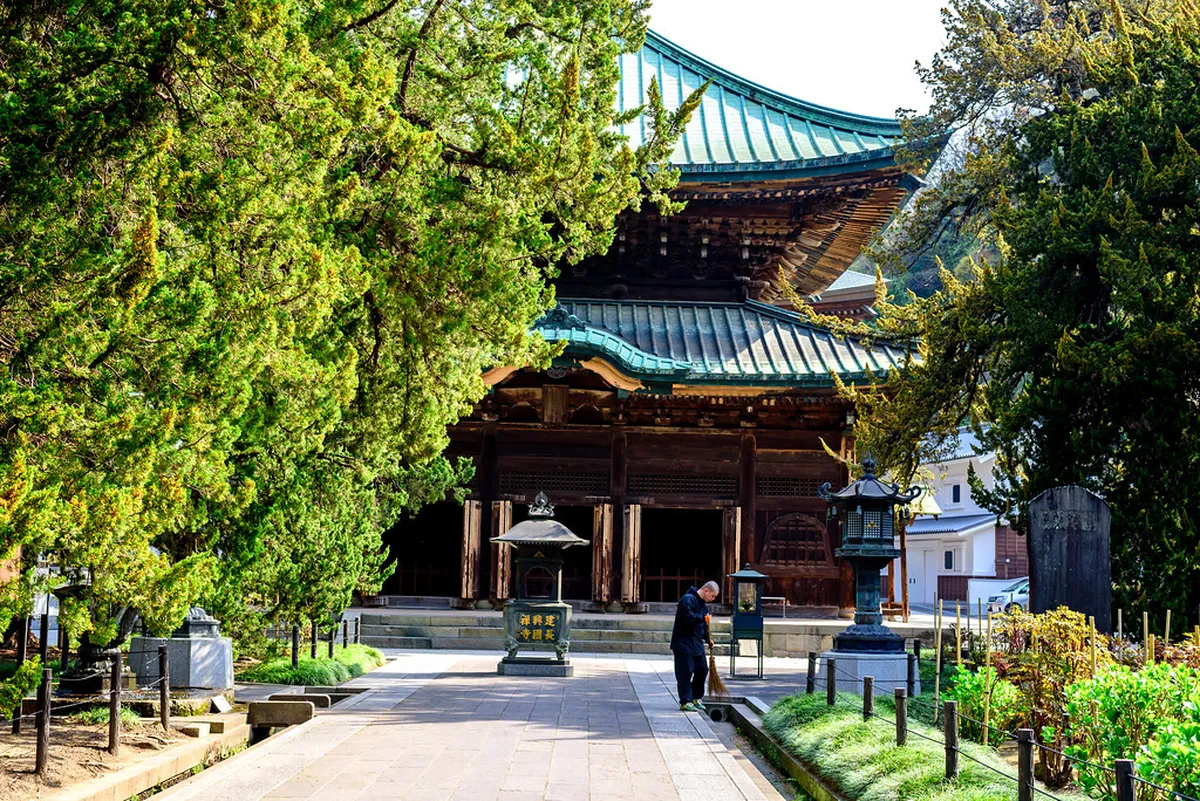
The Butsuden, or Buddha Hall, was relocated from the Tokugawa family mausoleum at Zojoji in Tokyo in 1647. Inside, the principal image is an unusually large seated Jizo Bodhisattva rather than the Shaka Nyorai or Amida Buddha found in most Zen temples. The reason is historically significant: Kencho-ji's grounds were previously an execution site, and Jizo — protector of travellers, children, and the souls of the dead — was worshipped to comfort those who perished there. When the temple was established, the decision to enshrine Jizo reflected this site's darker prior history, a detail most visitors walk past without knowing.
Behind the Butsuden stands the Hatto, the Dharma Hall, which is the largest wooden Buddhist structure in eastern Japan. Its ceiling carries the Unryu-zu, a 26-by-29-foot cloud dragon painted by artist Koizumi Junsaku in 2003 to mark the temple's 750th anniversary. To see the famous Dragon's Eyes effect, walk slowly from one side of the hall to the other while keeping your gaze on the dragon's face. The eyes appear to follow you across the floor. The effect is most striking in soft late-morning light when natural illumination enters the hall without harsh shadows.
Along the walls of the Hatto you can also see wooden statues of the Rakan disciples. Each figure carries a distinct posture and expression representing different states on the path to enlightenment. Take time with these before moving on — most visitors rush through heading for the garden.
The Hojo, the Garden, and the 750-Year-Old Junipers
Remove your shoes at the entrance to the Hojo, the head priest's former residence and now an Important Cultural Property from its 1646 reconstruction. Walk the tatami in stocking feet and step out onto the long engawa veranda that opens toward the rear garden. This wooden veranda is one of the best spots in the complex to sit quietly before the crowds arrive.
The rear garden centers on the Shinji-ike, a pond shaped like the Chinese character for "heart" or "mind," attributed to the 14th-century monk and garden master Muso Soseki. Stone arrangements frame the water on three sides and the wooded hillside rises steeply behind. Autumn foliage, peaking around mid-November, reflects in the pond and makes this one of the most photographed moments in all of Kamakura. Early April cherry blossoms offer a second peak. Sit on the engawa rather than stepping into the garden itself — this is a working temple, not a park.
In the front courtyard, before you reach the Hojo, look for the cluster of Byakushin junipers. These twisted, lichen-covered trees are over 750 years old, grown from seeds that founder Rankei Doryu reportedly carried from China in the 13th century. They are protected as a Kanagawa Prefecture natural monument. Their gnarled forms near the Butsuden facade are among the most evocative photographic subjects on the grounds — morning light from the east brings out the texture of the bark far better than midday sun.
The Karamon gate nearby features gold leaf detailing and intricate floral carvings in Momoyama period style. It was historically reserved for imperial messengers. The contrast between its ornate surface and the spare Zen aesthetic of the surrounding buildings is jarring and deliberate.
Hansobo Shrine and the Ten-en Hiking Trail
From the rear of the precinct, a stone staircase climbs approximately 245 steps to Hansobo, the guardian shrine of Kencho-ji perched on the hillside. The ascent takes 15 to 20 minutes and is steep in places. Dozens of bronze Tengu statues — the long-nosed mountain spirits of Japanese folklore — line the upper approach and guard the shrine against fire and misfortune. Their expressions range from serene to fierce and they make for striking photographs against the cedar canopy.
At the top, the viewing terrace places the temple rooftops in the foreground with Sagami Bay stretching across the middle distance. On cold, clear winter mornings — typically December through February — Mount Fuji appears above the western ridge. Late afternoon autumn light is the second-best window for photography. This is the highest publicly accessible point within the temple grounds.
From Hansobo you can join the Ten-en hiking course, a trail that connects the northern Kamakura hills to Zuisenji or Kakuonji. The walk takes about 90 minutes and is genuinely rewarding, with views over multiple valleys. Wear shoes with grip — the soil turns slick after rain. One critical timing note: do not start the Ten-en course after 14:30 in winter. The back gates of the temple precincts lock at dusk, and hikers who miscalculate are diverted onto longer road descents. Many hikers continue the trail toward Hokokuji bamboo grove if time allows.
Do not start the Ten-en hiking course after 14:30 in winter. Temple back gates lock at dusk and hikers who miss the closing are diverted onto long road descents. The trail soil becomes slippery after rain — grip-soled shoes are essential.
Zazen Meditation: How to Join a Public Session
Kencho-ji is one of the few major temples in the greater Tokyo area that opens its zazen sittings to walk-in foreign visitors at no charge beyond standard admission. Sessions are held on Friday and Saturday evenings at 17:00, with an additional sitting on the second and fourth Sunday of the month at 08:00. Each session lasts about one hour and is conducted by a resident monk. Basic Japanese is not required — the sessions are largely silent.
Logistics matter more than experience here. Arrive at the Hojo entrance at least 15 minutes before start time. Switch your phone to silent and wear loose clothing that allows you to cross your legs — loose trousers work well, short skirts do not. Remove watches and large jewellery before entering the hall. The monk demonstrates posture before the session bell rings. If a full or half-lotus position is uncomfortable, sitting on a folded cushion or kneeling seiza is fully acceptable. Do not photograph the meditation hall once the session begins. A monk may use a flat wooden stick (keisaku) to correct posture during the sitting — this is a standard part of the practice, not a reprimand.
Beyond the public sittings, Kencho-ji houses a sodo, or training hall, where novice monks follow a strict daily schedule. You may see them cleaning the courtyards in the early morning or raking gravel in the late afternoon. Watch quietly and do not block their path. Treating the temple as a working monastery — not just a sightseeing venue — is the single most important thing a visitor can do here.
Kenchin-jiru: The Soup That Started Here
Kenchin-jiru, the clear vegetable soup with daikon, carrot, burdock, taro, tofu, and sesame oil, is widely credited to the founding priests of Kencho-ji as part of the shojin-ryori vegetarian monastic diet. The name is a direct contraction of "Kenchoji" — making this one of the few cases in Japanese cuisine where a common household dish can be traced to a single specific monastery. The standard origin story involves a monk who dropped and crumbled a block of tofu; the head priest instructed him to add it to the broth rather than waste it. Whether legend or fact, the soup remains the most direct culinary connection to the temple's 13th-century roots.
The most authentic option nearby is Hachinoki Kita-Kamakura, a five-minute walk from the outer gate, which has served formal shojin-ryori courses for over fifty years. Kenchin-jiru appears on most set lunch menus from around ¥2,800. For a quicker stop, several small cafes and tofu shops along the Kita-Kamakura station road sell individual bowls in winter for ¥600 to ¥1,200. Most close by 17:00 and many take Wednesdays off — check before making the walk. A hot bowl after the Hansobo climb is one of the most satisfying combinations the area offers, especially from November through March.
The name "kenchin-jiru" is a direct contraction of "Kenchoji" — this everyday Japanese vegetable soup can be traced to a single monastery. The standard origin story says a monk accidentally crumbled a tofu block into the broth and the head priest told him not to waste it.
One Thing Most Visitors Don't Expect
Inside the Kencho-ji precincts, behind the main halls, sits Kenchoji Gakuen — a functioning middle school that operates within the temple grounds. On weekday afternoons you may hear bells, choir practice, or the sounds of PE lessons drifting through the cedar trees. It is harmless and often charming, but it is worth knowing in advance if you arrived expecting absolute silence on a Tuesday afternoon. The school's presence is a living reminder that Kencho-ji is not a preserved monument: it is a real institution that has continuously educated and trained people on this land for over 770 years.
The practical implication for photographers is straightforward: weekday mornings before 09:30 give you the quietest grounds. Weekend mornings between 08:30 and 10:00 are the next-best option. Tour groups and school visitors both tend to peak in the 10:00 to 14:00 window. If you specifically want the Hatto dragon ceiling without heads in the frame, arriving at opening is the reliable strategy.
Planning Your Visit: Nearby Temples and Itinerary Tips
Kencho-ji fits naturally into a Kita-Kamakura morning that pairs it with Engakuji, the second-ranked Kamakura Gozan temple located directly at Kita-Kamakura Station. Many visitors do Engakuji first (it is uphill from the station), then walk downhill to Kencho-ji. If you have a full day, continue south toward Tsurugaoka Hachimangu shrine and finish along Komachi Street for lunch and souvenirs.
A practical hour-by-hour sequence for a focused Kencho-ji morning: arrive at 08:30, see the Sanmon, Bonsho, and Hatto dragon ceiling before 10:00, move to the Hojo garden and juniper courtyard between 10:00 and 10:45, climb to Hansobo between 10:45 and 11:30, then return to Kita-Kamakura for a kenchin-jiru lunch by 12:00. This leaves the afternoon free for Hasedera or the Great Buddha at Hase, a short JR or bus ride south.
A common first-timer mistake is exiting at Kamakura Station expecting a short walk — that adds 25 minutes uphill on a busy road. Always exit at Kita-Kamakura. A second mistake is relying on cards inside the temple: the charm and goshuin counter prefers cash. The Kamakura-Enoshima 1-Day Pass covers the Enoden line and some buses for around ¥700 and is worth picking up at Shinjuku or Yokohama if you plan to visit Hase-side temples the same day.
- Seasonal highlights:
- Spring (late March to early April): cherry blossoms near the Sanmon
- June: hydrangeas along the Hansobo path and at nearby Meigetsuin
- Autumn (mid to late November): red and gold maples reflected in the Shinji-ike pond
- Winter (February): plum blossoms in the lower garden; best Fuji views from Hansobo
Frequently Asked Questions
How much time should you plan for Kencho-ji Temple?
You should plan to spend at least two hours to see the main halls and gardens. If you decide to hike up to the Hansobo Shrine, add another forty-five minutes to your schedule. This allows enough time to enjoy the views and explore the forest paths without rushing.
Is Kencho-ji Temple worth visiting on a day trip from Tokyo?
Yes, it is one of the most important historical sites in the entire region. It offers a much quieter experience compared to the crowded Great Buddha statue. The combination of architecture and hiking makes it a very rewarding stop for any traveler.
What is the best time of day to see the Dragon ceiling in the Hatto?
The best time is usually during the late morning when the sun is high. Natural light enters the hall and illuminates the details of the Unryu-zu painting. This makes the Dragon's Eyes effect much more noticeable as you walk across the floor.
Can beginners participate in Zazen meditation at Kencho-ji?
Beginners are welcome to join the public sessions held on Friday and Saturday evenings at 17:00, and on the second and fourth Sunday of the month at 08:00. The monks provide basic instructions on posture and breathing before the meditation begins. It is a great way to experience authentic Zen culture in a historic setting.
Kencho-ji rewards visitors who treat it as a working monastery first and a sightseeing stop second. Arrive at opening, walk slowly from the Sanmon through the Hatto, spend time with the ancient junipers, climb to Hansobo for the Sagami Bay view, and finish with a bowl of kenchin-jiru where the soup itself was invented. Combined with Engakuji and a glance at Meigetsuin in season, it makes for one of the most rewarding mornings within an hour of Tokyo.
For more Kamakura planning, see our Things to do in Kamakura, Kamakura itinerary, and Kamakura culture guides.