
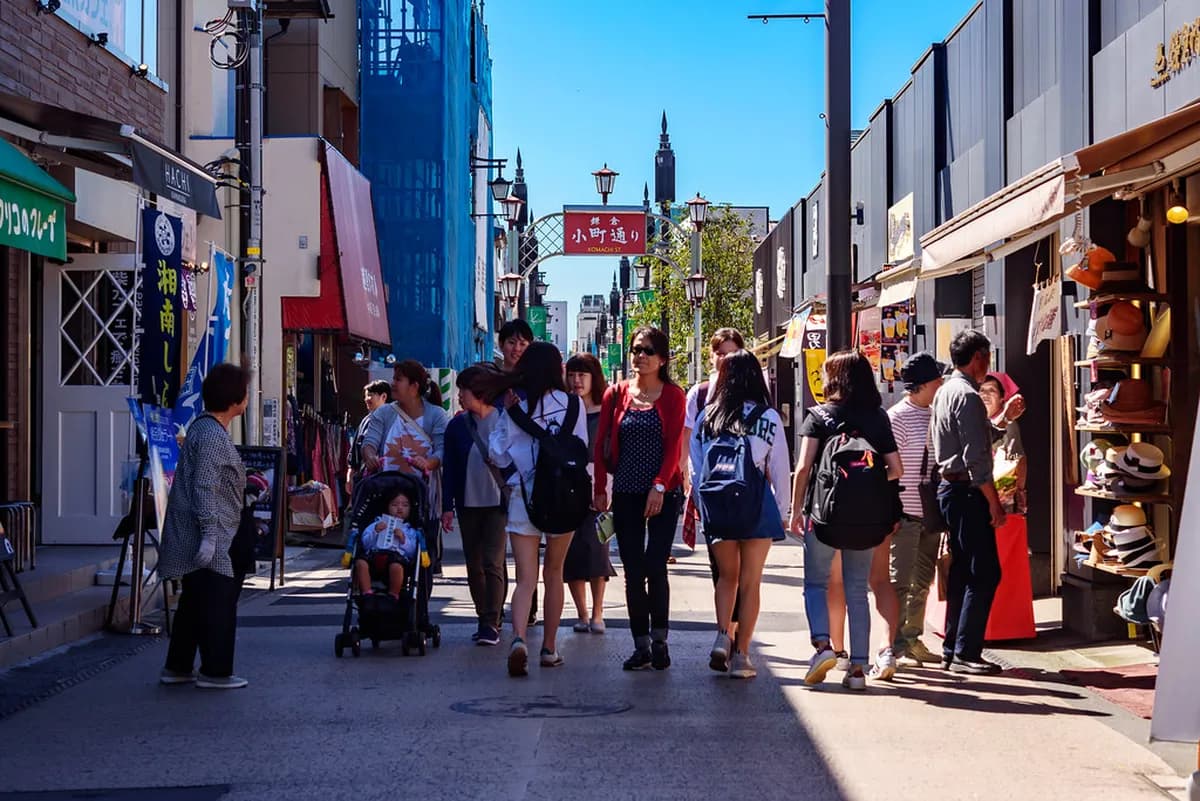
Komachi Dori (小町通り) is a 360-metre pedestrian shopping street that runs from the East Exit of JR Kamakura Station directly to Tsurugaoka Hachimangu shrine. Around 250 shops line both sides of the street, selling everything from street food and matcha desserts to lacquerware and seasonal souvenirs. The street is free to walk at any hour, and most shops open around 10:00 and close by 18:00.
This guide covers the street's history, food etiquette, the best things to eat and buy, practical access tips, and the seasonal crowd patterns that first-time visitors often miss. Planning around these details makes the difference between a rushed, crowded experience and a genuinely enjoyable afternoon in Kamakura.
Discover Komachi Street (小町通り): History and Origins
The street as visitors know it today is younger than it looks. Before 1889 the land here was farmland called Seto-kochi (瀬戸耕地). The Yokosuka Line opened that year and Kamakura Station was established, which triggered the first wave of commercial development along the eastern side of the station. Over the following decades small shops and teahouses filled in the narrow lane heading toward the shrine.
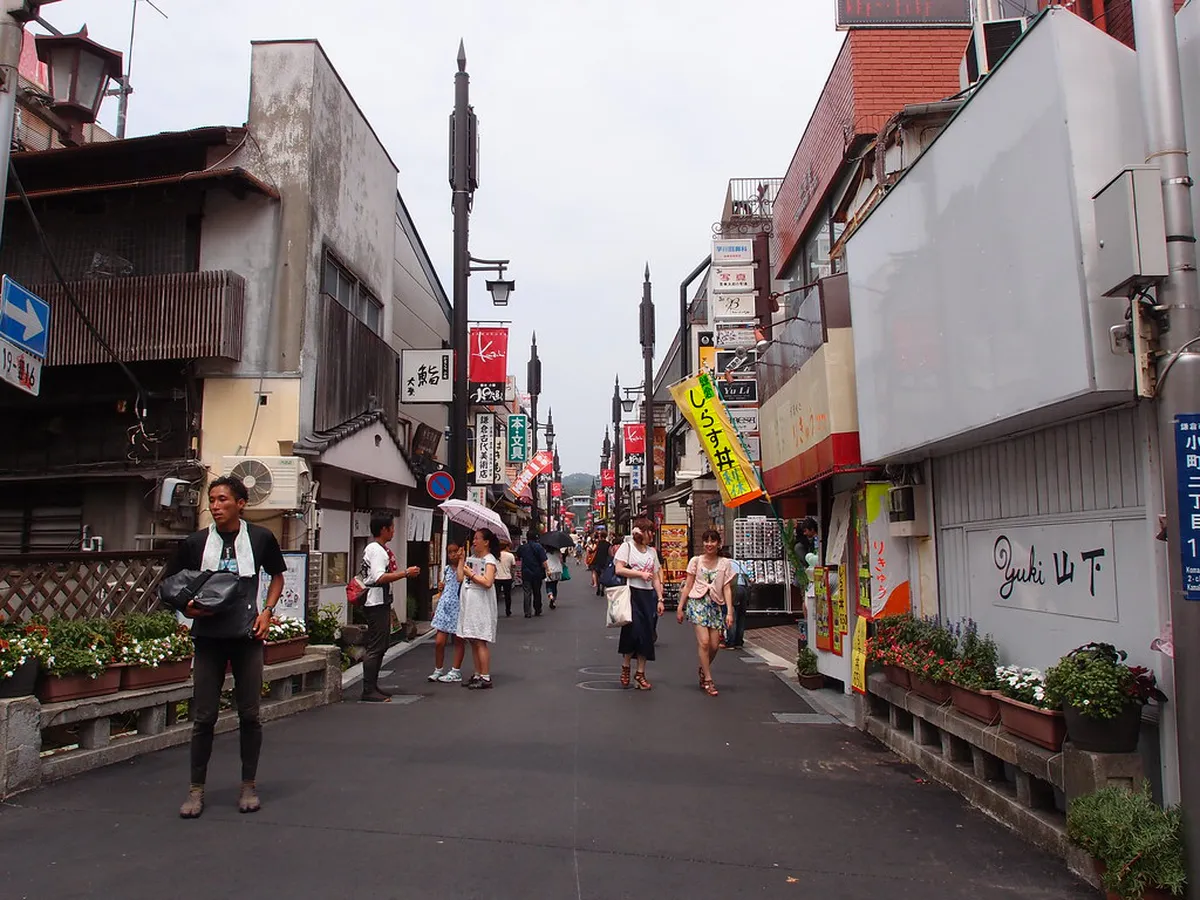
The Great Kanto Earthquake of 1923 reshaped the street decisively. Many businesses that had operated along Komachi-oji — the older commercial road to the east of Wakamiya-oji — relocated here during the post-earthquake rebuilding period. The name "Komachi Street" itself is thought to have solidified only after World War II, evolving from an area near Hongakuji Temple known as Shin-Komachi (新小町). The historical commercial hub of the Kamakura Shogunate period was actually the parallel Komachi-oji, not the present shopping street.
Walking the street today you can spot Meiji and Taisho-era timber facades tucked between glass-front boutiques. Preservation agreements within the shopping association limit certain kinds of exterior renovation, which is why the streetscape feels older than the individual shop businesses inside. This layered quality — modern retail inside historically scaled buildings — is what sets Komachi Dori apart from typical Japanese shopping arcades.
The "Shortcut to Hachimangu": What the Torii Gate Means
A large vermilion torii gate marks the entrance to Komachi Dori just outside the station's East Exit. The inscription on the gate reads "Hachimangu Okaido" (八幡宮お買い道) — a playful phrase meaning "shopping road to Hachimangu" — and designates the street as a shortcut to the shrine. This distinguishes it from the wide, ceremonial Wakamiya-oji avenue (若宮大路), which runs parallel and was the formal procession route used by the Kamakura Shogunate.
The practical implication for visitors is straightforward. Wakamiya-oji is lined with trees and the famous lotus ponds but has fewer shops. Komachi Dori is narrower, busier, and packed with food stalls and boutiques. Most visitors walk up Komachi Dori to the shrine, then return via Wakamiya-oji for a quieter experience — or vice versa. The two routes together form a natural loop of roughly 700 metres.
The torii gate has become one of the most photographed spots in Kamakura. Arriving before 09:30 on a weekday gives you the best chance of capturing the gate without crowds in the frame. Once shops start opening from 10:00 onward the entrance fills quickly, especially on weekends and public holidays.
The Etiquette of "Tabearuki" (Eating While Walking)
Tabearuki (食べ歩き) means eating while walking, and it is one of the main draws of Komachi Dori for visitors. In 2019 Kamakura City issued an official request asking tourists to stop doing it. The reasoning was practical: the street narrows to roughly four metres in several sections, and dropped food, wrappers, and accidental collisions were causing problems for both residents and other visitors.
The accepted approach now is to stop in front of the stall or shop where you bought your food and eat there before moving on. Most stalls provide a small standing ledge or a few wooden benches specifically for this purpose. Some have added painted footprint markers on the pavement to show where customers should stand while eating. The system works well in practice — you will rarely see anyone eating on the move, and the street stays notably clean as a result.
Kamakura City officially asked visitors not to eat while walking on Komachi Dori in 2019. Stand near the stall where you bought your food. The street is also a non-smoking zone throughout its length — designated smoking areas are clearly marked near the station and at the shrine end.
Rubbish bins are hard to find in Japan generally, and Komachi Dori is no exception. The cleanest approach is to return your skewer, wrapper, or cup to the stall's own bin before walking on. Pocketing small wrappers until you find a convenience store bin is the fallback. Do not carry food wrappers into shops. The street is also a non-smoking zone throughout its length; designated smoking areas are clearly marked near the station and at the shrine end.
Must-Try Local Flavors and Street Food
Shirasu (whitebait) is the defining ingredient of Kamakura's food identity, and Komachi Dori has multiple stalls and small restaurants selling shirasu-topped rice bowls for around 800–1,500 yen. Fresh shirasu is caught in Sagami Bay and typically available from mid-March through late December. During the fishing ban from January through mid-March, stalls switch to boiled shirasu, which is still worth trying but has a firmer texture and slightly less delicate flavour. Raw shirasu is available only within a day or two of the catch, so the version you eat here is genuinely fresher than anything sold further from the coast.
Warabi mochi is the other essential purchase — a soft, jelly-like sweet made from bracken starch, dusted in kinako (roasted soybean flour) and drizzled with black sugar syrup. Several stalls sell it by the cup for 400–600 yen. Daibutsu-yaki (大仏さま焼き) are small grilled cakes moulded in the shape of the Great Buddha, filled with red bean paste or custard and sold for around 200 yen each. Matcha soft-serve ice cream, bamboo charcoal soft-serve, and purple sweet potato soft-serve are all photogenic and priced around 400–500 yen.
Savoury options include deep-fried potato croquettes (コロッケ) stuffed with Kamakura purple yam or standard beef filling, sold at corner stands for 200–350 yen. Fresh senbei (rice crackers) made to order on small iron presses are another quick snack. For a sit-down meal, several restaurants just off the main street serve Kamakura vegetable set lunches using locally grown produce — worth the five-minute detour if you want something more substantial.
| Street food / snack | Price (yen) | Notes |
|---|---|---|
| Shirasu rice bowl | ¥800–¥1,500 | Fresh whitebait from Sagami Bay; raw version available mid-Mar to late Dec only |
| Warabi mochi (cup) | ¥400–¥600 | Bracken-starch jelly in kinako & black sugar syrup |
| Daibutsu-yaki cakes | ~¥200 each | Great Buddha-shaped; red bean or custard filling |
| Matcha / charcoal soft-serve | ¥400–¥500 | Bamboo charcoal and purple sweet potato flavours also available |
| Potato croquettes | ¥200–¥350 | Kamakura purple yam or beef filling |
| Fresh senbei | ~¥200 | Made to order on iron presses at corner stands |
Best Cafes and Historic Coffee Shops
Iwata Coffee (イワタコーヒー) has been open since 1948 and is the most famous cafe on the street. John Lennon and Yoko Ono visited during their stays in Kamakura in the late 1970s, and the retro interior with dark wood and stained-glass panels has changed little since then. The thick hotcakes (pancakes) take around 30 minutes to make and cost roughly 1,000 yen. Expect a wait of 20–40 minutes for a table during peak weekend afternoons. The coffee is old-school Japanese kissaten style — strong and served with a small biscuit.
The modern end of the cafe scene runs on matcha. Several stands along the main stretch serve matcha lattes, matcha tiramisu, and matcha soft-serve with flavour intensities labelled from mild to ceremonial grade. These queues move faster than Iwata's and suit visitors who want a quick photogenic drink rather than a sit-down break. Pricing is 500–800 yen for most drinks.
Hidden cafes in the side alleys off Komachi Dori offer the quietest option. Look for small wooden signs pointing away from the main drag — several garden cafes operate in converted machiya townhouses with outdoor seating. These spots are rarely mentioned in standard itinerary guides and hold their tables longer into the afternoon. They are a good choice for anyone visiting during peak cherry blossom or hydrangea season who wants to escape the main crowd.
Shopping for Souvenirs and Traditional Crafts
Kamakura-bori (鎌倉彫) lacquerware is the craft most closely associated with the city and well-represented on the street. Artisans hand-carve wooden blanks with floral or geometric patterns, then apply multiple layers of lacquer over weeks. Finished pieces range from small coaster sets at around 2,000–3,000 yen to large decorative trays that can exceed 20,000 yen. The Kamakura Carving Museum near the street provides context on technique if you want to understand what you are buying before spending.
General craft shops carry handmade washi paper items, furoshiki wrapping cloths, and hairpins. Character goods themed around the Great Buddha and the Enoden train are cheaper and easier to pack. Many shops stock Great Buddha cookies (大仏クッキー) and hydrangea manju, which make good shelf-stable gifts. For wearable souvenirs, several boutiques sell indigo-dyed cotton and yukata fabric by the metre or as finished garments.
International visitors should note that many shops on Komachi Dori offer tax-free purchases for spending above 5,000 yen. Carry your passport — the cashier will need to scan it for the exemption. Payment by card is widely accepted at permanent shops, but smaller food stalls often operate cash only. Keeping a few hundred yen in coins is useful for impulse snacks and coin-locker fees at the station.
Architectural Highlights and Atmosphere
The street was redesigned in the 1990s to underground the power lines, which gives an unusually open view of the sky for a Japanese shopping street. The result is a relatively clean visual environment where the shop facades compete for attention without a tangle of cables overhead. Combined with the human scale of the 4–6 metre-wide lane, this makes Komachi Dori feel less frenetic than comparable streets in Tokyo or Kyoto despite the high visitor density.
The morning light before 10:00 shows the street at its most photogenic. The red torii at the south end and the lantern-strung facades catch the low angle well, and the lack of crowds keeps the lane lines clean. By early afternoon the foot traffic bunches up at the food stalls and the light is harder. If photography is a priority, the first 30 minutes after shops open is worth an early train from Tokyo.
Narrow side alleys branch off both sides of the main street. These carry smaller galleries, a few independent fashion boutiques, and quiet residential lanes. Spending time in these detours slows the pace considerably and often reveals the oldest buildings on the block. A small Ebisu shrine sits just off one of the western alleys — the Ebisu Shrine (蛭子神社) is connected to the original naming history of the Shin-Komachi area and is easy to miss if you only walk the main drag.
Seasonal Events and Best Times to Visit
Cherry blossom season (late March to early April) brings the highest annual visitor counts to Kamakura. Komachi Dori is extremely crowded between 11:00 and 16:00 on weekends during bloom weeks. Arriving before 10:00 or after 16:30 significantly reduces queue times at food stalls. Shops stock cherry blossom-themed limited editions — sakura warabi mochi, sakura flavoured soft-serve — that sell out by midday on busy days.
Hydrangea season in mid-June is the second busiest period. The nearby temples such as Meigetsuin draw long queues of their own, which spill visitor traffic onto Komachi Dori. The humidity is high in June so plan for indoor cafe breaks. The advantage of a June visit is that summer food stalls appear earlier than the school holiday crowds, and several shops run early-summer seasonal menus not available in spring.
The quietest time to visit Komachi Dori in 2026 is a weekday morning between late January and mid-February, or in early December before the year-end school holiday traffic builds. These windows offer short food stall queues, unhurried browsing, and the best coin locker availability at the station. November and autumn leaf season sits between the two peak periods and offers pleasant temperatures with moderate crowds on weekdays.
Practical Information: Access and Opening Hours
Komachi Dori begins directly opposite the East Exit of JR Kamakura Station (鎌倉駅). From Tokyo Station take the JR Yokosuka Line (横須賀線) direct to Kamakura — the journey takes around 55–65 minutes and costs approximately 950 yen. From Yokohama Station the same line reaches Kamakura in around 25–30 minutes. The red torii gate is visible as soon as you pass through the East Exit ticket barriers and turn left.
The street itself is open 24 hours and is free to walk. Most shops open around 10:00 and close between 17:00 and 18:00; food stalls may close earlier if they sell out. There is no fixed closing day — the official Komachi-dori Association website at kamakura-komachi.com lists individual shop hours for 2026 and is the most reliable source for specific openings. Plan for a minimum of 90 minutes to browse and eat at a reasonable pace.
Coin lockers at Kamakura Station fill up by mid-morning on busy days. A secondary set of lockers is available inside the station near the West Exit and at a few convenience stores close to the station. Luggage storage services at the station offer an attended option for larger bags. Carrying your luggage down a 4-metre-wide street in peak hours makes the experience significantly less enjoyable for everyone around you, so storing bags before entering is worth the small fee.
Most food stalls on Komachi Dori are cash only — withdraw yen at the 7-Eleven ATM two minutes from the station before you enter the street. For tax-free shopping at permanent stores, bring your passport; the exemption applies per shop on purchases above ¥5,000.
Nearby Attractions: Beyond the Shopping Street
The street ends at the southern approach staircase of Tsurugaoka Hachimangu. The shrine grounds are free to enter and worth at least 30 minutes — the lotus ponds at the base of the steps and the panoramic view of central Kamakura from the main hall are highlights on their own. The shrine hosts major festivals throughout the year, including the Tsurugaoka Hachimangu Reitaisai in mid-September.
The Great Buddha at Kotoku-in requires a 10-minute ride on the Enoden Railway from Kamakura Station to Hase Station, then a 10-minute walk. The Hasedera temple, famous for its hydrangea garden and coastal views, is directly adjacent to Hase Station. Both are natural second stops after finishing the shopping street. The Hokokuji bamboo grove requires a short bus ride east of the station and offers one of the most tranquil contrasts to the Komachi Dori bustle.
The Enoden Railway day pass (700 yen) covers unlimited rides between Kamakura and Fujisawa, including the scenic coastal section between Yuigahama and Inamuragasaki. Combining a morning on Komachi Dori with an afternoon Enoden coastal trip is one of the most satisfying day-trip structures from Tokyo and keeps the itinerary manageable without rushing any single attraction.
Visitor FAQ and Real-Life Tips
A few practical points that catch first-timers out. Most food stalls are cash only, so withdraw yen before leaving the station — the ATMs inside the station building or at the 7-Eleven two minutes away are the easiest options. For tax-free shopping at permanent stores bring your passport; the exemption applies per shop on purchases above 5,000 yen before tax.
Komachi Dori is entirely flat and pushchair-friendly. The narrowest sections during peak hours can make a wide double pram slow-going, but a single pushchair or wheelchair navigates without difficulty. Wheelchair users should note that a few cafe entrances in older buildings have a single step at the door. The main street surface is smooth paved stone with no significant kerbs.
Arriving before the shops open at 10:00 gives you the torii gate and the street almost to yourself for photography. Staying until 17:30 lets you catch any late-day deals at food stalls clearing inventory before closing. Weekday visits in shoulder seasons remain the most relaxed option in 2026 — the street's popularity has grown steadily and summer weekend afternoons are now crowded enough to make browsing feel pressured rather than leisurely.
Frequently Asked Questions
Is eating while walking allowed on Komachi Dori?
Kamakura City officially requested in 2019 that visitors refrain from eating while walking to prevent litter and accidents. You should stand near the shop where you purchased your food to enjoy your snack comfortably. This practice helps keep the narrow street clean for all visitors and local residents.
What is the best time of day to visit Komachi Street to avoid crowds?
The best time to visit is early in the morning between 9:00 AM and 11:00 AM. Most shops open by 10:00 AM, allowing you to browse before the peak afternoon rush begins. Visiting on a weekday rather than a weekend also provides a significantly calmer shopping experience.
What are the must-try foods on Komachi Dori?
You should definitely try the local shirasu whitebait, which is a famous regional delicacy from the nearby bay. Other popular options include matcha-flavored soft serve ice cream, savory potato croquettes, and Daibutsu-yaki cakes. These snacks represent the unique blend of traditional and modern flavors found in Kamakura.
How do I get to Komachi Dori from Tokyo?
You can take the JR Yokosuka Line directly from Tokyo Station or Shimbashi Station to Kamakura Station. The journey takes approximately one hour and costs around 950 yen each way. Once you arrive, exit through the East Exit to find the red torii gate entrance immediately.
Komachi Dori offers an unforgettable blend of traditional Japanese culture and modern shopping excitement. By following the local etiquette and exploring the historic shops, you can fully experience Kamakura's charm. This street serves as the perfect starting point for your journey through the ancient capital's many wonders. We hope this guide helps you create lasting memories during your next visit to this beautiful coastal city.
For more Kamakura planning, see our Things to do in Kamakura, Kamakura day trip itinerary 2026, and Kamakura with kids guides.
