

Walking through the towering green stalks of the Arashiyama Bamboo Forest feels like stepping into a different world entirely.
This famous natural tunnel is one of the most photographed spots in all of Japan — and entirely free to enter, day or night.
Our arashiyama bamboo grove visitor guide helps you navigate this stunning landscape with practical local knowledge for 2026.
You will discover the best times to visit, how to get here on each train line, and hidden gems located just steps away from the main path.
Arashiyama Bamboo Grove Introduction
The Arashiyama Bamboo Forest is not a single continuous path but two separate groves, both sandwiched between the grounds of Tenryu-ji Temple and the JR Sagano-Saiin rail line. Together the groves span roughly 500 meters in length and about 140 meters in width — just enough to feel genuinely immersive before the path brings you back to daylight.
The sound of bamboo creaking in the wind here has been officially listed among the "100 Soundscapes of Japan" by the Japanese Ministry of Environment. That designation reflects something real: on a quiet morning the grove generates an eerie, hollow percussion that no forest of conventional trees reproduces. It is a place you hear as much as see.
Historically, bamboo was cultivated in the Arashiyama district for use in crafts and as a food source during the Edo period (1603–1868). Many groves were abandoned or cleared for housing as the economy changed. In 1967 the government intervened to protect what remained, which is why the grove survives today as a designated place of scenic beauty rather than a private garden or development site.
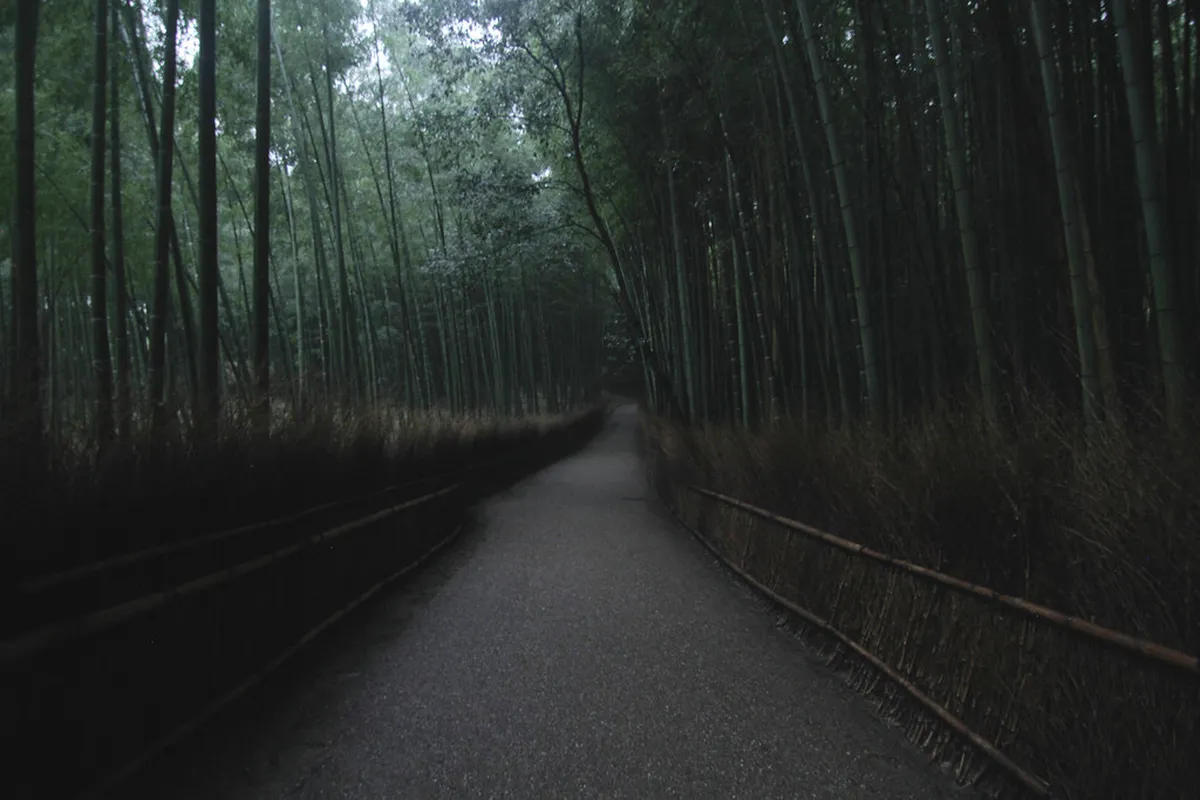
Entry to the path itself is free and open 24 hours. There are no ticket booths, no gates, and no closing time. The surrounding temples and villas do charge admission and operate on fixed hours, but the bamboo grove belongs to everyone.
How to Get to Arashiyama from Kyoto Station
Three separate train lines serve Arashiyama, and each deposits you at a different point relative to the grove. Choosing the right one depends on whether you are optimizing for speed, cost, or proximity to specific sights.
| Line | Departs from | Journey time | Fare | Walk to grove | JR Pass valid |
|---|---|---|---|---|---|
| JR Sagano Line | Kyoto Station | ~15 min | ¥240 | 10 min north-west | Yes |
| Hankyu Arashiyama Line | Katsura (change at Umeda) | ~25 min | ¥220 | 15 min via Togetsu-kyo Bridge | No |
| Randen Tram (Keifuku) | Shijo Omiya | ~25 min | ¥250 | 5 min direct | No |
The JR Sagano Line is the fastest option from Kyoto Station and the only one covered by the JR Pass. Alight at Saga-Arashiyama Station and walk roughly 10 minutes north-west through a residential neighborhood. You pass Torokko Saga Station on the way — useful if you plan to ride the Sagano Scenic Railway later in the day.
The Randen tram from Shijo Omiya drops you at Arashiyama Station (Keifuku), which sits right on the main commercial street. This is the closest station to the bamboo grove entrance and the best choice if you are coming from central Kyoto without a JR Pass. The single-car tram is itself a small experience — it runs through narrow residential streets at walking pace.
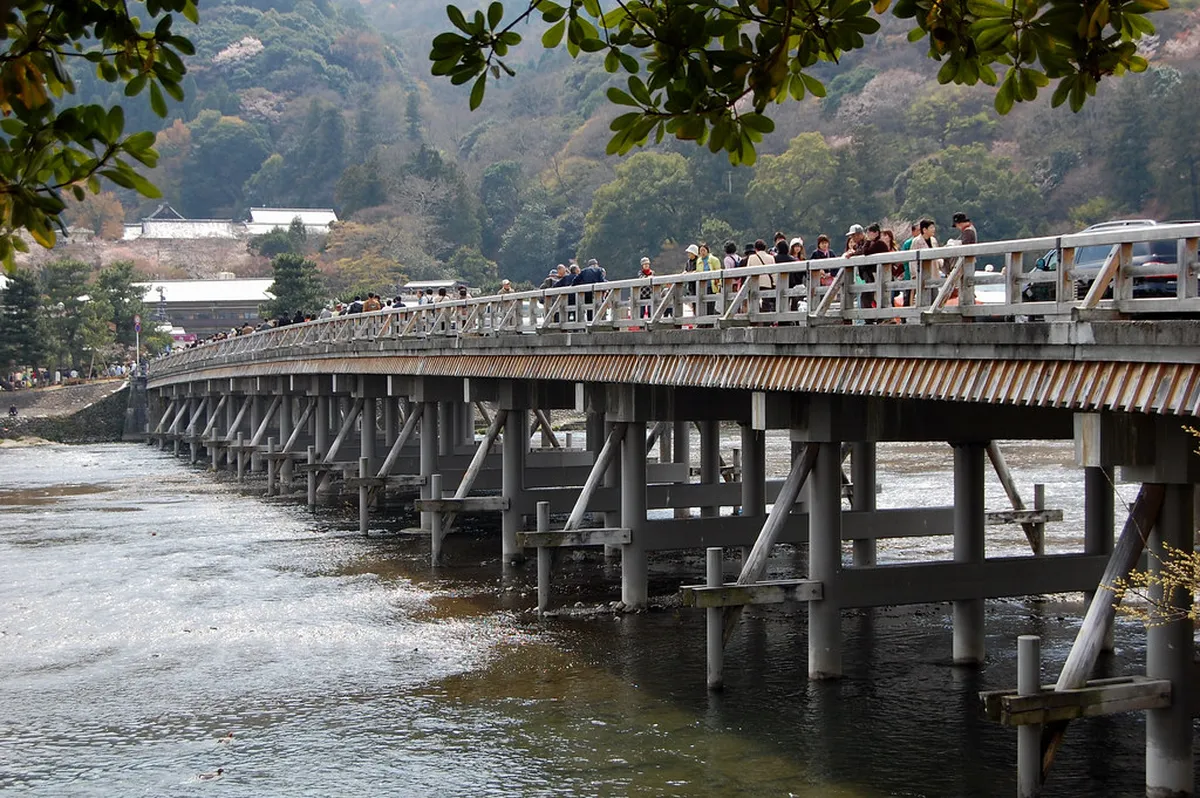
Hankyu Arashiyama Station requires crossing the Togetsu-kyo Bridge to reach the grove, adding about 15 minutes to your walk. This makes it the least efficient option for the bamboo forest specifically, though the bridge itself is worth pausing on for the mountain views upstream.
The Best Time to Visit (Avoiding the Crowds)
Arriving before 07:00 on a weekday is the most reliable way to walk the grove without crowds. Take the first JR train from Kyoto Station (around 06:00) to reach Saga-Arashiyama shortly after — early visitors consistently report having the path almost to themselves for 30–45 minutes.
Timing is the single most important factor for enjoying the bamboo paths without being surrounded by hundreds of other visitors. The grove becomes crowded as early as 09:00 on weekends and public holidays. By 10:00 it can feel claustrophobic in the narrow section near the main street entrance.
Arriving before 07:00 on a weekday gives you the best chance of a quiet grove. The first JR train from Kyoto Station departs around 06:00 and arrives at Saga-Arashiyama shortly after. Visitors who take that first service consistently report having the path almost entirely to themselves for 30 to 45 minutes. After 07:30 groups begin arriving in earnest, and the window closes quickly.
Seasonally, late November (second half, roughly 15–25 November) is peak autumn foliage in Arashiyama — a few days earlier than the rest of Kyoto due to slightly cooler temperatures. The bamboo looks spectacular against the orange maple canopy, but the crowds are also at their worst. Cherry blossom season (late March to early April) is the second peak. Winter weekday mornings, particularly January and February, are the quietest of the year and the only realistic chance of photographing the grove with light snow on the stalks — a condition that occurs roughly two to four times per winter in Kyoto, typically melting by midday.
If you miss the early window, late afternoon from 17:00 onward sees a second lull as tour groups depart and the light turns gold. The grove is open overnight, and a moonlit walk through the stalks is a legitimate option if you are staying locally.
Late November (15–25 Nov) and late March to early April are peak crowd seasons at the grove. During these windows even a 07:00 arrival is no longer a guarantee of a quiet walk. Winter weekday mornings (January–February) offer the only reliable empty-grove experience at popular visiting hours.
Arashiyama Bamboo Grove Walking Tour Route
The most effective way to avoid the worst crowds is to enter the grove from the north via Tenryu-ji's garden exit rather than from the main street side. This approach puts you at the bottom of the western section — the quieter end — and lets you walk uphill through the tallest and most dramatic part of the bamboo tunnel.
Start by entering Tenryu-ji Temple through its main gate on the west side of the main street. The garden-only ticket costs ¥500. Walk past the Sogenchi Pond Garden toward the Tahoden Hall, then exit through the North Gate. You will find yourself at the base of the bamboo grove. Turn left and walk uphill. This section contains the tallest stalks and creates the iconic arching canopy that appears in most photographs of the grove.
At the top of the slope, look right for the entrance to Okochi Sanso Villa (¥1,000, includes matcha tea and a sweet). After the villa, head south into Kameyama-koen Park. Follow the cobblestone path uphill to the summit viewpoint overlooking the Hozu-gawa River and the Arashiyama mountains. Descend via the southern edge of the park to reach the riverside walkway, then follow it downstream back to the main street near the Togetsu-kyo Bridge.
The full loop takes about one hour at a brisk pace, or three to four hours if you explore Tenryu-ji's garden, the villa, and the park properly. A useful hack: buy lunch at a convenience store near Saga-Arashiyama Station before you set out. Restaurants in Arashiyama fill up by noon and waits can exceed 45 minutes on peak days.
Tenryu-ji Temple and Nonomiya-jinja Shrine
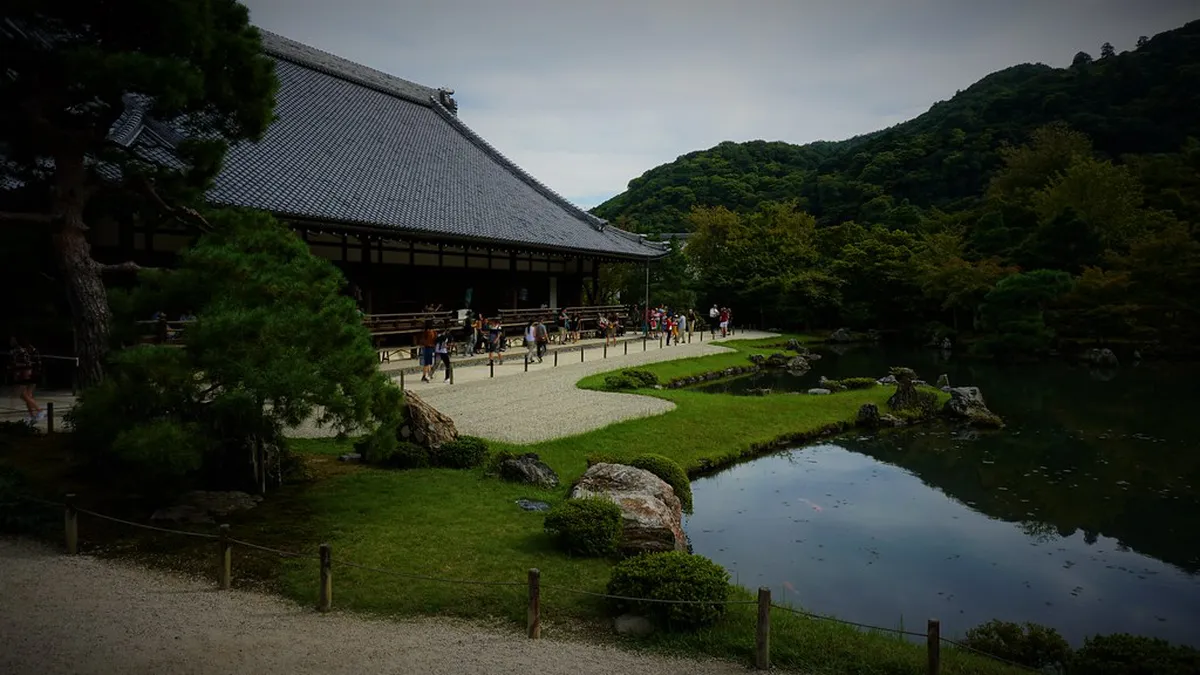
Tenryu-ji Temple is a UNESCO World Heritage site and home to one of the oldest surviving landscape gardens in Japan. The Sogenchi Pond Garden has remained largely in its original form since the 14th century, despite repeated fires that destroyed the temple buildings themselves. The garden ticket (¥500) covers the exterior garden circuit; a separate ¥300 surcharge admits you to the main hall interior. The garden-only route is sufficient for most visitors and directly connects to the bamboo grove's north exit.
During autumn, Tenryu-ji draws enormous crowds because its garden maples are among the most photogenic in Kyoto. A quieter alternative recommended by local guides is Jojakko-ji Temple, a ten-minute walk further into the hills. It reaches peak color at roughly the same time and typically sees half the visitors. Beyond Jojakko-ji, the narrow historically preserved lanes continue uphill toward smaller temples that most day-trippers never reach.
Nonomiya-jinja Shrine sits in the middle of the eastern section of the bamboo grove, identifiable by its distinctive black-lacquered torii gate. It is a Shinto shrine associated with the tale of the fictional Lady Rokujoo from "The Tale of Genji." Visitors come to pray for academic success, romantic matches, and safe childbirth. Entry is free and takes about five minutes to walk through, but the shrine atmosphere — dark timber, moss-covered rocks, small lanterns — is worth a pause even without a specific prayer.
Iwatayama Monkey Park and Kameyama-koen Park
The Iwatayama Monkey Park (entrance ¥550) operates on a reversed zoo concept: the Japanese macaques roam freely on the mountain while visitors who want to hand-feed them enter a wire-mesh cage. The 12-minute climb from the ticket booth is steep enough to deter casual visitors, which keeps the summit meaningfully less crowded than the bamboo grove below. Opening hours are 09:00–17:00 daily (last entry 16:30), with a panoramic view of Kyoto that stretches south to the distant mountains.
Kameyama-koen Park sits adjacent to the western end of the bamboo path and is free to enter. Its summit viewpoint overlooks a bend in the Hozu-gawa River and makes an excellent photography stop. The park is particularly striking in autumn when the maple canopy turns, and in late March during cherry blossom season. Monkeys from the Monkey Park occasionally descend into the lower sections of the park to forage — an unscripted encounter that surprises many visitors.
Between the two parks and the river, the Fufu no Yu onsen offers something no competitor guide seems to cover: a public hot spring bath accessible without a hotel reservation. It sits roughly five minutes' walk south of the Monkey Park entrance and about 15 minutes from the bamboo grove. Two outdoor baths and two indoor pools face the river. A visit here at the end of a full Arashiyama day — sore feet, views of the water — is one of the most satisfying ways to close out the district.
Photography Tips for the Bamboo Grove
The bamboo grove presents a specific technical challenge that no amount of Instagram browsing prepares you for: the canopy is overwhelmingly green, the contrast is low, and the light filtering through the stalks is highly directional. Most casual shots turn out either blown-out at the top or dark and muddy at path level.
The best light arrives in the 30 minutes after sunrise on a clear morning, when the sun is low enough to send shafts directly down through gaps in the canopy. This is the condition that produces the dramatic beam-of-light photographs you have seen online. By 08:00 the sun is too high and the lighting flattens. Overcast days paradoxically work well for full-length shots of the path because soft diffused light eliminates the contrast problem — the whole grove glows an even jade green.
For composition, position yourself low (crouch or sit on the path) and shoot upward toward the canopy. This exaggerates the height of the stalks and uses the converging vertical lines as a natural leading line. A wide-angle lens between 16mm and 24mm equivalent captures the full arch of the canopy. Longer focal lengths compress the stalks attractively but require standing well back from the nearest plants to avoid focus issues.
Visiting before 07:00 also solves the people-in-frame problem. The path is narrow — roughly two meters wide — and even a handful of visitors makes clean shots difficult during peak hours. If you arrive after the crowd window, look for the secondary bamboo stands off the main path near Nonomiya Shrine, which are less photographed and easier to frame without passersby.
Top 7 Things to Do in Arashiyama
While the bamboo grove is the main draw, the surrounding district offers enough to fill an entire day. The Sagano Scenic Railway (also called the Sagano Romantic Train) runs along the Hozu-gawa gorge between Torokko Saga Station and Kameoka, a 25-minute ride through terrain inaccessible by road. Tickets cost ¥880 each way and should be booked ahead during cherry blossom and autumn foliage seasons. You should also consider combining a visit here with Fushimi Inari on a different day — together they represent the two most iconic natural corridors in Kyoto.
- Walk the Togetsu-kyo Bridge for mountain views upstream — free access and a necessary arrival or departure moment regardless of which station you use.
- Ride the Sagano Scenic Railway through the Hozu gorge from Torokko Saga Station (¥880 one-way, advance booking recommended in peak season).
- Explore Okochi Sanso Villa at the far end of the grove — entry is ¥1,000 and includes matcha tea served in the hilltop teahouse, a practical mid-walk rest stop.
- Visit Otagi Nenbutsu-ji Temple in the northern hills for its 1,200 moss-covered stone rakan (disciple) statues, each with a different expression — admission ¥300 and rarely crowded even on busy weekends.
- Take the Hozugawa River Boat downstream from Kameoka to Arashiyama — a 90-minute ride through gentle rapids costing around ¥4,500 per person, best combined with the scenic railway for an outbound/inbound loop.
- See the Kimono Forest at Randen Station after dark — 600 illuminated pillars wrapped in kyoto-dyed fabric, free to walk through and operating every evening year-round.
- Visit Gio-ji Temple in the western hills for its moss garden — admission ¥300 and one of the quietest spots in the entire district even at peak season.
Where to Stay: Arashiyama Ryokans and Hotels
Staying overnight in Arashiyama is the single most effective strategy for beating the bamboo grove crowds. Guests at local ryokan can walk to the path before 06:30 — well ahead of the first trains from Kyoto Station — and have the grove genuinely to themselves for a half hour or more.
Arashiyama Benkei is the traditional choice, a riverside ryokan whose history as a country estate for Heian Period nobles gives it cultural weight beyond its décor. Private and shared onsen baths overlook the Katsura River, and multi-course kaiseki dinners are served in-room. Nightly rates run ¥30,000–¥50,000 per person including dinner and breakfast — expensive, but the full in-room kaiseki service is genuine, not staged. It sits roughly 12 minutes' walk from the grove entrance.
Nagi Kyoto offers a modern boutique alternative with considerably more restrained pricing, typically ¥15,000–¥25,000 per room per night. The design uses local timber and natural materials without the full ryokan ceremony, making it a better fit for travelers who want the proximity advantage without the multi-hour dinner ritual. It is a five-minute walk from the grove. Neither property is the right choice for visitors on a standard budget — for those travelers, a 06:00 train from a central Kyoto hotel achieves the same crowd-avoidance goal for the cost of a ¥240 train fare.
Dining in Arashiyama: Best Places to Eat
The district is famous for Yudofu — silken tofu simmered in a clear dashi broth, served in ceramic bowls in tatami rooms overlooking small gardens. It is a dish that reads as austere on paper but lands as deeply satisfying after a morning of walking. Several restaurants near the Togetsu-kyo Bridge specialize in it, and most open for lunch from 11:30. Queues begin forming by 11:45 on weekends.
Street food along the Randen Station approach is the faster option: matcha soft-serve ice cream, soy-glazed dango skewers, and yaki chestnuts in autumn. Prices are low (¥200–¥500 per item) and the quality is genuinely good because the shops compete directly with each other for passing foot traffic. If you are doing the early-morning grove visit, this strip also offers several cafes open from 07:30 serving coffee and breakfast before the main tourist wave arrives.
For dinner, the riverside restaurants between the Togetsu-kyo Bridge and Hankyu Station offer multi-course kaiseki menus in the ¥5,000–¥12,000 range. These require reservations at least a day in advance on weekends. A more spontaneous option is to end the day in Gion — the Hanamikoji and Kiyamachi streets have more restaurant density and easier walk-in access than anything in Arashiyama after 18:00.
Frequently Asked Questions
How much time should you plan for the Arashiyama Bamboo Grove?
You should plan for at least 30 to 45 minutes to walk through the main grove at a leisurely pace. If you include nearby temples like Tenryu-ji, allow three hours for the full experience. Consider visiting Kiyomizu-dera later in the day to maximize your Kyoto sightseeing schedule.
Is the Arashiyama Bamboo Grove worth visiting during peak season?
The grove remains worth visiting if you arrive very early in the morning to avoid the densest crowds. Peak seasons like cherry blossom or autumn foliage offer incredible colors that enhance the bamboo's green hues. However, late morning visits during these times can feel extremely crowded and less peaceful.
What is the best way to avoid crowds at the Arashiyama Bamboo Forest?
The most effective strategy is arriving before 7:30 AM on a weekday during the off-peak months of winter or summer. Staying at a local ryokan gives you a significant advantage for reaching the paths before the trains arrive. Walking toward the far end of the grove also helps escape the main groups.
Which Arashiyama attractions are best for first-time visitors?
First-time visitors should prioritize the Bamboo Grove, Tenryu-ji Temple, and the Togetsu-kyo Bridge for the most iconic photos. The Sagano Scenic Railway is also a top choice for those who enjoy relaxing views of the natural landscape. These spots provide a perfect introduction to the history and beauty of Western Kyoto.
The Arashiyama Bamboo Grove remains a cornerstone of any successful trip to the historic city of Kyoto.
By following this visitor guide, you can navigate the crowds and discover the true magic of this natural wonder in 2026.
Remember to pack comfortable shoes, bring a charged camera, and arrive early to capture the best light beneath the towering stalks.
Your journey through the bamboo forest will likely become one of your most cherished memories of Japan.
For more Kyoto planning, see our Things to Do in Kyoto, Kyoto Itinerary, and Kyoto Adventures guides.


