
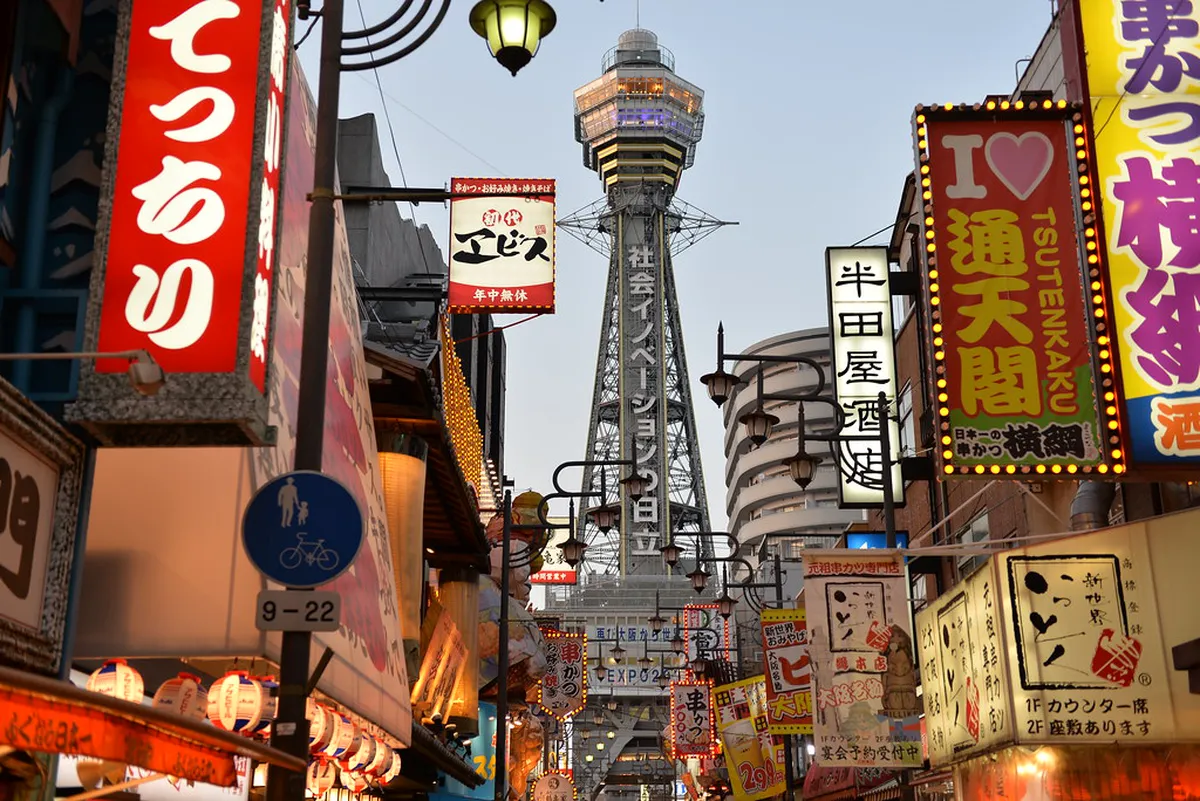
Tsutenkaku Tower is the defining landmark of Shinsekai, the retro entertainment district that has anchored southern Osaka since 1912. At 103 metres tall with an observation deck at 91 metres, it delivers panoramic city views, a stomach-dropping 60-metre slide, and a street below packed with kushikatsu restaurants. This guide covers everything you need to plan a smooth 2026 visit: exact prices, access from each nearby station, what to expect on the Tower Slider, and the practical details that most guides skip.
Essential Visitor Information: Tickets, Hours, and Fees
General admission to the main observation decks is ¥1,000 for adults and ¥500 for children aged 5–14. Infants under 5 enter free. The tower is open daily 10:00–20:00 with last admission at 19:30. Always check the Official Tsutenkaku Website for closures around special events and national holidays.
Two optional add-ons cost extra. The Tower Slider is an additional ¥1,000 per rider. Tenbo Paradise — the outdoor observation deck at the very top of the tower, roughly 100 metres above ground — costs an extra ¥300 for adults and ¥200 for children. Both are purchased separately at the ticket counter inside the building. If you plan to do everything, budget ¥2,300 per adult on top of any food in Shinsekai.
Combo tickets are sometimes available for groups and school parties. Online ticket purchase is possible through the official site and reduces queueing at the entrance, particularly useful on weekends and during Golden Week (late April to early May) when wait times at the counter can stretch past 20 minutes.
| Ticket / Add-on | Adult | Child (5–14) | Infant (<5) |
|---|---|---|---|
| Main observation deck | ¥1,000 | ¥500 | Free |
| Tower Slider add-on | ¥1,000 | ¥1,000* | Not eligible |
| Tenbo Paradise outdoor deck | ¥300 | ¥200 | Free |
| All-in total | ¥2,300 | ¥1,700 | Free |
- Adults: ¥1,000 main admission
- Children (5–14): ¥500 main admission
- Infants (under 5): Free
- Tower Slider add-on: ¥1,000 (all ages meeting requirements)
- Tenbo Paradise outdoor deck add-on: ¥300 adults / ¥200 children
- Hours: 10:00–20:00 daily, last admission 19:30
A Brief History of Osaka's Iconic Eiffel Tower
The original Tsutenkaku was built in 1912 as the centrepiece of the Shinsekai development, a neighbourhood modelled simultaneously on Paris (the north half) and New York's Coney Island (the south half). The design fused a version of the Eiffel Tower with the Arc de Triomphe as its base. The surrounding amusement park, Luna Park, operated through the following decades until a fire during World War II destroyed the tower in 1943. Rather than demolish the steelwork, locals donated the remaining metal to the war effort.
The current tower was designed by Tachu Naito and completed in 1956. Naito is known as Japan's king of towers, having also designed Tokyo Tower and the Sapporo TV Tower. The name Tsutenkaku translates roughly as "tower reaching heaven." At 103 metres it is not the tallest structure in Osaka, but it remains the most emotionally significant to locals — a symbol of post-war recovery and the irreverent working-class spirit of the city's south.
Exhibits on the lower floors document this history through photographs and artefacts. The third floor hosts detailed miniature dioramas of the 1912 Shinsekai streetscape, including the original Luna Park. A display dedicated to Ezaki Glico, Morinaga, and Nissin Foods on the basement floor (Wakuwaku Land) shows how the tower's neighbourhood shaped some of Japan's most recognisable snack brands.
The 60-Metre Tower Slider: What to Expect
The Tower Slider opened in 2022 and has become one of the most-discussed attractions at any Osaka landmark. It is a 60-metre enclosed spiral tube that descends from the third floor to the basement in roughly 10 seconds. Tickets cost ¥1,000 on top of general admission and are purchased at the basement-floor counter. Free lockers are provided for bags and loose items before you ride — you cannot carry a phone or bag on the slide.
Tower Slider riders must be aged 7–64, at least 120 cm tall, and under 100 kg. These limits are strictly enforced. Phones and bags must be stored in free lockers before riding — you cannot carry anything on the slide.
Staff issue a helmet and a padded sliding bag before you take the elevator up to the third-floor launch platform. You lie on your back in the bag, hands crossed over your chest, and are counted down before being released. There is a partially transparent section near the top that offers a brief glimpse of the surrounding steel structure and Shinsekai rooftops before the enclosed tunnel takes over. The whole ride lasts about 10 seconds. A video of your descent is automatically recorded and downloadable on the spot via a Wi-Fi QR code — useful since phones are not permitted during the ride.
Age and physical restrictions apply: riders must be between 7 and 64 years old, and at least 120 cm tall. Maximum weight is 100 kg. These limits are strictly enforced at the entrance to the slide. If you are travelling with young children or older family members who fall outside the 7–64 range, plan for them to wait at the base level or explore the souvenir floor instead. Morning visits on weekdays see the shortest queues; weekend afternoons can involve a 30–40 minute wait even after purchasing a ticket.
Observation Decks and Panoramic Views of Osaka
The tower has three distinct viewing levels, each with a different atmosphere. The fifth-floor Golden Observation Deck is the main indoor deck, decorated with gold leaf and offering 360-degree views across the city. On a clear day you can see the Ikoma Mountains to the east and the Osaka Bay waterfront to the west. The fourth-floor deck has a more colourful, playful interior that converts into a mirror-ball nightclub atmosphere after dark — an unexpectedly fun contrast with the floor above.
The Billiken statue sits on the fifth floor and is the tower's most photographed feature. Billiken is the Shinsekai "god of things as they ought to be," originally a North American design adopted by Osaka traders in the early 20th century. Rubbing the soles of his feet is considered to bring good luck. Multiple Billiken versions appear throughout the tower in displays and as souvenirs; the fifth-floor statue is the most significant.
For the most striking experience, pay the extra ¥300 for Tenbo Paradise. This outdoor deck at approximately 100 metres height includes TIP THE TSUTENKAKU — a small platform that extends outward from the tower structure with a transparent floor underfoot. The neon-lit staircase leading up to Tenbo Paradise photographs well and feels distinctly different from the enclosed indoor decks. Evening visits are worth planning around: the tower's LED exterior lights change colour by season (pink for cherry blossom, for example) and the top acts as a weather forecast beacon for the following day. Tenbo Paradise pairs well with other Osaka landmarks like the nearby Billiken statue and the surrounding Shinsekai architecture.
The tower's LED exterior acts as a weather forecast beacon each evening: white = clear tomorrow, orange = cloudy, blue = rain. Locals actually use it to plan their days — look up before you leave the neighborhood.
The LED weather forecast system uses a simple colour code visible across southern Osaka at night: white indicates clear skies tomorrow, orange means cloudy, and blue signals rain. Locals have used it to plan their days for decades. It is one of the small details that makes Tsutenkaku feel like a functioning part of the city rather than a purely tourist attraction.
Miniature Models and Shinsekai Souvenirs
The third floor is worth slowing down on before or after the slide. Detailed dioramas recreate Shinsekai as it looked in 1912, including the original Luna Park — Japan's second amusement park — and the Hankai Tramway line that ran south from Ebisucho and still operates today. The models are precise enough to show street-level shop signs and the layout of the original entertainment zone.
The gift shop stocks Billiken merchandise in every format: small charms, ceramic figures, key rings, and larger decorative statues. Many items are exclusive to this site. A practical and locally appropriate souvenir is "Mo Curry," an instant curry sauce whose Japanese name ("mo kaa rei") sounds identical to a phrase meaning "make profit" — a fitting nod to Osaka's merchant heritage. The Wakuwaku Land snack exhibit on the basement floor stocks items from Glico, Morinaga, and Nissin that are difficult to find in standard convenience stores.
Accessibility Guide: Wheelchair and Facility Info
A dedicated elevator connects all floors and is accessible to wheelchair users. The barrier-free route is signposted from the main entrance; staff at the ticket counter can provide a printed map of the accessible path on request. Restrooms with accessible facilities are located on the lower levels. Most exhibit displays are positioned at a height visible from a seated position.
The Tower Slider is the only major feature with physical restrictions: the age, height, and weight limits described above (ages 7–64, 120 cm minimum, 100 kg maximum) mean some visitors will not be eligible. The outdoor Tenbo Paradise deck involves a staircase to the launch platform; visitors with limited mobility should check with staff about the current configuration before purchasing that add-on. The surrounding Shinsekai streets are relatively flat and well-paved, which helps for wheelchair or stroller use between the tower and nearby restaurants.
Strollers can be taken inside the building but may need to be folded in peak-hour crowds near the elevator lobby. Staff members are trained to assist and will approach proactively if they see visitors who need help. Advance notice via the official website contact form is possible if you require specific arrangements.
How to Get to Tsutenkaku Tower: Transport and Access
Three stations give practical access to the tower, each with a different trade-off. Ebisucho Station (Osaka Metro Sakaisuji Line, Exit 3) is the closest at roughly a 3-minute walk and drops you directly into the covered Shinsekai shopping arcades. Dobutsuen-mae Station (Osaka Metro Midosuji and Sakaisuji Lines, Exit 5) is about a 6-minute walk and is convenient if you are also planning to visit Tennoji Zoo or Tennoji Park. Shin-Imamiya Station (JR Osaka Loop Line, also served by Nankai Railway) is a 5-minute walk and is the best option if you are arriving from Namba or using a JR Pass to travel across Osaka. Build your trip around Tsutenkaku with our Osaka itinerary and guide to things to do in Osaka.
A note on the JR Pass: it covers your train fare to Shin-Imamiya but does not include entry to the tower. Osaka Metro (subway) is a separate network that the standard JR Pass does not cover. If you are using the metro, load your IC card (ICOCA, Suica, or PASMO) rather than buying individual tickets at the gate. Parking in Shinsekai is very limited and the streets are narrow; public transport is strongly recommended.
For precise walking directions, use the Google Maps pin for Tsutenkaku. The tower is visible from several blocks away, so you can navigate by sight once you exit the station.
- Ebisucho Station (Sakaisuji Line, Exit 3): 3-minute walk — closest, enters the shopping arcades
- Dobutsuen-mae Station (Midosuji / Sakaisuji Lines, Exit 5): 6-minute walk — best for combining with Tennoji Zoo
- Shin-Imamiya Station (JR Loop Line / Nankai): 5-minute walk — use if arriving via JR Pass or from Namba
Exploring Shinsekai: Food and the Surrounding Area
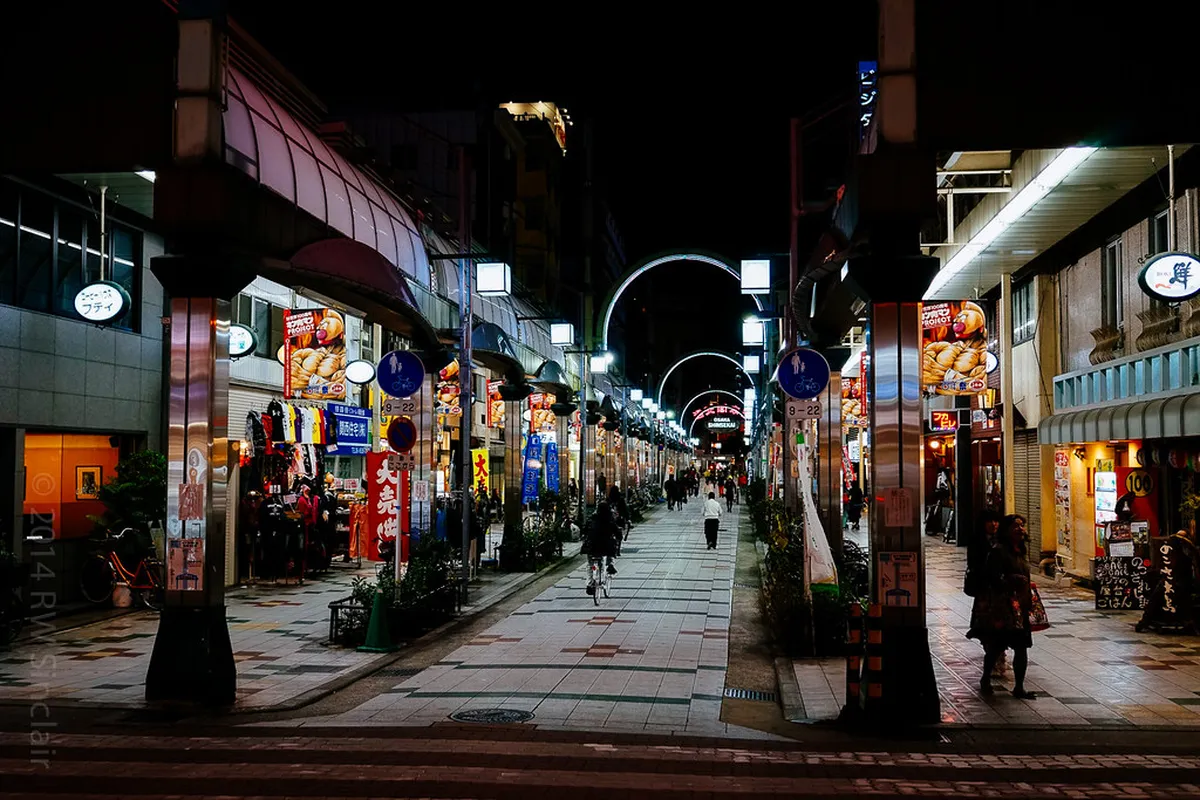
Kushikatsu is the dish most associated with Shinsekai: deep-fried meat, seafood, and vegetables on bamboo skewers, dipped once into a communal sauce. The rule against double-dipping is enforced seriously in every restaurant and exists for hygiene reasons — sauce bowls are shared between tables. Kushikatsu Daruma, which opened on Jan-Jan Yokocho in 1929, is the area's most famous kitchen; expect a queue during lunch and dinner hours. Jan-Jan Yokocho itself is a narrow covered alley parallel to the main Shinsekai arcade, lined with small restaurants and traditional shogi parlours.
After eating, the walk north to Kuromon Market takes about 15 minutes and adds a different food dimension — fresh seafood, grilled skewers, and street snacks served directly from stall counters. For an evening contrast, Dotonbori is a 20-minute walk or one metro stop north and offers the neon-heavy entertainment district atmosphere that defines Osaka in most travel photography.
Tennoji Zoo sits immediately adjacent to the tower entrance — one of the oldest zoos in Japan, with a broad mix of species and affordable entry. Tennoji Park, between the zoo and Abeno Harukas, provides a green rest stop if you are spending a full day in the area.
Family-Friendly Tips: Visiting with Children
The tower works well for families with children aged 7 and above who meet the Tower Slider requirements. The mix of the slide, the Billiken statue, the miniature models, and the basement snack exhibit keeps different ages engaged across the full visit. Allow 90 minutes to two hours for a relaxed visit that includes the slider and the observation deck. Morning arrivals on weekdays avoid the longest queues for the slide.
Strollers are manageable inside the building but the elevator lobby becomes congested on busy days. Children under 7 cannot ride the Tower Slider, so plan for them to explore the third-floor dioramas and Wakuwaku Land snack hall while older siblings ride. Vending machines for drinks are available on multiple floors. Staff are approachable and accustomed to helping families navigate the building.
The surrounding Shinsekai streets are safe and walkable for families. The covered arcades mean a rainy-day visit is still comfortable. Kushikatsu restaurants generally welcome children, and the skewer format suits picky eaters who can pick individual items rather than commit to a set menu.
Nearby Attractions: Tennoji Zoo and Abeno Harukas
Tennoji Zoo is the easiest add-on — the entrance is a two-minute walk from the tower and the combined half-day works well for families. Abeno Harukas, Japan's tallest building at 300 metres, stands immediately south of Tennoji Station and offers a markedly different skyline perspective from the one you get at Tsutenkaku. The contrast between the retro 103-metre tower and the modern glass skyscraper is one of the more visually striking juxtapositions in Osaka.
The ancient Shitenno-ji temple, founded in the sixth century, is a 10-minute walk east of the tower and provides a quiet counterpoint to the neon and fried food of Shinsekai. Its five-storey pagoda and pond garden are free to enter from the outer precinct. For a longer day, Osaka Castle is accessible by metro in about 25 minutes and rounds out a historically varied day across the city.
If you want another elevated view of Osaka, the Umeda Sky Building in the north of the city offers a floating garden observatory at 173 metres and feels architecturally very different from Tsutenkaku. The two towers are a good comparison point for anyone interested in how Osaka's sense of spectacle has evolved from 1956 to the present.
Frequently Asked Questions
Is the Tsutenkaku Tower Slider worth it?
The Tower Slider offers a unique thrill for visitors who enjoy high-speed attractions and modern architecture. It provides a quick ten-second adrenaline rush that creates lasting memories of your trip to Osaka. Most travelers find the extra cost justified for the unique experience.
How much does it cost to go up Tsutenkaku Tower?
General admission for adults is approximately 1,000 yen, which covers the main observation decks and historical exhibits. Children's tickets are usually half price at 500 yen. Please note that the Tower Slider requires an additional fee of 1,000 yen per person.
What is the best station for Tsutenkaku Tower?
Ebisucho Station on the Sakaisuji Subway Line is the closest option, located just a three-minute walk away. You can also use the Dobutsuen-mae Station on the Midosuji Line. Shin-Imamiya Station is ideal for those arriving via the JR Loop Line or Nankai Railway.
Can you use the JR Pass for Tsutenkaku Tower?
The JR Pass covers your train travel to nearby stations like Shin-Imamiya, but it does not include entry to the tower. You must purchase a separate ticket at the tower entrance to access the observation decks. It is a private attraction not operated by the Japan Railways group.
Tsutenkaku Tower remains an essential stop for anyone wanting to experience the soul of Osaka. From the historical dioramas to the modern thrills of the slider, there is something for everyone. We hope this guide helps you plan a perfect visit to this iconic and charming landmark.


