
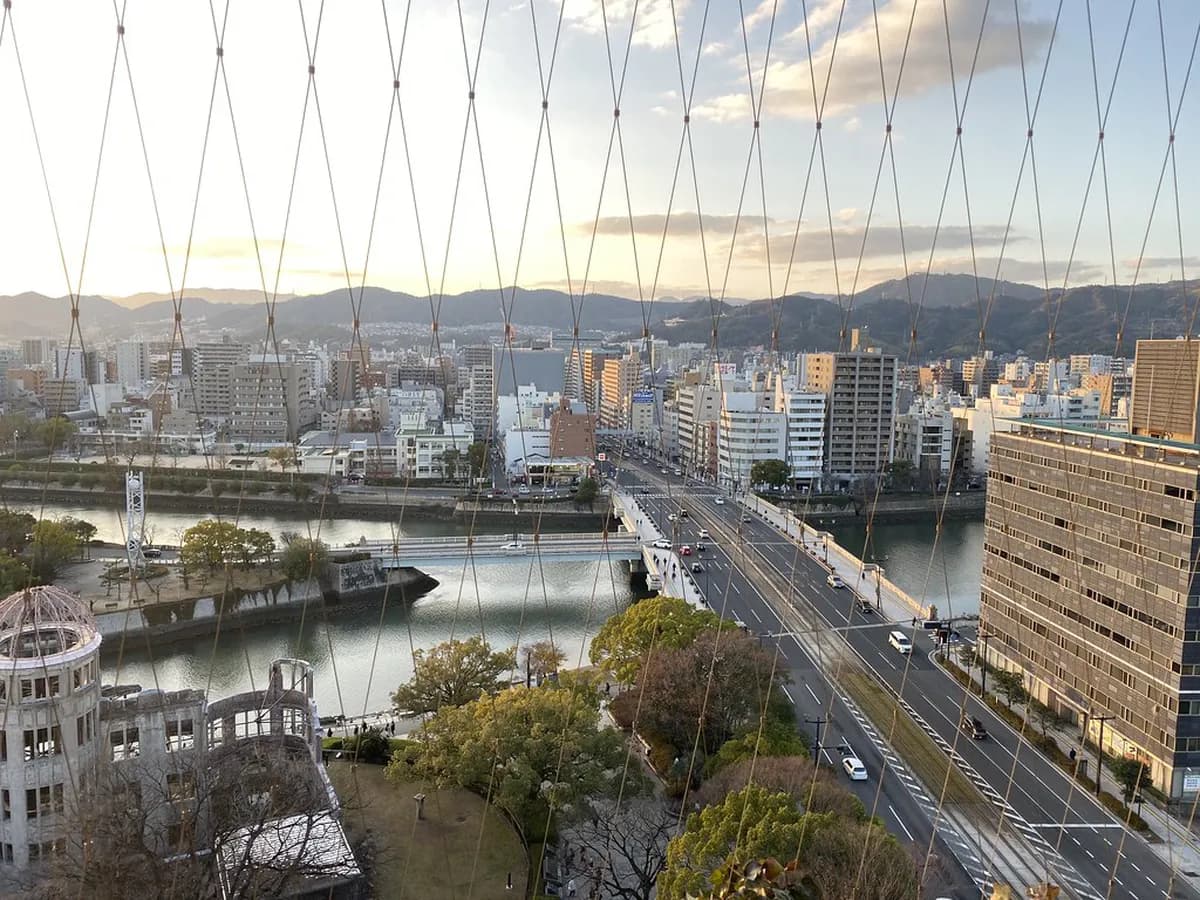
Orizuru Tower stands directly across the street from the Atomic Bomb Dome and gives you the closest aerial view of Peace Memorial Park that money can buy in Hiroshima. The 14-floor building packs an open-air observation deck, a paper-crane installation wall, an artist-mural walkway, and a 70-metre spiral slide into a single admission ticket. This guide walks you through every floor so you can plan your time and decide whether the ¥2,200 entry fee is right for your trip.
Overview of the Orizuru Tower Experience
Orizuru means "folded paper crane" in Japanese, and the entire building is built around that symbol of peace. The tower was originally an office block, converted and reopened in September 2016 as a mixed-use attraction combining a curated shop, organic cafe, exhibition space, and observation deck. At 50 metres tall it is one of the few high buildings permitted in the low-rise zone surrounding Peace Memorial Park, which makes the view from the top genuinely rare.
The visitor flow is designed top-down: you ride the lift to the 14th-floor observation deck first, then work your way down nine floors via the Sampo Spiral Slope, pausing at the 12th-floor Orizuru Square before eventually reaching the ground-floor shop and cafe. Understanding that the observation deck is on floor 14 and the interactive crane square is on floor 12 prevents confusion when navigating between floors. The distinction matters because the two spaces feel completely different in atmosphere and purpose.
- Height: 50 metres (164 ft)
- Floors: 14 total, 9 open to visitors via the spiral slope
- Opened: September 2016
- Observation deck: 14th floor (Hiroshima Hills)
- Interactive crane wall: 12th floor (Orizuru Square)
- Ticket valid for same-day re-entry
The Hiroshima Hills Open-Air Observation Deck
The 14th-floor deck, named Hiroshima Hills, is surrounded by wire mesh rather than glass — a deliberate design choice that keeps the air moving and lets you take unobstructed photographs from every angle. Looking directly down and to the north, the skeletal steel dome of the Genbaku Dome fills the foreground while Peace Memorial Park spreads out below. On clear winter and autumn days you can see the torii gate of Miyajima floating in the water roughly 20 kilometres to the south-west. Gate Park and the greener strips of the Motoyasu River delta are also clearly legible from this height.
A visual landmark guide is posted on the deck railing so you can identify each view without guesswork. The wooden floor and bench seating create a warm contrast to the steel mesh, and a small cafe counter on the deck sells coffee and soft drinks so you can linger without heading back downstairs. Sunset visits (the tower closes at 18:00, last entry 17:00) produce dramatic light over the memorial, but the A-Bomb Dome is easier to photograph in soft morning or overcast light when shadows are flat and the dome's lattice is sharply detailed.
The reconstructed Hiroshima Castle is visible to the north-east on clear days, rising above the tree canopy roughly 1.5 kilometres away. Most visitors spend 20–30 minutes on the deck before descending; arriving before 11:00 on weekdays usually means you have the space largely to yourself.
Seasonal Rooftop Bar Hours on the Hiroshima Hills Deck
On selected evenings during the warmer months, the Hiroshima Hills deck extends beyond its standard 18:00 close for a seasonal rooftop bar. The pop-up typically runs Friday and Saturday nights from around July through September, with the exact dates published on the official Orizuru Tower website each spring — worth checking before you plan an evening visit, since the schedule shifts year to year.
The drinks list draws on the same Hiroshima Prefecture sourcing as the ground-floor Akushu Cafe: Setouchi lemon highballs sit alongside a rotating craft beer and light bar snacks such as grilled oysters and edamame. A standard tower ticket gets you onto the deck for the bar hours; drinks and food are purchased separately at the counter.
The appeal is the same mesh-walled, open-air setting described above, but after dark — the Genbaku Dome and Peace Memorial Park are lit rather than sunlit, and the city skyline beyond fills in with lights that the daytime view doesn't show. Bring a light layer even in summer, since the 14th floor catches more wind after sunset than the streets below.
Interactive Fun at Orizuru Square
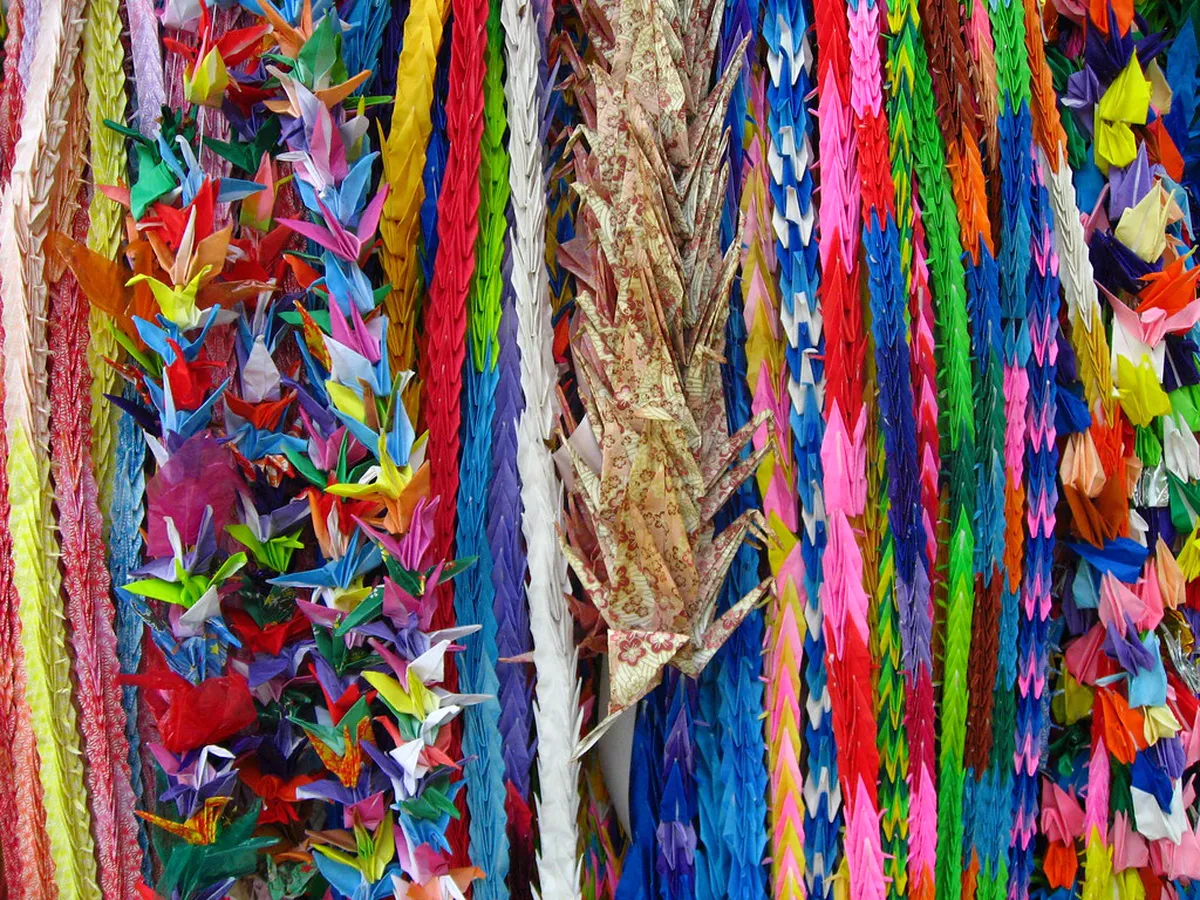
Two floors below the observation deck, the 12th floor houses Orizuru Square, the exhibition centrepiece of the building. The most striking feature is the Orizuru Wall: a floor-to-ceiling glass panel where thousands of paper cranes folded by visitors accumulate in layers visible from both sides. Folding paper and a small folding guide are available at the station on the floor; once your crane is complete, you drop it through a chute into the glass enclosure where it joins the collection below.
The folding itself takes three to five minutes for adults and up to ten minutes for children attempting it for the first time. The step-by-step guide on the folding table uses photos rather than text, so language is not a barrier. Dropping the crane into the wall is the emotional payoff — watching it flutter down through the cranes already there gives a visceral sense of the cumulative wishes represented inside that glass.
Beyond the crane wall, the floor uses projection mapping and motion sensors to create digital art installations that respond to movement. Children enjoy the interactive screens where silhouettes trigger animated cranes. These digital elements keep the space engaging for visitors who may feel emotionally saturated after the Peace Park and museum, offering a lighter and more playful experience before you begin the descent.
The Sampo Spiral Slope and 70-Meter Slide
The Sampo Spiral Slope is a 450-metre walking ramp that descends nine floors from the observation area to the ground floor. Every floor of the ramp displays a large-format mural created as part of the 2045 Nine Hopes project, in which invited artists were asked to depict their wishes for Hiroshima on the centenary of the atomic bombing. The murals range from abstract optimism to detailed visions of a greener city; reading the artist notes posted beside each work adds ten to fifteen minutes to the descent but is worth the time.
The Cool-Cool-Cool slide is built into the same ramp: a 70-metre continuous slide that runs from floor 12 to floor 1, with exit points at each landing so you are not committed to a full run. The critical practical detail is that slide sheets — thin padded mats you sit on — are distributed only at the entry point at the top, not at each floor along the way. Pick up your sheet before you start walking down the ramp. If you forget and decide mid-descent that you want to slide, you will need to go back up to retrieve one.
Slide sheets (the thin mats for the 70-metre Cool-Cool-Cool slide) are handed out only at the top entry point — not at each floor. Collect yours before you start descending the Sampo Spiral Slope, or you will have to backtrack to retrieve one.
The slide is fast but staffed at each section, and adults ride it without any weight or height restrictions beyond common sense. Children under roughly 100 centimetres need to sit on a parent's lap. The mesh walls along the ramp keep you connected to the city air and allow views of the Dome at several heights, giving you a different photographic angle at each floor compared to the open deck above.
Local Flavors at Akushu Cafe and Select Shop
The ground floor is accessible from the street without a tower ticket, so you can visit the shop and cafe even if you are not paying for the observation deck. The Akushu Cafe leans on Hiroshima Prefecture ingredients: the lemon soda uses Setouchi lemons, and seasonal menus include oyster dishes from Miyajima waters. The seating area faces the street and provides an informal vantage point to rest after a long morning in Peace Park.
The Select Shop stocks products you are unlikely to find in the larger souvenir outlets near Okonomimura. Kumano makeup brushes — a traditional craft from the mountain villages east of the city — sit alongside local sake, artisan stationery, and Hiroshima-branded ceramics. The curation skews toward quality over volume, and prices reflect that. Staff can explain the origin of most items, which is useful if you are buying as a serious gift rather than a generic souvenir.
The shop also stocks a small range of origami paper and crane-folding kits that make compact travel gifts. If you plan to fold a crane for the Orizuru Wall on the 12th floor, you do not need to buy paper in advance — supplies are provided upstairs. The kits here are for taking home rather than for use inside the tower.
Practical Planning: Tickets, Access, and Hours
The tower opens daily from 10:00 to 18:00, with last entry at 17:00. Hours sometimes extend into the evening in summer — check the official Orizuru Tower website before you go. Tickets are sold at the counter on the first floor and are valid for same-day re-entry, so you can leave for lunch at a nearby restaurant and return without paying again.
Admission in 2026 is structured by age group:
- Adults (university age and above): ¥2,200
- Teens (junior high / high school): ¥1,400
- Children aged 6–11: ¥900
- Preschoolers aged 4–5: ¥600
- Atomic-bomb survivors (hibakusha): free
| Visitor type | 2026 admission |
|---|---|
| Adult (university age and above) | ¥2,200 |
| Teen (junior high / high school) | ¥1,400 |
| Child aged 6–11 | ¥900 |
| Preschooler aged 4–5 | ¥600 |
| Atomic-bomb survivor (hibakusha) | Free |
Your admission ticket allows same-day re-entry — visit the deck in the morning for clear light on the A-Bomb Dome, take a break for lunch in Peace Park, and return in the afternoon for sunset views without paying again.
To reach the tower from Hiroshima Station, take Hiroden tram line 2 or line 6 to the Genbaku Dome-mae stop. The tower is directly across the street — a one-minute walk from the tram platform. The building has lifts on every floor and accessible toilets, making it fully navigable for wheelchair users and strollers. Budget 60–90 minutes for a complete visit covering the deck, crane folding, the spiral slope, and the ground-floor shop. Consult the Hiroshima Convention & Visitors Bureau for any seasonal closures or special events that may affect your visit.
Saving on Admission: Web Tickets and Receipt Discounts
Orizuru Tower sells advance tickets online through its official website, which is worth doing if you're visiting on a weekend, a national holiday, or during peak cherry blossom or autumn foliage weeks, when the first-floor counter queue can run past thirty minutes. Web tickets are issued at the same price as counter admission but let you walk straight to the lift with a QR code on your phone.
A separate saving applies if you're combining Orizuru Tower with another Hiroshima sight on the same day. Showing a same-day receipt or ticket stub from a partner attraction — the Hiroshima Peace Memorial Museum, Hiroshima Castle, and the Miyajima ropeway are the most commonly accepted — typically takes around ¥200 off the adult admission price, bringing it from ¥2,200 down to roughly ¥2,000 at the counter. The discount is applied per ticket holder, so bring separate receipts if your group is folding the cost across multiple visitors.
This pairs naturally with a Peace Park morning: many visitors fold a crane at the Peace Memorial's crane-folding stations before crossing the street to add another one to the Orizuru Wall on the 12th floor, and the museum admission receipt from that same morning can be shown at the tower counter for the discount.
Is Orizuru Tower Worth the Entry Fee?
The honest answer depends on what you value in Hiroshima. Peace Park and the A-Bomb Dome are free, and the Hiroshima Rest House nearby gives you a ground-level view of the memorial for nothing. What Orizuru Tower adds is altitude: the aerial perspective on the Dome, surrounded only by wire mesh and open sky, is genuinely different from anything you get at ground level. For photographers and anyone who wants to understand the spatial layout of the memorial zone, that elevated angle is worth the ¥2,200 alone.
Families with children get the most obvious additional value — the slide and crane folding are activities that the Peace Memorial Museum cannot offer, and they give younger visitors a tactile, hands-on way to engage with the site's themes. Solo travelers or couples on a tight budget may reasonably skip it, especially if they are also planning a day trip to Itsukushima Shrine on Miyajima, where the ferry and shrine admission add up quickly.
One detail that improves the value calculation: the same-day re-entry policy means you can visit the deck in the morning, walk the park, have lunch, and return in the afternoon for different light on the Dome without paying twice. For visitors spending a full day in the memorial district, that flexibility makes the single admission stretch further than the headline price suggests.
Frequently Asked Questions
Is Orizuru Tower worth the entry fee?
Yes, Orizuru Tower is worth the entry fee for its unique open-air views of the A-Bomb Dome. The interactive crane folding and the 70-meter slide provide a memorable experience that you cannot find elsewhere in Hiroshima. It offers a modern perspective on the city's recovery.
How much are tickets for the Orizuru Tower?
Adult tickets typically cost around 2,200 yen, though prices can vary based on age and special promotions. There is an additional small fee if you wish to participate in the paper crane folding activity. Check the official website for the most current pricing before your visit.
Can you see the A-Bomb Dome from Orizuru Tower?
The observation deck provides one of the best and closest bird's-eye views of the A-Bomb Dome in the city. Because the deck is open-air and lacks glass windows, you can take perfectly clear photos of the historic site. It is a powerful spot for reflection.
What is the Cool-Cool-Cool slide in Hiroshima?
The Cool-Cool-Cool slide is a 70-meter spiral slide that allows visitors to descend the Orizuru Tower quickly. It is a safe and fun alternative to taking the stairs or the elevator. Staff provide special mats to ensure a smooth and exciting ride for all guests.
The Orizuru Tower is more than just an observation deck; it is a living monument to peace and creativity. Whether you are sliding down the spiral slope or folding a crane, the experience connects you to Hiroshima's spirit. Make sure to include this unique landmark on your itinerary for a truly well-rounded visit to this historic city.
Plan your wider Hiroshima trip: see our Hiroshima attractions guide, Hiroshima itinerary, Hiroshima landmarks guide for routing, pacing, and what to slot in alongside this stop.

