

The Mazda Museum sits inside Mazda's working headquarters in Fuchu, just six minutes by train from central Hiroshima. Admission is free, but entry is by guided tour only, and spots are limited. This guide covers everything you need: how to book, how to get there, what each zone contains, and what to do if every slot is taken.
The 90-minute experience moves from a hall of historic vehicles through to an elevated walkway above an active assembly line producing around 1,000 cars per day. It is one of the best free factory tours in Japan for 2026, and one of the most popular — the English-language slot fills months in advance.
Essential Mazda Museum Visitor Information
The museum is located within Mazda's sprawling headquarters complex in Fuchu-cho, Aki-gun, not in Hiroshima city centre. The address is 3-1 Shinchi, Fuchu-cho — this is the head office building where your tour begins. Admission is free for all visitors, making it an exceptional value for the quality of access.
Tours run on weekdays only. There are no tours on weekends, Japanese public holidays, or company closure dates. Each tour group is capped at 45 people maximum; groups of 11 or more can request their own dedicated group tour. The standard tour lasts approximately 90 minutes, though you should allow two hours total to include check-in and the gift shop.
Photography is strictly prohibited from the moment you board the bus to the assembly plant through the entire production line walk. Cameras and phones must be stowed completely — no exceptions. You may photograph freely only in the museum exhibition zones and lobby.
Photography rules are strict and worth knowing before you go. You may photograph freely in the museum exhibition zones and the lobby. Cameras and phones must be put away entirely during the bus transfer to the plant and throughout the assembly line walk — this protects both worker privacy and manufacturing trade secrets.
- Admission: Free
- Duration: 90 minutes guided (allow 2 hours total)
- Group cap: 45 people maximum per tour
- Days open: Weekdays only, excluding public holidays
- Booking: Mandatory in advance — no walk-ins accepted
How to Book Your Mazda Museum Tour (English Website)
Reservations must be made through the Official Mazda Museum Guide & Booking system. The English-language tour runs once daily at 14:15. This single slot typically books out two to three months in advance — if you want an English tour in 2026, open the booking calendar as soon as your travel dates are confirmed.
Japanese-language tours run at 09:15 and have larger capacity with shorter lead times, usually two to four weeks. If you join a Japanese tour, you will follow the same route and see the same exhibits, but the verbal commentary will be in Japanese only. The visual experience on the assembly line is equally rewarding either way.
The online portal shows real-time availability for the next several months. Complete your details carefully and save the confirmation email. Arrive at the head office reception desk at least 15 minutes before your tour start time — guides leave promptly.
- English tour: 14:15 daily, books out 2–3 months ahead, capacity 45 max
- Japanese tour: 09:15 daily, books out 2–4 weeks ahead, larger groups permitted
- Groups of 11+: Contact Mazda directly to arrange a dedicated group session
| Tour option | Start time | Language | Book ahead | Admission |
|---|---|---|---|---|
| English guided tour | 14:15 | English | 2–3 months | Free |
| Japanese guided tour | 09:15 | Japanese | 2–4 weeks | Free |
| Group tour (11+ people) | By arrangement | Both available | Contact Mazda direct | Free |
The English tour at 14:15 is the first to sell out — often two to three months ahead of Golden Week and autumn foliage season. Open the Mazda booking calendar the moment your travel dates are confirmed and secure your spot immediately.
Getting to the Mazda Factory: Mukainada Station Guide
The fastest way to reach the factory is by local JR train. From Hiroshima Station, board an eastbound service on the JR Sanyo Line or JR Kure Line. Trains run every 15 minutes and the journey to Mukainada Station takes about six minutes. Note that express trains skip Mukainada — take only local services. The fare is ¥190 one way, or free if you hold a JR Pass.
Exit Mukainada Station via the South Exit. Street signs for Mazda are visible from the platform. The walk to the Mazda head office building takes around five minutes along a straight, well-marked path. The large industrial campus can be disorienting if you wander, so stay on the signed route and head directly for the main lobby entrance marked "Mazda Head Office." Use Google Maps: Mazda Museum Location to confirm you are heading to the right building, not one of the surrounding manufacturing buildings.
A bus alternative also exists. Bus lines 11, 12, or 13 from Hiroshima Station stop at Mukainada-eki mae (also signed as Mazda-honsha mae). The bus journey takes around 15 minutes, longer than the train, but useful if you are coming directly from a hotel in the city centre with heavy bags.
Mazda Museum Hiroshima History: From Cork to Cars
The company was founded in 1920 as Toyo Cork Kogyo, a manufacturer of cork products in Osaka. It pivoted to machinery, then to three-wheeled trucks — the first rolled out of Hiroshima in 1931. The brand name "Mazda" references Ahura Mazda, the god of wisdom and light in Zoroastrian tradition, and also echoes the surname of founder Jujiro Matsuda.
The atomic bombing of Hiroshima on 6 August 1945 fell on Matsuda's 70th birthday. The company acknowledges this soberly in its introductory film shown at the start of every tour. What is remarkable is the speed of recovery: the factory resumed production of three-wheeled trucks within four months of the bombing and played a direct role in the physical rebuilding of the city. This resilience is woven through the museum's identity today.
The Hiroshima plant now operates three factories and four proving grounds in Japan, with 15 additional production sites worldwide. In 2021, the global network produced 1.29 million vehicles. Seeing that scale begin with a hand-built three-wheeler in 1931 is genuinely striking.
Must-See Mazda Attractions: The 10 Exhibition Zones
The museum was renovated in May 2022 and now spans ten chronological zones covering more than 100 years of automotive history. The route begins with the brand's earliest vehicles and ends with concept cars and future technology. Allow yourself time to read the panels — each zone contains detail that rewards slower visitors.
Zone 1 opens with the Type-TCS three-wheeled truck, the vehicle that helped rebuild postwar Hiroshima. Zone 2–3 moves into consumer vehicles and introduces the origin of Mazda's signature red. The Cosmo AP was one of the first production vehicles launched in red at a time when high-end cars came only in black, white, or silver — a deliberate break from convention. Zone 5 contains a genuine rarity: Mazda's only V12 engine, a 4,000cc prototype developed between the late 1980s and 1992 by connecting two V6 units. It never reached production, but it exemplifies the engineering ambition that defined the era.
Zone 7 features the safety engineering display, home to a Mazda CX-30 crushed during routine crash testing. The cockpit remains largely intact while the front is severely deformed — a visceral demonstration of how modern crumple zones protect passengers. Zone 8–9 covers Kodo design and the active production line observation, and Zone 10 closes with concept vehicles including the Vision Coupe, RX-VISION, and the LM55 Vision Gran Turismo — a life-size model of the virtual car from the Gran Turismo racing game.
The Assembly Line: Watching the Production Process
The factory section of the tour does not begin on foot. After the museum, your group boards a bus — an Isuzu, not a Mazda, because Mazda does not manufacture buses — for a ten-minute ride through the sprawling plant to the Ujina assembly facility. The campus runs 33 internal shuttle buses for employees and visitors and has its own power generation plant, four wastewater treatment facilities, and a private bridge used only by Mazda staff.
At the Ujina Plant, visitors walk along an elevated observation deck above the active production line. The line is up to 1.2km long and can handle up to four different models simultaneously — you may see a Mazda 3 followed by an MX-5 followed by another CX-series vehicle, each in a precise sequence. A single car takes around 15 hours to travel from one end of the line to the other. The plant produces approximately 1,000 vehicles every day.
Photography is strictly prohibited from the moment you board the bus to the moment you return to the museum lobby. No exceptions are made. What you can observe freely from the walkway includes robots applying adhesive to windscreens, workers fitting interior panels, hoists raising bodies onto wheel cradles, and the final quality checks before completed cars move to the port. The port is on-site — Mazda ships vehicles domestically and internationally from its own facility, and up to 7,000 finished cars can be stored in the adjacent yard at any time.
The Group C Sports Prototype That Won Le Mans
Zone 4 centres on the Mazda 787B — the car that won the 24 Hours of Le Mans in 1991. Drivers Johnny Herbert, Volker Weidler, and Bertrand Gachot took team Mazdaspeed to victory in one of endurance racing's most famous upsets. The 787B remains the only rotary-engined car ever to win Le Mans, and Mazda's display treats it accordingly: the car is presented in a full pit garage setup, surrounded by race memorabilia.
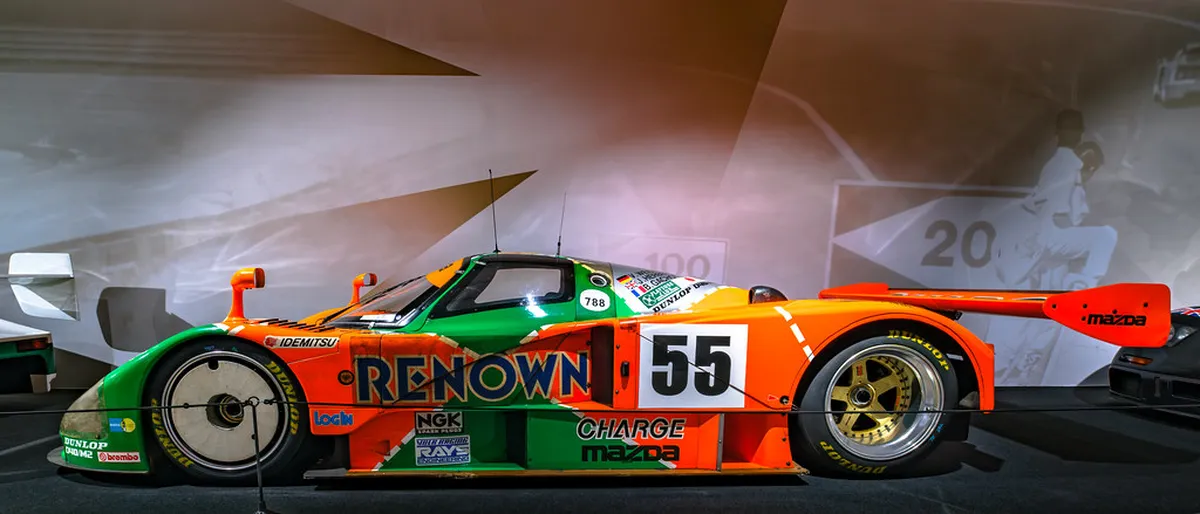
The rotary (Wankel) engine that powered the 787B is famous for its distinctively high-pitched sound — a scream unlike anything a conventional piston engine produces. Mazda produced rotary engines commercially from 1967 to 2012. No other automobile manufacturer has copied the design at scale. Research into rotary technology continues, particularly as a range-extender for electric vehicles. The museum's Zone 4 traces this entire history alongside the racing displays.
For motorsport enthusiasts, this section functions as a genuine pilgrimage destination. The bright orange-and-green Renown livery of the 787B is immediately recognisable. Give yourself extra time here.
The SUV That Gave The World "Kodo: Soul of Motion"
The Mazda CX-5, released in 2012, was the first production vehicle to carry the Kodo: Soul of Motion design language. The brief for Kodo was drawn from the image of a cheetah at the moment before it lunges — taut, directional energy expressed in sheet metal. Zone 7 explains how this visual philosophy was developed and how it continues to guide every vehicle Mazda produces today.
The Takuminuri painting process displayed in this zone is one of the most technically specific exhibits in the museum. Robots are programmed to replicate the brush strokes of human master craftsmen (takumi) to achieve the deep, layered finish of colours like Soul Red Crystal and Machine Gray. The process applies multiple translucent colour layers over a reflective base so that the surface appears to shift in tone as light angle changes. No flat photograph fully captures this effect — it is worth studying in person on the display panels.
The CX-5 section also introduces Skyactiv Technology, Mazda's platform for maximising combustion efficiency. Full-scale clay models nearby show how designers refine vehicle proportions before any digital rendering becomes final. These working models make the design process tangible in a way that a screen presentation cannot.
What to Do If the Tour Is Fully Booked
The English tour slot at 14:15 is the first to fill — often months before popular travel periods such as Golden Week (late April–early May) and autumn foliage season (October–November). If that slot is gone, check the Japanese tour at 09:15 first. It is the same physical route; the only difference is that the guide commentary will be in Japanese. Many non-Japanese visitors join and still find the assembly line observation fully worthwhile without the language.
If both tours are unavailable for your dates, Mazda offers a virtual tour of the museum on its official website. The online experience does not include the assembly line, but it covers the key exhibition zones with narrated walkthroughs. It is a genuinely useful fallback and also functions as a preview before your visit if you do secure a booking.
Cancellations do occur, particularly for corporate group slots. It is worth checking the booking calendar again a week and then two days before your travel date. Single spots opened by cancellations are made available online without announcement.
Tips for Visiting the Mazda Museum with a JR Pass
If you hold a Japan Rail Pass, the ¥190 train fare to Mukainada Station is covered. Local JR trains on both the Sanyo and Kure Lines are included — remember to board a local service, not an express, as expresses skip Mukainada. You can find full route details in the JR Pass Official Information blog.
The Mazda Museum visit fits naturally into a half-day. The English tour at 14:15 means your morning is free. Combine it with a walk through the Hiroshima Peace Memorial Museum in the morning and you have a full and thematically layered day — one site representing destruction, the other showing recovery and industrial rebuilding, both rooted in the same city.
If you are not yet committed to buying a JR Pass, the single-day cost from Hiroshima to Mukainada and back is ¥380 — inexpensive enough that the pass decision should be based on your wider Japan itinerary rather than this trip alone.
Looking for Day-by-Day Itineraries in Hiroshima?
Hiroshima has more to offer beyond the factory. Our Hiroshima city guide maps the city's top sites in priority order. You can find guidance on the ferry to Miyajima Island, the best spots for okonomiyaki in Nagarekawa, and the best order to visit sites so you are not doubling back across the tram network.
The Orizuru Tower is a strong second stop if you want city views and a paper-crane folding experience — it sits directly beside the Peace Memorial Park and requires no advance booking. The Peace Memorial Museum is free for children under 18 and ¥200 for adults, and the ticket also covers the adjacent Memorial Hall. Both are walkable from the Hiroshima tram network.
Frequently Asked Questions
What if the Mazda Museum tour is full for my dates?
If the English tour is full, check for Japanese slots which may have space. You can also explore the Hiroshima area for other technology-focused museums. Occasionally, cancellations occur, so check the booking site daily for new openings.
Can I take photos on the Mazda assembly line?
No, photography is strictly prohibited on the assembly line for security reasons. You are welcome to take photos in the museum exhibition zones and the lobby. Always follow the guide's instructions regarding camera usage during the tour.
How long does the Mazda Museum tour take?
The entire guided experience lasts approximately 90 minutes. This includes the bus ride to the plant, the museum exhibits, and the assembly line walk. Plan for about two hours total to include check-in and the gift shop.
Is the Mazda Museum tour suitable for children?
Yes, children often enjoy seeing the robots on the assembly line and the crash-test cars. The museum is stroller-friendly, but some areas may require walking. It is an educational and fun experience for families visiting Hiroshima.
The Mazda Museum rewards anyone who plans ahead. Book as early as possible — the English slot at 14:15 is the constraint around which the rest of your Hiroshima itinerary should be arranged. Once you are in, the combination of historic vehicles, motorsport heritage, and a live assembly line is unlike anything else available to general visitors in Japan for free.
From the 787B in its pit garage to the crumpled CX-30 in the safety zone to robots applying Takuminuri paint layers, the museum covers automotive history at a depth that surprises most first-time visitors. Use this guide to arrive prepared, exit the right station, and make the most of every zone.
Plan your wider Hiroshima trip: see our Hiroshima attractions guide, Hiroshima itinerary, Hiroshima highlights for routing, pacing, and what to slot in alongside this stop.

