

Hiroshima Castle History and Visitor Guide: Complete Travel Guide
Discover the history of Hiroshima Castle (Carp Castle), from its samurai origins to its post-war rebirth. Includes hours, admission, and expert visitor tips.
On this page
Hiroshima Castle stands as a powerful symbol of resilience and samurai history in the heart of the city.
Known as the Carp Castle, this landmark anchors a free public park, a five-floor museum, and a reconstructed wooden second bailey on the Ota River delta.
This guide covers everything from its 16th-century origins to 2026 hours, ticket prices, transit directions, and the Sannomaru complex that opened in 2024.
The History of Hiroshima Castle: From Mori Clan to Modernity
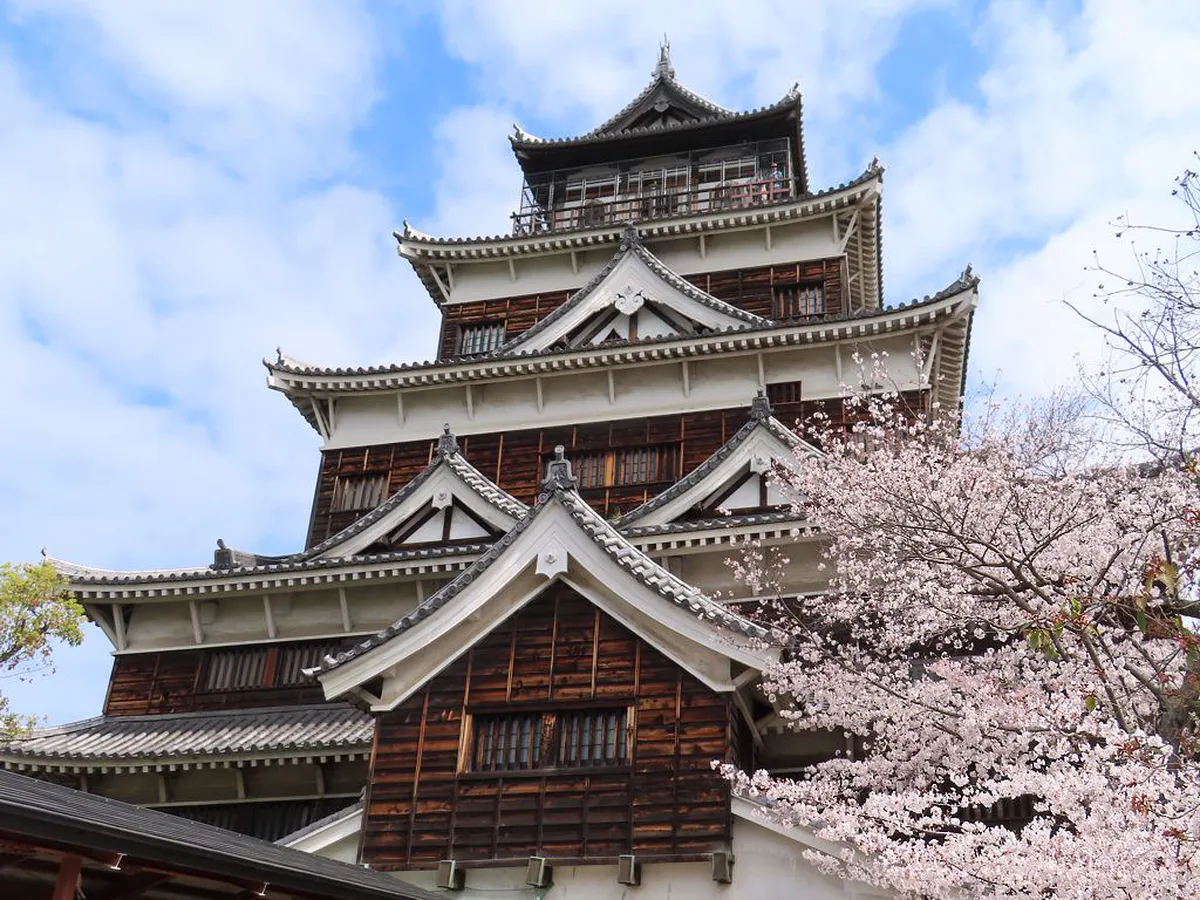
Mori Terumoto founded the castle in 1589 on the flat Ota River delta, choosing the site as a strategic seat for his vast western Honshu domain. Kyoto's castles and Tokyo's fortresses offer historical significance, but Matsumoto Castle and this fortress showcase distinctive architectural achievements. He drew inspiration from Toyotomi Hideyoshi's Jurakudai palace in Kyoto and from Osaka Castle's tiered keep design. Construction finished around 1599, just before the Battle of Sekigahara reshaped Japan.
After Mori backed the losing side at Sekigahara, the clan was stripped of Aki Province and relocated to Hagi, ending their decade-long claim on the castle. The new fortress quickly became the heart of a thriving town that grew into modern Hiroshima. You can explore many hiroshima landmarks that date back to this formative era.
The "Carp Castle" (Rijo) nickname has two competing origins. One tradition links it to the carp swimming in the Ota River and the moats. The other points to the dark wooden cladding of the original keep, which gave the silhouette a fish-like sheen against the sky. Both readings have stuck and the carp later became Hiroshima's civic mascot, including the city's professional baseball team.
The Edo Period: Rule of the Fukushima and Asano Clans
Fukushima Masanori took the castle in 1600 after Sekigahara and reinforced the stone walls and outer defenses. His tenure ended in 1619 when the Tokugawa shogunate exiled him for repairing the castle without permission, a violation of the strict one-castle-per-domain rules.
The Asano clan inherited Hiroshima Domain in 1619 and held it for twelve generations until the Meiji Restoration in 1869. They focused on developing the surrounding town and maintaining the castle as a center of local hiroshima culture. Asano-era city planning still defines downtown Hiroshima's grid, including the merchant streets that became today's Hondori arcade.
During the Edo period the castle housed the regional administration and the daimyo's family. After 1869 it became a Meiji-era army base and Imperial General Headquarters during the First Sino-Japanese War, when Emperor Meiji briefly ran the war from inside the keep in 1894. That military legacy is why the castle was a primary target on August 6, 1945.
Destruction and Resilience: The 1945 Atomic Bombing
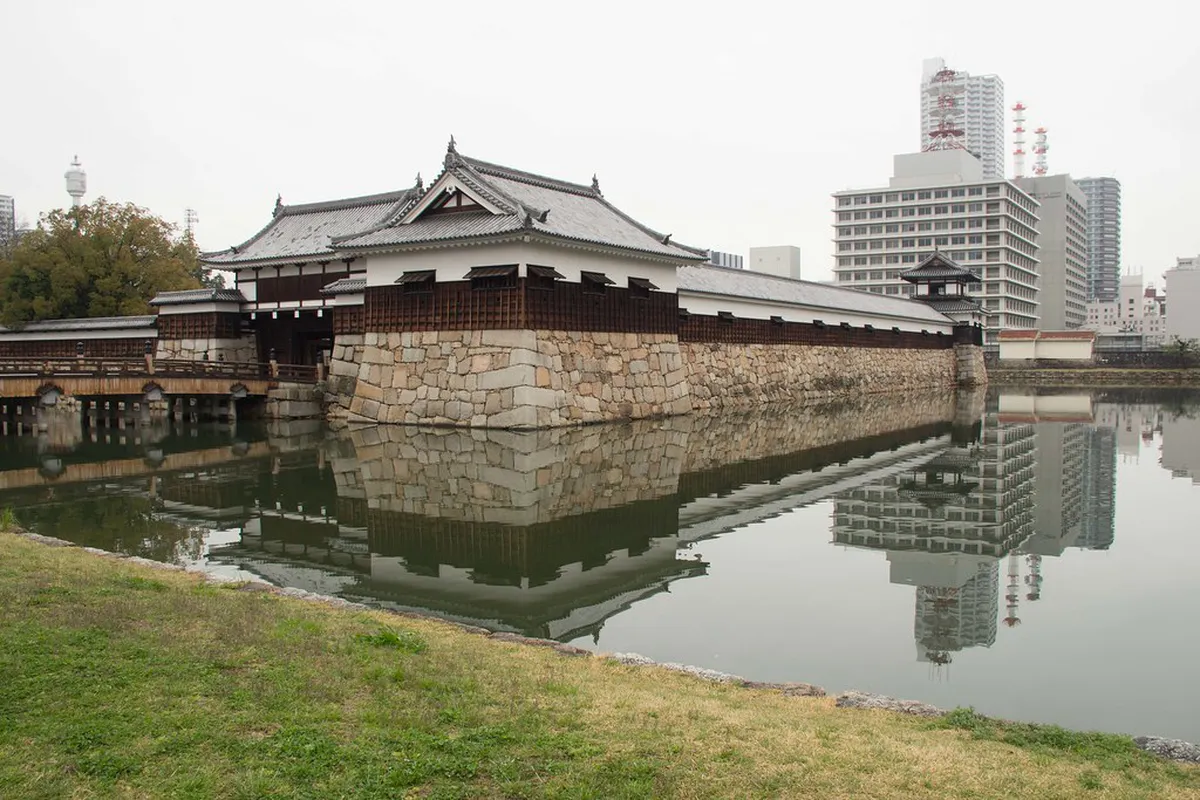
The atomic bomb detonated roughly 900 metres south of the castle and the original wooden keep, designated a National Treasure in 1931, collapsed in the blast wave. The wooden superstructure was flattened in seconds, but the massive stone foundations and the moat survived intact. Visit the hiroshima peace memorial museum for the wider context of that morning.
A handful of trees on the castle grounds survived the blast and are still alive today. A Eucalyptus on the south side of the inner bailey and a Willow nearer the moat are both registered "hibakujumoku" (A-bombed trees) by the city. Plaques in English mark each survivor and explain the burn scars on their trunks.
Two hibakujumoku (A-bombed survivor trees) grow on the castle grounds — a Eucalyptus on the south inner-bailey side and a Willow near the moat. English plaques mark each one. These are among the quietest, most moving spots in Hiroshima and are easy to miss without looking for them deliberately.
The grounds also held the Imperial General Headquarters bunker and the Chugoku Military District Communications Bunker. The communications bunker is partially preserved and is where the first telegraph reporting the bombing was sent from Hiroshima to Tokyo. It is a small, sobering stop most tourists walk past without noticing.
Reconstructing the Main Keep (Tenshu) and Museum
The current main keep was rebuilt in 1958 in reinforced concrete, with the exterior closely matching the 1589 design. The choice was practical: concrete met postwar fire codes, accommodated a modern museum interior, and kept costs manageable while the city was still rebuilding. The Ninomaru gate, by contrast, was reconstructed in the 1990s using traditional joinery, which is why the wood-and-concrete distinction matters once you are inside.
The five-floor museum is laid out for a roughly 60-minute visit. Plan your time around what you most want to see.
- Floor 1: Castle origins, scale models of the original Hiroshima castle town, and Mori-era construction.
- Floor 2: Edo-period samurai daily life, with clothing, household items, and Asano-clan documents.
- Floor 3: Weapons and armor, including authentic katanas, matchlocks, and a hands-on samurai dress-up corner that families queue for.
- Floor 4: Rotating temporary exhibitions, often tied to seasonal themes or recent archaeological finds.
- Floor 5: 360-degree observation deck with sightlines to the Atomic Bomb Dome, Mount Futaba, and the Seto Inland Sea on clear days.
Resilience Comparison: 1589, 1945, and 1958
Three versions of the keep have stood on this same stone foundation. Side by side they tell the structural story most travel write-ups gloss over.
- Original keep (1589 to 1945): timber frame with white plaster and black wooden cladding, five exterior tiers and five interior floors, designated a National Treasure in 1931, used as Imperial General Headquarters in 1894.
- Atomic blast (August 6, 1945): the wooden superstructure was destroyed in seconds; stone walls, the moat, three trees, and the underground communications bunker survived.
- Modern keep (1958 to today): reinforced-concrete shell roughly 26 metres tall, museum interior, elevator-free stairs, exterior closely faithful to 1589 dimensions but not built to current Japanese seismic standards for older concrete, which is why a major renovation is on the horizon.
The Ninomaru complex is the outlier: rebuilt in 1989 to 1994 using traditional wooden methods and assembled with mortise-and-tenon joinery. Walking from the concrete keep into the Ninomaru gate is the easiest way to feel the difference between postwar reconstruction and traditional craft.
Exploring the Castle Grounds and Ninomaru
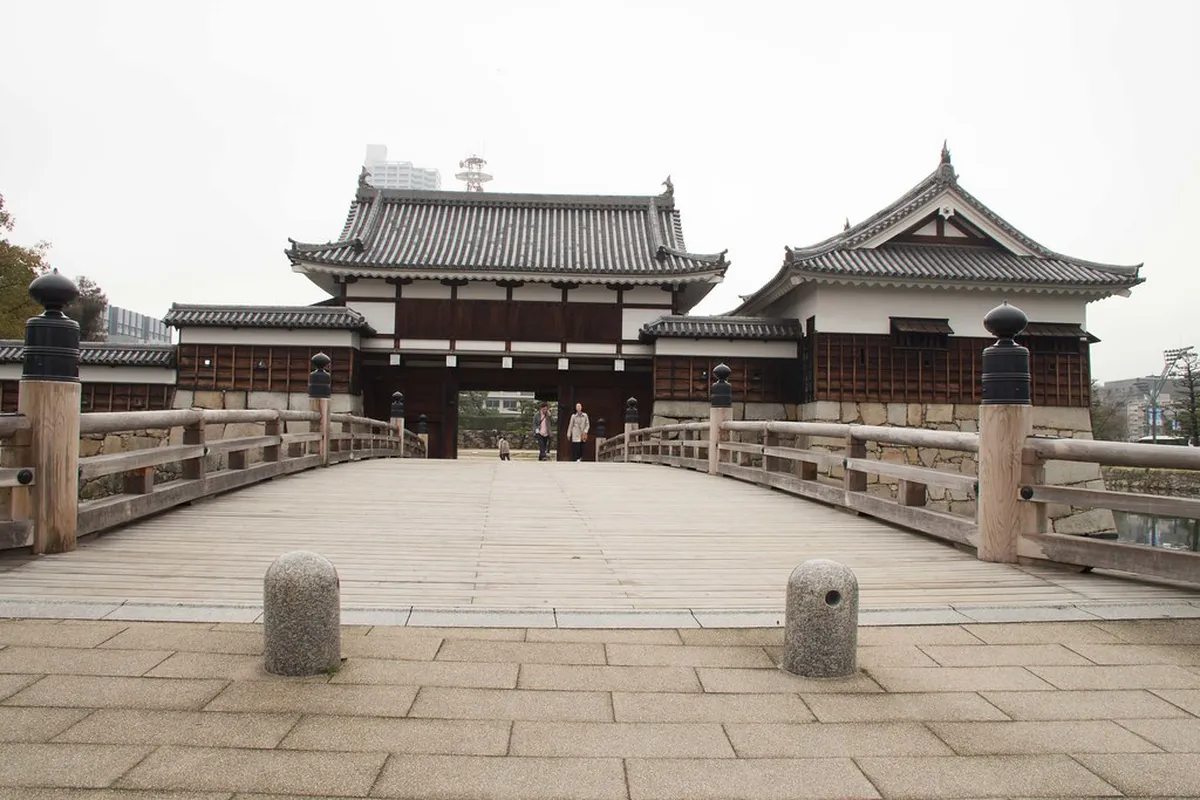
The Ninomaru, or second bailey, sits on the south side of the inner moat and is free to enter once you cross the wooden Omotegomon bridge. Inside the Tamon Yagura long corridor and the Taiko Yagura drum tower, you remove your shoes and walk on bare cypress floors. The smell of wood, the cool air, and the shadows from the lattice windows give a far better sense of feudal-era life than the keep itself.
The grounds also house Hiroshima Gokoku Shrine, one of the most popular hatsumode (New Year shrine) destinations in western Japan, drawing more than half a million visitors in the first three days of January. The Eucalyptus survivor tree stands a short walk from the shrine. Several small cafes and the Oshiro-no-Chaya teahouse serve matcha and matcha soft-serve in the warmer months.
The wide moat is a peaceful loop walk of about 25 minutes. Consider adding this stop to your 15 best things to do in hiroshima 2026 itinerary. The southwest corner gives the best reflection shot of the black keep against the water, especially during cherry blossom week in late March and early April.
Admission and Opening Hours: Practical Visitor Info
The castle park, the Ninomaru wooden buildings, and the grounds are free at all times. Only the main keep museum charges a fee.
| Ticket type | 2026 price (¥) | Hours |
|---|---|---|
| Adults (keep museum) | 370 | 09:00–18:00 Apr–Sep; 09:00–17:00 Oct–Mar |
| Seniors 65+ / high school students | 180 | Same as above (ID required) |
| Junior high and elementary | Free | Same as above |
| Combined keep + Shukkeien Garden | 610 | Saves ~¥110 vs separate tickets |
| Grounds, Ninomaru, moat walk | Free | Open 24 hours |
- Adults: 370 yen.
- Seniors (65+) and high-school students: 180 yen with ID.
- Junior-high and elementary students: free.
- Combined ticket with Shukkeien Garden: 610 yen and saves around 110 yen versus separate tickets.
Opening hours follow the season. From April through September the keep is open 09:00 to 18:00, with last entry at 17:30. From October through March it closes at 17:00. Around the New Year (December 29 to January 2) the keep shuts but the grounds stay open for hatsumode.
Hiroshima City has confirmed plans to close the 1958 concrete keep for extended renovation later this decade due to seismic concerns. Check the official Hiroshima City Tourism Board page before visiting — the Ninomaru, moat walk, and Sannomaru complex remain open during any closure.
Important for 2026 and 2027 visitors: Hiroshima City has confirmed plans for a long-term renovation of the 1958 concrete keep due to seismic and ageing concerns, with the museum scheduled to close for an extended period later this decade. Check the official Hiroshima City Tourism Board page for the latest dates before you book. While the keep is closed, the Ninomaru, the moat walk, and the Sannomaru complex remain open. You should check current availability for hotels in Hiroshima close to the castle so you can swing by twice if your trip overlaps a partial closure.
Accessibility at Hiroshima Castle for Wheelchairs and Strollers
The reconstructed keep is the least accessible part of the site: it was rebuilt in 1958 as a five-floor concrete museum with stairs only, so wheelchair users and visitors with strollers cannot reach the upper floors or the fifth-floor observation deck. A ground-floor lobby covers the ticket counter and a small orientation display before the staircase begins, so it is still possible to see part of the museum without climbing.
The rest of the grounds are far easier to navigate. The paths connecting the outer moat, the Ninomaru bridge, and Hiroshima Gokoku Shrine are flat and paved, and a wheelchair can complete the full moat loop without difficulty. The Ninomaru buildings are the one exception: visitors remove their shoes at the entrance and step up onto a raised wooden floor, which is not wheelchair passable, though the exterior and the Omotegomon bridge can still be viewed and photographed from ground level.
Accessible restrooms are located near the main ticket gate and inside the Ninomaru area. If mobility is a concern, plan a visit around the free grounds, the moat walk, and the shrine, and treat the keep museum as optional rather than essential.
How to Get to Hiroshima Castle (Access Guide)
The castle sits in the geographic center of Hiroshima, about 1.6 km north of Peace Memorial Park and 2 km west of JR Hiroshima Station. Knowing how to get around hiroshima by streetcar and bus will simplify the trip.
- Streetcar: take Lines 1, 2, or 6 to Kamiyacho-higashi or Kamiyacho-nishi. The walk to the south gate is about 10 minutes. Single fare is 220 yen.
- Hiroshima Sightseeing Loop Bus (Meipuru-pu): the Orange and Lemon routes stop at "Hiroshima-jo / Gokoku-jinja-mae." Single ride 220 yen, day pass 600 yen, free with Japan Rail Pass.
- Walking from JR Shin-Hakushima Station: about 10 minutes south on foot, the most direct rail option.
- Walking from Peace Memorial Park: about 15 to 20 minutes north along the Motoyasu and Honkawa river paths.
- Walking from JR Hiroshima Station: 25 to 30 minutes; usually faster by streetcar.
- By car: roughly 20 minutes from Hiroshima IC on the Sanyo Expressway. Paid parking lots near the south side are limited and fill on weekends.
The Sannomaru Complex and the 2024 Renewal
This is the section every other guide on page one of Google still misses. In March 2024 Hiroshima City opened the new Sannomaru complex, a wooden-clad food, retail, and exhibition zone in the third bailey just inside the south gate. The architecture echoes Edo-era warehouses and is the city's attempt to reconnect the castle visit with the surrounding downtown.
Three buildings sit on the site. The food and gift hall sells Hiroshima specialties (lemon products from the Setouchi islands, sake from Saijo, anago and oyster snacks). A casual restaurant serves okonomiyaki and Setouchi seafood lunches in the 1,200 to 1,800 yen range. A small interpretive gallery explains castle-town life and rotates free exhibitions tied to the museum upstairs.
For most visitors this changes the visit shape: previously you walked in, climbed the keep, and left. Now you can land at Sannomaru first, eat lunch, then enter the keep with context. If you arrive while the main keep is closed for the upcoming renovation, Sannomaru plus the Ninomaru together still justify a 90-minute stop.
Hiroshima Castle Reviews: What Visitors Say
Across Tripadvisor, Google Maps, and Japan-focused travel blogs, Hiroshima Castle averages around 4.0 to 4.2 out of 5. Reviewers consistently praise the bilingual museum signage, the samurai armor try-on corner, and the observation deck. Families report the keep works well for kids aged 7 and up; the staircases are steep and there is no elevator.
The most common criticism is that the concrete interior feels less authentic than fully wooden castles like Himeji or Matsumoto. Reviewers who manage their expectations (museum first, monument second) tend to leave satisfied. Visitors with mobility concerns flag the staircases and the gravel paths around the moat as challenges.
Repeat visitors note that weekday mornings before 10:30 are noticeably quieter than afternoons. The grounds are generally less crowded than Peace Memorial Park even in peak cherry-blossom week, which is a useful planning detail if April crowds are a concern.
Beyond the Castle Walls: Nearby Attractions and Nightlife
The castle pairs naturally with downtown Hiroshima rather than with Peace Park alone. After the keep, walk 10 minutes east to Shukkeien Garden, an Asano-era landscape garden with a tea house and a koi pond that survived the 1945 blast and was rebuilt to the original 1620s design.
For dinner, head south to Nagarekawa and Ekinishi for the city's bar and music scene. A hiroshima nightlife itinerary can map the bar-hopping circuit. Ekinishi in particular has become Hiroshima's small-bar and street-art neighborhood, with murals along the railway underpasses and standing bars in converted shipping containers.
If you have a day to spare, consider the seamless rail run east to Onomichi (about 90 minutes via the Sanyo Line, or 40 minutes by Shinkansen plus a short transfer at Mihara). Onomichi is the western terminus of the Shimanami Kaido cycle route and pairs well with Hiroshima for travelers tracing the Seto Inland Sea coast. It is a more interesting eastern day trip than most guides suggest, and the JR Pass covers it.
Where to Stay Near Hiroshima Castle: Best Neighborhoods
Hiroshima Castle sits within a 15 to 20-minute streetcar ride or walk of the city's main hotel districts, so where you stay shapes how easily a castle visit fits with the rest of the city.
Kamiyacho, the streetcar stop used to reach the castle, is the most convenient base: it puts the castle, Hondori shopping arcade, and Peace Memorial Park all within walking distance, with business hotels generally running ¥8,000 to ¥15,000 a night.
Hiroshima Station is the second common choice, especially for travelers arriving or continuing on by Shinkansen. It has a wider range of hotel chains and slightly better value, though it adds a 10 to 15-minute streetcar ride to reach the castle.
Nagarekawa, Hiroshima's nightlife district a few blocks east of the castle, suits travelers who want to combine sightseeing with evening dining and bars; it stays walkable to both the castle grounds and Hondori.
Budget travelers often base themselves near Hiroshima Station or along the Kamiyacho–Hatchobori streetcar line, where hostels and capsule hotels start from around ¥3,000 to ¥5,000 a night. Wherever you stay, the streetcar network makes the castle a short, direct trip from most central neighborhoods.
Frequently Asked Questions
How much does it cost to enter Hiroshima Castle?
Entry to the castle grounds is free for all visitors. To enter the main keep museum, adults must pay 370 yen, while students and seniors pay 180 yen. You can find more details about local costs in our hiroshima attractions guide.
Is Hiroshima Castle the original building?
No, the original wooden castle was destroyed during the atomic bombing in 1945. The main keep was reconstructed in 1958 using reinforced concrete. The Ninomaru gate and turrets were later rebuilt using traditional wooden methods in the 1990s.
How long does it take to tour Hiroshima Castle?
Most visitors spend between 1 and 1.5 hours exploring the museum and the grounds. If you enjoy photography or visiting the Gokoku Shrine, you may want to allow for two hours. This fits well into a half-day city itinerary.
What is the best time of year to visit Hiroshima Castle?
Spring is the most popular time to visit because of the beautiful cherry blossoms surrounding the moat. Autumn is also excellent for viewing the colorful maple trees on the grounds. Both seasons offer mild temperatures that are perfect for walking.
Can you see the Atomic Bomb Dome from Hiroshima Castle?
Yes, you can see the Atomic Bomb Dome from the observation deck on the fifth floor. It provides a unique perspective on the distance between these two major landmarks. This view highlights the scale of the 1945 blast and the city's recovery.
Hiroshima Castle remains a must-visit site for anyone interested in samurai culture and the city's incredible recovery.
Walking through the gates offers a unique perspective on how history shapes the modern Japanese landscape.
Plan your visit today to experience the enduring legacy of the Carp Castle.
Free: The Hiroshima Essentials guide
Top things to do, where to stay, a perfect day plan, getting around, and the best time to go — a Hiroshima mini-guide you can take offline.
You might also like


Continue reading
More guides you'll find useful


