Hiroshima Historical Landmarks: A 2026 Architecture & Heritage Guide
Hiroshima's most important historical landmarks for 2026: Atomic Bomb Dome, Hiroshima Castle, Itsukushima Shrine, Daisho-in, Fudoin and Mitaki-dera. Construction dates, architectural notes, entry fees, hours and photo tips.
On this page
Hiroshima's most important historical landmarks are the Atomic Bomb Dome (1915, UNESCO World Heritage), Itsukushima Shrine on Miyajima (founded 593, UNESCO), Hiroshima Castle (1589, reconstructed 1958), Daisho-in Temple (founded 806), Fudoin Temple (Muromachi-period main hall, National Treasure), Mitaki-dera (founded 809), Shukkeien Garden (1620) and the Kenzō Tange-designed Peace Memorial Park (1955). Together they span more than fourteen centuries of Japanese architectural history — from Heian-era esoteric Buddhism, through Edo-period stroll gardens and Sengoku-era castle building, to the postwar modernism that gave the world its first urban-scale peace memorial.
This guide is not a generic things-to-do list. It is a focused architectural and heritage tour of the landmarks that historians and UNESCO consistently single out as Hiroshima's defining built heritage. For each you'll find the construction dates that matter, the architectural details to look for, 2026 entry prices and hours, and the angles photographers actually want. For a broader sightseeing roundup, see the Hiroshima attractions pillar guide; for the castle in particular, see our dedicated Hiroshima Castle history and visitor guide.
Why these landmarks define Hiroshima's heritage
Hiroshima is unusual among Japanese cities because its built heritage straddles two extremes: extraordinarily old (Heian-period Buddhist temples founded in the 9th century) and extraordinarily modern in its symbolism (the Atomic Bomb Dome, preserved exactly as the blast left it on 6 August 1945, and the Peace Memorial Park master-planned a decade later). Two sites — the Atomic Bomb Dome and Itsukushima Shrine — carry UNESCO World Heritage inscriptions. One, Fudoin's main hall, is a designated National Treasure (Kokuhō). The remainder are Important Cultural Properties, designated scenic sites or significant religious complexes that survived, were destroyed and rebuilt, or sit just far enough outside the blast hypocenter to retain original timbers.
Reading the city through these structures gives you the architectural through-line that the standard "top 10 things to do" lists miss. It also makes the contemporary Peace Memorial landscape legible: you cannot understand why the Dome is preserved as a ruin until you have seen what intact pre-war Japanese architecture (Fudoin, Itsukushima) actually looks like, nor why the Cenotaph faces precisely where it does until you have walked Kenzō Tange's axis.
Free: The Hiroshima Essentials guide
Top things to do, where to stay, a perfect day plan, getting around, and the best time to go — a Hiroshima mini-guide you can take offline.
1. Atomic Bomb Dome (Genbaku Dome) — 1915, UNESCO World Heritage
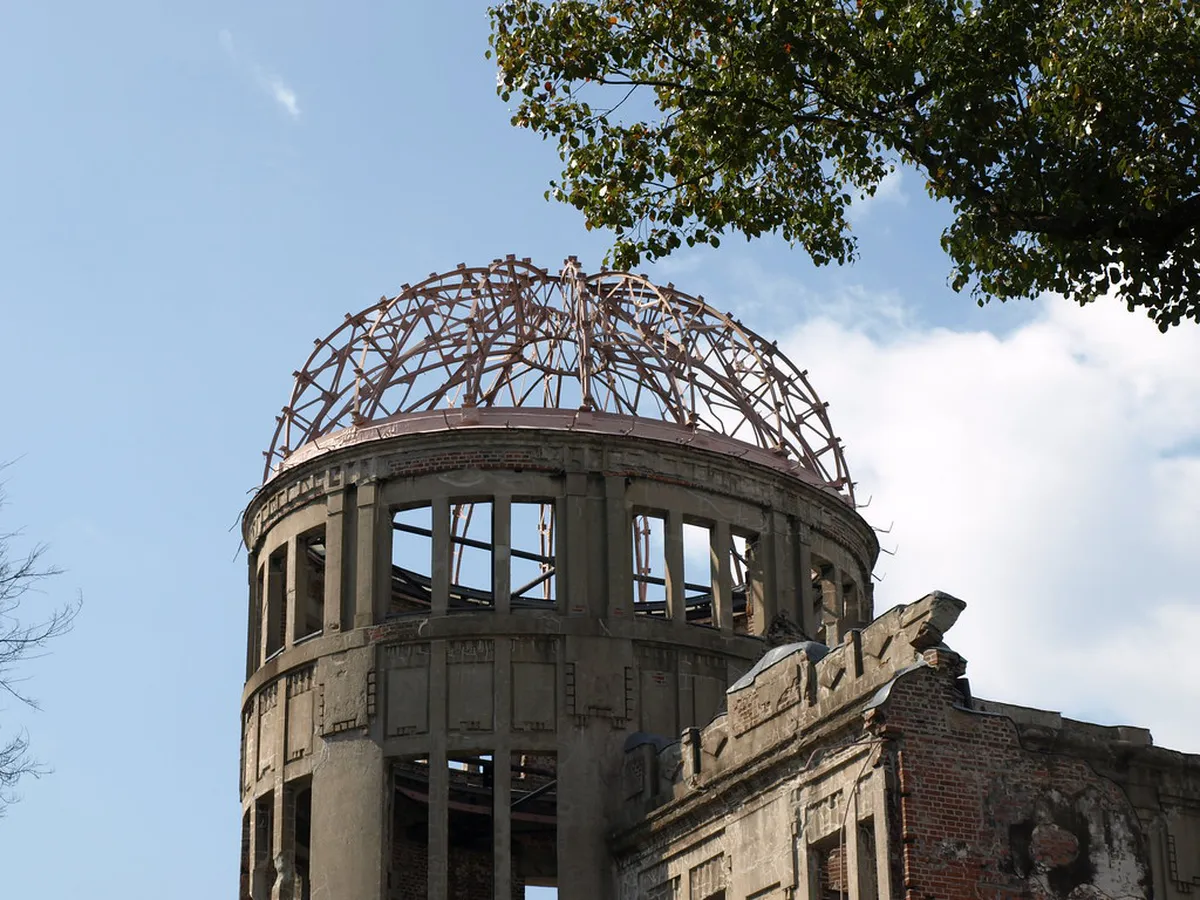
What it is: The skeletal remains of the former Hiroshima Prefectural Industrial Promotion Hall, designed by Czech architect Jan Letzel and completed in April 1915. It stood roughly 160 metres from the hypocenter when the bomb detonated at 8:15 a.m. on 6 August 1945. Inscribed on the UNESCO World Heritage List in December 1996.
Architectural notes: The building is a rare Japanese example of European Secessionist (Vienna Secession) architecture — note the elongated oval dome, brick-and-mortar walls reinforced with steel, and the surviving radial ribs of the dome's iron framework. The vertical load-bearing walls partially survived because the blast pressure travelled almost straight down, while the surrounding low timber buildings were obliterated. Conservation works in 1967, 1989–1990, 2002–2003 and 2015–2016 stabilised the structure without restoring it; you are looking, deliberately, at 1945 in arrested decay.
2026 visit details: The dome itself is viewed from the perimeter — there is no interior access, no ticket, and it is open 24 hours. The adjacent Hiroshima Peace Memorial Museum (a separate landmark) charges 200 JPY for adults in 2026 and is open 08:30–18:00 (until 19:00 in August, until 17:00 December–February). For ticket details and exhibit-by-exhibit advice, see our Peace Memorial Museum tickets and tips guide.
Photo tips: The classic shot is from the east bank of the Motoyasu River with the dome framed against the sky. For the strongest light, arrive 30 minutes before sunset in autumn — the warm side-lighting picks out the brickwork and the ribs of the dome read clearly against the sky. Cherry blossom along the Motoyasu (late March–early April) gives the most photographed seasonal frame.
The Atomic Bomb Dome is viewable 24 hours a day from the surrounding paths — free, no ticket required. It is dramatically lit at night and least crowded in the early morning before 07:30, when the riverbank is nearly empty.
2. Peace Memorial Park, Cenotaph and Children's Peace Monument — 1955, Kenzō Tange
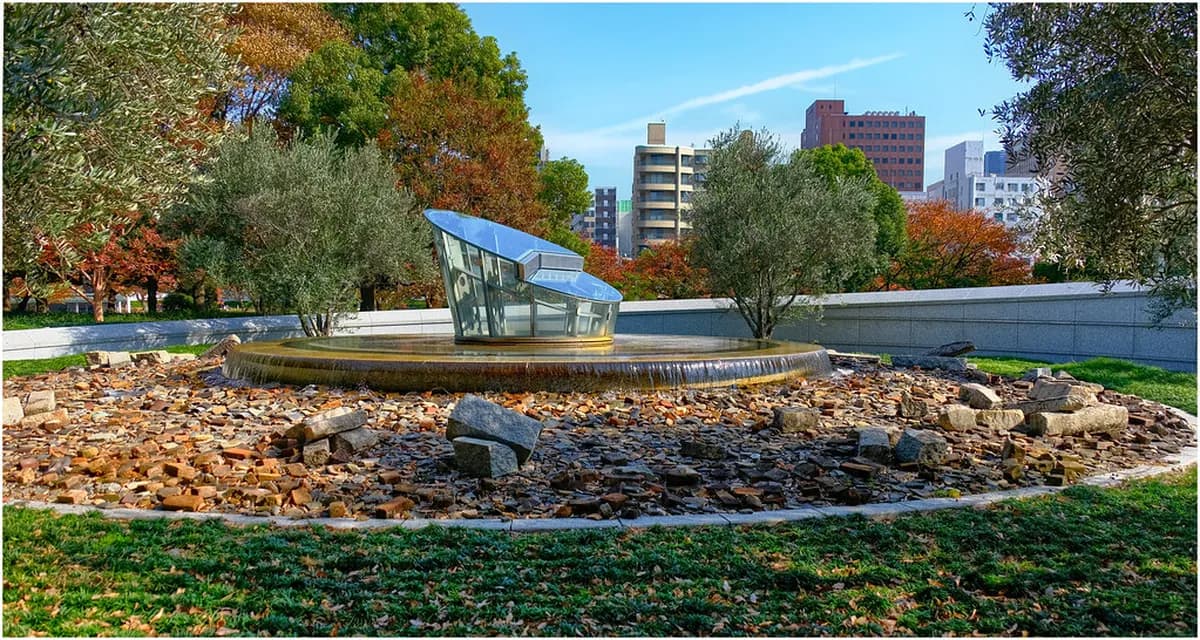
What it is: The 12.2-hectare memorial park that occupies what had been Nakajima, a dense merchant district vaporised on 6 August 1945. Master-planned by Kenzō Tange after his winning 1949 competition entry and inaugurated on 6 August 1955, it is widely regarded as the founding work of postwar Japanese modernism and the first peace-themed urban landscape in the world. The park contains the Cenotaph (Tange, 1952), the Peace Memorial Museum (Tange, 1955; restored and reopened 2019), the Children's Peace Monument with the Sadako Sasaki statue (1958), the Flame of Peace (1964) and the Peace Bell (1964).
Architectural notes: Tange's master stroke is an axis. Stand at the Cenotaph — a saddle-shaped concrete arch modelled on the haniwa clay tomb-figures of pre-Buddhist Japan — and the line of sight runs north through the Flame of Peace, through the open pilotis-lifted Peace Memorial Museum behind you, and onward to frame the Atomic Bomb Dome itself across the Motoyasu River. Few SERP roundups bother to mention it, but this single deliberate sight line is why the park reads as a coherent monument rather than a scattering of statues. The Museum's main building is a textbook example of Le Corbusier-influenced Japanese modernism — raised on slender pilotis to keep the ground plane permeable, with a brise-soleil concrete grille moderating the sun. Restoration in 2019 reinforced the building seismically without altering Tange's facade.
2026 visit details: The park is open 24 hours, free of charge. The Children's Peace Monument (with thousands of folded paper cranes left by school groups year-round), the Cenotaph and the Flame of Peace are all viewable any time. The Peace Memorial Museum charges 200 JPY adults in 2026; the National Peace Memorial Hall for the Atomic Bomb Victims, immediately east of the museum, is free.
Photo tips: Stand directly behind the Cenotaph — there is a small gravel circle marking the photographic spot — and align the arch's centre with the dome of the Genbaku Dome through the museum's open ground floor. This composition was framed deliberately by Tange and is the single most architecturally significant photograph you can take in Hiroshima.
3. Itsukushima Shrine — founded 593, current structures 1168, UNESCO World Heritage
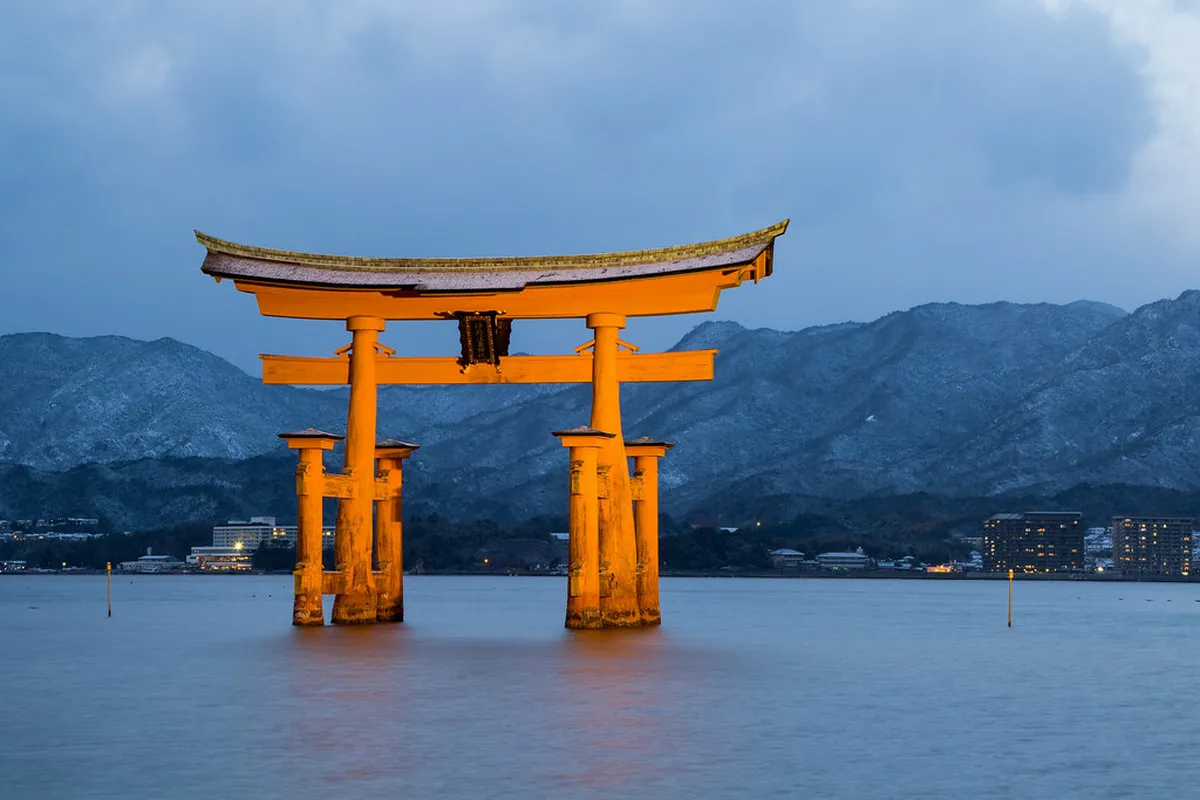
What it is: The vermilion Shinto shrine on Miyajima Island, with its famous "floating" torii gate standing in the sea. The shrine was founded in 593 CE and rebuilt in its current over-water configuration by Taira no Kiyomori in 1168, in shinden-zukuri palace style. Inscribed on UNESCO's World Heritage List in 1996.
Architectural notes: Itsukushima is the most complete surviving example of Heian-period shinden-zukuri aristocratic architecture applied to a religious site. The 280-metre-long boardwalk connects a series of pavilions raised on stilts above the tidal flats so that the entire complex appears to float at high tide. The current great torii is the eighth on the site — it dates to 1875 and stands 16.6 metres tall, made of camphor wood. A major restoration concluded in December 2022, so what you see in 2026 is the freshly re-vermilioned gate. The shrine's noh stage, built in 1568 and rebuilt in 1680, is the only one in Japan that stands over the sea.
2026 visit details: Shrine entry 300 JPY adults / 200 JPY high-school / 100 JPY elementary; combined ticket with the Treasure Hall 500 JPY. Open 06:30–18:00 (06:30–17:30 in winter, 06:30–18:30 mid-March to mid-October). The JR Miyajima ferry from Miyajimaguchi is 200 JPY one-way for adults plus a 100 JPY visitor tax introduced in October 2023. For tide planning and step-by-step logistics see our Itsukushima Shrine floating torii guide.
Itsukushima Shrine requires a 100 yen Miyajima visitor tax on top of the regular ferry fare (200 yen) and the 300 yen shrine entry. Both the JR ferry and the Matsudai ferry collect the tax automatically with your ticket.
Photo tips: Plan your visit around the tide chart, not the clock. High tide gives the floating torii; low tide lets you walk to its base. The single best window in 2026 is a high tide that coincides with the 30 minutes after sunset — the shrine lanterns and the torii are illuminated until 23:00, and the wet sand on a partial low gives a perfect mirror reflection. Shoot from the western beach south of the shrine for the cleanest gate-only composition.
4. Hiroshima Castle (Carp Castle) — 1589, reconstructed 1958
What it is: The five-storey black-and-white wooden keep on the Ōta River delta, built by warlord Mōri Terumoto starting in 1589 and completed around 1599. The original keep was a designated National Treasure — until it was destroyed by the atomic bomb on 6 August 1945. The current keep is a 1958 ferro-concrete reconstruction housing a samurai-history museum.
Architectural notes: Hiroshima is a classic hirajiro (flatland castle) — built on the delta rather than a hilltop, with massive stone walls and a triple-moat defensive system. The keep is a five-tiered, five-storey design (5重5階) atop a stone base, with the characteristic curved shikoku-style gables and dark lower-storey wood panels that earned it the nickname Carp Castle (Rijō). The Ninomaru (second bailey), with its Omote Gate, Tamon Yagura and Taiko Yagura turrets, was reconstructed in traditional wood between 1989 and 1994 and gives a more authentic sense of original castle carpentry than the concrete keep. The decision to rebuild the 1958 keep in concrete rather than timber was driven less by aesthetics than by postwar steel-and-cement availability and a tight municipal budget; Nagoya and Osaka made the same decision for the same reasons. Plans floated since 2019 to eventually reclad or replace the keep in wood remain unfunded as of 2026, so the concrete shell will likely stand for at least another decade.
2026 visit details: Adults 370 JPY, children 180 JPY for the keep museum; the surrounding park is free. Open 09:00–18:00 March–November (last entry 17:30); 09:00–17:00 December–February. The Ninomaru reconstruction is free. For the full reconstruction story and a floor-by-floor walk-through, see our Hiroshima Castle history and visitor guide.
Photo tips: The strongest exterior composition is from the south-east corner of the inner moat, with the keep reflected in the water and the Ninomaru gates in the foreground. From the top floor (5th storey) of the keep you get a 360-degree view that includes the Atomic Bomb Dome and Peace Memorial Park to the south — useful for orienting your day.
5. Shukkeien Garden — 1620, Edo-period stroll garden
What it is: A 4-hectare strolling garden ten minutes' walk north-east of Hiroshima Castle, commissioned in 1620 by daimyō Asano Nagaakira's tea master Ueda Sōko one year after Asano was installed in Hiroshima. The garden's name (Shukkei-en, "shrunken-scenery garden") refers to its design conceit: the landscape is a miniaturised, idealised composition of mountain, forest and valley scenery around a central pond, traditionally said to be modelled on West Lake in Hangzhou.
Architectural notes: Shukkeien is a textbook kaiyū-shiki (pond-circuit) garden — the path winds clockwise around Takuei Pond, presenting a sequence of framed compositions through carefully positioned tea pavilions, an arched stone bridge (the Kōko-kyō, rebuilt in 1973), and miniature islands. Like much of central Hiroshima it was destroyed in the 1945 blast, just 1.3 km from the hypocenter, but post-war restoration returned it to its 1783 layout based on surviving Edo-period plans. A small grove of hibaku (A-bombed) trees within the garden, including a ginkgo and a eucalyptus, survived and is officially registered as living heritage.
2026 visit details: Adults 260 JPY, students 150 JPY, children 100 JPY; combined ticket with the adjacent Hiroshima Prefectural Art Museum 660 JPY. Open 09:00–18:00 April–September (last entry 17:30); 09:00–17:00 October–March. About 15 minutes on foot from the Atomic Bomb Dome, or two stops on the streetcar.
Photo tips: The Kōko-kyō arched bridge over Takuei Pond is the signature composition. Late November cherry-leaf colour and early-April cherry blossom both work; for cleaner reflections, shoot in the first hour after opening before any wind picks up.
6. Daisho-in Temple, Miyajima — founded 806
What it is: A Shingon Buddhist temple on the lower slopes of Mt Misen on Miyajima Island, traditionally said to have been founded by Kūkai (Kōbō Daishi) in 806 after he completed 100 days of ascetic training on Misen's summit. Daisho-in is the head temple of the Omuro school of Shingon Buddhism in this region.
Architectural notes: Daisho-in is a working mountain temple, not a museum, so the architecture is layered across centuries — the Maniden Hall, Kannon-do, Daishi-do and Henjokutsu cave are arranged up the hillside in a stepped composition typical of Shingon mountain temples. The 540 rakan statues lining the staircase, each with a slightly different expression, are 19th-century additions. The daihannya kyō spinning sutra wheels along the entry stair are believed to confer the merit of reading the entire 600-volume Mahāprajñāpāramitā Sūtra if rotated. The Henjokutsu cave at the temple's heart contains 88 sand-grains brought from each of the 88 temples of the Shikoku pilgrimage, allowing pilgrims to complete a symbolic Shikoku circuit in one visit.
2026 visit details: Free entry, no ticket required. Open 08:00–17:00 daily. Located a 10-minute walk from Itsukushima Shrine. The Mt Misen ropeway (separate, 1840 JPY round-trip in 2026) starts roughly 15 minutes uphill from the temple. For a full hike-or-ropeway breakdown see our Hiroshima hiking trails guide.
Photo tips: Mid-November is peak momiji (autumn maple) season — Daisho-in's grounds are framed in red and orange against the temple's bright vermilion buildings, a uniquely photogenic combination unavailable at most Hiroshima sites. Early morning before 09:00 gives you the staircase of rakan statues without crowds.
7. Fudoin Temple — Muromachi-period main hall, National Treasure
What it is: The most architecturally important surviving Buddhist building in Hiroshima city itself. Fudoin's Kondō (main hall) is a Muromachi-period structure, with the Konghō bell dated 1433. It sits in northern Hiroshima, roughly four kilometres from the hypocenter — far enough that it survived the 1945 blast almost intact, making it one of the very few pre-Edo buildings left in the city.
Architectural notes: The Kondō is built in the karayō (Chinese-influenced) Zen architectural style, distinguished by its steep, gracefully curved roof line and elaborate tokyō (bracket) system supporting deep eaves. It is one of only a handful of intact Muromachi karayō halls in western Japan and was designated a National Treasure in 1958. The temple bell, cast in 1433, is also nationally important. Because it survived 1945, Fudoin gives you something the Atomic Bomb Dome cannot: a glimpse of what intact medieval Hiroshima architecture actually looked like before the war.
2026 visit details: Free entry to the grounds. Hours roughly 09:00–16:30; the main hall interior is opened only on certain days — check before going. Located near Ushita-shinmachi, reachable in about 20 minutes by bus or streetcar from central Hiroshima. For getting-around details, see our streetcar and bus guide.
Photo tips: The Kondō's roofline is the photographic prize — shoot from the south-east corner of the courtyard at low angle to capture the curve of the eaves against the sky. Late afternoon side light highlights the bracket detail.
8. Mitaki-dera — founded 809
What it is: A mountain temple complex tucked into a forested ravine on the west side of central Hiroshima, founded in 809 CE during the Heian period. The "three falls" (mitaki) of the name refer to three small waterfalls within the temple grounds — water from one of them is used in the Hiroshima Peace Memorial Ceremony each 6 August.
Architectural notes: Mitaki-dera's pagoda is the architectural centerpiece — a two-storey tahōtō pagoda relocated to Mitaki-dera in 1951 from Hironaga in Wakayama, where it was originally built in 1526. Inside is a wooden Amida Nyorai statue from the late Heian period. The main hall (Hondō) and the Tarōbō shrine sit higher up the slope. The site is exceptional because Heian-period mountain-temple layouts (founder Kūkai's school again) survive here in their original orientation, even though specific structures have been rebuilt.
2026 visit details: Free entry, open roughly 08:00–17:00. A 12-minute walk from JR Mitaki Station. Easily combined with Fudoin in a half-day "old Hiroshima" itinerary that avoids the central tourist zone. For more hike-themed itineraries see our Hiroshima hiking trails guide.
Photo tips: Mid-November to early December is peak season — the maple canopy over the pagoda is one of the most spectacular autumn-colour scenes in western Japan. Shoot the pagoda framed by maple from the path 20 metres downhill of it; the contrast of vermilion, dark wood and red maple is the canonical Mitaki-dera composition.
| Landmark | Founded / Built | 2026 Adult Entry | Hours |
|---|---|---|---|
| Atomic Bomb Dome | 1915 (UNESCO 1996) | Free | 24 hours |
| Peace Memorial Park | 1955 (Kenzō Tange) | Free (museum ¥200) | 24 hours (museum 8:30–18:00) |
| Itsukushima Shrine | Founded 593, rebuilt 1168 (UNESCO 1996) | ¥300 + ¥100 visitor tax | 6:30–18:00 |
| Hiroshima Castle | 1589, reconstructed 1958 | ¥370 (keep) | 9:00–18:00 |
| Shukkeien Garden | 1620 | ¥260 | 9:00–18:00 |
| Daisho-in Temple | Founded 806 | Free | 8:00–17:00 |
| Mitaki-dera | Founded 809 | Free | 8:00–17:00 |
| Fudoin Temple | Muromachi period (National Treasure) | Free | 9:00–16:30 |
Hibaku jumoku: the 170 living survivors of 1945
An overlooked layer of Hiroshima's heritage register sits not on plaques but in the bark of trees. The city's Green Promotion Division maintains an official list of hibaku jumoku — A-bomb-survivor trees that were standing within roughly 2 km of the hypocenter on 6 August 1945 and lived through the blast and the firestorm that followed. As of 2026 the list contains 170 trees of 32 species, each tagged with a small green-on-white plaque giving the species, the distance from the hypocenter and a registration number.
The most accessible cluster is in Hiroshima Castle's inner bailey: a eucalyptus (740 m from the hypocenter), a willow at the Honmaru, and a holly tree are all officially registered. Shukkeien Garden contains a registered ginkgo. A pair of camphor trees at Hosen-ji and a famous weeping willow on the riverbank near the Aioi Bridge round out the must-see specimens. Walking a self-guided hibaku jumoku circuit alongside the built-heritage circuit reframes the city's recovery story in a way the museum exhibits do not — the trees were the first living things to demonstrate that the hypocenter was survivable, and several began producing seeds within five years of the blast. Saplings grown from those seeds have since been distributed to peace organisations in 39 countries.
How these landmarks fit a one-day or two-day historical-landmarks itinerary
If you have only one day and want to see Hiroshima's heritage in chronological depth, a workable order is: morning at Itsukushima Shrine + Daisho-in on Miyajima (catch the 09:25 ferry, plan around high tide), early afternoon at Hiroshima Castle + Shukkeien (2 hours), then late afternoon walking the Peace Memorial Park axis to finish at the Atomic Bomb Dome for sunset. Skip Fudoin and Mitaki-dera on a one-day plan — they reward a slower second day.
For a full two-day historical circuit, devote Day 1 entirely to Miyajima (Itsukushima + Daisho-in + Mt Misen) and Day 2 to mainland heritage — Hiroshima Castle, Shukkeien, the Peace Memorial Park axis and Atomic Bomb Dome, then Fudoin and Mitaki-dera in the late afternoon for the pre-1945 architecture you'll find nowhere else in central Hiroshima. See our Hiroshima 2-day itinerary or the focused Hiroshima & Miyajima 1-day itinerary for transit-by-transit plans.
FAQ — Hiroshima Historical Landmarks
Which Hiroshima landmarks are UNESCO World Heritage Sites?
Two: the Atomic Bomb Dome (inscribed December 1996, Memorial of Peace) and Itsukushima Shrine on Miyajima Island (inscribed 1996). They are roughly 25 kilometres apart and a 10-minute JR train + 10-minute ferry from each other, so seeing both in one day is straightforward.
What is the oldest landmark in Hiroshima?
By foundation date, Itsukushima Shrine (founded 593 CE) is the oldest, though its current over-water layout dates to Taira no Kiyomori's 1168 reconstruction. Daisho-in (806) and Mitaki-dera (809) follow. By surviving original structure, Fudoin's Muromachi-period main hall is arguably the oldest intact building still standing in Hiroshima city itself, since most older central-Hiroshima structures were destroyed in 1945.
Which Hiroshima landmarks are free to visit?
The Atomic Bomb Dome exterior, the entire Peace Memorial Park (Cenotaph, Children's Peace Monument, Flame of Peace), Daisho-in Temple, Fudoin Temple and Mitaki-dera are all free in 2026. Hiroshima Castle keep is 370 JPY for adults; the surrounding Ninomaru and park are free. Shukkeien Garden is 260 JPY adults. Itsukushima Shrine charges 300 JPY adults plus a 100 JPY Miyajima visitor tax.
Are Hiroshima's landmarks wheelchair accessible?
Mostly yes for the modern landmarks, with caveats for the historic ones. The Peace Memorial Park, Atomic Bomb Dome viewpoints and Peace Memorial Museum are fully step-free with elevators and accessible toilets. Shukkeien Garden's main loop is paved and largely flat. Hiroshima Castle grounds and Ninomaru are accessible, but the keep itself has internal stairs only — no lift. Itsukushima Shrine's main boardwalk is largely flat and wheelchair-friendly at high tide; the JR ferry has step-free boarding. Daisho-in, Fudoin (uneven stone), and Mitaki-dera (forested slope, multiple staircases) are difficult or impossible for full wheelchair access. Mt Misen ropeway is accessible to the upper station; the summit hike from there is not.
How long do I need at each landmark?
Plan roughly: Atomic Bomb Dome 30 minutes (exterior viewing), Peace Memorial Park axis walk 45 minutes, Peace Memorial Museum 90–120 minutes, Hiroshima Castle 60–90 minutes, Shukkeien Garden 45 minutes, Itsukushima Shrine 60 minutes plus tide buffer, Daisho-in 45 minutes, Fudoin 30 minutes, Mitaki-dera 45–60 minutes. The total bare minimum to see all landmarks in person is about 7–8 hours of landmark time, which is why a two-day plan works much better than rushing them into one.
What is the best time of year to photograph these landmarks?
For Mitaki-dera and Daisho-in, mid-November to early December (peak momiji) is unrivalled. For the Atomic Bomb Dome, Hiroshima Castle and Shukkeien, late March to early April (cherry blossom along the Motoyasu River and around the castle moat) is the strongest seasonal frame. For Itsukushima Shrine the best photographic conditions are governed by the tide chart, not the calendar — aim for a sunset that coincides with high tide. See our best season for autumn colours guide and the 2026 cherry-blossom spots guide for week-by-week timing.
Did any of these landmarks survive the 1945 atomic bomb intact?
Yes — three of the older structures were far enough from the hypocenter to survive almost untouched: Itsukushima Shrine on Miyajima (around 25 km from the blast), Mitaki-dera (3.5 km, screened by terrain), and Fudoin Temple (around 4 km, north of the blast). Daisho-in, also on Miyajima, was unaffected. Hiroshima Castle and Shukkeien Garden were both destroyed and reconstructed — the original castle keep had been a National Treasure. The Atomic Bomb Dome partially survived only because it was directly below the airburst — preserved exactly as it stood at 8:16 a.m. on 6 August 1945, and now a UNESCO Memorial of Peace. Across the city, 170 individual hibaku jumoku trees also survived and remain officially registered as living heritage.
For the broader Hiroshima sightseeing list (food, nightlife, day trips, modern attractions), see the Hiroshima attractions pillar guide. For the deepest single-landmark walk-through, see our dedicated Hiroshima Castle history and visitor guide.
Free: The Hiroshima Essentials guide
Top things to do, where to stay, a perfect day plan, getting around, and the best time to go — a Hiroshima mini-guide you can take offline.
You might also like


Continue reading
More guides you'll find useful