

Huis Ten Bosch Theme Park Guide: 10 Essential Planning Tips
Master your visit to Japan's 'Little Holland' with our Huis Ten Bosch theme park guide. Covers tickets, the Kingdom of Lights, transport from Fukuoka, and family tips.
On this page
Huis Ten Bosch stands as a unique piece of Europe nestled in the heart of Kyushu. This massive theme park in Sasebo recreates a Dutch city with stunning accuracy. Visitors often include this destination on a day trip from Fukuoka or a longer Nagasaki tour. Planning ahead ensures you see the best flowers and lights without feeling rushed.
The park spans over 152 hectares, making it the largest theme park in Japan. Brick paths and winding canals lead you through nine distinct themed areas. Travelers exploring Nagasaki landmarks often treat the park as its own full day. This guide covers tickets, transport, top attractions, and the seasonal events that make each visit different.
What Is Huis Ten Bosch?
The park takes its name from one of the residences of the Dutch Royal Family. Built in 1992 to honor the centuries-long trading relationship between Japan and the Netherlands, it recreates a 17th-century Dutch city with genuine architectural detail. Windmills, cobblestone canals, and gabled brick facades define every street. You feel transported to Holland while remaining in the scenic Nagasaki countryside.
A centerpiece of the park is the faithful recreation of Palace Huis Ten Bosch, modeled after the actual residence in The Hague, built with the permission of the Dutch Royal Family. For more history on this iconic theme park, explore on Wikipedia. Inside, you can explore art galleries displaying works by MC Escher and Rembrandt, and walk through baroque-style gardens that illuminate dramatically at night. The Museum of Glass inside the Stad House replica features the largest chandelier made from blown glass in Japan.
Waterways play a central role in the park's design. Canal cruisers transport guests between different zones, offering a practical and relaxing way to cover ground. Many visitors enjoy the contrast between the peaceful canals — where swans glide alongside boats — and the vibrant seasonal flower displays. The blend of culture, architecture, and leisure creates an environment unlike any other theme park in Japan.
Types of Huis Ten Bosch Tickets and Passes
Choosing the right ticket depends on your arrival time and specific interests. The 1-Day Passport is the standard choice for first-time visitors. As of 2026, adult prices sit around ¥7,400 and children aged 4–11 pay approximately ¥4,600. Preschoolers under four enter free. This pass covers park entry plus most attractions, canal boat rides, and the evening illumination.
| Ticket Type | Adult (2026) | Child (4–11) | Entry Window |
|---|---|---|---|
| 1-Day Passport | ~¥7,400 | ~¥4,600 | All day |
| Afternoon Passport | ~¥5,400 | ~¥3,600 | From 15:00 |
| After 5 PM Passport | ~¥4,400 | varies | From 17:00 |
| Under 4 / Preschool | Free | Free | Any time |
The JR Limited Express "Huis Ten Bosch" train from Hakata Station drops you directly at the park entrance with no transfers — journey time is about 1 hour 45 minutes and is fully covered by the JR Kyushu Rail Pass. Sit on the left side departing Hakata for the best coastal views of Omura Bay.
Travelers who primarily want the Kingdom of Lights can save significantly with time-restricted passes. The Afternoon Passport (entry after 3:00 PM) costs around ¥5,400 for adults and ¥3,600 for children. The After 5 PM Passport drops further to approximately ¥4,400 for adults. Both options give you access to the full illumination while skipping the midday crowds — an ideal strategy for solo travelers or couples without young children.
Multi-day passes are worth considering if you are staying at an official on-site hotel and want to explore without rushing. Some premium attractions, including Jurassic Island and certain VR experiences in Attraction Town, require a separate fee of ¥500–¥2,500 on top of your passport. Budget a family of four roughly ¥20,000–¥24,000 for 1-Day Passports alone before adding food and transport. Booking tickets online in advance through platforms like Klook avoids queuing at the entrance gate.
Getting There: JR Limited Express and Driving Options
Most visitors travel from Fukuoka using the JR Limited Express "Huis Ten Bosch" train. The service runs directly from Hakata Station to Huis Ten Bosch Station, which sits right at the park entrance with no transfers needed. The journey takes approximately 1 hour 45 minutes. Adult reserved seats cost around ¥4,200 one way, and children aged 6–11 travel at half price. This service is fully covered by the JR Kyushu Rail Pass, making it cost-effective for travelers using regional rail. Reviewing a transport guide helps clarify these regional rail connections.
Sit on the left side of the train when departing Hakata for the best coastal scenery. The route hugs the Omura Bay coastline as you approach Sasebo, delivering sweeping views of the bay and its scattered islands. This stretch is one of the most scenic rail rides in Kyushu, so keep a camera ready. Heading back toward Nagasaki City on the JR Omura Line, switch to the right side of the carriage for the same bay views.
From Nagasaki Airport, a direct Saihai bus marked "Huis Ten Bosch" takes about 55 minutes and costs ¥1,250 one way. From Nagasaki Station, the fastest route uses the Nishi Kyushu Shinkansen to Isahaya, then connects to the Omura Line for a total journey of around 75 minutes. Driving from Fukuoka takes approximately 1 hour 40 minutes via the Nagasaki Expressway. Parking at the park costs ¥800–¥1,000 per day, and ample space makes driving a reasonable choice for families managing strollers and luggage.
Exploring the Park by Area
The park is divided into nine distinct areas best explored in a clockwise loop from the Welcome Gate. Start at the Adventure Park near the entrance, where Flower Road greets you with three large windmills framing seasonal flower carpets. This area is ideal for early morning photography before crowds arrive. The open grassy fields alongside Flower Road also give young children room to run freely.
Attraction Town forms the bustling core of the park, centered on a Dutch-style town square with a detailed fountain. The gabled buildings house specialty shops selling Nagasaki castella cake, 30 varieties of popcorn, cheese, and chocolate. This is also where the digital and VR attractions cluster, including Fantasy Forest for young children and the VR experiences for older visitors. Japan's first three-storey merry-go-round, the Sky Carousel, sits here and becomes spectacularly lit at night.
Amsterdam City sits further along the loop and offers more shopping and dining than rides. The arcade-style undercover walkway houses European goods, Venetian glassware, and a Miffy cafe — Miffy, known as Nijntje in Dutch, has a dedicated themed cafe and shop here that draws significant crowds from families and character fans. The Museum of Glass inside the Stad House replica, with its floor-to-ceiling blown-glass chandelier, is the area's standout attraction.
Harbour Town leads to Palace Huis Ten Bosch and the quieter Forest Villa zone in the southern corner of the park. Tower City sits toward the eastern edge, dominated by the 105-metre Domtoren tower and its surrounding canal promenades. Art Garden near the exit closes the clockwise loop and is best saved for last when the illumination displays are running. Following this sequence means you finish exactly where the evening light shows are most concentrated.
The Domtoren Observation Deck: Best Sunset Spot in the Park
The Tower City area is anchored by the Domtoren, a 105-metre replica of the famous Utrecht cathedral tower. Most visitors walk past it on their way between zones and miss the observation platform entirely. Riding to the top is included in your passport, costs no extra fee, and delivers unobstructed views across the entire park and Omura Bay. It is one of the most underused perks in the park.
Timing your Domtoren visit for around 30 minutes before sunset turns a simple tower visit into a genuine highlight. From that height you can watch the park transition from daylight into the beginning of the Kingdom of Lights, with sections of the grounds below starting to glow before you descend. The surrounding canal restaurants in Tower City are also the most relaxed dining area in the park — less crowded than Amsterdam City and with pleasant waterfront seating for a pre-illumination dinner.
The Kingdom of Lights: Japan's Largest Illumination
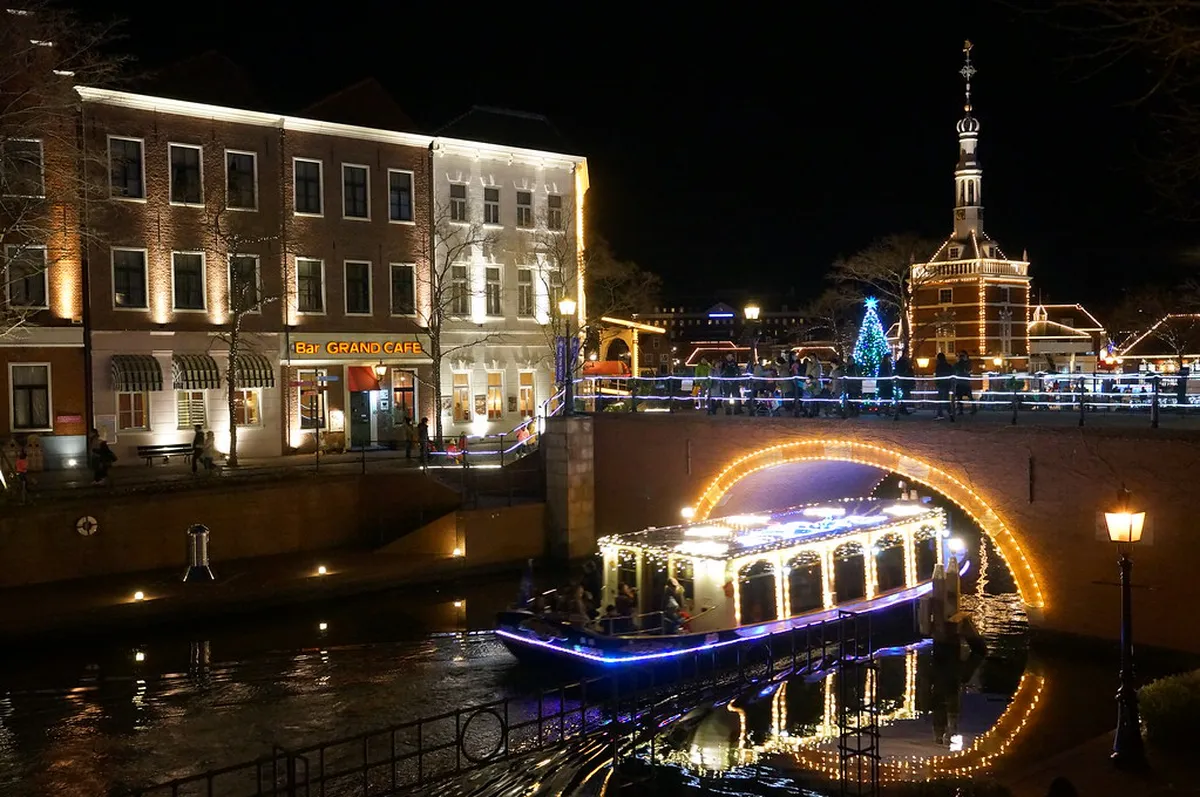
When the sun sets, the park transforms into the spectacular Kingdom of Lights. Over 13 million LED bulbs illuminate buildings, canals, and gardens in a display consistently ranked as one of the best in Japan. The illumination runs year-round, with the lights typically switching on at sunset — around 17:30 in winter and 19:00 in summer. Winter (November through February) is the peak season when the most elaborate displays are active.
The Art Garden is the most photogenic illumination zone: a sea of blue LED lights covers the ground like a glowing ocean, with light waterfalls and a 66-metre cascading wall of color-shifting lights that families often stand in front of for several minutes. Projection mapping shows in Amsterdam City use the facades of grand buildings as canvases for animated digital stories. The main square in front of Stad House typically hosts a live performance timed to the first full illumination activation, which includes coordinated fireworks and artificial snow effects from the lampposts.
A night canal cruise offers a completely different perspective on the illumination. The reflections in the water double the visual impact, and the swans are still visible gliding in the lit water. Queue times for the boats peak during the first hour after the lights come on, so either ride before sunset or wait until 20:00 when demand eases. Plan at least two to three hours for the full evening program to feel unhurried.
Best Attractions for Families and Kids
Fantasy Forest inside Attraction Town is the single most important stop for families with young children. This large indoor soft-play area features ball pits, padded slides, rope nets, and tunnels in a fully climate-controlled space. It is air-conditioned in summer — essential given Kyushu's humidity — and enclosed enough that toddlers cannot wander. Budget at least 60 to 90 minutes here, and many families return for a second session in the afternoon.
The Miffy cafe and character shop in Amsterdam City is a dedicated draw for younger children and character fans. Miffy merchandise at this location is sold exclusively within the park and the themed cafe serves Miffy-shaped food. For active older children, Adventure Park near the entrance offers the Shooting Star zipline over a canal, the Sky Castle rope course (accessible from around 110 cm height), and the Dinosaur Woods escape-game walkthrough. Jurassic Island is a separate paid experience (around ¥2,500 per person, not included in the passport) where you board a boat to a nearby island and use AR laser guns to hunt dinosaurs — thrilling for children aged 6 and above but too time-intensive for toddler-led families.
The canal boat ride deserves mention as both transport and attraction. Children enjoy watching swans glide alongside the boat, and fish food sold at canal-side vending points lets them interact with the wildlife. VR King and the broader VR cluster in Attraction Town work well for teens, though most experiences have age or height restrictions — typically 7-plus or 130 cm minimum. Check the signs at each entrance before queuing.
Exploring Nagasaki with kids beyond the park is straightforward: the Nagasaki Bio Park, about 40 minutes south by car, pairs naturally as a next-day activity where children can feed capybaras and flamingos hands-on.
Seasonal Flower Festivals Throughout the Year
Flowers are a year-round attraction at Huis Ten Bosch, but the species change completely with each season. The Tulip Festival from February through April is the park's signature event. Millions of colorful tulips bloom across the fields and along the canals, peaking in late March to mid-April when conditions are also the most comfortable for walking. Plan your visit according to seasonal highlights, as this is the most popular period for both domestic and international visitors, so book accommodation well in advance for weekends.
Early summer brings the Rose Festival, with thousands of fragrant varieties filling the Grand Rose Garden in red, pink, and white. Hydrangeas follow in June, lining the canal paths in blue and purple clusters. Sunflowers dominate the fields in August, coinciding with summer water-play events. Autumn sees Halloween decorations added across the park, with crowds building again in November as the illumination season ramps up.
Winter visitors in December through February get the fullest Kingdom of Lights experience alongside seasonal poinsettias and Christmas-themed plantings. Even in the coldest months the park maintains lush outdoor displays. Check the official flower calendar on the Huis Ten Bosch website before booking: the exact peak weeks for tulips and roses shift by one to two weeks depending on the year's weather patterns.
Where to Stay: Official Hotels vs. Sasebo Stays
Staying at an official on-site hotel eliminates the need to commute back to Nagasaki city after the illumination, which would otherwise take up to two hours. Hotel Europe is the flagship luxury option, positioned inside the park on a canal with large rooms and private boat check-in services. It is expensive but delivers complete immersion. The Watermark Hotel Nagasaki Huis Ten Bosch offers mid-range family rooms directly adjacent to the park entrance and is considered the best value among official hotels, with a solid breakfast buffet. Hotel Okura JR Huis Ten Bosch connects directly to Huis Ten Bosch Station and is the most practical choice if you are arriving late by train with tired children.
Budget-conscious travelers can save 40 to 50 percent by staying in Sasebo city, one train stop away. Several business hotels near Sasebo Station provide clean, comfortable rooms at a fraction of the official hotel prices. The trade-off is a 15 to 20 minute journey each morning and a potentially tiring return trip after the late illumination. Sasebo also offers broader local dining options in the evening — including the legendary Sasebo Burger shops the park does not replicate.
Forest Villa, a collection of lakeside cottages inside the park perimeter, suits families or groups who prefer a residential feel over hotel corridors. The cottages are quieter, surrounded by greenery, and away from the main crowds. They provide a natural retreat after a full day of walking. Whichever option you choose, guests staying at official properties often receive early entry privileges that let you reach Flower Road before the general public arrives.
Practical Tips: Food, Rainy Days, and Getting Around
Food quality varies across the park's dozens of restaurants and stalls, but several options stand out. The Sasebo Burger counters serve the region's signature oversized fresh-ingredient burgers — a local specialty worth trying for lunch. Cheese Warf near the harbour serves fondue dishes and is a practical choice for families. For quick hunger moments, the Amsterdam City food stalls carry crepes, churros, and soft-serve. A Lawson convenience store inside the park near the entrance is ideal for stocking up on onigiri, juice boxes, and backup snacks for children at a fraction of the restaurant prices.
Rainy days do not require a change of plans at Huis Ten Bosch. The Fantasia City of Lights indoor light rooms, the Museum of Glass, the VR Attraction Town cluster, Fantasy Forest, and Teddy Bear Kingdom all keep you fully occupied under cover. The park sells umbrellas and ponchos at multiple shops, but the indoor-focused Attraction Town zone is the best base if showers are forecast. The combination of indoor digital attractions and covered arcades makes Huis Ten Bosch one of the more resilient wet-weather theme park destinations in Japan.
Some premium attractions (Jurassic Island and certain VR experiences) require a separate fee of ¥500–¥2,500 on top of your passport. The cobblestone streets can cause vibration problems for standard strollers — bring or rent one with larger wheels. The park's onsen (Yunotsu no Yu) charges a separate ¥600 per person entry.
The park involves substantial walking — budget for 15,000 or more steps on a full-day visit. Coin lockers at the main entrance handle heavy bags, and bicycle rentals are available for covering ground more quickly. Stroller rental costs around ¥500–¥1,000 per day at the Welcome Gate, though the cobblestone streets require strollers with larger wheels to avoid vibration problems on long stretches. The park's onsen (Yunotsu no Yu) charges a separate entry of approximately ¥600 per person or ¥2,000 for a family — a genuinely useful option on cold winter evenings after the illumination when your feet need recovery before the train home. The paper map available at the entrance in English is more detailed than any app: it marks medicine shops, baby facilities, charging spots, and specialty stores by content type.
Sample 1-Day Itinerary for First-Time Visitors
Start your morning at Flower Road to capture the windmill backdrops while the light is soft and crowds are thin. Head straight to Adventure Park next to beat the midday queues for the Shooting Star zipline and Sky Castle. If traveling with young children, make Fantasy Forest the first indoor stop after the morning flower walk — spending 60 to 90 minutes there prevents afternoon energy crashes later. Following a structured 1-day itinerary approach helps you stay on track across the park's nine zones.
Spend the middle of the day in Amsterdam City and the Museum of Glass. Take lunch at one of the Tower City canal restaurants, which are less crowded than the central zones. At around 15:30 to 16:00, climb the Domtoren for pre-sunset views over the bay and the park. This is the ideal moment to photograph the entire illumination layout before the lights switch on and the best vantage positions fill up.
Dedicate your evening to the Art Garden illumination and then the projection mapping shows near Amsterdam City. Watch the first synchronized performance at the Stad House square at around 18:30 to 19:00. Take the night canal cruise after 20:00 when queues ease. If the weather is cold, finish the evening at the park onsen before departing, then catch the JR train back to Fukuoka or your accommodation in Sasebo.
Frequently Asked Questions
Is Huis Ten Bosch worth visiting from Fukuoka?
Yes, it is highly worth a visit for its unique Dutch atmosphere and world-class light displays. The direct train makes it an easy addition to any Nagasaki Itinerary for First-Timers in 2026. Most travelers find the floral scenery and night illuminations provide excellent value for the ticket price.
How many days do you need at Huis Ten Bosch?
One full day is usually enough to see the main highlights and evening lights. However, families or photography enthusiasts may prefer staying overnight to explore at a slower pace. Two days allow you to enjoy the attractions without rushing between different themed zones.
Can you use the JR Pass for the Huis Ten Bosch train?
The JR Pass and the JR Kyushu Rail Pass cover the Limited Express 'Huis Ten Bosch' train. You can reserve seats at any JR ticket office before your journey. This makes the park a very cost-effective destination for travelers using regional rail passes.
What is the best month to see flowers at Huis Ten Bosch?
March and April are the best months to visit for the iconic Tulip Festival. If you prefer roses, aim for May or early June. Each season features different blooms, so the park remains beautiful throughout the entire year for visitors.
Huis Ten Bosch offers a rare blend of European charm and Japanese hospitality. Whether you come for the flowers, the Domtoren views, or the Kingdom of Lights, the experience is genuinely memorable. Using this guide will help you navigate the logistics with ease and confidence. Your visit will likely be a highlight of your time in the Nagasaki region.
Remember to check the seasonal calendar for the most up-to-date event schedules and flower peak dates. Early planning for transport and tickets ensures a stress-free day of exploration. Explore more Nagasaki Itinerary for First-Timers in 2026 options to round out your Kyushu adventure.
Pair this with our broader Nagasaki tourism attractions guide for the full city overview.
Free: The Nagasaki Essentials guide
Top things to do, where to stay, a perfect day plan, getting around, and the best time to go — a Nagasaki mini-guide you can take offline.
You might also like


Continue reading
More guides you'll find useful


