Kamakura Transportation: Get There, Get Around, Save 600 Yen
The right train saves 30 minutes and the right pass saves 600 yen — full Tokyo-Kamakura routes via JR, Odakyu, and the Enoden line for 2026.
On this page
Kamakura sits an hour south of Tokyo on Sagami Bay, and the way you reach it shapes the entire day. The right train line saves 30 minutes, the right pass saves 600 yen, and the right station exit saves a confused loop around the bus terminal.
This kamakura transportation guide covers every leg of the trip in 2026: which JR line to board from your Tokyo hotel, when the Odakyu route via Fujisawa actually beats it, how the Enoden line and the Keikyu and Enoden buses connect the temples, and how to pay for all of it with a single Suica card.
It also covers the parts most guides skip: bus stop numbers mapped to specific temples, return-train timing so you do not get stranded after sunset, and a Kita-Kamakura first strategy that lets gravity do the walking.
Quick Summary: Modes, Times, and Fares
Pick a row based on where you start and how flexible your day is. All times are 2026 timetable averages from the published JR East, Odakyu, and Enoden schedules, and all fares are adult one-way unless noted.
| Route | From | Duration | Fare |
|---|---|---|---|
| JR Yokosuka Line | Tokyo Station | 56 min | 950 yen |
| JR Shonan-Shinjuku Line | Shinjuku / Shibuya | 60 min | 950 yen |
| Odakyu via Fujisawa + Enoden | Shinjuku | 80–90 min | 610 + 200 yen |
| Enoshima-Kamakura Freepass | Shinjuku (Odakyu) | — | 1,640 yen (day) |
| Enoden (end to end) | Kamakura | 35 min | 320 yen |
| Local bus within Kamakura | East Exit | varies | 200–250 yen |
- JR Yokosuka Line from Tokyo Station to Kamakura: 56 minutes, 950 yen, no transfer needed.
- JR Shonan-Shinjuku Line from Shinjuku or Shibuya to Kamakura: 60 minutes, 950 yen, runs every 15 to 20 minutes.
- Odakyu line from Shinjuku to Fujisawa, then Enoden to Kamakura: 80 to 90 minutes, 610 yen base fare, cheapest if you are skipping JR.
- Enoshima-Kamakura Freepass from Shinjuku: 1,640 yen, includes round trip plus unlimited Enoden rides.
- Local Enoden train end to end (Kamakura to Fujisawa): 35 minutes, 320 yen.
- Local bus within Kamakura: 200 to 250 yen flat per ride, every 10 to 15 minutes.
- Kamakura Free Environment Bill: 900 yen all-day for buses plus the Kamakura-to-Hase Enoden segment.
Getting to Kamakura from Tokyo: Best Train Routes
The JR Yokosuka Line is the default direct route from Tokyo Station, Shinagawa, and Yokohama. Trains depart every 10 to 15 minutes during the day and reach Kamakura in 55 to 60 minutes for 950 yen one way. Look for trains bound for Zushi, Yokosuka, or Kurihama on the platform displays at Tokyo Station platforms 1 and 2.
The JR Shonan-Shinjuku Line is the better pick from Shinjuku, Shibuya, and Ebisu. It avoids the loop through Tokyo Station and reaches Kamakura in roughly 60 minutes for the same 950 yen. Service is less frequent than the Yokosuka, with one to three trains per hour, so check times before you leave the hotel.
Some rapid services terminate at Ofuna Station rather than continuing to Kamakura. Ofuna is a major junction one stop north, and the cross-platform transfer to a Yokosuka local is usually under five minutes. If you are coming from western Tokyo, the Tokyu Toyoko line to Yokohama and a switch to the Yokosuka Line is also a valid budget routing that shaves a few yen off the fare.
- JR Yokosuka Line — Tokyo or Shinagawa, 56 minutes, 950 yen, best for travelers staying in central or eastern Tokyo.
- JR Shonan-Shinjuku Line — Shinjuku or Shibuya, 60 minutes, 950 yen, best for travelers based on the Yamanote west side.
- Odakyu Line via Fujisawa — Shinjuku, 80 to 90 minutes, 610 yen plus 200 yen Enoden, best for budget travelers and Enoshima combinations.
Pro tip: Board the rear three cars on the Yokosuka Line. They are reserved Green Cars only on weekday rush hours and are usually the emptiest unreserved seats off-peak, especially the early Sunday departures from Tokyo Station around 08:30.
A single Suica or Pasmo IC card covers every JR train, every Enoden train, every Keikyu and Enoden bus, and most convenience-store snacks. Recharge at any station ticket machine in 1,000 yen increments.
Comparing the Enoshima-Kamakura Freepass and JR Passes
The Odakyu Enoshima-Kamakura Freepass covers a round-trip Odakyu ride between Shinjuku and Fujisawa plus unlimited Enoden rides for one day. From Shinjuku it costs 1,640 yen, which beats buying a 610 yen Odakyu ticket twice plus three or four Enoden hops. It is the obvious pick for any itinerary that includes Enoshima, Hase, and central Kamakura in the same day.
The pass does not cover local Keikyu or Enoden buses, and it does not work on the Romancecar limited-express trains without an extra surcharge. If your plan is mostly bus-based temple hopping in eastern and northern Kamakura, the freepass is poor value.
JR Pass and Tokyo Wide Pass holders ride the Yokosuka and Shonan-Shinjuku Lines for free, but neither pass covers the private Enoden line, the Odakyu, or any bus. For a single-day visit, the JR Pass rarely pays for itself just on the Tokyo to Kamakura leg, so save it for longer-distance trips and use a Suica for everything else inside Kamakura.
- Enoshima-Kamakura Freepass: 1,640 yen from Shinjuku, breaks even at three or more Enoden segments plus the Enoshima leg.
- Kamakura Free Environment Bill: 900 yen for adults, 450 yen for children 12 and under, covers Enoden between Kamakura and Hase plus most tourist bus routes, sold at the East Exit Tourist Information Center.
- JR Pass / Tokyo Wide Pass: covers the Tokyo to Kamakura segment but nothing local, best when Kamakura is one stop on a multi-day Kanto loop.
How to Get Around Kamakura: An Overview of Local Transit
Kamakura's tourist core is roughly four kilometers wide, with the central station, Hachimangu shrine, and Komachi-dori clustered in the middle, the Great Buddha and Hasedera to the southwest, and the bamboo grove of Hokokuji to the east. Three modes carry every visitor: the Enoden train along the coast, local Enoden and Keikyu buses radiating from the East Exit, and your own feet.
The general rule is that the Enoden handles the southwest corridor toward Hase, Enoshima, and Fujisawa, while buses cover the north, east, and inland temples that the train does not reach. Walking is genuinely viable for the central cluster — Hachimangu is 12 minutes on foot from the station — but tackling Hase and Hokokuji in the same day on foot will burn 90 minutes you did not plan for.
A simple loop most first-timers can copy: arrive at Kita-Kamakura, walk south through Engakuji and Kenchoji to Hachimangu and Komachi-dori, take the Enoden to Hase for the Great Buddha and Hasedera, then bus or Enoden back to Kamakura Station for the train home. This pattern is the basis of our Kamakura day trip itinerary from Tokyo and works year round.
Kamakura Station Exits: East vs West
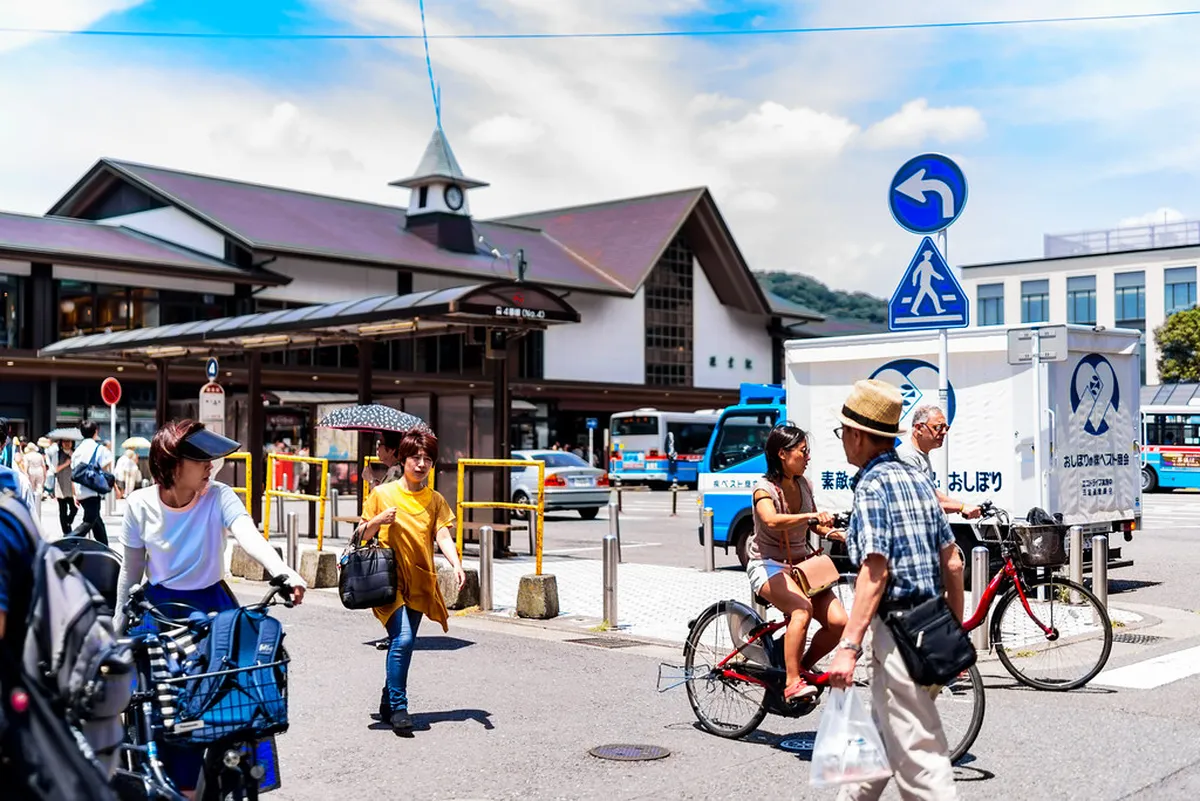
Kamakura Station has two exits that do not connect outside the gates, and choosing the wrong one is the single most common navigation mistake. The East Exit opens onto the bus terminal, the taxi rank, the Tourist Information Center, and the red torii at the foot of Komachi-dori. Anyone heading to Hachimangu, Hokokuji, or any bus-served temple wants this exit.
The West Exit faces the Enoden Kamakura station, City Hall, and the quieter residential side. Use it if your next move is the Enoden toward Hase and the Great Buddha, or if you are buying the Kamakura Free Environment Bill at the Enoden ticket window. The two sides are connected by an underground passage past the gates and a station overpass inside them.
Coin lockers exist on both sides, but the East Exit lockers are larger and refill faster mid-morning. If you are carrying a roller bag from a hotel checkout, drop it at the East Exit before crossing under to the Enoden side. The Tourist Information Center at the East Exit also stocks free English bus maps that mark every stop discussed below.
Taking the Bus in Kamakura: Routes, Stops, and Fares
Two operators run the city's buses: Enoden Bus in orange and tan livery, and Keikyu Bus in blue with red and silver stripes. Both leave from the seven numbered bus stops outside the East Exit. Enoden services depart from Stops 1 and 2; Keikyu services depart from Stops 3 through 7. Fares are distance-based but tourist-relevant rides land between 200 and 250 yen.
Knowing which numbered stop serves which temple is the difference between a 5-minute ride and a wrong-direction loop. Use this stop-to-temple map, which mirrors the live timetables posted at each platform and the routings on the Enoden Bus Official Site and Keikyu Bus Official Site.
- Bus Stop 1 (Enoden) — services K1, K3, K11, F11 toward Hase-Kannon (Hasedera) in 6 minutes for 210 yen, and Daibutsu-mae (Great Buddha) in 9 minutes for 210 yen.
- Bus Stop 2 (Enoden) — services N2, A21 toward Hachimangu-mae in 3 minutes, Kenchoji in 5 minutes, and Kita-Kamakura in 8 minutes for 250 yen.
- Bus Stop 4 (Keikyu) — services 鎌23, 鎌24, 鎌36 toward Hachimangu and Jomyoji Temple in 8 minutes for 220 yen.
- Bus Stop 5 (Keikyu) — service 鎌20 toward Egara Tenjin and Kamakura-gu shrine in 7 minutes for 220 yen.
- Bus Stop 6 (Keikyu) — service 鎌4 toward Hase-Kannon and the Great Buddha in 8 minutes for 200 yen, useful when Stop 1 is queued.
- Bus Stop 7 (Keikyu) — services 鎌12, 鎌40, 鎌41 toward Kuhonji, Zaimokuza Beach, and Komyoji Temple.
Boarding pattern depends on the bus design. Most local services board through the rear or middle door, where you tap your Suica or Pasmo or pull a paper numbered ticket. You exit at the front and either tap out, or drop the paper ticket plus the displayed fare into the box. Cash payment requires coins or a 1,000 yen note — the fare box has a coin-changer slot, but it does not break 5,000 or 10,000 yen bills, so charge your IC card before you board.
Pro tip: Child fares on both operators are half the adult rate for ages 6 to 12, free under age 1, and free for up to two children aged 1 to 6 traveling with one paying adult.
The Enoden Line: A Scenic Guide to the Coastal Railway
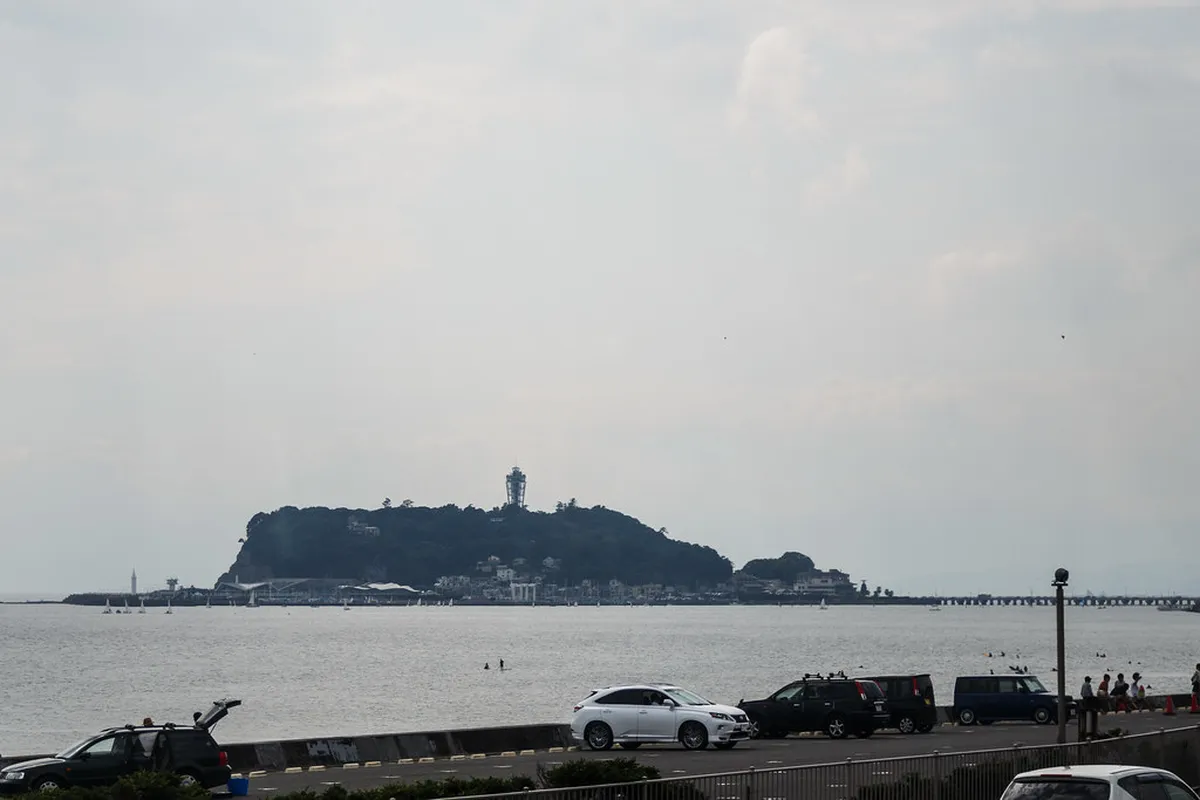
Founded in 1900, the Enoshima Electric Railway (Enoden) runs 10 kilometers between Kamakura and Fujisawa, threading through residential backyards before opening onto the Sagami Bay coastline. Single rides are 200 to 320 yen depending on distance, and trains depart every 12 minutes throughout most of the day.
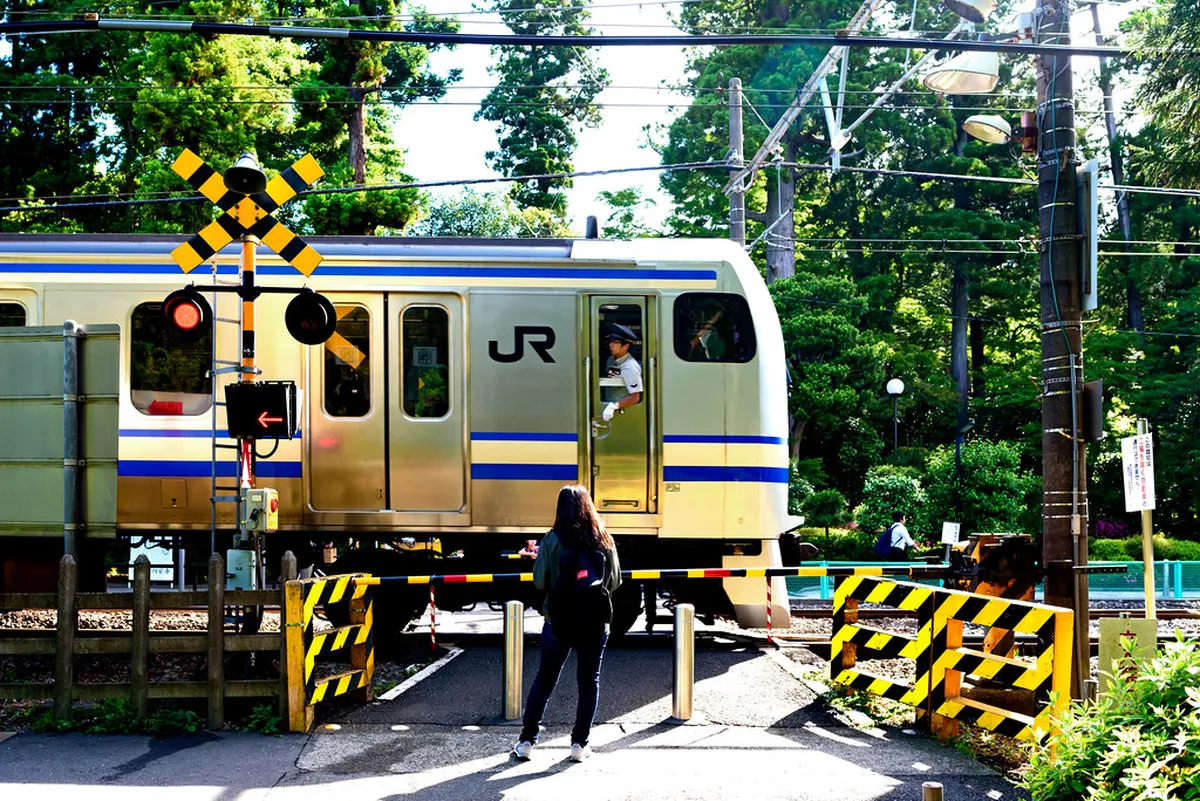
Three stops account for nearly all tourist traffic. Hase is the closest stop for the Great Buddha visiting guide and Hasedera, both a 7-minute walk from the station. Kamakurakokomae is the famous railroad-crossing photo spot featured in the anime Slam Dunk, where the train passes against the open ocean. Enoshima connects to the holiday island for a longer half-day extension you can read about in our Enoshima from Kamakura day trip guide.
Crowding is the single biggest Enoden trap. On Saturday and Sunday afternoons between 12:00 and 16:00 — and any weekend in June for hydrangea season at Hasedera — Hase Station can run a queue that makes you wait two or three trains to board. If you hit that wall, the Keikyu Bus from Hase back to Kamakura Station leaves every 15 minutes and is genuinely faster door to door. Treat the Enoden as the inbound morning leg and the bus as the safety valve for the return.
Pro tip: The last Enoden from Hase toward Kamakura is around 23:00, but the connecting Yokosuka-line trains back to Tokyo Station thin out after 22:30, with the last direct services around 22:50. After that you transfer at Ofuna and rides take 30 minutes longer. Build a dinner cutoff at 21:30 if you want to make the direct train home.
On Saturday and Sunday afternoons between 12:00 and 16:00 — and any weekend during hydrangea season in June — Hase Station can queue you two or three trains to board the Enoden. Use the Keikyu Bus from Hase as a faster return option.
Exploring Kamakura on Foot and by Rental Bicycle
The single best routing trick in Kamakura is to start at Kita-Kamakura Station, one stop north on the JR Yokosuka Line, and walk south. The route runs gently downhill through Engakuji, Kenchoji, and Tokeiji before joining the main road at Hachimangu. You see four major temples in 90 minutes of mostly easy walking, then arrive at Kamakura Station with energy still in the tank for Hase. Doing the same route in reverse is uphill the entire way and burns visibly more stamina.
- Kamakura Station to Tsurugaoka Hachimangu via the Dankazura raised path: 12 to 15 minutes.
- Kita-Kamakura to Kamakura Station via temples: 60 to 90 minutes with stops.
- Hase Station to Great Buddha: 7 minutes.
- Hase Station to Hasedera: 5 minutes.
- Hachimangu to Hokokuji bamboo grove: 18 to 20 minutes (or one bus stop).
- Daibutsu Hiking Trail (Kita-Kamakura to Hase): 60 to 90 minutes, moderate.
Rental bicycles are available at Grove Kamakura near the East Exit and at outlets near Hase Station, typically 1,500 to 2,000 yen for a half day. Cycling makes sense for visitors who want to combine inland temples like Hokokuji with the Zaimokuza coast in a single morning, but it does not help inside Hachimangu, Hasedera, or Engakuji where bikes must stay parked outside the gates. The roads near Komachi-dori are pedestrianized on weekends, so plan to push the bike on foot through that stretch.
Pro tip: If you book a bike, ride the gentle coastal road from Hase east to Yuigahama Beach. The path is flat, the Enoden tracks run beside you for half the distance, and you can park the bike at any of the public seafront racks for a swim or coffee break.
Practical Tips for Using IC Cards (Suica/Pasmo) in Kamakura
One Suica or Pasmo handles every JR train, every Enoden train, every Keikyu and Enoden bus, and most convenience-store snacks during the day. Welcome Suica and the mobile Suica on Apple Pay or Google Pay both work identically at every gate and reader in town, and you can recharge in 1,000 yen increments at any station ticket machine.
The Enoden quirk that catches first-timers is the touch-on, touch-off requirement at unstaffed stations like Kamakurakokomae and Yuigahama. These stops have small yellow or blue card readers on the platform rather than full ticket gates. If you forget to tap on at boarding or tap off at arrival, the system records an incomplete journey and locks the card until staff at Kamakura or Fujisawa station reset it. Look for the reader before you step onto the platform and again before you leave.
Buses use a similar two-tap pattern: tap on as you board through the rear or middle door, tap off at the front when you exit. The fare adjusts automatically based on distance. JR gates inside major stations are standard touch-on, touch-off, but transferring between JR and Enoden at Kamakura requires you to tap out of one system and tap into the other rather than walking straight through. Keep your card or phone ready for the many Kamakura attractions you will visit and recharge by mid-afternoon to avoid being caught at a closed-counter station.
Frequently Asked Questions
What is the cheapest way to get from Tokyo to Kamakura?
The cheapest way is using the Odakyu Railway from Shinjuku to Fujisawa, then transferring to the Enoden line. This route costs roughly 610 yen one-way, which is significantly less than the direct JR lines. You can save even more by purchasing a discount pass for your Kamakura attractions visit.
Does the JR Pass cover the Enoden Line?
No, the JR Pass does not cover the Enoden Line as it is operated by a private company. You will need to pay for these rides separately using cash or an IC card like Suica. The JR Pass only covers the initial trip from Tokyo to the main station.
Is Kamakura walkable or do I need to take the bus?
The city center is very walkable, with many shrines located within 15 minutes of the station. However, reaching the Great Buddha or the bamboo grove is much easier by bus or train. Most visitors use a combination of walking and short transit rides to see everything efficiently.
How do I pay for the bus in Kamakura?
You can pay using a Suica or Pasmo IC card by tapping the readers when boarding and exiting. If you use cash, take a numbered ticket when you enter and pay the driver at the front. Most local buses accept 1,000 yen notes but cannot change larger bills.
Which station should I get off at for the Great Buddha?
Hase Station on the Enoden Line is the closest stop for visiting the Great Buddha. From the station, it is a well-marked 7-minute walk to the temple entrance. You can also take a bus from the main station's East Exit directly to the Kotoku-in bus stop.
Kamakura rewards travelers who plan their transport before they pack their day. Use the JR Yokosuka or Shonan-Shinjuku line for a direct hour from Tokyo, switch to the Enoden Line for the southwest coast, and let the Keikyu and Enoden buses handle the inland temples that the trains cannot reach.
A single Suica covers every fare, the Kita-Kamakura first strategy keeps the day mostly downhill, and the 21:30 dinner cutoff keeps you on a direct train home. With those four habits, every part of this coastal city becomes 30 minutes closer than the average tourist will reach.
For the wider Kamakura context, see our complete Kamakura attractions guide.
For related Kamakura deep-dives, see our 10 Best Ryokan in Kamakura Travel Guide and Kenchoji Temple Kamakura Travel Guide guides.
Free: The Kamakura Essentials guide
Top things to do, where to stay, a perfect day plan, getting around, and the best time to go — a Kamakura mini-guide you can take offline.
You might also like


Continue reading
More guides you'll find useful