

Kenchoji Temple Kamakura Travel Guide
Plan kenchoji temple kamakura with top picks, neighborhood context, timing tips, and practical booking advice for a smoother trip.
On this page
Kenchoji Temple in Kamakura is the oldest Zen training monastery in Japan, founded in 1253 by the regent Hojo Tokiyori. It is ranked first of Kamakura's Five Great Zen Temples (Gozan) and remains the head temple of the Kenchoji branch of Rinzai Zen. The complex stretches from the valley floor deep into the wooded hills behind, with sub-temples, a working monastery, and a hilltop shrine that frames Sagami Bay on a clear day.
For 2026, gates open at 08:30 and close at 16:30 daily, and admission is 500 yen for adults and 200 yen for children. Most visitors reach Kenchoji on foot in about 15 minutes from Kita-Kamakura Station on the JR Yokosuka Line, and many fold the visit into a broader kamakura day trip itinerary with nearby Yokohama as a secondary stop. Plan 90 minutes for the main halls and gardens, or two and a half hours if you climb to Hansobo Shrine.
Must-See Kenchoji Attractions
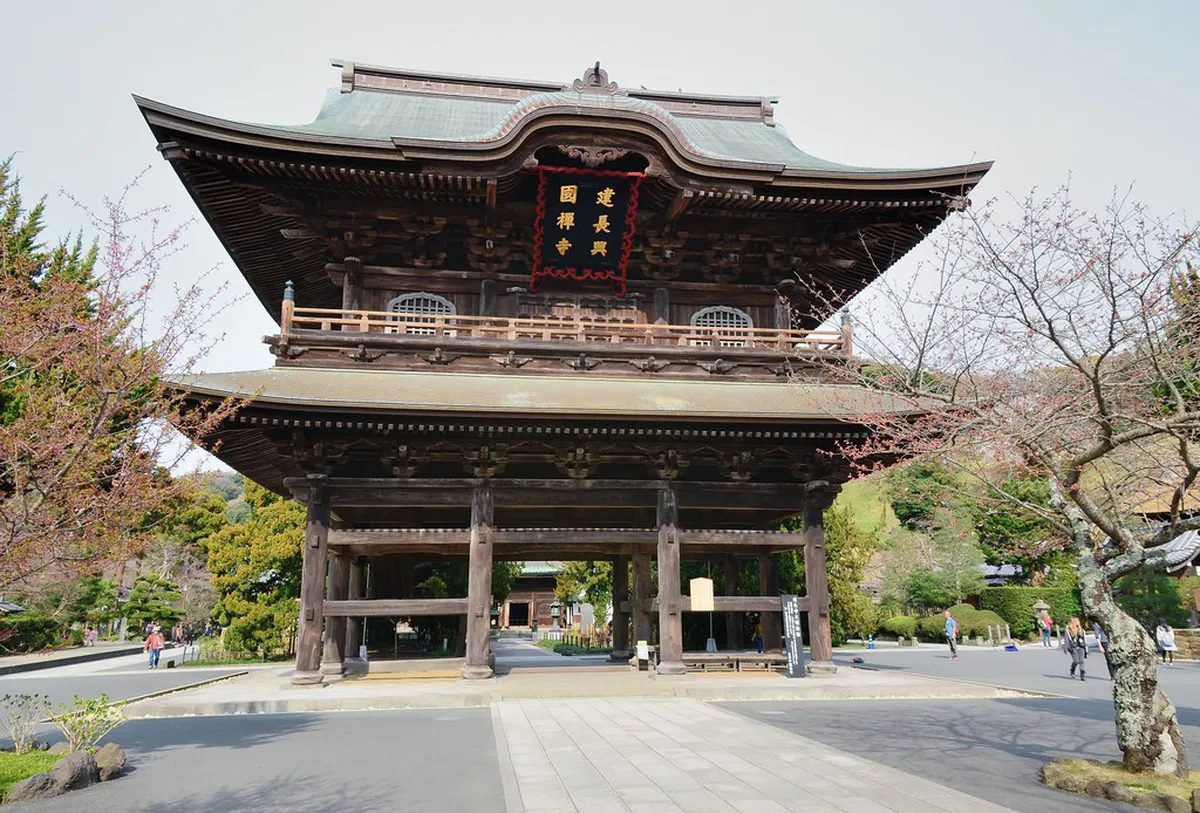
The Sohmon, the outer entrance gate moved here from Hanju-Sanmaiin Temple in Kyoto in 1940, sets the tone before you reach the main precinct. A few steps further sits the Sanmon, a two-story wooden gate rebuilt in 1775 and famous for the maxim that walking beneath it cleanses worldly desires. Just to the right of the Sanmon, in a small open pavilion, hangs the Bonsho temple bell, cast in 1255 and registered as a National Treasure.
The Butsuden, or Buddha Hall, was relocated from the Tokugawa family mausoleum at Zojoji in Tokyo in 1647. Inside is the principal image, an unusual seated Jizo Bodhisattva instead of the more typical Shaka Nyorai, a clue to Kenchoji's history on a former execution ground where Jizo was worshipped to comfort the souls of the dead. Behind it stands the Hatto, the Dharma Hall, the largest wooden Buddhist structure in eastern Japan and the venue for major ceremonies.
Arrive at 08:30 opening to have the Sanmon, Bonsho, and Hatto largely to yourself for the first 45 minutes — tour groups typically appear from around 10:00. Morning light is also kindest to the dragon ceiling and to the ancient juniper courtyard.
Look up inside the Hatto for the Unryu-zu, a 26-by-29 foot cloud dragon painted on the ceiling by Koizumi Junsaku in 2003 to mark the temple's 750th anniversary. The dragon's eyes track you as you walk the hall, an effect that is best in the soft late-morning light. Allow yourself ten unhurried minutes here before continuing to the Hojo.
Museums, Art, and Culture in Kenchoji
The Hojo, originally the head priest's residence, is now used for ceremonies and quiet visitor circulation. Remove your shoes at the entrance and walk the cool tatami in stocking feet. Sliding-door panels, lacquered beams, and a long wooden engawa veranda open onto the garden behind, and the building is itself an Important Cultural Property dating to a 1646 reconstruction.
In the front courtyard, do not miss the cluster of Byakushin junipers said to have been grown from seeds carried from China by founder Rankei Doryu in the 13th century. Several are over 750 years old, with twisted, lichen-covered trunks that reach toward the Butsuden. They are among the oldest living things in the city and are protected as a Kanagawa Prefecture natural monument.
For deeper context, the Kamakura Museum of National Treasures, a ten-minute walk away inside Tsurugaoka Hachimangu's grounds, holds rotating exhibits of paintings and statues borrowed from Kenchoji and other Kamakura temples. Entry there is 400 to 700 yen depending on the exhibition. It pairs well with Kenchoji on a culture-focused half-day.
Parks, Gardens, and Outdoor Spots in Kenchoji
Behind the Hojo lies the Shinji-ike, a pond shaped like the Chinese character for "heart" or "mind" and credited to the celebrated 14th-century monk and garden designer Muso Soseki. The reflections are at their best in mid-November during the kamakura autumn leaves guide window, and again in early April for cherry blossom. Sit on the engawa, not in the garden, and keep voices low; this is still a working temple.
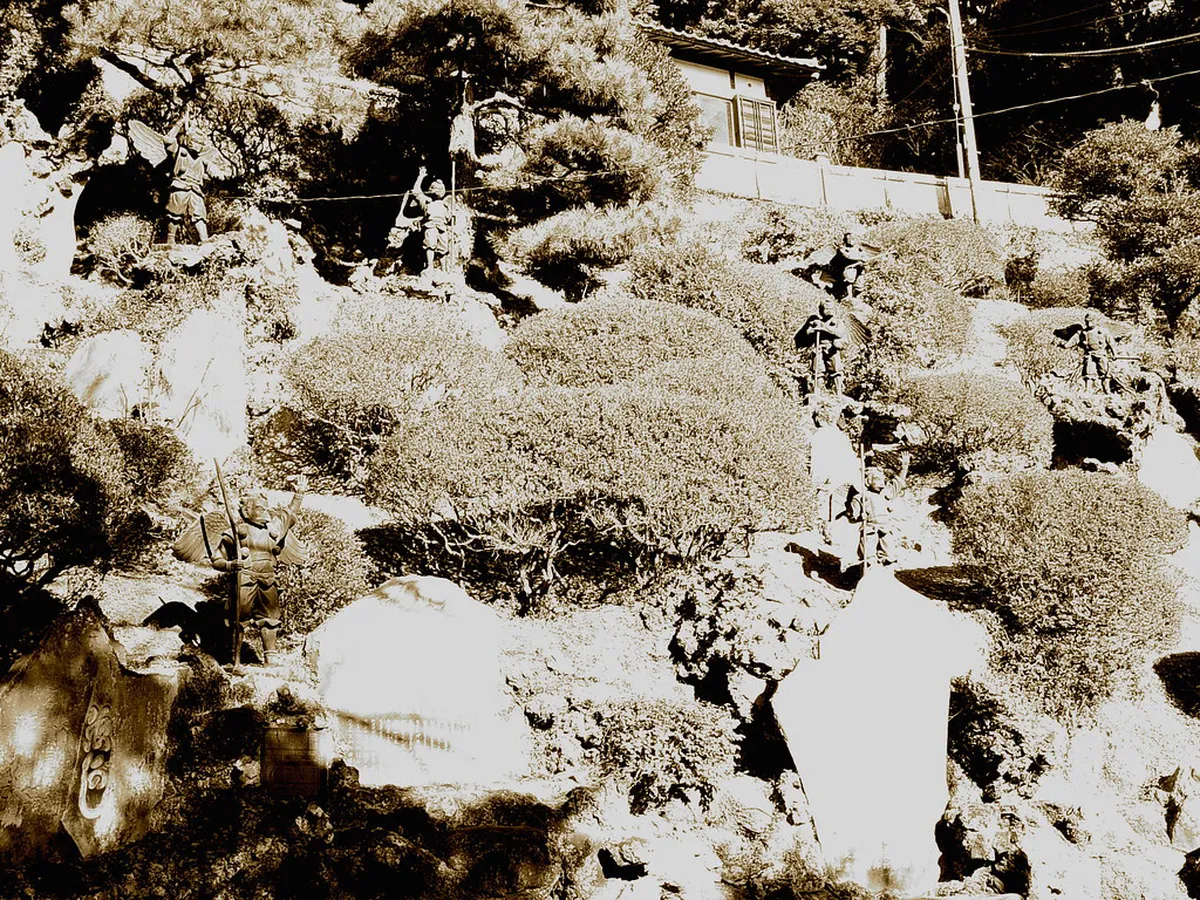
From the rear of the precinct, a stone-and-step path climbs roughly 245 stairs to Hansobo, the temple's guardian shrine, lined with bronze statues of Tengu, the long-nosed mountain spirits believed to protect Kenchoji. The climb takes 15 to 20 minutes and is steep in places. The upper terrace gives you the temple roofs in the foreground, Sagami Bay across the middle distance, and on cold, clear winter mornings a clean line of Mount Fuji to the west.
Do not start the Ten-en hiking course after 14:30 in winter — the trail loses light fast and the back gates lock, forcing a longer road descent. The Hansobo climb is also not stroller-friendly: roughly 245 steep stairs with no alternate route.
From Hansobo you can pick up the Ten-en hiking course, one of the classic kamakura hiking trails linking the northern hills to Zuisenji or Kakuonji. Allow 90 minutes for the through-walk and wear grippy shoes; the soil turns slick after rain. Do not attempt this route in the last 90 minutes before closing, as the back gates lock and you will be diverted onto longer road descents.
Zazen Meditation and Monastic Life
Kenchoji is one of the few major temples in the Tokyo area that opens its zazen (seated meditation) sessions to walk-in foreign visitors at no extra cost beyond standard admission. Public sittings are typically held on Friday and Saturday at 17:00, with an additional session on the second and fourth Sunday of the month at 08:00. Sessions last about an hour, are conducted by a resident monk, and are largely silent, so basic Japanese is not required.
Etiquette matters more than experience here. Arrive at least 15 minutes early at the Hojo entrance, switch your phone to silent, dress in clothing that lets you cross your legs (loose trousers, not a short skirt), and remove watches and large jewellery. The monk demonstrates posture before the bell; if your knees do not allow a half-lotus, sitting on a folded cushion or kneeling seiza is fully acceptable. Do not photograph the meditation hall once the session begins.
Beyond the public sittings, Kenchoji is also home to a working sodo (training hall) where novice monks live a strict daily schedule. You may see them on cleaning duty in the early morning or sweeping leaves in the late afternoon. Watch quietly and do not block their path; this is a workplace, not a performance, and respecting that boundary is the heart of a Zen visit.
Family-Friendly and Budget-Friendly Options in Kenchoji
At 500 yen for adults and 200 yen for children, Kenchoji is one of the better-value major temples in the Kanto region. The wide gravel main path from the Sohmon to the Hatto is flat, stroller-passable in dry weather, and shaded for most of the walk. There are toilets near the entrance and again behind the Hojo, and benches by the Shinji-ike garden where parents can rest while older children wander the courtyards.
Families travelling kamakura with kids should know that the climb to Hansobo is not stroller-friendly and is genuinely tiring for under-sevens; many parents trade off, with one adult staying with the youngest near the dragon ceiling while the other does the hilltop loop. Pack water in summer, when the upper trail offers little shade. The carp in the Shinji-ike usually keep small children entertained for ten minutes near the rest benches.
One quietly useful detail: there is a small middle school, Kenchoji Gakuen, operating inside the temple precincts behind the main halls. You may hear bells, choir practice, or PE lessons drifting through the cedars on weekday afternoons. It is harmless, often charming, but worth knowing if you came expecting absolute silence on a Tuesday at 14:00.
Kenchin-jiru and the Temple's Culinary Heritage
Kenchin-jiru, the clear vegetable soup with daikon, carrot, burdock, taro, tofu, and a splash of sesame oil, is widely held to have been invented here by the temple's founding priests as part of the shojin-ryori vegetarian monastic diet. The name "kenchin" itself is a contraction of "Kenchoji." It is one of the few cases in Japan where a household soup can be traced to a specific monastery, and tasting a bowl on site turns the visit from sightseeing into something closer to a cultural meal.
The most authentic option is Hachinoki Kita-Kamakura Branch, a five-minute walk from the temple's outer gate, which has served formal shojin-ryori courses for over fifty years and lists kenchin-jiru on most set menus from around 2,800 yen for lunch. For a quicker stop, several small cafes and tofu shops along the Kita-Kamakura station road sell single bowls or take-away versions in winter for 600 to 1,200 yen. Check the day's hours before walking over; most close by 17:00 and many take Wednesdays off.
If you would rather stretch your visit into the evening with a wider menu, the best restaurants in kamakura sit closer to the main Kamakura station, a short JR ride away. Either way, a hot bowl of kenchin-jiru after the Hansobo climb is one of the most satisfying combinations the area offers, especially between November and March.
How to Plan a Smooth Kenchoji Attractions Day
Arrive at 08:30 opening to have the Sanmon, Bonsho, and Hatto largely to yourself for the first 45 minutes; tour groups typically appear from about 10:00. Morning light is also kindest to the dragon ceiling and to the juniper courtyard, where strong midday sun flattens the texture of the bark. The official Japan Guide page is a reliable source for any seasonal hour shifts and special-event closures.
From Tokyo Station, take the JR Yokosuka Line direct to Kita-Kamakura, about 55 to 65 minutes for 940 yen one way, or covered by the JR Pass and the Kamakura-Enoshima 1-Day Pass. Get off at Kita-Kamakura, not Kamakura; the walk along the old road passes Engakuji, Tokeiji, and Meigetsuin before reaching Kenchoji. A kamakura transportation guide covers the local Enoden and bus options if you continue south afterwards.
| Time | Stop | Duration |
|---|---|---|
| 08:30–10:00 | Sanmon gate, Bonsho bell, Butsuden, Hatto dragon ceiling | 90 min |
| 10:00–10:45 | Hojo hall, Shinji-ike garden, juniper courtyard | 45 min |
| 10:45–11:30 | Climb to Hansobo Shrine; views of Sagami Bay and Mt. Fuji | 45 min |
| 11:45–12:45 | Kenchin-jiru lunch in Kita-Kamakura | 60 min |
| 13:00 onward | Bus or JR to Great Buddha at Hase | — |
- 08:30 to 10:00: enter Kenchoji, see Sanmon, Bonsho, Butsuden, Hatto dragon
- 10:00 to 10:45: Hojo, Shinji-ike garden, juniper courtyard
- 10:45 to 11:30: climb to Hansobo, photos at the upper viewing terrace
- 11:45 to 12:45: kenchin-jiru lunch in Kita-Kamakura
- 13:00 onward: bus or JR to the great buddha kamakura at Hase
Common first-timer mistakes are easy to dodge once you know them. Do not get off at Kamakura Station expecting a short walk; that adds 25 minutes uphill. Do not rely on credit cards inside the temple shop, which still prefers cash for charms and stamps. And do not start the Ten-en hiking course after 14:30 in winter, when the trail loses light fast.
Nearby Zen Temples Worth Pairing
Engakuji, the second-ranked of Kamakura's Five Great Zen Temples, sits directly above Kita-Kamakura Station and is the most natural pairing with Kenchoji. Many visitors do engakuji temple first because it is uphill from the station, then walk downhill to Kenchoji. Engakuji's draws are the Shariden hall, said to enshrine a tooth of the Buddha and itself a National Treasure, and a quieter, more wooded feel; expect 60 to 90 minutes for a focused visit.
Meigetsuin, halfway between the two, is famous as the "ajisai-dera" (hydrangea temple) and is best in mid-June, when more than 2,500 hydrangea bushes turn the approach a saturated blue. Tokeiji, just across the railway from Engakuji, was historically a refuge temple where women could divorce their husbands by completing three years of service, and it has a small but lovely garden of plum and magnolia in late winter.
If your time is tight, the simplest trade-off is this: choose Kenchoji for scale, the dragon ceiling, and the Hansobo viewpoint; choose Engakuji for atmosphere and proximity to the train; add Meigetsuin only in June. All three can be combined into a single Kita-Kamakura morning, making this stretch one of the most efficient temple loops in greater Tokyo and a strong addition to any wider list of kamakura attractions.
Frequently Asked Questions
How much time should you plan for kenchoji temple kamakura?
You should plan for at least 90 minutes to two hours. This allows time to see the main halls and the Zen garden. If you plan to hike up to the Hansobo Shrine for the view, add another 45 minutes to your schedule.
Is kenchoji temple kamakura worth including on a short itinerary?
Yes, it is definitely worth it because it is the most important Zen temple in the city. Its location near the station makes it easy to visit quickly. You can see the highlights and still have time for best restaurants in kamakura nearby.
What should travelers avoid when planning kenchoji temple kamakura?
Avoid visiting during the middle of the day on weekends if you want peace. The main courtyard can get crowded with tour groups. Also, do not wear uncomfortable shoes if you intend to explore the upper hillside paths and shrines.
Kenchoji rewards visitors who treat it as a working monastery first and a sightseeing stop second. Arrive early, walk slowly from Sanmon to Hatto, climb to Hansobo for the Sagami Bay view, and finish with a bowl of kenchin-jiru where the soup itself was invented. Combined with Engakuji and a glance at Meigetsuin in season, it makes for one of the most rewarding half-days within an hour of Tokyo.
Pair this with our broader Kamakura attractions guide for the full city overview.
For related Kamakura deep-dives, see our Engakuji Temple: The Ultimate Visitor Guide to Kamakura’s Zen Landmark and Sasuke Inari Shrine Travel Guide guides.
Free: The Kamakura Essentials guide
Top things to do, where to stay, a perfect day plan, getting around, and the best time to go — a Kamakura mini-guide you can take offline.
You might also like


Continue reading
More guides you'll find useful


