

Great Buddha Kamakura: Essential Visiting Tips & Entry Fee
See the 11.3m Great Buddha at Kotoku-in in Kamakura — entry fees, transport options, going inside the statue, and nearby spots, in 10 practical tips.
On this page
The Great Buddha of Kamakura is the only National Treasure Buddha statue in the city and one of the few large bronze figures in Japan that has stood outdoors for nearly seven centuries. Known locally as the Daibutsu, this 11.3-meter seated figure of Amida Nyorai sits within the grounds of Kotoku-in, a temple of the Jodo sect in the Hase neighborhood. Our great buddha kamakura visiting guide focuses on the practical details most travelers miss: precise entry fees, the Enoden vs bus tradeoff, what going inside actually looks like, and how to time your visit around the school-group rush. A trip here pairs naturally with any Kamakura day trip itinerary 2026.
This is not a museum experience. Kotoku-in is an active temple, and the Daibutsu has weathered fires, earthquakes, and the 1495 tsunami that destroyed the original wooden hall around it. The 53 stone bases visible across the grounds are the only surviving foundation pieces of that lost building. Read on for the 10 tips that turn a quick photo stop into a properly planned cultural visit, in 2026 conditions.
History and Significance of the Kamakura Daibutsu
Construction of the Great Buddha began in 1252 during the height of the Kamakura Shogunate, the first samurai government and the political force behind founder Minamoto no Yoritomo's earlier consolidation of power. The statue was cast in bronze using stacked clay molds and originally gilded; faint traces of gold leaf remain near the ears for visitors who look closely in raking sunlight. For nearly 250 years it sat sheltered inside a wooden Daibutsu-den hall, similar to the one that still protects the Nara Daibutsu today. You can find further historical context through Rudyard Kipling's 1892 poem, which helped fix the statue in the Western imagination.
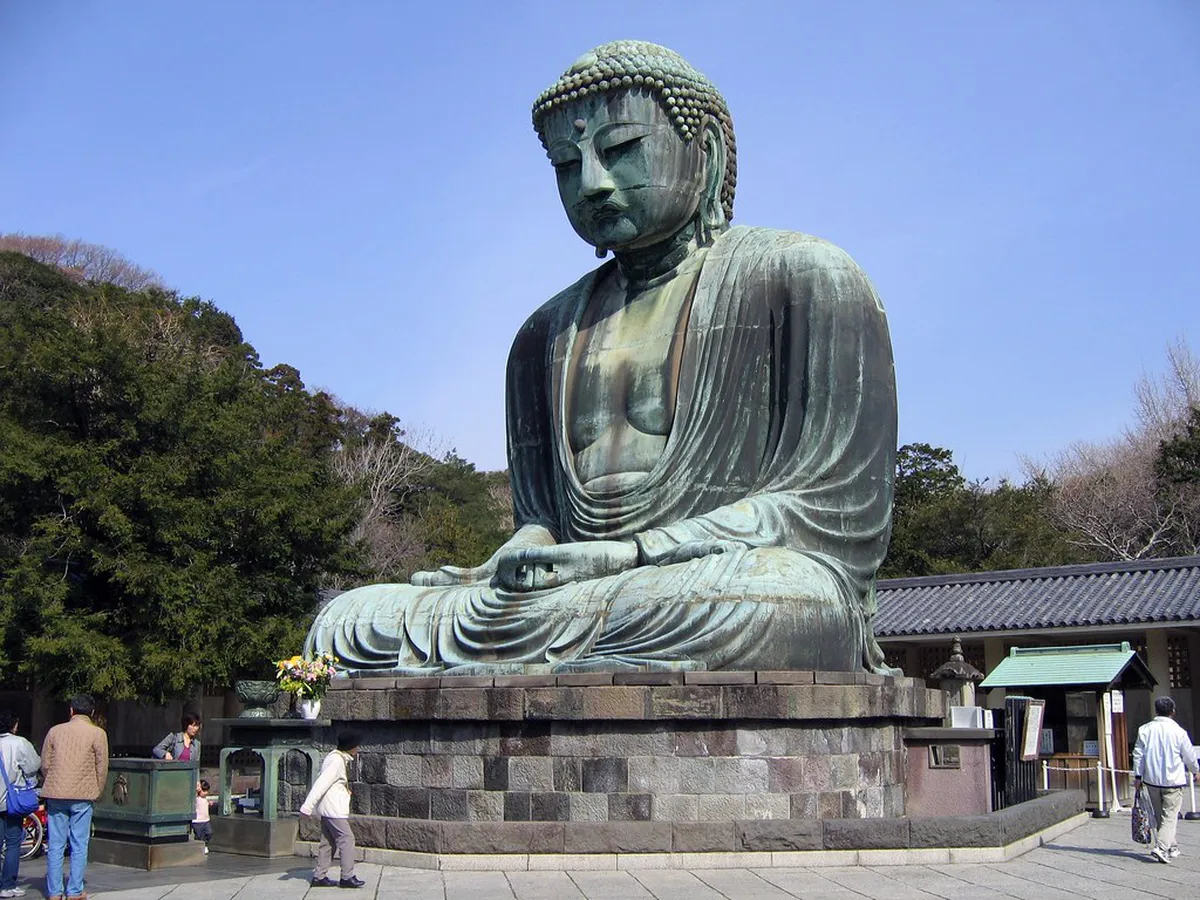
A massive tsunami in 1495 swept away the surrounding hall but left the bronze figure standing on its lotus base. The temple chose not to rebuild, and the Daibutsu has remained an open-air monument ever since, framed seasonally by hydrangeas, cherry blossoms, and autumn foliage. The statue is the principal icon of the Jodo Sect at Kotoku-in and is registered as a National Treasure of Japan, the country's highest cultural designation. Note the distinction the temple itself emphasizes: Kotoku-in is the temple, Daibutsu is the statue, and confusing the two is a common first-timer slip.
Essential Visiting Information: Hours, Fees, and Tickets
Kotoku-in operates on a seasonal schedule in 2026: 8:00 to 17:30 from April through September, and 8:00 to 17:00 from October through March. Last entry is fifteen minutes before closing. The interior of the statue keeps shorter hours, 8:00 to 16:30, with last entry ten minutes before closing. Verify before travel via the official Kotoku-in website, since religious observances and weather can shift hours without notice.
- Adult admission to the temple grounds: 300 yen (cash only at the gate booth)
- Elementary school students: 150 yen
- Preschool children: free
- Interior of the Great Buddha (separate ticket): a small additional cash fee paid at the booth beside the statue, payable in coins
- Drone use, commercial photography, and selfie sticks inside the statue are prohibited
- Pets allowed only inside fully enclosed carriers; no leash walking except for assistance dogs
The illustrated paper ticket doubles as a souvenir and is worth keeping. ATMs on the Hase walking street are not always reliable for foreign cards, so withdraw yen at Kamakura Station before changing to the Enoden.
Adult admission to Kotoku-in is ¥300 (cash only at the gate booth). Going inside the statue costs an additional ¥20 in coins at the booth beside the lotus base. Both ticket spots are cash-only, so carry small change before you arrive.
How to Get to Kotoku-in Temple from Tokyo and Kamakura Station
From central Tokyo, the cleanest route is the JR Yokosuka Line direct to Kamakura Station, roughly 55 to 65 minutes from Tokyo Station and fully covered by a Japan Rail Pass. The Shonan-Shinjuku Line is a useful alternative from Shinjuku, Shibuya, or Ikebukuro and runs at similar frequency. Our Kamakura transportation guide covers exit numbers, locker locations, and Suica reload points.
From Kamakura Station you have two practical options for the final leg. The Enoden Line, a single-track coastal tram from the West Exit, takes about four minutes to reach Hase Station, from which Kotoku-in is a flat seven-to-ten-minute walk north. Alternatively, the city bus from bus stop 1 or 6 outside the East Exit drops you directly at the "Daibutsu-mae" stop, faster on busy weekends when the Enoden becomes standing-room only. A third route prized by photographers: take the JR line one stop south to Ofuna, transfer to the Shonan Monorail (a suspended-train system unique to the region), then connect to the Enoden at Enoshima for a coastal approach that doubles as sightseeing.
Key Architectural Highlights of the Great Buddha Statue
The bronze statue stands 11.3 meters tall (13.35 meters including the lotus pedestal) and weighs approximately 121 tons. Casting was completed using a layered mold technique in roughly eight horizontal sections; on the body you can clearly trace the seam lines where each layer was joined and chased. The slight forward tilt of the head and oversized cranium are deliberate Kamakura-period aesthetic choices, designed to look proportionally correct to a viewer standing on the gravel directly in front of the lotus base.
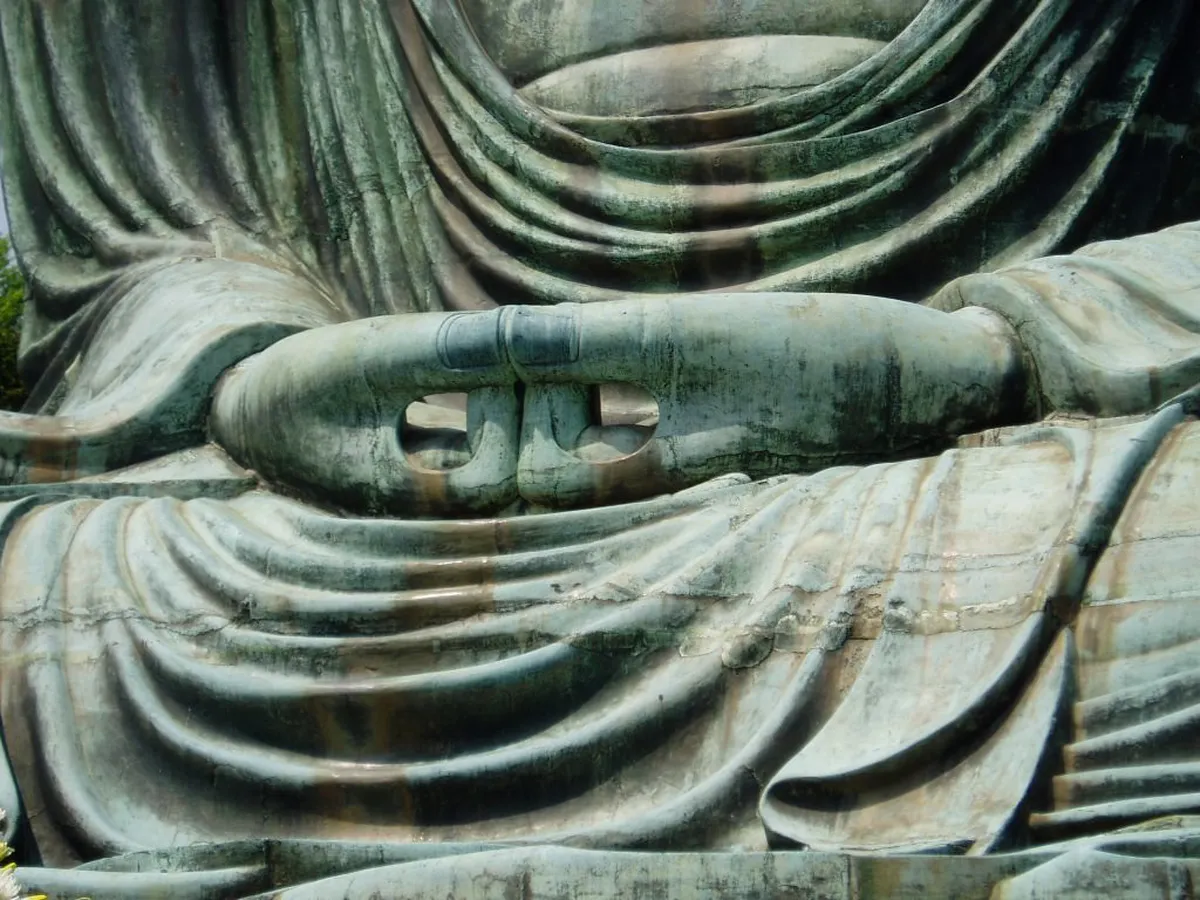
The hands rest in the dhyana mudra of meditation, the thumbs and index fingers forming an oval on the lap, signifying Amida's vow to receive the faithful into the Pure Land. The eyes are half-closed, the smile faint, and the elongated earlobes are a symbolic vestige of the Buddha's princely past. Walk a slow lap around the base before stepping inside; the back of the statue carries two square ventilation windows that locals refer to as the "Buddha's windows," visible only from the rear path. For comparison, you can also visit the larger Nara Daibutsu, which sits indoors.
Kamakura Daibutsu vs Nara Daibutsu at a glance
| Feature | Kamakura Daibutsu | Nara Daibutsu |
|---|---|---|
| Height | 11.3 m | 14.98 m |
| Material | Cast bronze, originally gilded | Cast bronze, originally gilded |
| Year completed | 1252 | 752 (recast multiple times) |
| Setting | Outdoor since 1495 | Indoor in Todai-ji's Daibutsu-den |
| Buddha depicted | Amida Nyorai (Pure Land) | Vairocana (Cosmic Buddha) |
| Interior access | Yes (¥20 extra) | No |
The Unique Experience of Going Inside the Daibutsu
Going inside the statue is the experience that distinguishes Kotoku-in from every other large Buddha site in Japan. Entry costs only 20 yen, payable in coins at a small booth beside the lotus base, and the queue rarely runs longer than ten minutes outside school-trip season. Inside, the air is still and noticeably warmer than outside, since the bronze shell absorbs heat all day; in mid-summer the cavity can climb above 35 degrees Celsius and feels like a sauna. The interior staircase is steep, narrow, and made of unpadded metal.
What you actually see is medieval engineering laid bare: horizontal casting seams running across the chest and back, internal iron ribs added during a later Edo-period reinforcement, and patches where 16th and 19th-century repairs were welded onto the original 13th-century shell. Two small windows admit dim natural light, enough to read the cast lines. Travelers who are claustrophobic, mobility-limited, or wearing a heavy backpack should skip it; the interior is the one part of Kotoku-in that is not wheelchair accessible. The temple grounds themselves, by contrast, are largely flat gravel and reachable for wheelchair users via the main gate, with one accessible unisex restroom on site.
The Giant Straw Sandals and Other Grounds Details
To the right of the statue, hung against the wall of the inner gate, you will see a pair of woven straw sandals roughly 1.8 meters long. These are waraji, replaced every few years by schoolchildren from Matsuzaka in Hitachi-Ota City, Ibaraki Prefecture, a tradition that began in 1956. The symbolism is literal: the sandals are sized for the Buddha so that he might walk across Japan spreading peace, and they double as a prayer for strong legs and safe travel for the donor children and visitors alike.
Look down as you walk the perimeter and you will count 53 cut stones embedded in the gravel, the original foundation pieces of the Daibutsu-den hall destroyed in 1495. They are easy to miss because they sit flush with the ground. Near the rear of the statue, the temple keeps a small collection of stone monuments inscribed with poems by Japanese authors who visited the Buddha; the Yosano Akiko verse is the most famous. At the entrance hall, two restored Nio guardian statues flank the path, and a small office on the right sells goshuin (calligraphic temple stamps) for 500 yen, a useful keepsake for travelers collecting them across Kamakura.
Best Time to Visit for Seasonal Scenery and Crowds
School groups arrive by chartered bus between 10:00 and 14:00, especially on weekdays from late April through June and again in October. Arrive before 9:30 or after 16:00 to avoid the busiest periods and get the best photography light.
The dominant crowd pattern at Kotoku-in is school groups arriving by chartered bus between 10:00 and 14:00, especially on weekdays from late April through June and again in October and early November. Tour-bus day-trippers from Tokyo layer on top of the school traffic between 11:00 and 15:00. The two genuinely quiet windows are 8:00 to 9:30 and 16:00 to closing; the late slot is the better photographic option because western light hits the statue's face directly. Check our Kamakura cherry blossom season guide for predicted peak dates.
Spring brings cherry blossoms behind the statue, with peak typically in early April. Hydrangea season in mid-June is technically a Hase-dera draw next door, but the walk between the two looks at its best then. Autumn foliage peaks in mid-to-late November and frames the bronze in red and gold. Winter mornings after a clear cold front are underrated: the bronze is matte black against a hard blue sky and the crowds drop sharply.
Photography Angles and Hidden Vantage Points
The default tourist angle is straight-on from the front gate, and it is the worst one. The slight forward tilt of the head reads as flat from there, and crowds will be in your frame all day. Walk left along the inner perimeter to the side-on profile shot near the small bell pavilion; from this angle the bowed posture and elongated proportions of the 13th-century aesthetic become legible, and the lotus base lines up cleanly. In cherry blossom season, the back-left corner of the grounds gives you blossoms in the foreground and the Buddha's profile behind, a far stronger composition than any front-facing image.
For the rear shot, walk the path that loops behind the statue and shoot upward against the sky to capture the two ventilation windows and the seam line across the shoulders, a detail most visitors never notice. A second underused angle is the gravel just beside the offering stand: kneeling here puts the lotus base at eye level and lets you frame the Buddha against trees rather than the inevitable wall of selfie-takers. Tripods and selfie sticks are not permitted inside the statue and are discouraged in tight crowd zones; a wide-angle prime in the 24mm to 35mm range covers everything you actually need.
Temple Etiquette and Cultural Customs for Visitors
Bow once at the main gate when you enter, a small gesture of respect to the temple precinct. At the offering stand in front of the Buddha, the customary practice is to drop a 5-yen coin (lucky for its homophone "go-en" meaning karmic connection), bring your hands together silently, bow once, and step aside. There is no clapping at a Buddhist temple; clapping is reserved for Shinto shrines like nearby Tsurugaoka Hachiman-gu. If you light incense at the burner, waft the smoke toward your head and shoulders for symbolic purification.
Speak quietly on the grounds and avoid running or eating, both common mistakes from first-time visitors. Photography is permitted across the grounds but not in the small inner halls. Drones are forbidden, and commercial shooting requires written permission. The whole site is non-smoking. School groups will sometimes ask, in rehearsed English, to interview you for a class project; saying yes is a minor highlight of any visit and takes about two minutes.
Top Nearby Attractions to Explore in the Hase Area
The single highest-value pairing is Hase-dera, a five-minute walk south of Kotoku-in. Our Hase-dera Temple guide covers the 9.18-meter Eleven-Headed Kannon (the largest wooden Kannon in Japan), the hydrangea path, and the cliffside terrace with views over Sagami Bay. Budget 60 to 90 minutes there and combine it with the Daibutsu in a single morning.
If you have time, walk ten minutes further south to Yuigahama Beach, a wide gray-sand stretch popular with local surfers. Heading the other direction, take the Enoden back to Kamakura Station and visit Tsurugaoka Hachimangu Shrine, the spiritual heart of the medieval city, with its 1.8-kilometer Wakamiya Oji approach lined with cherry trees. Hardier walkers can pick up the Daibutsu Hiking Trail near the entrance to Kotoku-in for a 90-minute forest route to Kita-Kamakura past Zeniarai Benten and Sasuke Inari shrines.
Local Food and Souvenirs Near Kotoku-in
The Hase walking street between the station and the temple is a compact food strip. Try the murasaki-imo (purple sweet potato) soft-serve at one of the takeaway stands, the freshly baked senbei rice crackers brushed with soy and wrapped in nori, and shirasu-don, the local rice bowl topped with whitebait caught off Yuigahama. Our list of the best restaurants in Kamakura covers sit-down options. For a quieter walk back, take the residential side street that runs parallel one block east of the main road; it skips the souvenir crush and passes a small Inari shrine.
For souvenirs, two items are genuinely associated with Kamakura rather than generic Japan. Hato Sabure are dove-shaped butter cookies from the Toshimaya bakery, a Kamakura institution since 1894; the tin makes a clean gift. Kamakura-bori is a centuries-old style of carved lacquerware, expensive but heirloom-grade. Skip the mass-market items and look for shops displaying the official artisan certification mark on the door.
Practical Tips for Planning Your Kamakura Day Trip
A workable single-day template from Tokyo: 8:00 train, arrive Kamakura around 9:00, take the Enoden to Hase, hit Kotoku-in at opening, walk to Hase-dera, lunch on the walking street, Enoden back, Tsurugaoka Hachimangu mid-afternoon, and a return train before the 17:00 commuter wave. If you would rather add a hike, swap Tsurugaoka for the Daibutsu Hiking Trail or consult our Kamakura hiking trails guide.
Carry yen in 100 and 500 coins, since both temple booths are coin-friendly and several side stalls do not take cards. Pack a compact bag rather than a roller suitcase; the Enoden is narrow, the temple grounds are gravel, and Hase Station has only a small luggage area. Wear shoes you can slip on and off in case you visit any of the inner halls. Plan your return for a Yokosuka or Shonan-Shinjuku Line train before 17:30 to avoid the Tokyo evening rush, particularly if you are continuing to a hotel with stairs.
Frequently Asked Questions
Is it worth going inside the Kamakura Great Buddha?
Yes, going inside the Great Buddha is a unique experience that only costs 20 yen. It allows you to see the medieval casting techniques and structural reinforcements from the 13th century. However, the space is narrow and can be quite hot during the summer months.
How much does it cost to visit the Great Buddha in Kamakura?
The general admission fee for Kotoku-in Temple is 300 yen for adults. If you wish to go inside the statue, there is an additional fee of 20 yen. Please remember that these fees must be paid in cash at the entrance booths.
How do I get from Tokyo to the Great Buddha?
Take the JR Yokosuka Line from Tokyo Station to Kamakura Station, then transfer to the Enoden Railway. Get off at Hase Station and walk for about ten minutes to reach the temple. You can find more details in our Kamakura transportation guide online.
What is the best time of day to visit Kotoku-in?
The best time to visit is early in the morning, right when the temple opens at 8:00 AM. This allows you to beat the large tour groups and enjoy a peaceful atmosphere for photography. Late afternoon is also a good choice for softer lighting and fewer crowds.
Can you see the Great Buddha and Hase-dera in one day?
Yes, both attractions are located in the Hase area and are only a five-minute walk from each other. Most visitors combine these two sites into a single morning or afternoon trip. This is a very efficient way to explore the major landmarks of Kamakura.
Visiting the Great Buddha of Kamakura rewards travelers who plan around the school-group rush, carry coins for both ticket booths, and walk a slow loop around the statue rather than treating it as a single front-facing photo. The combination of an open-air National Treasure, a 13th-century interior you can actually climb into, and the Hase neighborhood next door makes Kotoku-in one of the strongest single-site visits in the Kanto region. Use this great buddha kamakura visiting guide as a checklist and you will leave with the historical detail, the side-angle shots, and the goshuin most day-trippers miss. Pair it with our other Kamakura attractions for a fuller picture of the city.
Combine this with our main Kamakura attractions guide for a fuller itinerary.
For related Kamakura deep-dives, see our Kenchoji Temple Kamakura Travel Guide and Engakuji Temple: The Ultimate Visitor Guide to Kamakura’s Zen Landmark guides.
Free: The Kamakura Essentials guide
Top things to do, where to stay, a perfect day plan, getting around, and the best time to go — a Kamakura mini-guide you can take offline.
You might also like


Continue reading
More guides you'll find useful


