

Hase-dera Temple Guide Kamakura: 7 Essential Tips & Highlights
Discover the 11-headed Kannon, explore the Benten-kutsu cave, and enjoy coastal views with our complete Hase-dera Temple guide for Kamakura visitors.
On this page
Hase-dera sits on the Kannon-zan hillside above the coastal city of Kamakura, looking out over Sagami Bay. The temple is best known for a 9.18-metre gilded wooden statue of the eleven-headed Kannon, a candle-lit grotto called Benten-kutsu, and a hydrangea path that draws crowds every June. Most visitors fold it into a Kamakura day trip itinerary from Tokyo alongside the Great Buddha at Kotoku-in.
The grounds rise across three tiers connected by stone staircases, with the Main Hall, Amida Hall, and Prospect Path on the upper terrace. A separate Kannon Museum opened beside the main hall and now requires its own admission. Photography rules differ by building, accessibility is partial, and June visits run on a numbered-ticket system that changes by the hour.
This 2026 guide covers exactly what you need to know before you tap your IC card at the gate: fares from Kamakura Station, the museum surcharge, where you can and cannot lift a camera, and how to pace the climb if stairs are an issue. It also flags the bloom calendar month by month so you can pick a visit window that matches what you actually want to see.
One quick disambiguation: this is the Kamakura Hase-dera, founded in 736 on the Miura Peninsula coast. The other famous Hase-dera, in Sakurai near Nara, is a different temple with the same name and a different Kannon statue carved from the same legendary tree. Don't mix the two when researching opening hours.
Essential Hase-dera Temple Guide Kamakura Information
The temple sits five minutes on foot from Hase Station, the third stop from Kamakura on the Enoshima Electric Railway (Enoden). The Enoden terminal is right next to JR Kamakura Station, so the transfer is straightforward, and a single ride costs 200 yen. If you plan to combine Hase-dera with the Great Buddha and Enoshima the same day, the Enoden one-day pass at 800 yen pays off after three rides. Japan's national tourism board lists the temple in its official Kamakura attractions guide. Our Kamakura transportation guide breaks down which pass fits which itinerary.
Standard temple admission in 2026 is 400 yen for adults and 200 yen for children. The Kannon Museum, beside the Main Hall, is a separate 300 yen and is worth it for English placards on the eleven-headed Kannon, a 13th-century temple bell, and historical scrolls. IC cards (Suica, Pasmo, Icoca) are accepted at the main gate alongside cash.
The temple is open year-round. Gates open at 8:00 daily, with last entry 30 minutes before closing. Closing time tracks daylight, so confirm before you go on the official Hase-dera site.
- March through September: open until 17:00, last entry 16:30.
- October through February: open until 16:30, last entry 16:00.
- Hydrangea peak (mid-June to early July): same closing time but with a numbered-ticket system on the Hydrangea Path.
- New Year (1–3 January): special hours, opens earlier for the bell-ringing ceremony.
The Legend of the 11-Headed Kannon Statue
The Main Hall, called the Kannon-do, houses a 9.18-metre gilded wooden statue of the eleven-headed Kannon, the Bodhisattva of Mercy. It is one of the largest wooden Buddhist sculptures in Japan and the reason most visitors come. Each of the eleven heads represents a stage in the search for enlightenment, allowing the goddess to perceive suffering in every direction at once.
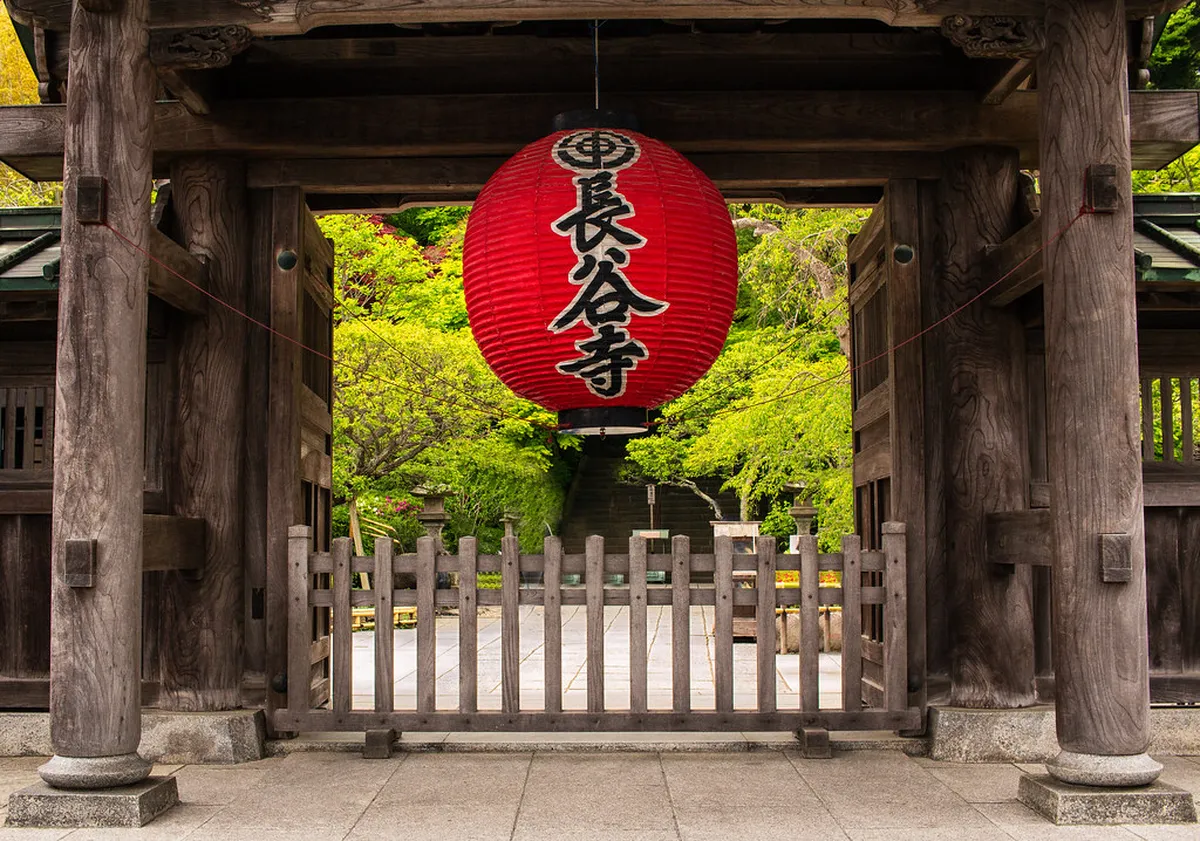
The founding legend dates to 721, when the monk Tokudo Shonin reportedly carved two statues from a single giant camphor tree near Nara. The lower half became the Kannon at Sakurai's Hase-dera. The upper half was set adrift in the sea with a prayer that it would resurface where it was meant to be enshrined. Fifteen years later, in 736, it washed ashore on the Miura Peninsula, and the Kamakura temple was founded to receive it — a founding legend documented by historians.
Photography is strictly prohibited inside the Kannon-do. The hall is dim, lit by hanging lanterns, and visitors are expected to stand on the prayer mats rather than approach the platform. The statue's gold leaf has been restored several times, most recently in the 1990s, but the carved core is original. Take a few minutes inside in silence; the scale only registers when you stop moving.
If you are comparing Hase-dera with other Kamakura icons, our Great Buddha Kamakura visiting guide covers the bronze Daibutsu at Kotoku-in, a ten-minute walk uphill. The two are usually paired in one visit and offer very different scales of devotional sculpture: monumental outdoor bronze versus enclosed gilded wood.
Exploring the Benten-kutsu Cave and Statues
Tucked into the north corner of the lower grounds, the Benten-kutsu cave is where most first-time visitors form their strongest memory of Hase-dera. A red torii marks the entrance, and inside, a low candle-lit tunnel opens onto carvings of Benzaiten, the goddess of music, water, and fortune, surrounded by sixteen of her disciples chiselled into the rock walls. The tradition links the site to Kobo Daishi, the founder of Shingon Buddhism, who is said to have practiced here in seclusion.
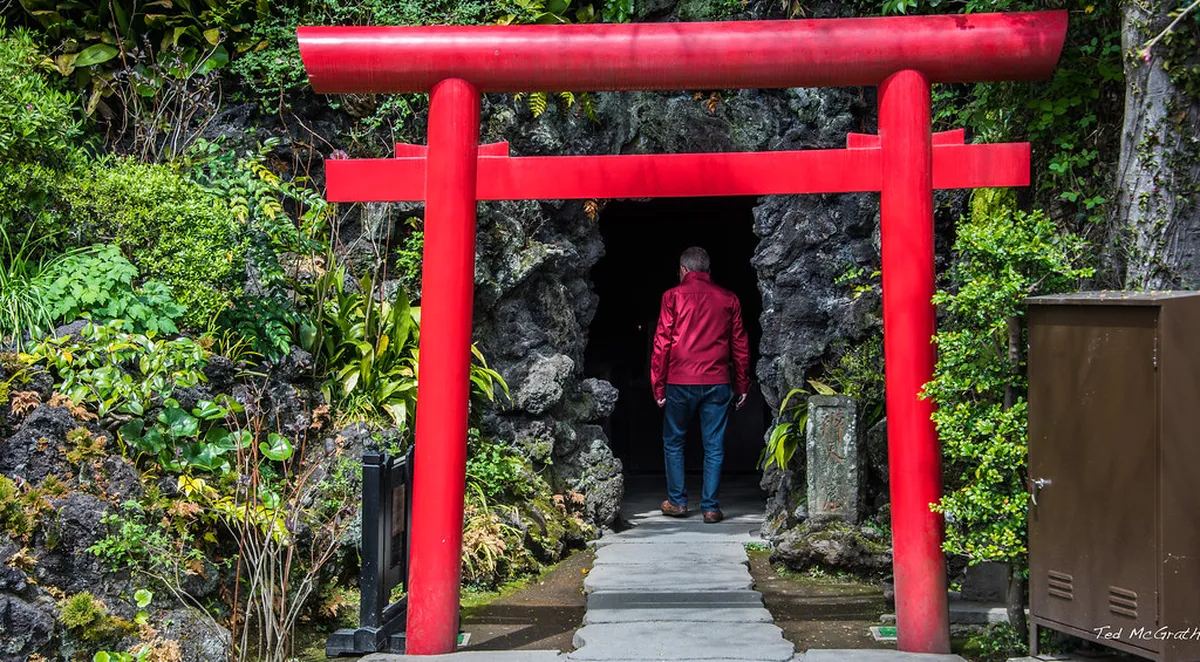
The ceilings drop low in several sections, low enough that adults around 175 cm need to duck. Visitors can buy a small wooden statue of Benzaiten holding a biwa (a long-necked lute) for 300 yen at the entrance, write their name and a wish on it, and place it on a ledge inside. Proceeds support temple maintenance, and the candles are real, so watch sleeves and long hair.
Plan ten to fifteen minutes for the cave. It sits before the climb to the upper temple, so do it on the way up rather than doubling back. Stone floors stay damp year-round, even in summer; non-slip soles matter more here than anywhere else on the grounds. Strollers and wheelchairs cannot enter the cave because of the narrow passage and steps at the entrance.
Seasonal Beauty: Gardens, Hydrangea Path, and the Bloom Calendar
Hase-dera's gardens are tended for year-round colour, not a single hero season. The lower garden surrounds two koi ponds and rotates through ume (plum), narcissus, sakura, peonies, lotus, hydrangea, hibiscus, red spider lily, autumn maples, and winter peonies wrapped in straw cloaks. Knowing what is actually in bloom on your travel date saves you from arriving for hydrangeas in May or autumn maples in October.
- January–February: ume (plum) blossoms, narcissus, straw-wrapped winter peonies.
- March–early April: sakura along the lower path; over 150 varieties of peonies opening late March.
- May: late peonies, irises along the pond edge.
- Mid-June–early July: 2,500 hydrangea bushes in 40+ varieties on the Hydrangea Path, peak bloom.
- July–August: lotus on the ponds, summer hibiscus.
- September: red spider lilies (higanbana) along the stairs.
- Mid-November–early December: maple foliage, often with evening illuminations on weekends.
- December: camellias and the first wrapped winter peonies set out.
The Hydrangea Path is the busiest single experience in Kamakura in June. The temple manages crowds with a numbered-ticket system: at the gate, you receive a separate slip with a time block (typically 60–90 minutes out) when capacity is high. You can roam the rest of the temple in the meantime; come back when your number is called over the loudspeaker. Tickets sell out by 11:00 on weekend bloom-peak days, so arrive at 8:00 opening or after 15:00 if you want to walk the path the same day. Our Kamakura hydrangea season guide has the weekday-versus-weekend timing strategy.
| Month | What's in bloom |
|---|---|
| January–February | Ume (plum), narcissus, straw-wrapped winter peonies |
| March–early April | Sakura, peonies (150+ varieties opening late March) |
| May | Late peonies, irises along the pond edge |
| Mid-June–early July | 2,500 hydrangea bushes (40+ varieties) — peak bloom |
| July–August | Lotus on the ponds, summer hibiscus |
| September | Red spider lilies (higanbana) along the stairs |
| Mid-Nov–early Dec | Maple foliage, evening illuminations on weekends |
| December | Camellias, first wrapped winter peonies |
The Enoden one-day pass (¥800) covers unlimited rides including Hase-dera, the Great Buddha, and Enoshima — it pays off after just three single-fare trips (¥200 each).
Panoramic Views from the Prospect Path
The Prospect Path runs along the upper terrace and curves down the western flank of Kannon-zan. From the observation deck beside the Main Hall, you look across Yuigahama Beach, the curve of Sagami Bay, and on a clear winter morning as far as the Miura Peninsula and the silhouette of Oshima island. The Enoden trains are visible threading between rooftops below.
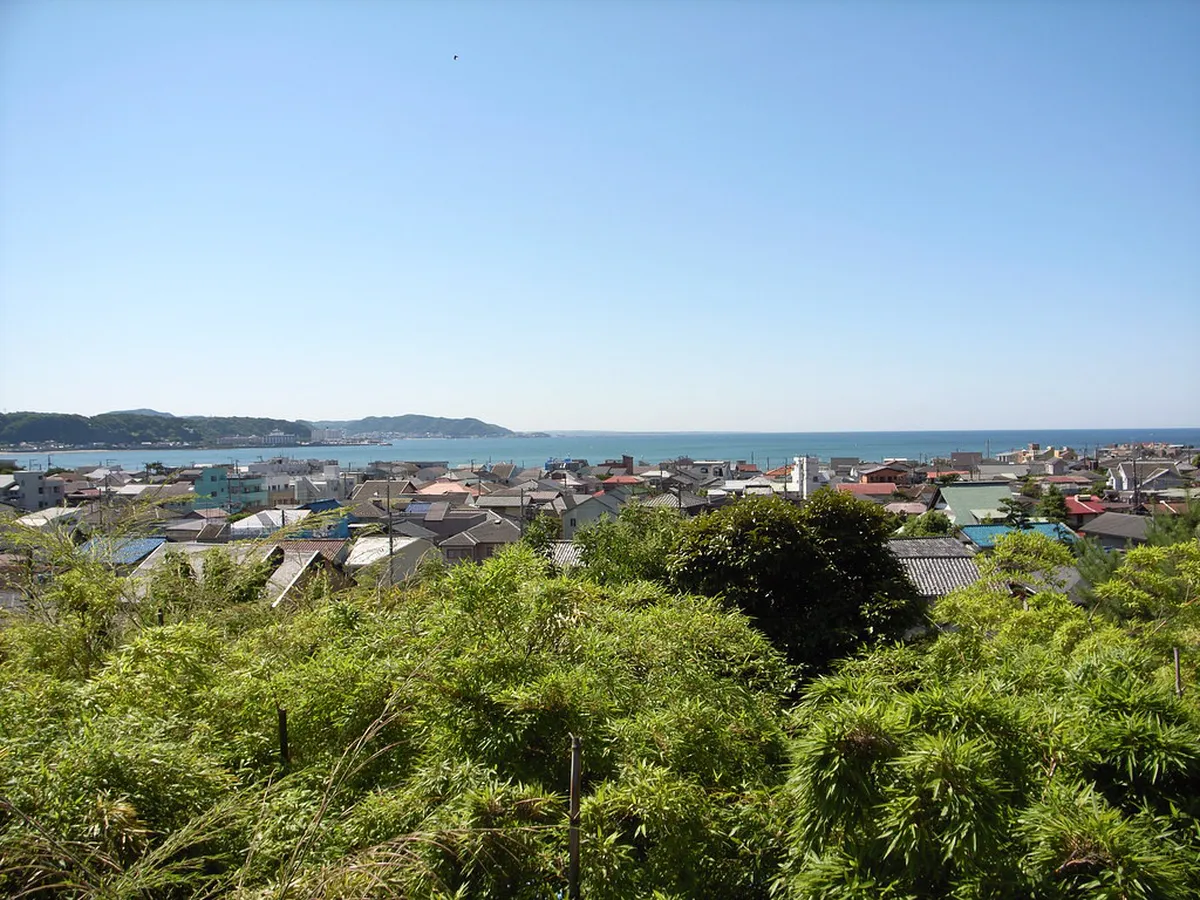
The deck has a covered bench area with benches along the edge and a small kiosk selling matcha, soft-serve ice cream, and rice crackers. It is the only seated viewpoint inside the temple grounds, so if you brought older relatives or you are simply tired from the climb, this is where to rest. Drinks are allowed on the deck but not on the path itself.
For photographers, the best light hits the bay between 14:00 and 16:00 in winter, when the sun is low enough to glance off the water without backlighting the coast. The path itself becomes the photo subject in June (hydrangeas) and late November (maples). Tripods are not permitted because the path narrows to about 1.5 metres in several spots.
Temple Grounds Highlights: Amida Hall, Jizo Statues, and the Sutra Repository
The upper terrace is a complex of three buildings rather than a single hall. The Kannon-do (Main Hall) is flanked by the Amida Hall on one side and a smaller hall housing a statue of Daikoku, one of the seven gods of fortune, on the other. The Amida Hall holds a gold-leafed seated Amida Buddha carved in 1189, commissioned by the shogun Minamoto Yoritomo to ward off misfortune as he turned forty-two, an inauspicious age in Japanese tradition.
Just outside the Main Hall stands the Shoro Belfry. The original bronze bell was cast in 1264, making it the oldest temple bell in Kamakura; the bell on display today is a faithful 1984 recasting, and the original is preserved in the Kannon Museum next door. The bell is rung at 8:00 each morning when the gates open and again on New Year's Eve for the joya-no-kane ceremony of 108 strikes.
Hundreds of small Jizo Bodhisattva statues line the staircases between the lower and upper grounds. Originally placed by parents asking the deity to protect living children, the statues today are mostly memorials for children lost to miscarriage, stillbirth, or early death. Many wear red bibs and knitted caps left by family members. Old statues are quietly retired and replaced annually, so the rows you see in 2026 are different from the rows photographed in 2018.
Most visitors miss two smaller features. The Inari shrine on the climb up is dedicated to the kakigara, the oysters that legend says clung to the floating Kannon statue and shielded it during its fifteen years at sea; the walls are covered in real oyster-shell ema (votive plaques) rather than the wooden ones you see at most shrines. Below the Prospect Path, a short bamboo grove leads to the Kyōzō, a sutra repository housing rotating wooden cylinders called rinzō. Spinning the wheel is said to grant the merit of reading every sutra inside, and you may do so on the 18th of each month and on a few feast days when the building is open. These two stops are part of the broader cluster of Kamakura attractions worth slowing down for.
Photography Rules and the Best Shots on the Grounds
Hase-dera has clear photo rules that catch a lot of visitors out, because they are not the same in every part of the complex. The Kannon-do (Main Hall), the Amida Hall, the inside of the Kannon Museum, and the Daikoku-do are all no-photo zones. Staff will politely stop you if you raise a phone or camera; flash photography is treated more seriously than ambient shots.
Everywhere outside is fine: the gardens, the Jizo statue rows, the koi ponds, the Hydrangea Path, the Prospect Path, the observation deck, the Shoro belfry, the Inari shells, and the bamboo grove around the Kyōzō. Inside Benten-kutsu cave, photos without flash are tolerated but be quick and don't block the narrow passage. Drones are prohibited across the entire site under Kamakura municipal rules.
For the strongest single image, line up the eleven-headed Kannon roof eaves against Sagami Bay from the south end of the Prospect Path; you get temple architecture and ocean horizon in one frame. Mid-June at 9:00 puts soft side-light on the blue hydrangeas without the harsh midday wash. November illumination evenings (advance ticket required) give the maples a backlit glow you cannot get during daylight.
Photography is strictly prohibited inside the Kannon-do (Main Hall), the Amida Hall, and the Kannon Museum. Staff will stop you if you raise a camera in these buildings. Outside areas including the gardens, cave, and Prospect Path are freely photographable.
Stairs, Mobility, and Practical Tips for Your Kamakura Itinerary
Hase-dera is built into a hillside, and the climb to the upper temple is roughly 60 stone steps from the lower garden, broken into two flights with a Jizo-lined landing in between. There is a small pulley-style elevator on the side of the upper terrace for visitors with mobility issues, but it is staff-operated; ask at the ticket booth on entry rather than at the top of the stairs. The elevator reaches the Main Hall and observation deck. It does not reach the Benten-kutsu cave, the Hydrangea Path, the Prospect Path, or the Kyōzō, all of which involve steps or unpaved trails.
For visitors with strollers, the lower gardens, koi ponds, and main staircase landing are accessible. The cave and the upper Hydrangea Path are not. A folding stroller works better than a full pram if you plan to visit the upper terrace by elevator.
For lunch, the temple's own restaurant, Kaikoan, sits on the upper terrace beside the observation deck. Its house dish is a vegetarian temple curry served with seasonal pickles and a small soup, around 1,300 yen, with floor-to-ceiling windows facing the bay. There is also matcha and warabi-mochi for a lighter stop. Capacity is small, so the queue forms by 11:30 on weekends; eat before noon or after 14:00. For broader options nearby, see our best restaurants in Kamakura roundup.
Plan 90 minutes for a focused visit and two hours if you include the Kannon Museum and a tea break. Pair it with the Great Buddha at Kotoku-in (8 minutes' walk uphill) for a half-day. Avoid eating or drinking while walking the prayer halls, and keep voices low near the Main Hall and the cave; the temple is an active place of worship, not an open-air museum.
Frequently Asked Questions
How much is the entrance fee for Hasedera Temple?
The standard admission fee for adults is 400 yen, while children can enter for 200 yen. You can pay using cash or major IC cards like Suica at the main gate. These fees help maintain the historic halls and the beautiful hillside gardens for all visitors to enjoy.
How do I get to Hasedera Temple from Kamakura Station?
Take the Enoden Railway from Kamakura Station and get off at Hase Station. From there, it is a well-marked five-minute walk through a charming neighborhood to the temple entrance. You can find more route options in our Kamakura day trip itinerary guide.
Is Hasedera Temple worth visiting during the rainy season?
Yes, the rainy season in June is actually the most popular time to visit the temple. This is when the famous hydrangea path is in full bloom with thousands of colorful flowers. Be prepared for large crowds and a numbered ticket system during this peak floral window.
Can you take photos inside the Kannon-do Hall?
No, photography is strictly prohibited inside the main Kannon-do Hall to maintain its sacred and quiet atmosphere. However, you are welcome to take photos of the gardens, the cave, and the coastal views from the observation deck. Please respect all posted signs regarding camera usage.
Hase-dera rewards visitors who plan around three things: the closing time on their travel date, what is in bloom that month, and whether the Kannon Museum surcharge fits the budget. Get those right and the temple delivers an unusually complete experience for the 400-yen base ticket: a monumental gilded statue, an underground grotto, an ocean panorama, and a year-round garden that very few sites in greater Tokyo can match.
The smart visit window in 2026 is early morning at 8:00 opening any month except mid-June, when arriving by 8:30 is the only reliable way to walk the Hydrangea Path the same day without a long ticket-block wait. Pair the climb with the Kotoku-in Great Buddha eight minutes uphill and you have a clean half-day from Tokyo on the Enoden line. Bring cash for the museum and good shoes for the cave; the rest is the temple doing the work.
Combine this with our main Kamakura attractions guide for a fuller itinerary.
For related Kamakura deep-dives, see our Kenchoji Temple Kamakura Travel Guide and Engakuji Temple: The Ultimate Visitor Guide to Kamakura’s Zen Landmark guides.
Free: The Kamakura Essentials guide
Top things to do, where to stay, a perfect day plan, getting around, and the best time to go — a Kamakura mini-guide you can take offline.
You might also like


Continue reading
More guides you'll find useful


