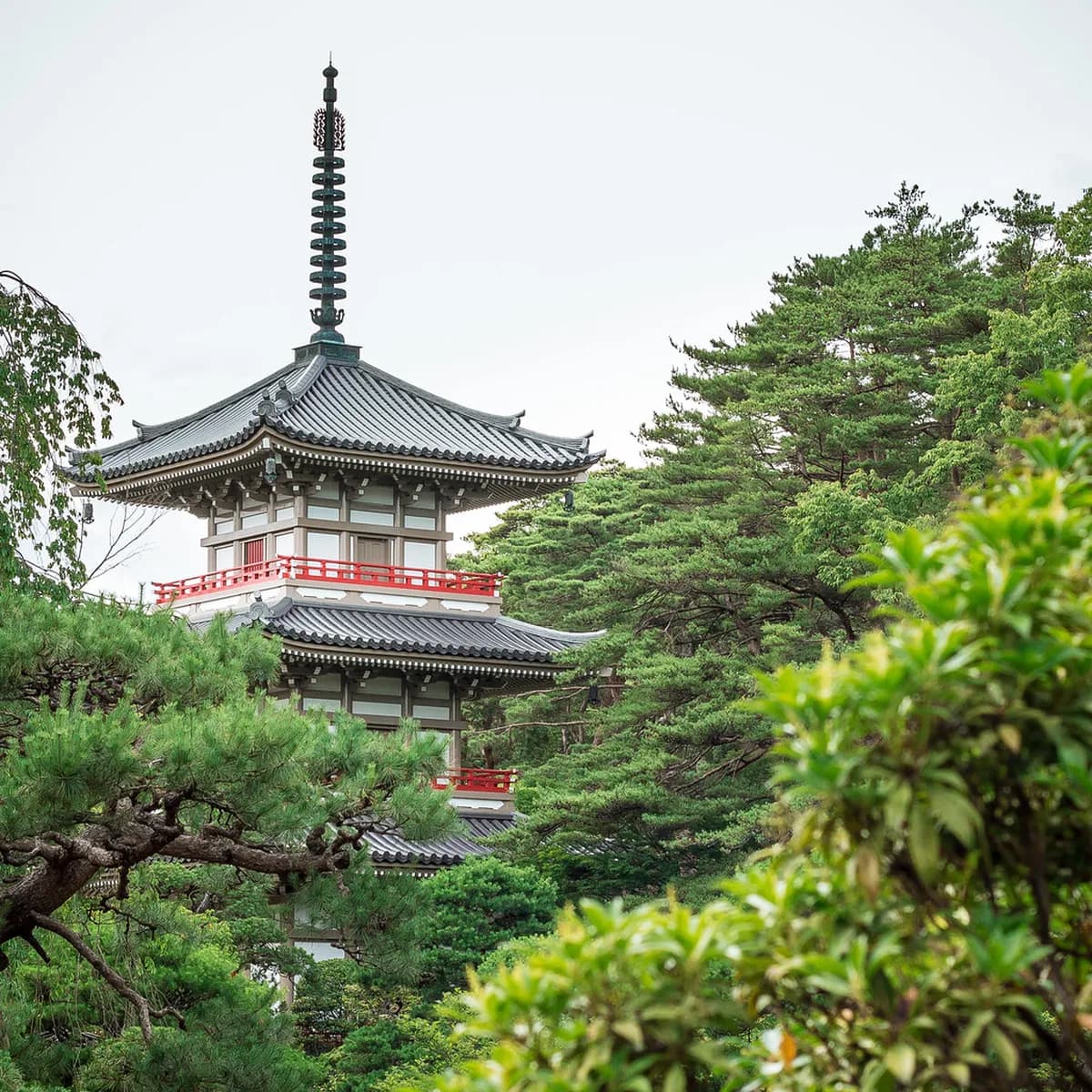
Nikko Toshogu Shrine Guide: 7 Essential Highlights and Tips
Plan your visit to Japan's most lavish shrine. Our guide covers the 7 must-see highlights of Nikko Toshogu, including the Three Wise Monkeys, tickets, and transport.
On this page
Nikko Toshogu Shrine stands as a breathtaking masterpiece of Japanese history and architecture. This UNESCO World Heritage site offers a striking contrast to the typical simplicity found in other Shinto shrines. Visitors often feel overwhelmed by the intricate gold leaf and vibrant wood carvings covering every surface. It serves as the final resting place for Tokugawa Ieyasu, the founder of the Tokugawa Shogunate.
Exploring the toshogu shrine nikko complex requires a blend of historical appreciation and practical planning. The site features 55 buildings (eight of them National Treasures) nestled within a dense forest of ancient cedar trees. Each structure tells a story of power, artistry, and spiritual devotion from the early Edo period. This guide gives you the seven highlights to anchor your visit, plus the transport, ticket, and timing details that change a chaotic morning into a smooth one in 2026.
The History and Legacy of Tokugawa Ieyasu
Tokugawa Ieyasu founded the Tokugawa Shogunate after winning the Battle of Sekigahara in 1600 and was named Shogun by Emperor Go-Yozei in 1603. His dynasty ruled Japan for more than 250 years, the era we now call the Edo period. When Ieyasu died in 1616 he was first interred in a modest mausoleum on this hillside; his grandson Iemitsu, the third shogun, rebuilt it in 1636 into the lavish complex you see today, mobilizing roughly 15,000 craftsmen and a budget that would dwarf most modern construction projects.
The shrine reflects Ieyasu's transformation from human leader into deity. He was posthumously enshrined as Tosho Daigongen, the Great Deity of the East Shining Light. That apotheosis cemented the divine right of the Tokugawa family to rule and tied their legitimacy to a sacred mountain north of Edo (modern Tokyo) — a direction Japanese geomancy treated as the gate that protected the capital from misfortune.
Most traditional Shinto shrines favor untreated wood and restrained design. Toshogu deliberately breaks that convention with gold leaf, vermilion lacquer, and over-the-top wood carving. The lavishness was the point: the shogunate wanted regional lords visiting Nikko to feel the weight of central power before they returned home. It remains one of the most decorated religious sites in the world and is a centerpiece of the UNESCO World Heritage Shrines and Temples of Nikko, inscribed in 1999.
Getting to Toshogu Shrine: Bus Routes and Walking Paths
Most travelers begin with a train from Tokyo to either Tobu-Nikko or JR Nikko Station — the two stations sit two minutes apart in central Nikko town. Reviewing How To Get To Nikko From Tokyo: 10 Essential Travel Tips in advance saves time and money, especially if you are weighing the Tobu Spacia X limited express against cheaper local connections. From either station, the World Heritage Sightseeing Bus loops through every major site in the central area and runs every 10 to 30 minutes depending on season.
You have a strategic choice between two stops. Get off at stop 7 (Shinkyo Bridge) if you want to photograph the iconic vermilion bridge first and walk uphill through Rinnoji Temple toward Toshogu — this is the slower, scenic ascent. Stay on until stop 83 (Omotesando) if your goal is to beat the tour-bus wave at the shrine itself; you arrive at the cedar-lined approach within a two-minute walk of the ticket office. Most travelers do stop 83 inbound and stop 7 outbound, which combines crowd-avoidance with a downhill stroll back to the station. Confirm timings on the Tobu Bus Nikko Route Map before you go.
Walking the full distance from the station to the shrine takes roughly 35 to 45 minutes along a steady uphill grade through the souvenir-lined town. It is pleasant in spring or autumn but punishing in summer heat or winter ice. A common compromise: bus up, walk down. The descent is downhill, well-marked, and lets you stop for yuba (Nikko's signature tofu skin) at the shops along Inari River without losing time on the climb.
The Nikko All Area Pass and the cheaper Nikko World Heritage Area Pass both cover round-trip Tobu rail from Asakusa plus unlimited buses, but they differ in geographic scope. The World Heritage Area Pass is enough if you are only visiting Toshogu, Rinnoji, and Futarasan — it costs roughly half of the All Area Pass. Choose the All Area Pass only if you plan to continue up to Lake Chuzenji or Kegon Falls. Activate it at the Tobu-Nikko Tourist Center before boarding your first bus.
Iconic Wood Carvings: The Monkeys and the Sleeping Cat
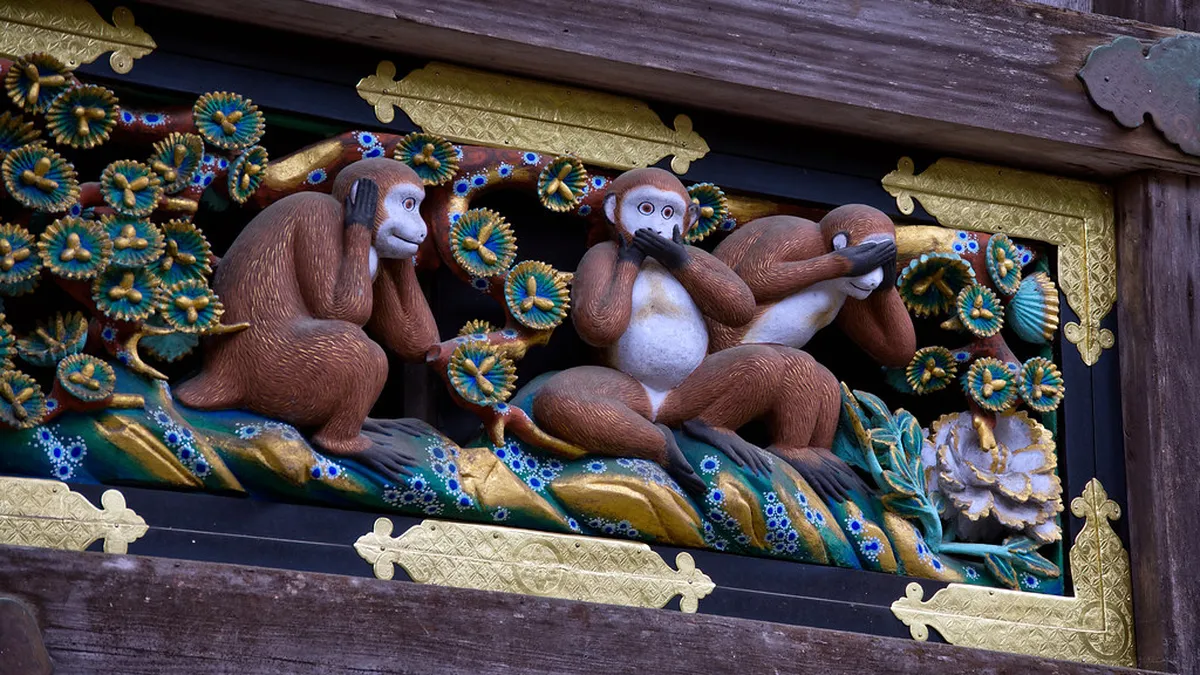
The Sacred Stable (Shinkyusha) carries the world-famous Three Wise Monkeys panel — Mizaru (see no evil), Kikazaru (hear no evil), and Iwazaru (speak no evil). What guidebooks rarely tell you is that these three are part of a sequence of eight panels tracking a monkey's life cycle, from infancy through old age. Walk the full length of the stable and read them in order; the famous trio represents the childhood phase, when adults shield children from corrupting influences. Toshogu is also the birthplace of the saying — the Japanese verb endings -zaru double as a pun on saru, the word for monkey.
The Three Sacred Storehouses opposite hold the Sozonozo Elephants, carved by the master artist Kano Tanyu in the 1630s. Tanyu had never seen a real elephant; he worked entirely from secondhand descriptions and his own imagination. The result has bushy tails, splayed ears, and unmistakably feline claws. Treat them as a charming Edo-era game of telephone rather than a zoological failure — they tell you something about how isolated Japan was during the early shogunate.
The Sleeping Cat (Nemuri-neko) sits above the gate that leads to the inner shrine, carved by the legendary Hidari Jingoro. Look closely: the cat appears to be napping, but its paws are tensed and its body coiled — it is ready to pounce. On the reverse side of the same beam, sparrows play unmolested. The pairing symbolizes the Tokugawa peace, an era so secure that even predators could nap while prey danced behind them. The carving is small and easy to miss; it sits about three meters above the path, so look up.
Thousands of additional carvings hide across the eaves, pillars, and gates. Spot dragons, phoenixes, kirin (Chinese unicorns), the imaginary giraffes, and even tigers chosen because Ieyasu was born in the year of the tiger. Each animal carries specific symbolism in Sino-Japanese mythology, and the sheer density rewards a slow lap with binoculars or a zoom lens.
The Yomeimon Gate and Architectural Highlights
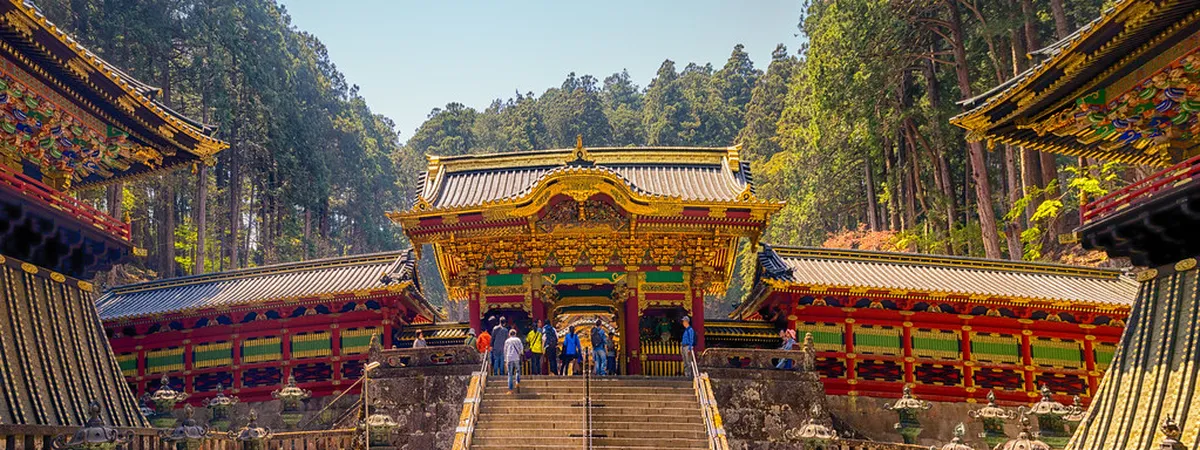
The Yomeimon Gate is widely considered the most beautiful gate in Japan and is designated a National Treasure. It carries 508 individual wood carvings of dragons, mythical beasts, Chinese sages, and cheerful musicians. Locals nicknamed it the Higurashi-no-mon ("Sunset Gate") on the theory that you could stand and stare at it until dusk without ever exhausting the detail. After a six-year restoration that wrapped in 2017, the gilding and pigments are now closer to the original 17th-century appearance than at any time in living memory.
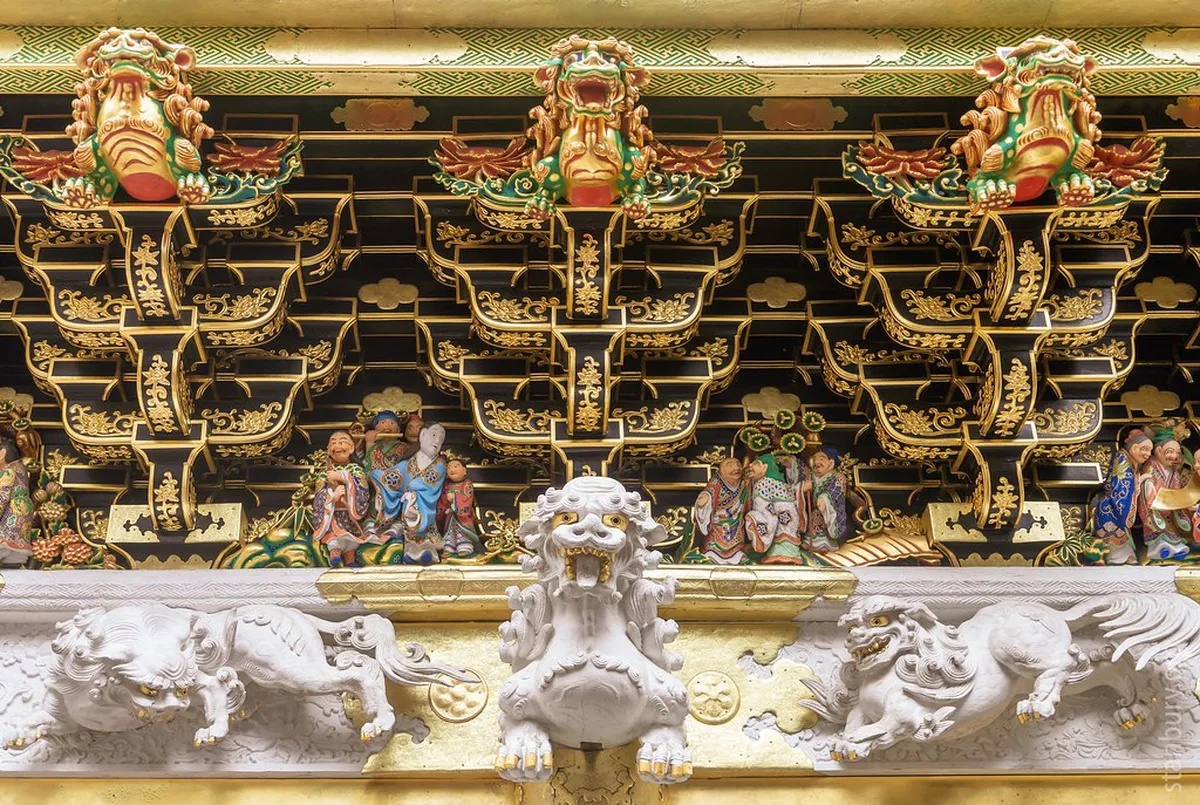
Look at the white pillars on the gate's north face. One of them — the third from the left as you enter — has its grain pattern intentionally inverted. This is the Ma-yoke no Gyaku-bashira, the "evil-warding upside-down pillar." Edo-period belief held that perfection invited the jealousy of the gods, which would then trigger decay; by leaving the gate one element shy of perfect, the builders bought it eternal protection. For photography, the best Yomeimon shots come from the bottom of the staircase looking up at a slight angle around 09:30 to 10:30, when sunlight catches the gold without overexposing the white pillars. Avoid the center of the staircase — that is the most-trafficked angle and you will rarely get a clean frame.
The Yakushido Hall (also called Honjido) hosts the famous Crying Dragon (Nakiryu). A 6-meter dragon is painted across the ceiling, and a resident monk demonstrates the room's acoustic trick: he claps two wooden blocks together, first away from the dragon's head — silence — then directly beneath its mouth, where the parallel walls and shaped ceiling produce a sharp metallic echo that genuinely sounds like a cry. The phenomenon is a standing-wave effect; the room functions like a tuned cavity. Photography and video are forbidden inside, and visitors must stay silent so the demonstration is audible. Plan three to five minutes here and treat it as a separate stop, not a hallway pass-through.
The five-story pagoda flanking the front entrance is another quiet feat of engineering. Its central pillar (shinbashira) is suspended from chains rather than fixed to the ground, allowing the pagoda's stories to sway out of phase during earthquakes — a passive damping system that contemporary skyscraper engineers have studied and adapted. The pagoda was rebuilt in 1818 after lightning destroyed the 1650 original, but the suspension principle is original.
Visiting the Inner Shrine and Mausoleum
Arrive at Toshogu by 08:50 to be among the first through the gate. Tour buses begin disgorging passengers around 10:30, and by 11:00 the Yomeimon staircase is shoulder-to-shoulder. The Inner Shrine climb to Ieyasu's tomb takes 25–35 minutes round-trip and closes 30 minutes before the main gate.
Reaching Ieyasu's tomb requires climbing 207 stone steps starting just past the Sleeping Cat gate. The path winds through a quiet cedar grove that feels worlds away from the gilded courtyard below. The grade is steady rather than steep, but the steps are uneven and slick after rain — wear shoes with grip. Allow 25 to 35 minutes round-trip including time at the top.
You pass through a massive bronze torii before reaching the mausoleum itself, a simple bronze urn sealed inside a small enclosure. Ieyasu was buried here on April 15, 1617, exactly one year after his death, and the urn has remained undisturbed since. The understated design is intentional — Edo-period burial protocol kept the actual grave plain, while reserving the lavish display for the public-facing structures below. Many visitors call this section the most spiritually moving part of the complex precisely because it is so quiet.
A small subordinate shrine at the top sells charms (omamori) tied to longevity and protection from misfortune. The cat-themed amulets reference Hidari Jingoro's Nemuri-neko and are popular with families. Vending machines selling green tea and water sit just beyond the shrine — useful in summer when the climb leaves you parched.
The descent gives you angles on the rooflines you cannot see from below, with gold leaf glinting through the cedar canopy. Avoid scheduling the inner-shrine climb at the very end of your visit if you have a return train — losing track of time at the top is common. Aim to be back at the main courtyard by your 90-minute mark to leave room for the Crying Dragon demonstration.
Practical Tips: Tickets, Hours, and Best Time to Visit
Toshogu sells four ticket variants in 2026 and the counter is cash-only Japanese yen — no cards, no IC, no foreign currency. Bring physical bills before you arrive; the nearest reliable ATMs are at the post office near Tobu-Nikko Station, not at the shrine itself. Confirm current pricing on the Official Toshogu Shrine Website (English) before you travel.
The Toshogu ticket counter is cash-only Japanese yen — no cards, no IC cards, no foreign currency. ATMs are at the post office near Tobu-Nikko Station, not at the shrine. If you purchased a ticket through Klook, GetYourGuide, or Tobu Top Tours, exchange your voucher at the Tobu-Nikko Station Tourist Center before boarding the bus — the shrine gate cannot exchange vouchers.
| Ticket Type | Adult Price | What's Included |
|---|---|---|
| Shrine entry only | ¥1,600 | Main precinct, Yomeimon Gate, Yakushido (Crying Dragon), Sleeping Cat, mausoleum climb |
| Shrine + Toshogu Museum combo | ¥2,400 | Best value; adds Ieyasu's armor and personal effects |
| Toshogu Museum only | ¥1,000 | Historical artifacts |
| Toshogu Art Museum | ¥800 | Painted screens; skip if under 3 hours total |
- Shrine entry only: ¥1,600 adult, ¥550 child — covers the main precinct, Yomeimon Gate, Yakushido (Crying Dragon), Sleeping Cat, and the climb to the mausoleum.
- Combo ticket (Shrine + Toshogu Museum): ¥2,400 adult — best value if you want to see Ieyasu's armor and personal effects.
- Toshogu Museum only: ¥1,000 adult.
- Toshogu Art Museum: ¥800 adult — separate building with painted screens; skip if you have under three hours total.
Opening hours are 09:00 to 17:00 from April through October and 09:00 to 16:00 from November through March. Last entry is 30 minutes before closing. Arrive at 08:50 to be among the first through the gate; tour buses begin disgorging passengers around 10:30, and by 11:00 the Yomeimon staircase is shoulder-to-shoulder. The Best Time to Visit Nikko: Seasonal Guide & Weather Tips for clear weather is May or late October, when humidity is low and the cedar forest is either bright green or framed by autumn maples.
Two festivals are worth scheduling around. The Spring Grand Festival on May 17 and 18 reenacts the procession that carried Ieyasu's spirit from Sumpu to Nikko — the centerpiece is the Sennin Musha Gyoretsu, a parade of 1,000 samurai-armored marchers winding through the shrine grounds. The Autumn Grand Festival in mid-October repeats a smaller version. Both swell crowds dramatically; book lodging at least three months out and expect ticket queues to add 30 to 45 minutes. If you prefer the shrine quiet, target a weekday in early June or early November and skip those festival dates.
Online Vouchers and the Taiyuin Mausoleum Clarification
If you bought a Toshogu ticket through Klook, GetYourGuide, Tobu Top Tours, or Trip.com, your email confirmation is a voucher, not a ticket. You must exchange the voucher for a physical paper ticket at the Tobu-Nikko Station Tourist Center before you board the bus to the shrine. The shrine entrance gate cannot exchange vouchers, and travelers regularly arrive at the ticket counter only to be sent back down the hill. The exchange takes two minutes if you have your QR code or booking number ready, so build that single station-stop into your plan and you avoid an hour-plus round trip.
A second navigation trap to know about: roughly 200 meters past Toshogu's exit sits Taiyuin, the mausoleum of Ieyasu's grandson Iemitsu — the shogun who actually built Toshogu in 1636. Taiyuin is often confused with Toshogu in maps and signage because both are Tokugawa mausolea, but Taiyuin requires a separate ticket (¥550), is significantly less crowded, and arguably has more refined carving work than its more famous neighbor. If your itinerary lists "Tokugawa mausoleum" without specifying which, double-check the kanji or address; ending up at the wrong site costs an extra 20 minutes of backtracking. For visitors with three hours or more, the Toshogu plus Taiyuin pairing tells the full story of the dynasty better than Toshogu alone.
Beyond the Shrine: Exploring Central Nikko
Nikko packs several major sites within walking distance of the Toshogu complex. The Shinkyo Bridge, a vermilion arched bridge crossing the Daiya River, marks the historical entrance to the sacred area and is one of Japan's three most famous bridges; expect five minutes to photograph it from the public viewpoint (free) or pay ¥300 to walk across. Rinnoji Temple sits between the bridge and Toshogu and houses three towering golden Buddha statues in its main Sanbutsudo Hall — pair it with the shrine for a complete morning. You can find more Nikko Attractions: 20 Must-See Sights & Things to Do across the wider area.
Futarasan Shrine is older than Toshogu and feels like a different planet — moss-covered stone lanterns, towering cedars, no gold leaf in sight. It is a 90-second walk from Toshogu's exit and shares the UNESCO inscription. Visiting both back-to-back gives you the full architectural range of Edo-period Shinto, from austere to ornate, in under three hours of walking time.
Many travelers find a two-day Nikko itinerary ideal: Day 1 covers the World Heritage cluster (Toshogu, Rinnoji, Futarasan, Taiyuin) and Day 2 ascends to the mountain area for Kegon Falls and Lake Chuzenji. Staying overnight unlocks ryokan dinners, onsen, and the chance to walk the temple grounds at dusk after day-trippers leave. See Where to Stay in Nikko: 6 Best Areas and Lodging Guide for ryokan and hotel picks across price ranges.
If you only have one day, a Nikko Day Trip From Tokyo: The Ultimate 1-Day Itinerary still works — focus the morning on Toshogu and Shinkyo Bridge, eat yuba for lunch in town, and catch the 16:00 train back. Yuba (delicate dried tofu skin) is Nikko's signature food, originating from the area's Buddhist vegetarian temple cuisine; try it sashimi-style at a sit-down lunch or rolled into yuba-maki at the takeaway shops along Nikko's main street.
Frequently Asked Questions
Is Nikko Toshogu Shrine worth it?
Yes, the shrine is absolutely worth visiting for its unique architectural style and historical importance. It features the most intricate wood carvings in Japan and serves as a major UNESCO World Heritage site. Most travelers find the level of detail far exceeds other traditional shrines.
How do I get from Tokyo to Nikko Toshogu Shrine?
You can take the Tobu Railway from Asakusa Station or the JR line from Tokyo Station. Once in Nikko, board the World Heritage Sightseeing Bus to reach the shrine entrance. The total journey typically takes about two to three hours each way.
How long does it take to walk through Toshogu Shrine?
Most visitors spend between two and three hours exploring the main buildings and the inner shrine. This includes time to see the famous carvings and climb the stairs to the mausoleum. If you visit the museum, plan for an additional hour. Consider a Nikko Itinerary: 1-Day, 2-Day & 3-Day Plans for better timing.
What are the famous carvings at Nikko Toshogu?
The most famous carvings include the Three Wise Monkeys, the Sleeping Cat, and the Imaginary Elephants. There are also over 500 carvings on the Yomeimon Gate alone. These artworks represent a mix of moral lessons, mythical stories, and prayers for national peace.
Toshogu Shrine Nikko remains one of the most significant cultural landmarks in all of Japan. Its blend of Shinto and Buddhist elements, layered onto the political theater of the early Edo period, creates an atmosphere found nowhere else in the country. From the gilded gates to the quiet cedar paths above the mausoleum, every corner rewards a slower pace and a careful eye.
Plan around the cash-only ticket counter, exchange any online vouchers at Tobu-Nikko Station before you ride up, and arrive by 09:00 to enjoy the Yomeimon Gate before the tour-bus tide arrives. Whether you are a history reader, a photographer, or a first-time visitor to Japan, Toshogu earns its reputation — and the brief detour to Taiyuin next door is what separates a good visit from a memorable one.
Free: The Nikko Essentials guide
Top things to do, where to stay, a perfect day plan, getting around, and the best time to go — a Nikko mini-guide you can take offline.
You might also like


Continue reading
More guides you'll find useful