Sankeien Garden Yokohama Guide: 10 Essential Tips & Highlights
Master your visit with our Sankeien Garden Yokohama guide. Includes 10 essential tips on bus routes, seasonal photography spots, and historic tea houses.
On this page
Sankeien Garden spreads across 17.5 hectares of pondside paths, hillside groves, and seventeen relocated heritage buildings on the southern edge of Yokohama. It is the quietest major attraction in the city and the only one in the Kanto region that lets you walk through a 15th-century pagoda, a Tokugawa-era villa, and an Edo-period farmhouse on the same loop. Most first-time visitors lose 30 to 40 minutes to bus confusion before they even reach the gate. Planning a yokohama day trip from tokyo around Sankeien works best when you treat the transit as part of the itinerary, not an obstacle.
This 2026 guide covers what you actually need: opening hours, fare specifics, the right bus from each station, the historic buildings worth slowing down for, and the seasonal windows that justify a special trip. The brief was built against the five top-ranking pages currently published on Sankeien, so the structure mirrors what searchers are clicking and the gaps where most guides fall short.
Quick Facts: Sankeien Garden at a Glance
Use this snapshot to settle the basics before you read further. Every figure here is current for 2026 and matches the official Sankeien notices, but always reconfirm hours during festival weeks when the closing time stretches into the evening.
- Address: 58-1 Honmokusannotani, Naka-ku, Yokohama, Kanagawa 231-0824
- Hours: 09:00 to 17:00 daily; last entry 16:30
- Closed: 26 to 31 December
- Admission: 900 yen adults, 200 yen children, free for under-6
- Area: 17.5 hectares with 17 designated heritage buildings, three of them Important Cultural Properties
- Parking: 500 yen per day, weekends fill before 10:00 in sakura and koyo seasons
- Typical visit: 2 to 3 hours; allow 3.5 hours with a tea ceremony
- Official site: sankeien.or.jp/en
What is Sankeien Garden? History and the Silk-Trade Story
Sankeien opened to the public in 1906 as the private project of Hara Tomitaro, a Gifu-born businessman who took the artistic name Sankei. He inherited his adoptive family's silk-export trading house in Yokohama just as raw silk became Meiji Japan's largest single export. By 1900, Hara was supplying European mills directly from the Yokohama docks, and the profits funded a personal collection of architecture, painting, and tea-ceremony culture that rivalled any in the country.
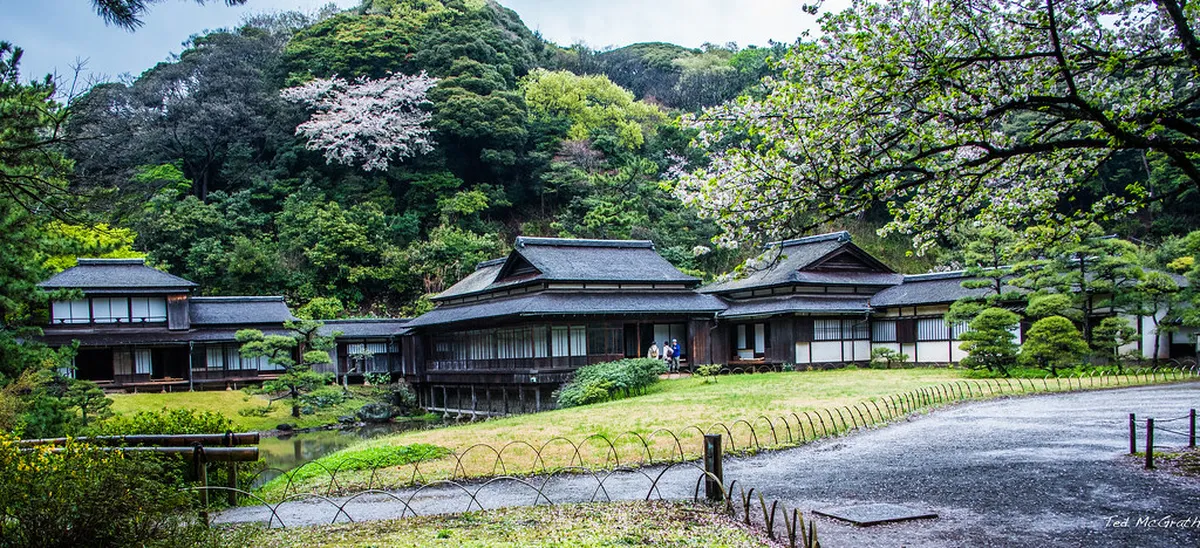
The silk-trade context matters because it explains the scale. Hara did not merely buy a few tea houses; he had entire buildings dismantled in Kyoto, Kamakura, and Gifu, shipped to Yokohama by rail and barge, and reassembled on the hillside above Honmoku Bay. The Three-Story Pagoda of Old Tomyo-ji was moved from a Kyoto mountainside in 1914. The Rinshunkaku villa, originally built for the Kishu branch of the Tokugawa family, arrived in pieces from Wakayama in 1917. The garden became a working preservation project decades before Japan had a national heritage register.
Hara also used the garden as a salon. Painters including Yokoyama Taikan and Shimomura Kanzan stayed in the Inner Garden buildings, and the tea master Sen Sosa held ceremonies in Rinshunkaku. When Hara died in 1939 his family donated the estate to the city; the Outer Garden opened first, and the Inner Garden followed after post-war restoration. The whole complex is now managed by the Sankeien Hoshokai foundation, which charges the 900-yen admission to fund ongoing roof, thatching, and structural work — far less than comparable heritage gardens in Kyoto.
Essential Visitor Information: Hours, Fees, and Best Time to Visit
The gates open at 09:00 and the ticket office stops selling at 16:30. The 900-yen adult ticket covers both gardens, the heritage buildings open that day, and the small art gallery in the Sankei Memorial Hall. Children pay 200 yen, and seniors who can show a Yokohama city residence card pay 700 yen on weekdays. Cash and major IC cards both work at the entrance, though the small in-garden tea houses are cash-only.
Three windows each year override the standard hours. During the cherry blossom illumination in late March and early April, closing extends to 20:30. The autumn koyo light-up in late November and early December runs to 19:30. The early-summer "Hayaake Sankeien" lotus mornings push the opening to 06:00 on selected July weekends. These extensions are announced on the official site about six weeks ahead.
For weather and crowds, the most comfortable months are late April through early June and mid-October through late November. Mid-summer can hit 33 to 35 C with high humidity; carry water and use the shaded paths in the Inner Garden. Checking the best time to visit yokohama alongside the bloom calendar below helps you pick a date that fits both climate and seasonal interest.
The garden closes 26–31 December every year. During the sakura and koyo illumination seasons the gates stay open until 20:30 and 19:30 respectively — check the official site around six weeks before your visit as dates shift each year.
How to Get to Sankeien Garden Without Bus Stress
Sankeien sits in Honmoku, a residential ward two kilometres from the nearest train station, so every approach ends in a bus or taxi. The most common first-timer mistake is boarding a Sakuragicho-bound JR train from Tokyo, which forces a transfer; trains marked for Negishi or Ofuna run straight through. From Tokyo Station the Keihin-Tohoku Line to Negishi takes about 45 minutes and costs 580 yen.
From Yokohama Station East Exit, the Yokohama Municipal Bus routes 8 and 148 leave bus stop number 2 and reach Sankeien-iriguchi in 35 minutes for 220 yen. From Motomachi-Chukagai Station on the Minatomirai Line, walk to the Yamashita-cho stop and take routes 8 or 148 for 15 minutes. On weekends and public holidays, the dedicated Burari-Sankeien Bus drops passengers at the closer Honmoku stop with no transfer, which trims roughly five minutes of walking. Detailed timetables are published by the Yokohama City Burari-Sankeien Bus page.
Compare the options before you board, because the cheapest route is not always the fastest in peak season. A taxi from Negishi Station costs about 1,200 to 1,500 yen and takes 8 minutes, which often beats a 30-minute bus queue on sakura weekends. Learning how to get to yokohama from tokyo before you choose a station saves time on the Tokyo leg.
- Burari-Sankeien Bus: Yokohama Station East stop 2, weekends and holidays only, 35 minutes, 220 yen, drops at Honmoku (2-minute walk).
- Municipal Bus 8 or 148: Yokohama Station East stop 2, runs daily every 10 to 15 minutes, 35 minutes, 220 yen, drops at Sankeien-iriguchi (5-minute walk).
- Municipal Bus 58, 99 or 101: JR Negishi Station stop 1, runs daily, 10 minutes, 220 yen, drops at Honmoku (10-minute walk).
- Municipal Bus 8 or 148 from Motomachi-Chukagai: Yamashita-cho stop, 15 minutes, 220 yen, useful if you start the day in Chinatown.
- Taxi from Negishi Station: 8 minutes, 1,200 to 1,500 yen, best fallback on crowded sakura and koyo weekends.
Exploring the Outer Garden: Pond, Pagoda, and Farmhouses
The Outer Garden opens directly past the ticket gate and contains most of the attractions casual visitors photograph. A large central pond reflects the hillside above, and a single counter-clockwise loop covers the major buildings in about 75 minutes. Walking shoes matter; the surface is gravel and packed earth with low steps near the pagoda climb.
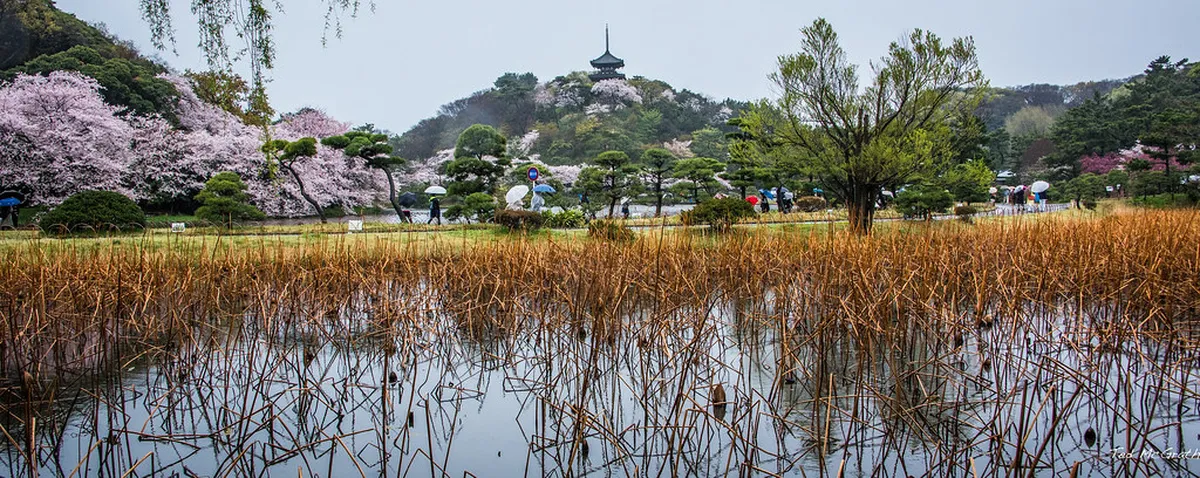
The Three-Story Pagoda of Old Tomyo-ji is the visual anchor. Built in 1457 and moved here in 1914, it sits on the hilltop and shows in almost every pond reflection. The Former Yanohara Family Residence, a thatched gassho-style farmhouse relocated from the Hida region of Gifu, sits below the pagoda and is open to walk inside; the central irori hearth is often lit on winter mornings. The Old Tomyo-ji Main Hall, the Rindo-an tea house, and the Yokobue-an mark the remaining stops on the Outer loop.
Allow time for two side paths most visitors miss: the climb to the pagoda viewpoint above the pond, which gives the only elevated angle in the garden, and the short trail to the Tenju-in shrine near the southern fence, which is usually empty even in peak season. Both add about 20 minutes round trip.
The Inner Garden: Rinshunkaku and the Tea Houses
The Inner Garden was Hara Sankei's personal residential compound and remains the more refined half of the visit. It is reached by a separate gate beyond the central pond and feels noticeably quieter; the paths narrow, the buildings cluster more tightly, and the planting shifts from broad seasonal sweeps to controlled mossy details.
Rinshunkaku is the highlight and a designated Important Cultural Property. Built in 1649 for the Kishu Tokugawa, it shows the sukiya-zukuri style at its most refined: sliding paper doors stacked four deep, asymmetric tatami rooms, a study with a moon-viewing window over the inner stream. The interior is open to walk through during the spring and autumn special openings, which the foundation announces six to eight weeks in advance.
The Choshukaku tea pavilion, a small Tokugawa-era retreat moved from Kyoto's Nijo Castle grounds, and the Kinmokutsu, a thatched hermitage with a single-mat tea room, complete the Inner Garden's main loop. Both buildings are normally viewed from the exterior, but interior tea ceremonies are occasionally held in Kinmokutsu during plum-blossom season. The Tenzui-ji Juto Oido, a Momoyama-period memorial hall behind Rinshunkaku, marks the back of the loop.
Seasonal Highlights and the Month-by-Month Bloom Calendar
Sankeien is a year-round garden, and the foundation deliberately staggers plantings so that something is in bloom or in colour every month. The four moments most worth a special trip are plum in February, cherry in late March, lotus in July, and maple in late November. Plum is the underrated choice because crowds are roughly a quarter of sakura levels and the air is cold enough to keep photographs crisp.
The two illumination seasons, sakura and koyo, are the busiest. If you can only visit on a weekend during these windows, arrive by 09:00 or after 17:00 for the light-up; the middle hours bring tour groups from Yokohama Station. Lotus mornings in July open at 06:00 on roughly four Saturdays and Sundays; the blooms close by 10:00 so the early start is mandatory.
- February: Plum blossoms across the Outer Garden hillside. Low to moderate crowds, white and pink varieties, 2 to 3 weeks of peak colour.
- Late March to early April: Cherry blossoms around the central pond with evening illumination until 20:30. Very high crowds, 7 to 10 days of peak, classic pagoda reflection shot.
- May: Wisteria along the Inner Garden trellises and azalea on the hill paths. Light crowds, comfortable temperatures.
- July: Morning lotus in the central pond, 06:00 openings on selected weekends. Moderate early crowds, blooms close by mid-morning.
- August: Evening firefly viewing on selected dates, hosted in the Inner Garden streams. Ticketed, advance reservation.
- October: Higanbana red spider lilies and early ginkgo near the south fence.
- Late November to early December: Maple and ginkgo koyo with evening illumination until 19:30. High weekend crowds, 3 to 4 weeks of colour.
- January: Wintersweet and early plum buds, plus New Year tea ceremonies in the Sankei Memorial Hall.
| Season | Bloom / Event | Typical Window | Crowd Level |
|---|---|---|---|
| February | Plum blossoms | Early–late Feb | Low–moderate |
| Late March – early April | Cherry blossoms + evening illumination (until 20:30) | 7–10 days peak | Very high |
| May | Wisteria & azalea | Early–mid May | Light |
| July | Morning lotus (06:00 openings, selected weekends) | 4 weekends | Moderate early |
| Late Nov – early Dec | Maple & ginkgo koyo + illumination (until 19:30) | 3–4 weeks | High weekends |
Cultural Experiences: Matcha, Festivals, and In-Garden Dining
The Sankei Memorial Hall, just past the main entrance, runs a casual matcha service for 700 yen including a seasonal wagashi sweet. No reservation is needed for the standard service, which seats 12 at a time around a low counter. The full tea ceremony in Rinshunkaku or Kinmokutsu happens roughly six times a year, costs 3,500 to 5,000 yen, and books out four weeks ahead through the foundation's online form.
Festivals follow the bloom calendar. The early-March Plum Blossom Festival features koto and shakuhachi performances on the pond stage; the May Children's Day display puts samurai armour in Rinshunkaku; the August Bon Odori weekend brings yatai food stalls to the Outer Garden lawn. Most events are included in the standard admission.
For food inside the garden, three small shops serve a limited menu: Sankeien Saryo near the entrance pours matcha sets and Hara-Sankei-branded sweets, Taishunken on the central pond does soba and udon from 11:00 to 15:00, and Sangen-ya near the Inner Garden gate sells dango skewers and oden in winter. None take reservations and all close by 16:00, so plan a proper lunch in Chinatown or Minato Mirai before or after.
Photography Cheat Sheet: Where the Iconic Shots Are
Five spots account for almost every published photograph of Sankeien. Knowing them in advance lets you work the light instead of wandering for it. The pond surface goes glassy roughly 30 minutes after dawn and again 30 minutes before closing; both windows give the cleanest pagoda reflections.
- The southwest corner of the central pond, level with the second stone lantern from the main path, is the classic mirror shot of the Three-Story Pagoda. A 35mm to 50mm focal length frames the pagoda with its full reflection.
- The pagoda viewpoint at the top of the hill trail, reached by the stone steps behind the Yanohara farmhouse, is the only elevated angle. Telephoto compression at 85mm pulls the pagoda over the pond against the distant Yokohama port cranes.
- The wooden bridge between Choshukaku and Kinmokutsu in the Inner Garden delivers the painterly maple shot in late November; aim from the east side with the building roof as the foreground frame.
- The Yanohara farmhouse interior, with the irori hearth in the foreground and the open shoji as a backlit frame, works best on overcast winter mornings when the smoke catches the soft light.
- The lotus stage on the east bank of the central pond is set up before each July lotus morning; arrive by 06:30 to get a tripod spot near the railing before the queue forms.
The small in-garden tea houses (Taishunken, Sangen-ya) are cash-only and close by 16:00 — plan a proper lunch before or after visiting if you want a full meal.
The "Slow Down" Approach: Reading the Garden Against the Port
Sankeien rewards a slower visit more than almost any major attraction in greater Tokyo. The buildings were chosen and arranged to be read as a sequence; each turn of the path is meant to compose a new view, and the layout deliberately hides what comes next until the moment you arrive. Walking it in 60 minutes works as a checklist, but two and a half hours unlocks the pacing the original landscape architects designed for.
The wider context sharpens the contrast. From the pagoda viewpoint you can see the cranes of Honmoku container terminal and, on clear days, the Yokohama Bay Bridge. Hara Sankei built this garden in the same decade that the port directly below was becoming the busiest in Asia; the silk that funded the relocation of every tea house in the garden left through those same docks. Sitting on the Rinshunkaku veranda with the working port in the distance is a more honest read of the place than treating it as a frozen historical postcard.
Practical version of "slow down": pick one heritage building to enter and sit inside for at least ten minutes. The Yanohara farmhouse in winter, Rinshunkaku during a spring special opening, or Kinmokutsu during the plum bloom each offer a quiet room and tatami seating. Most visitors photograph the exterior and move on; the interior light, the smell of cedar and tatami, and the silence are the parts the cameras miss.
Sample Yokohama Itinerary: Fitting Sankeien Into a Day
Integrating a garden visit into a larger yokohama itinerary works best when Sankeien sits at the front of the day. Start at 09:00 when the gates open, walk the Outer Garden loop, climb to the pagoda viewpoint, and finish the Inner Garden by 11:30. That puts you back at the bus stop ahead of the late-morning crowd that arrives from Yokohama Station.
From Sankeien-iriguchi, route 8 reaches Chinatown's Chukagai-iriguchi stop in 15 minutes for a noodle or dim-sum lunch. Routes 8, 106, or 168 continue to Sakuragicho Station, which is the gateway to the yokohama minato mirai guide area. Routes 8 or 168 stop at Nihon-odori-eki-mae for Osanbashi Pier and the sunset harbour view. The same three bus lines run in reverse all afternoon, so an early garden visit gives the most flexible afternoon.
For a longer trip, pair Sankeien with the cup noodles museum yokohama in Minato Mirai or with the Hikawa Maru and Yamashita Park along the waterfront. If you are staying overnight, consult where to stay in yokohama; the Minato Mirai hotels keep you within a single bus ride of the garden the next morning.
Pair this with our broader Yokohama attractions guide for the full city overview.
For related Yokohama deep-dives, see our Yokohama Minato Mirai Guide and Things to Do in Yokohama Chinatown guides.
Frequently Asked Questions
What is the best way to get to Sankeien Garden from Yokohama Station?
The best way is taking the Burari-Sankeien Bus from the East Exit on weekends. This direct service takes 35 minutes and drops you very close to the entrance. On weekdays, use municipal bus Route 8 or 148. For more details, see our yokohama attractions overview.
How much is the entrance fee for Sankeien Garden?
Adults pay 900 yen for entry, which includes access to both the Inner and Outer gardens. Children and seniors over 65 receive a discount at the ticket counter. Prices are subject to change during special night illumination events or festivals throughout the year.
Is Sankeien Garden worth visiting?
Yes, it is highly recommended for anyone interested in Japanese architecture, history, or photography. The collection of seventeen historic buildings makes it unique compared to other standard landscaped gardens. It provides a quiet, authentic atmosphere that contrasts beautifully with the industrial city surroundings.
How long does it take to walk through Sankeien Garden?
Most visitors spend between two and three hours exploring the entire site at a comfortable pace. This allows enough time to see the major landmarks in the Outer Garden and the villas in the Inner Garden. If you plan to participate in a tea ceremony, add an extra forty-five minutes.
Sankeien Garden rewards travellers who treat it as more than a checklist stop. The 17 heritage buildings, the staggered bloom calendar, and the working port visible from the pagoda hill all sit in the same frame, and a slower visit reads them together. Plan the transit ahead, arrive at 09:00 if you can, and sit inside at least one of the historic buildings before you leave.
Confirm the seasonal calendar before booking, especially around the sakura and koyo illuminations when the gates stay open into the evening. Pair the morning garden visit with a Chinatown lunch and a Minato Mirai afternoon for the most efficient single-day route through Yokohama. The 900-yen ticket remains one of the highest-value cultural admissions in the Kanto region.
Free: The Yokohama Essentials guide
Top things to do, where to stay, a perfect day plan, getting around, and the best time to go — a Yokohama mini-guide you can take offline.
You might also like


Continue reading
More guides you'll find useful