
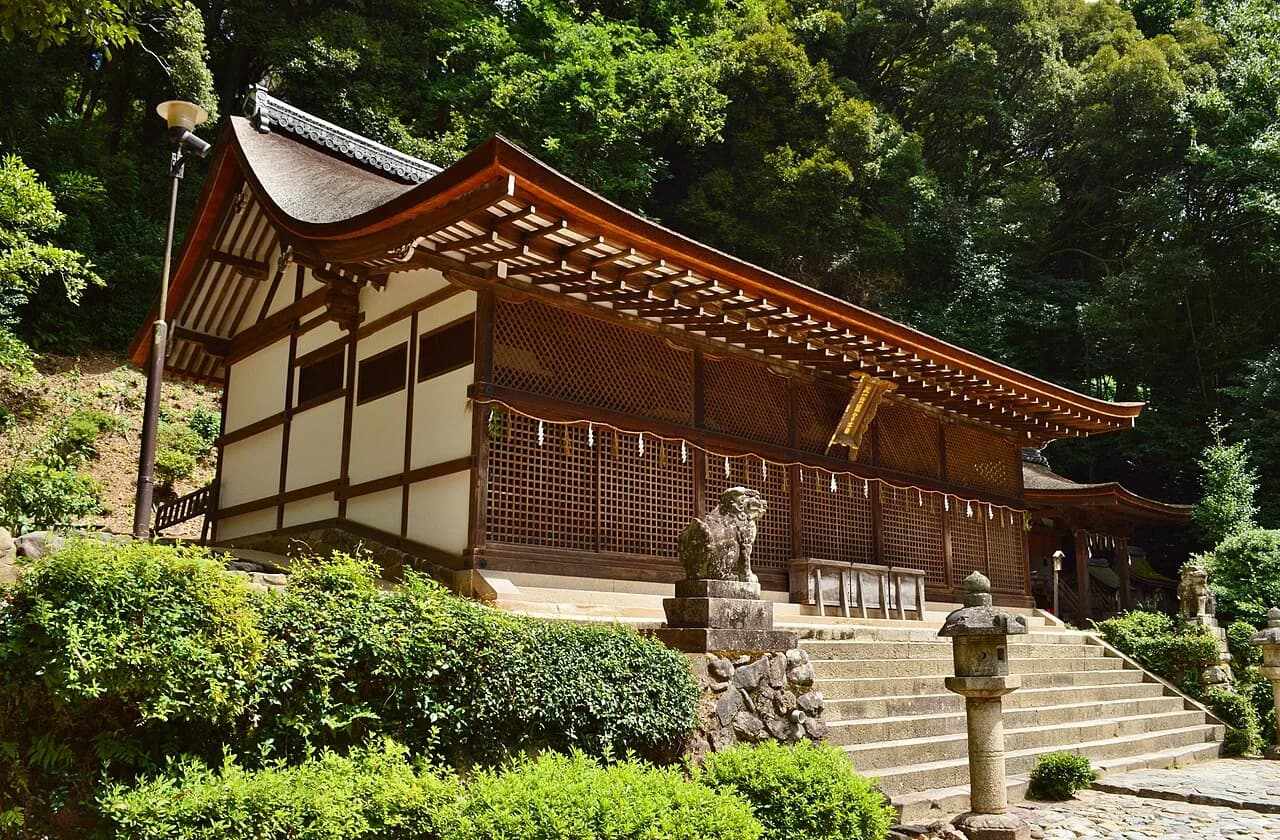
Ujigami Shrine occupies a quiet wooded hillside above the eastern bank of the Uji River, and its honden — the main hall sheltering three inner sanctuaries — is the oldest surviving Shinto shrine building in Japan, constructed around 1060 during the late Heian period.
The shrine holds UNESCO World Heritage status as part of the Historic Monuments of Ancient Kyoto cluster, and both the honden and the adjacent haiden (worship hall) are designated National Treasures. Despite this extraordinary pedigree, the grounds are entirely free to enter.
A visit is compact and contemplative: allow 15 to 20 minutes to walk the precinct, observe the nagare-zukuri architecture, search for the rabbit motifs that mark the shrine's sacred messenger, and pause at the Kirihara-mizu spring — one of Uji's seven celebrated waters.
This guide covers everything you need to plan your 2026 visit: the shrine's history, layout, access from Uji's main sights, and practical tips for pairing it with the surrounding east-bank heritage trail.
Why Visit Ujigami Shrine? A Living Record of Heian Japan
In a city already dense with UNESCO-listed heritage, Ujigami Shrine stands apart. While Byodo-in draws visitors by the thousands with its Phoenix Hall and gleaming pond, Ujigami sits just uphill on the opposite bank — quieter, greener, and home to what no other shrine in Japan can claim: the oldest surviving wooden shrine structure on the archipelago.
That distinction belongs to the honden, which scholars date to approximately 1060. For context, this hall was already nearly two centuries old when the great temples of Kamakura were being raised. Visiting it requires no specialised knowledge of Japanese architecture to feel the weight of that age — the low, mossy roofline and the stillness of the precinct convey it immediately.
The shrine is also entirely free of charge, a rarity among Uji's top-tier heritage sites. There are no ticket booths or queue management zones. You arrive via the Sawarabi-no-michi heritage path, pass beneath a simple torii gate, and enter at your own pace — much as worshippers have for close to a millennium.
For a full picture of what the east bank of Uji has to offer, see the guide to things to do in Uji, which maps the cluster of sites within walking distance. And for deeper context on the shrine's place in the city's pilgrimage landscape before you visit, our things-to-do guide to this World Heritage shrine covers the historical background in full.
History and Significance of Ujigami Shrine
Ujigami Shrine enshrines Uji-no-Wakiiratsuko, a prince of the early Yamato royal court. According to tradition, the shrine was established to honour him after his death — a common pattern in early Japanese religion whereby high-ranking individuals were venerated as protective deities of a locality.
The current honden dates to around 1060, at the height of the late Heian period — a time when the Fujiwara clan held dominance over the imperial court and Uji served as their retreat gateway from the capital. The honden is built in nagare-zukuri style, characterised by an asymmetrical sloping roof that sweeps forward over the front of the building to shelter worshippers from rain. Three separate inner sanctuaries sit side by side beneath this single extended roofline, each housing a deity drawn from the Uji-no-Wakiiratsuko lineage.
The haiden (outer worship hall), dating roughly to the Kamakura period (12th–14th centuries), is also designated a National Treasure and is the structure that visitors encounter first upon entering the precinct. Its straightforward post-and-beam construction feels austere by the standards of later Shinto architecture — intentionally so, reflecting the Heian preference for forms that expressed continuity and spiritual restraint rather than ornamental display.
In 1994, Ujigami Shrine was inscribed on the UNESCO World Heritage List as one of seventeen properties forming the Historic Monuments of Ancient Kyoto cluster — the same designation shared by Kinkaku-ji, Nijo Castle, and Byodo-in. For such an intimate site, the inscription is a statement of irreplaceable rarity: there is simply nowhere else in Japan where an intact shrine hall of this antiquity survives above ground.
On the grounds, the Kirihara-mizu sacred spring feeds a small ablution basin beside the haiden. This spring is counted among the seven famous waters (nanatsu no mizu) of Uji — a premodern distinction that reflects the town's long association with exceptional water quality, embodied also in its celebrated uji-cha green tea culture.
Getting to Ujigami Shrine: Access and Transport
Ujigami Shrine sits on the east bank of the Uji River at Yamada-59, Uji City, Kyoto Prefecture. The most convenient rail access is via Uji Station on the JR Nara Line — served by rapid trains from Kyoto Station in approximately 20 minutes — or Uji Station on the Kintetsu Kyoto Line (roughly 30 minutes from Kyoto's Kintetsu Station). The two stations are about 500 metres apart and both place visitors within easy walking distance of the shrine.
From JR Uji Station, cross the Uji River and turn south along the east bank. The Tale of Genji riverside trail threads uphill through a grove of mature trees, passing the precinct of Uji-jinja just below, before arriving at the main approach to Ujigami Shrine. The walk from the station takes approximately 10 to 15 minutes at a relaxed pace.
Many visitors approach from Byodo-in, which stands on the west bank roughly five minutes from JR Uji Station. After touring the Phoenix Hall, cross the Asagiri Bridge to the east bank and follow the Sawarabi-no-michi path northward — this same route passes the the Tale of Genji Museum before reaching Ujigami, making it straightforward to absorb all three sites in a single half-day circuit. The sequence Byodo-in → museum → Ujigami flows naturally with the terrain.
There is no dedicated car park at the shrine. Visitors arriving by car should use the pay car parks near Byodo-in and cross on foot. The roads in this part of Uji's heritage zone are narrow and parking directly at the shrine is not available. Cycling is a pleasant alternative: bike hire is available near JR Uji Station, and the riverside path is well-suited to a slow pedal between sites.
Highlights of Ujigami Shrine: What to See
The honden is the reason to make the journey. From behind the open haiden you can see the low, sheltering roof of the inner hall — the oldest of its kind surviving in Japan. Three inner sanctuaries sit side by side beneath a single asymmetric nagare-zukuri roofline. The wood has the colour and grain of deep time: pale silvered cedar worn smooth by a thousand years of seasons. Visitors cannot enter the honden itself, but the view through the open worship hall is unobstructed and well worth a long, attentive pause.
The haiden directly in front is also a National Treasure, though from a somewhat later period. Its simple post-and-beam construction is typical of Heian–Kamakura shrine architecture: functional, unornamented, and remarkably well preserved. The atmosphere of the entire precinct is one of muted ceremony — a site that has never required spectacle to command reverence.
Look for the rabbit (usagi) motifs woven into the shrine's decorative elements. The rabbit is the divine messenger of Ujigami Shrine, connected in Japanese mythology to the moon and to Uji-no-Wakiiratsuko himself. Small votive plaques (ema) featuring rabbits are sold at the shrine office and are among the most distinctive souvenirs in Uji. The motif also appears on the the historic Uji Bridge and at other heritage sites across the east bank, forming a subtle visual thread through the neighbourhood.
Before leaving, find the Kirihara-mizu spring, set into the ground beside the haiden. The water is cold and clear, classified as one of the seven famous waters of Uji. It is a tangible link to the centuries of ritual use for which this small precinct has always been the setting, and a quiet reminder that the shrine's significance extends well beyond its architecture.
Planning Your Visit: Hours, Access, and Tips
The grounds of Ujigami Shrine are open daily, roughly 09:00–16:30, and entry is free. The outer approach — the Sawarabi-no-michi path and the torii gate area — is accessible from dawn to dusk, so early-morning and late-afternoon photography is possible even outside the core hours. No advance reservation or ticket purchase is required at any point.
The visit itself is brief: most visitors spend 15 to 20 minutes exploring the precinct. It pairs best with Byodo-in (allow one to two hours, including the Byodo-in Museum), the Tale of Genji Museum (30–45 minutes), and the riverbank walk between them. A full east-bank circuit — station to Byodo-in to Ujigami to museum and back — fits comfortably within a half-day.
Crowds here are minimal compared to Byodo-in or Kyoto's central temples. Even during cherry-blossom season (late March to mid-April), when the Uji riverbank draws large numbers, the shrine precinct itself remains uncrowded. If you visit on a weekend morning in spring or autumn, arrive before 10:00 for the most peaceful experience. Weekday visits at any time of year are typically very quiet.
The precinct has uneven gravel paths and one short flight of stone steps leading toward the honden viewing area. It is manageable for most visitors but may be challenging for wheelchair users. The surrounding Sawarabi-no-michi path is also partially unpaved, so wear comfortable, sturdy footwear if you are walking the full east-bank circuit. For the broader context of what to see in and around Uji, the Uji attractions hub has full listings and itinerary suggestions to help plan your day.
Frequently Asked Questions
Is Ujigami Shrine free to visit?
Yes, Ujigami Shrine is entirely free to enter. There are no admission charges for the grounds, the haiden, or the Sawarabi-no-michi path leading to the shrine. The only optional costs are small votive items such as ema (votive plaques) and omamori (amulets) available at the shrine office if you wish to purchase them.
What are Ujigami Shrine's opening hours?
The grounds are open daily, roughly 09:00–16:30 in 2026. The outer approach and torii gate area are accessible from dawn to dusk. Hours may vary for special ceremonies, so check locally before planning an early-morning or late-afternoon arrival.
How old is Ujigami Shrine's main hall?
The honden (main hall) is dated to around 1060, during the late Heian period, making it the oldest surviving Shinto shrine building in Japan. The haiden (worship hall) in front of it is from a later period, approximately the Kamakura era (12th–14th centuries), and is also a National Treasure. The shrine as a whole was inscribed on the UNESCO World Heritage List in 1994.
What deity is enshrined at Ujigami Shrine?
Ujigami Shrine enshrines Uji-no-Wakiiratsuko, a prince of the early Yamato royal court. Three inner sanctuaries beneath the honden's single sweeping roof each house a related deity from this lineage. The shrine was established to venerate Uji-no-Wakiiratsuko as a guardian spirit of the Uji locality.
How do I get to Ujigami Shrine from Uji Station?
From JR Uji Station, cross the Uji River and follow the east-bank Sawarabi-no-michi path uphill for approximately 10 to 15 minutes. The shrine is signposted and sits just above Uji-jinja on the wooded hillside. Alternatively, after visiting Byodo-in on the west bank, cross the Asagiri Bridge and walk the riverside path — the same route passes the Tale of Genji Museum before reaching Ujigami Shrine.
What is the significance of the rabbit at Ujigami Shrine?
The rabbit (usagi) is the divine messenger of Ujigami Shrine, connected in Japanese mythology to the moon and to the enshrined deity Uji-no-Wakiiratsuko. Rabbit motifs appear in the shrine's decorative details and on the ema (votive plaques) sold at the shrine office. The rabbit is one of the most distinctive symbols of Uji's heritage and features across the city's craft and souvenir traditions.
Ujigami Shrine asks very little of the visitor — no ticket, no queue, a 15-minute walk from the main sights — and returns something rare: direct, unmediated contact with Japanese religious architecture at its most ancient. The honden's thousand-year presence on this quiet hillside makes every other claim to antiquity in the region seem slightly recent by comparison.
Pair it with Byodo-in, the Tale of Genji Museum, and the Sawarabi-no-michi riverside walk for a half-day that takes in the full depth of Uji's UNESCO landscape. The east bank rewards the extra effort it takes to cross the river.