

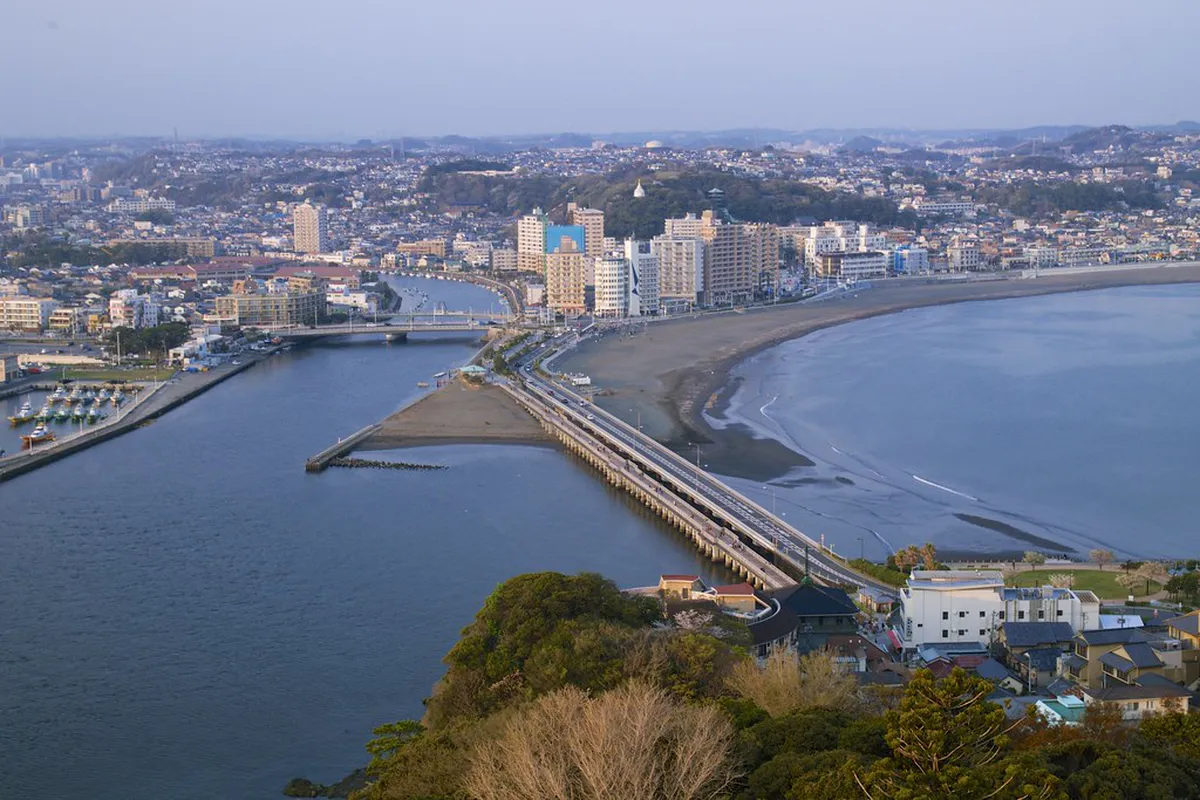
Benten Bridge is the single entry point to Enoshima Island, a small sacred island about 70 km south-west of central Tokyo. The 389-metre pedestrian causeway crosses a tidal channel between Katase beach and the island, offering open-ocean views in both directions. Crossing it is free and the bridge never closes. Everything else on the island — shrines, gardens, sea cave, observation tower — sits within walking distance once you arrive on the other side.
This guide covers every section of the island in the order you will naturally encounter it, from the bridge itself to the Sea Candle at the summit. Practical details (prices, hours, transport costs) reflect 2026 figures. The island is compact — about 1 km from the bridge landing to the Iwaya Caves at the far western tip — but the terrain rises steeply, so budget four to six hours for a complete visit.
Getting to Benten Bridge and Enoshima Island
From Shinjuku, take the Odakyu Line direct to Katase-Enoshima Station. The express journey takes about 65 minutes and costs roughly ¥640 one-way. The station building is modelled on the mythical undersea castle of Ryūgū-jō — dragon motifs on the facade announce the island's mythology before you have even left the platform. Benten Bridge is a five-minute walk from the station exit.
A second option is to change at Fujisawa and board the Enoden, a narrow-gauge tram that rattles along the coast to Enoshima Station. The Enoden leg costs ¥260 and takes around 10 minutes, but the ride through seaside towns is worth it in itself. If you plan to combine Enoshima with Kamakura on the same day, buy the Enoshima-Kamakura Free Pass at Shinjuku or Fujisawa. In 2026 the pass costs ¥1,640 from Shinjuku. It covers the Odakyu round trip plus unlimited Enoden rides for the day, which saves money the moment you take the Enoden more than once.
From Kamakura, the Enoden runs direct to Enoshima Station in about 25 minutes for ¥260. Enoshima Station is a slightly longer walk to the bridge than Katase-Enoshima, but the route is well signed. Driving is possible — paid car parks line the approach road — but traffic on summer weekends can add an hour to your journey.
Crossing Benten Bridge: What to Expect
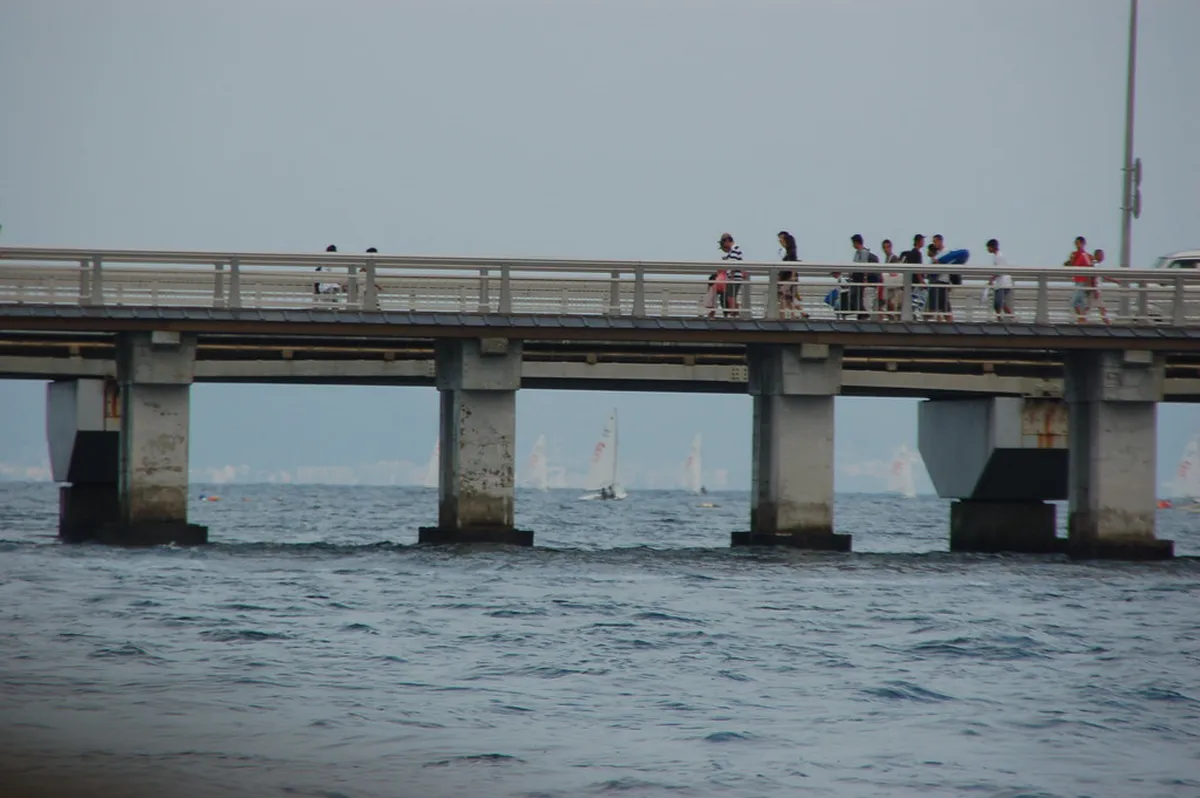
The bridge is 389 metres long and about 4 metres wide, with a footpath on one side and a narrow lane for service vehicles on the other. The walk from the mainland approach to the island gate takes 10 to 15 minutes at a relaxed pace — a parent with a toddler in tow will not need more than that. Two large bronze dragon lanterns flank the island end of the bridge, hinting at the dragon mythology woven throughout the island.
Below the bridge on both sides, the beach is heavily used by locals: on summer weekends you will see barbecue grills, beach chairs, and even hammocks strung between the girders. The sight is unusual and worth a look down before you continue. On a clear day, particularly in autumn and winter mornings, Mount Fuji is visible from the bridge facing west — but only before about 09:00, when haze typically builds. If Fuji is a priority, plan to reach the bridge by 08:30 in October through February.
The bridge is free, open 24 hours, and has no turnstile. Cyclists must dismount and push. There is no shelter from wind or rain, so bring a layer even in summer.
Nakamise Street: Food, Shops, and the Bronze Torii
Stepping off the bridge you pass through a bronze torii gate — the formal entrance to the island's sacred precinct, last rebuilt in 1821 with wave carvings at the base. Immediately beyond it, Nakamise Street runs uphill for about 300 metres. The street is flanked by restaurants, seafood stalls, and souvenir shops. It is narrow and can feel busy between 10:00 and 15:00 on weekends.
Enoshima's signature food is shirasu, young whitebait harvested from Sagami Bay. Almost every restaurant on Nakamise serves shirasu don — a bowl of warm rice topped with raw or par-boiled whitebait — for ¥1,000–¥1,500. The texture is mild and slightly briny; it is worth trying even if you are cautious about raw fish. A second local snack is tako-senbei, a shrimp cracker pressed flat in front of you and sold for around ¥200 at stalls near the street entrance. Note that many Nakamise shops and stalls close by 17:00–18:00, and close earlier if the weather turns wet.
Beyond food, the street is known for denim — several shops sell locally made jeans, a remnant of Shonan's surf-influenced fashion scene. Towards the top of Nakamise, just before the red torii gate that marks the shrine zone, there are stalls selling ema (wooden wish plaques, ¥500–¥1,000). Enoshima's ema feature the island's dragon paired with Benzaiten. The ema hanging trees near the shrine are particularly popular with couples, as two trees standing together are considered auspicious for relationships — buying one here makes for a distinctive souvenir that is tied to the island's mythology rather than generic tourist merchandise.
Enoshima's Spiritual Side: Shrines and Benzaiten
Enoshima Shrine is not a single building but three separate shrines spread across the island. The first, Hetsunomiya, sits at the top of the escalator above Nakamise and enshrines the water goddess Tagitsuhime. Before approaching any shrine, wash your hands at the temizuya (the stone basin with ladles) — this is standard Shinto etiquette. The second shrine, Nakatsunomiya, is a short walk further along the main path. The third, Okutsunomiya, is near the far end of the island beyond the Samuel Cocking Garden.
All three enshrine aspects of Benzaiten, the Buddhist goddess of water, music, and eloquence. According to island legend, Benzaiten descended from a storm cloud and married a sea dragon who had been terrorising the local fishing villages — the dragon imagery on the bridge lanterns and throughout the island commemorates this. The famous Hoanden hall, just beside Hetsunomiya, holds a rarely-displayed naked statue of Benten. Admission is ¥150 (or covered by the Enopass); photos are not permitted inside. Many visitors skip it, but the interior is surprisingly detailed, with a large carved bell and statues of Benzaiten's 15 attendants.
The shogun Minamoto no Yoritomo (1147–1199) prayed here before defeating the Fujiwara clan and founding the Kamakura Shogunate. Tokugawa Ieyasu visited in 1600. The shrine has been a destination for powerful patrons for over 800 years — it rewards a slow look rather than a quick walk-through.
Reaching the Summit: Samuel Cocking Garden and the Sea Candle
Above Hetsunomiya, the island rises sharply. Three escalator stages — the Enoshima Escar — bypass the steepest stairs. A single-stage ticket costs ¥100; a full three-stage pass is ¥360 per person. The escalators only go up; you descend by stairs on the way back. For visitors with young children or knee problems the Escar is worthwhile. The escalators are inside narrow buildings and do not prevent you from stopping at the shrines along the route.
The Samuel Cocking Garden sits at the top. Cocking was a British merchant who established a botanical garden here in 1882; the present garden retains a blend of European and Japanese planting. Admission is ¥200 for adults, ¥100 for children. The garden is open daily 09:00–20:00 (last entry 19:30). Lon Café inside the garden is a popular coffee stop, though prices are high for the location — budget around ¥2,000 per person for a light meal or dessert.
The Enoshima Sea Candle is a 59.8-metre lighthouse tower at the garden's centre. Entry costs ¥500 for adults (combined garden + Sea Candle ticket: ¥500). The outdoor observation deck offers 360-degree views of the Shonan coast, the Miura Peninsula, and — on clear days — Mount Fuji to the north-west and the Izu Peninsula to the south-west. Opening hours are 09:00–20:00 daily. The best light for photographs is around sunset (approximately 17:30–18:30 in autumn), when the Ōyama mountains turn orange behind the tower. Arrive 30 minutes before sunset and queue before the lift.
Best Time to Visit and Avoiding Crowds
The busiest window on Benten Bridge and Nakamise Street is Saturday and Sunday between 10:00 and 15:00, year-round. Arriving before 09:30 on a weekend gives you 60–90 minutes of relatively quiet sightseeing before the main crowd builds. Weekday visits in the same morning window are quieter still. Late afternoon (after 16:00) is the second quieter window, and it aligns well with golden-hour Sea Candle photography.
Seasonally, summer (July–August) brings the heaviest crowds because Enoshima's beaches become one of Tokyo's main swimming spots. Expect queues for the Escar and the Sea Candle on summer weekends. Spring (late March to April) and autumn (October to November) offer pleasant temperatures and moderate crowds. Winter is the quietest season and has two advantages: the Samuel Cocking Garden runs illuminations in December and January, and cold clear mornings (October–February) are your best chance of seeing Mount Fuji from both the bridge and the Sea Candle deck.
Golden Week (late April to early May), Obon (mid-August), and the December illumination period are exceptions to the weekday-is-quiet rule — those windows are busy every day of the week.
Essential Practical Tips
Wear shoes you can walk in for three to five hours, including uneven stone steps. The main path up through the shrine zone involves long staircase sections even if you use the Escar for the steepest parts. Flip-flops work on the bridge and Nakamise but cause problems higher up. The island has public toilets near the visitor centre at the bridge entrance and again near the Samuel Cocking Garden entrance.
The Enopass (also called the Enoshima Pass or island combo ticket) covers the three Escar stages, the Samuel Cocking Garden, Sea Candle entry, and the Iwaya Caves for ¥1,000 adults, ¥500 children. If you plan to visit all those attractions, the pass saves roughly ¥360 versus buying each ticket separately. Pick it up at the visitor information centre on the right side just before the bridge underpass. Note that the Benten Shrine Hoanden (¥150) is not included and must be paid separately or covered by the Enoshima-Kamakura Free Pass holder's discount.
Cash is still preferred at most stalls on Nakamise, though the larger restaurants take IC cards (Suica, Pasmo). The island has no ATM beyond the post office near the bridge approach. Withdraw cash at the station convenience store before crossing. Mobile signal is fine across the island; the Sea Candle observation deck has adequate 4G for photos to upload instantly.
Accessibility: the main path from the bridge to Nakamise is flat and stroller-friendly. Above the second torii gate — from the Escar base upward — strollers become impractical on the stairs. The escalators fit a folded pushchair; the observation tower lift accommodates a wheelchair. The Iwaya Caves involve low ceilings and uneven cave floors and are not suitable for wheelchairs or large strollers.
Beyond Enoshima: Connecting to Kamakura
Kamakura is 25 minutes from Enoshima Station on the Enoden line (¥260). The two destinations make a natural same-day pairing, but honest advice: doing both thoroughly in one day is tiring. A manageable split is Enoshima in the morning (arrive 09:00, leave by 13:00–14:00) and Kamakura in the afternoon (Great Buddha and Tsurugaoka Hachimangu are both within 15 minutes of Kamakura Station).
The Great Buddha at Kotoku-in costs ¥300 to enter and stands 13.4 metres tall. The temple is open daily 08:00–17:30 (last entry 17:15). Tsurugaoka Hachimangu Shrine, Kamakura's central Shinto shrine, is free and open 06:00–20:30. Both are short walks from Kamakura Station. The Enoshima-Kamakura Free Pass covers all your Enoden travel for the day, so moving between the two towns costs nothing extra once you have the pass.
If one day is too rushed, Kamakura also works well as a standalone day trip from Tokyo. Either way, the Enoden is the transport link that makes the combination work — it is slow, charming, and runs frequently enough that you do not need to plan around a timetable.
Frequently Asked Questions
How long is the Enoshima Bridge?
Benten Bridge, leading to Enoshima Island, is approximately 600 meters long. Most visitors can walk across it in about 10-15 minutes at a leisurely pace, enjoying the coastal views.
How to get to Enoshima Island?
Enoshima Island is accessible by train. The most common route is via the Odakyu Line to Katase-Enoshima Station or the Enoden Line to Enoshima Station. Both stations are a short walk from Benten Bridge.
What to do on Enoshima Island?
On Enoshima Island, you can explore Enoshima Shrine, stroll Nakamise Street, visit the Samuel Cocking Garden, and ascend the Enoshima Sea Candle for panoramic views. The Iwaya Caves also offer a unique experience.
Is Enoshima worth visiting?
Yes, Enoshima is definitely worth visiting for its blend of natural beauty, spiritual sites, and vibrant street life. It offers stunning ocean views, delicious local food, and a relaxing escape from city bustle.
What is Shirasu?
Shirasu refers to young whitebait fish, a local specialty of Enoshima. It is often served raw over rice (shirasu donburi) or cooked in various dishes. Many restaurants on Nakamise Street offer fresh shirasu.
Benten Bridge truly serves as your perfect introduction to the enchanting island of Enoshima. With our comprehensive guide, you are well-equipped to plan an unforgettable day trip. From spiritual shrines to breathtaking panoramic views, Enoshima offers diverse attractions. We encourage you to immerse yourself in the local culture and savor its unique coastal charm.
Remember to consider our timing tips to avoid crowds and enhance your experience. Whether you choose to explore leisurely or follow a packed itinerary, Enoshima awaits. We hope this guide makes your visit smooth, enjoyable, and filled with lasting memories. Enjoy your journey across Benten Bridge and into the heart of Enoshima.
To verify current details, consult the Benten Bridge on Wikipedia and Benten Bridge official site.