The Enoshima Sea Candle is a 60-meter lighthouse observation tower sitting 120 meters above sea level in the heart of Samuel Cocking Garden. From its top deck you get 360-degree views across Sagami Bay and, on clear days, a straight-line sightline to Mount Fuji. This guide was last updated in June 2026 and covers current prices, opening hours, seasonal illumination events, and a practical time-based itinerary for a day trip from Tokyo.
Enoshima Island is small — about 0.45 km² — but dense with things to see. Getting the order right matters. Arrive early, work your way from Benten Bridge uphill through the shrines and garden, and position yourself at the Sea Candle for late afternoon. That sequence gives you the best crowds, the best light, and the best value from a single ticket.
Why Visit Enoshima Sea Candle? Highlights and Views
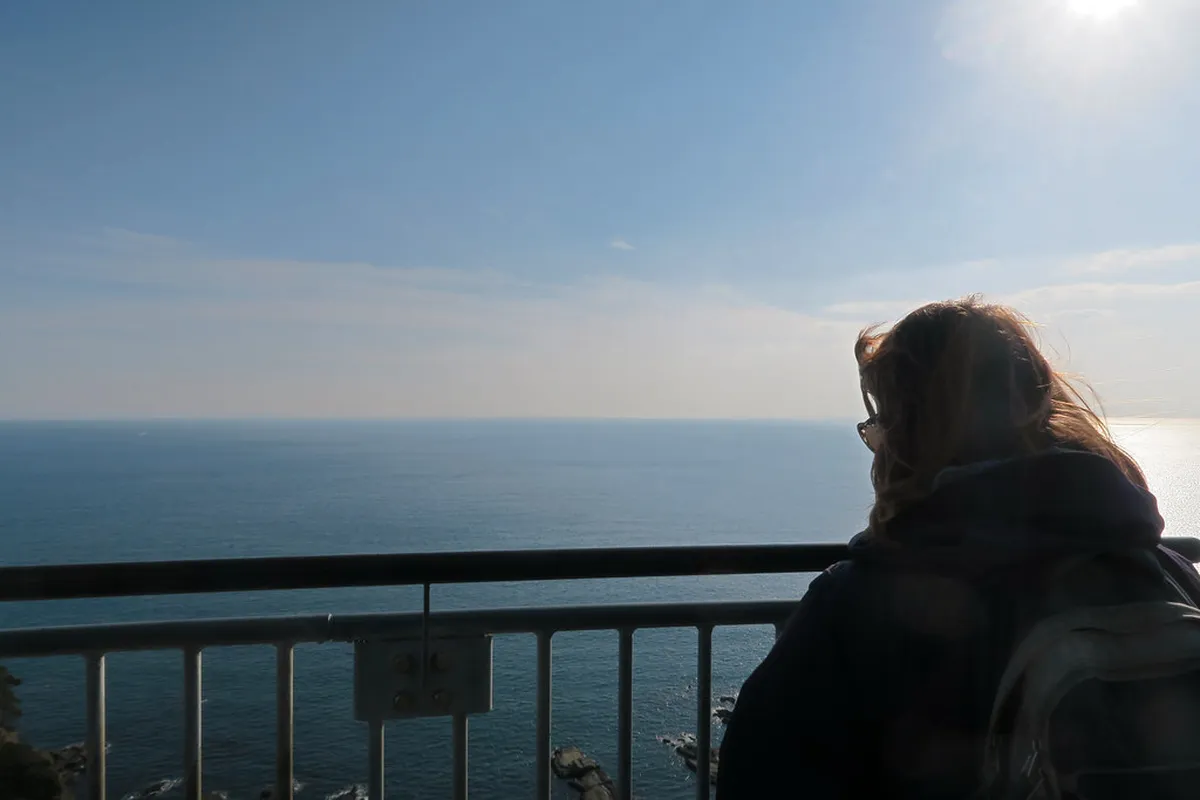
The Sea Candle doubles as both a functioning lighthouse and an observation tower. The indoor deck wraps fully around the tower's top, giving unobstructed sightlines in every direction. Looking north on a clear winter morning, Mount Fuji appears close enough to feel reachable. Looking south, the Pacific stretches to the horizon with the Izu Peninsula visible on clear days.
The tower rises from Samuel Cocking Garden, a botanical garden established by English merchant Samuel Cocking in 1882. Entry to the garden is included in your Sea Candle ticket, so you get both for one fee. The garden has small European-style paths, a café, and a free second-floor terrace called the Sunset Terrace — more on that below. Together, the garden and tower make a 60–90 minute stop even before you reach the view from the top.
Beyond the views, the Sea Candle anchors Enoshima's two major illumination festivals: the winter Shonan no Hoseki, recognised as one of Japan's Three Great Illuminations, and the autumn Shonan Candle event in October-November. If your visit coincides with either, budget extra time at the garden.
Planning Your Trip: Getting to Enoshima from Tokyo
Enoshima is accessible from central Tokyo in about 60–90 minutes by train, depending on which line you take and where you start. Most visitors come from Shinjuku on the Odakyu Line, which runs a direct express to Katase-Enoshima Station in about 65–75 minutes. From the station it is a 15-minute walk across Benten Bridge to the island entrance. This is the fastest, simplest option.
The second common route uses JR lines. Take the JR Tokaido Line from Tokyo Station to Fujisawa Station (about 50 minutes), then transfer to the Enoden Line for a 10-minute coastal ride to Enoshima Station. The Enoden is a charming single-car tram that runs along the seafront — many visitors enjoy the ride itself. From Kamakura, the same Enoden Line reaches Enoshima in about 20–30 minutes, which makes combining both destinations easy.
If you plan to visit Kamakura as well, the Enoshima-Kamakura Free Pass from Odakyu is worth calculating. In 2026 it costs approximately ¥1,640 for adults from Shinjuku and covers the round-trip Odakyu fare plus unlimited rides on the Enoden. Compare that against individual tickets: a one-way Shinjuku–Katase-Enoshima ticket is around ¥650–¥700. If you take the Enoden three or more times, the pass saves money. Pick it up at any Odakyu station ticket window.
Your Ideal Enoshima Sea Candle Day Trip Itinerary
The itinerary below works for a single full day from Tokyo. It is structured to move uphill with the crowds rather than against them, and to put you at the Sea Candle during the best light. Total time on the island is about 7–8 hours. Wear comfortable shoes — the paths are uneven around the shrine and cave areas.
- 09:30 — Arrive at Katase-Enoshima Station. Cross Benten Bridge (free) and enter the island.
- 09:45–10:30 — Walk Benten Nakamise Dori Street. Sample street food: grilled octopus crackers (takosenbei, ¥300–¥500) or raw shirasu (whitebait) rice bowl at a ground-floor restaurant (¥900–¥1,400). Weekday mornings are quiet; snack stalls open by 09:00.
- 10:30–11:30 — Visit Enoshima Shrine: the three connected shrines — Hetsumiya, Nakatsunomiya, and Okutsunomiya — are free to enter. Climb the stone steps between them or pay ¥360 for a one-way Escar ride (four escalator sections, 4 minutes vs. 20 minutes on foot).
- 11:30–13:00 — Walk south through Lovers' Hill to Iwaya Caves. Admission is ¥500 for adults, ¥200 for children (open 09:00–17:00). The two caves contain stone statues and glow-in-the-dark dragon sculptures. Allow 30–40 minutes inside.
- 13:00–14:00 — Lunch near the cave exit. Several small restaurants with ocean-facing terraces serve fresh seafood bowls here; expect ¥1,200–¥2,000 per head.
- 14:00–15:30 — Samuel Cocking Garden and Sea Candle. The combined ticket (garden + observation deck) costs ¥800 for adults, ¥400 for children. If you want to skip the queue for the tower, buy the digital Sea Candle Set Ticket online before arriving — it includes the Escar, garden, and tower in one QR code.
- 15:30–17:30 — Stay at the Sea Candle for sunset. In autumn the sun sets around 16:45–17:00; in winter around 16:30. The candle-lighting ceremony at the Shonan Candle event begins at 17:00, so if you visit in October–November, this timing puts you in the right place at the right moment.
- 17:30–18:30 — Walk back down Benten Nakamise Dori, pick up souvenirs, and cross back to the station. Last trains run well past 22:00 from Katase-Enoshima.
Families with children should add the Enoshima Aquarium (Shin-Enoshima Suizokukan) to the end of the day. It sits on Katase beach next to the station and is Japan's first modern aquarium, opened in 1954. Budget 90 minutes and roughly ¥2,500 per adult.
Navigating the Island: Escar vs. Walking the Steps
The Enoshima Escar is Japan's first outdoor escalator, installed in 1959. It covers 106 meters in length with a total rise of 46 meters across four sections. Walking the equivalent stone steps takes roughly 20 minutes; the Escar does it in 4 minutes. The escalators run uphill only — you always walk down.
A full Escar pass costs ¥360 for adults (¥180 for children). Individual sections are ¥200 each. The Enoshima 1-Day Passport, which costs ¥1,000 for adults and covers the Escar, Sea Candle, and Samuel Cocking Garden, is worth buying if you plan to use the escalator and visit the tower. On a busy weekend, the passport also includes a small discount at Iwaya Caves. Pick it up at the Escar entrance or at the Enoshima Tourist Association.
For most able-bodied visitors on a weekday, walking up is pleasant — the steps pass through shaded shrine precincts with stone lanterns and small shops. On a hot summer day or if you are traveling with elderly relatives or strollers, take the Escar up and walk the steps down for variety. The downhill route is gentler and lets you stop at viewpoints you miss in a hurry.
The Sunset Terrace: A Free View Most Visitors Miss
On the second floor of the Sea Candle building, accessible without buying the observation deck ticket, is the Sunset Terrace. It is an open-air platform with unobstructed views over Sagami Bay to the west. Drinks and light snacks are available from a small counter. The terrace is free as long as you have paid garden entry (or are visiting during a free-entry period before 17:00 outside illumination season).
Most visitors queue straight for the tower lift and miss this entirely. In practice, the Sunset Terrace often delivers a better sunset experience than the glass-enclosed upper deck — the air is open, the sound of the sea carries up, and there is no glass reflection to fight when taking photos. If you are on a tight budget, you can genuinely enjoy the sunset from here without the ¥800 tower ticket.
During the Shonan Candle event in October–November, the terrace view of the candles lighting up below is particularly striking. The candle-lighting starts at 17:00 and the glow builds as dusk deepens, so arriving at the terrace by 16:30 gives you the full transition from golden hour to candlelight.
Best Time to Visit: Seasons, Events, and Avoiding Crowds
Weekday mornings are consistently the least crowded time on Enoshima. Saturday afternoons in summer are the worst for queues, particularly at the Escar and the Sea Candle lift. If you must visit on a weekend, arrive before 10:00 and complete the cave walk before returning uphill for the tower in mid-afternoon.
For Mount Fuji views from the Sea Candle, winter (December–February) gives the clearest skies. Fuji is most visible in the morning before haze builds — aim to be at the top deck by 10:00 on a cold, cloudless day. In summer, haze and humidity usually obscure the volcano by mid-morning.
Three illumination events shape the evening calendar:
- Shonan no Hoseki (late November–mid February): Enoshima's flagship winter illumination, consistently ranked as one of Japan's Three Great Illuminations and a Kanto Region top-three event. The entire Samuel Cocking Garden and Sea Candle tower are lit with jewel-toned LEDs, including the Shonan Chandelier tunnel and the Houseki Forest path. Garden entry after 17:00 costs ¥500 for adults (¥250 children); Sea Candle tower is ¥800 (¥400 children). Buy your garden tickets at the vending machine during the day — evening queues for tickets can stretch 30+ minutes.
- Shonan Candle (October–November): Around 10,000 real candles are lit inside the garden at 17:00. Workshops let you draw wishes on candle cups or make recycled-wax candles. The view from Chigogafuchi Abyss, just past the caves, is particularly dynamic as the candlelight reflects off the tidal rocks below.
- Enoshima Lantern Festival (summer, July–August): Around 1,000 lanterns of different shapes are placed across the island, from the shrine approach steps to the Sea Candle area. Traditional shadow puppet shows run on weekends. Cooler evenings make this a pleasant way to revisit the island in summer without the beach crowds.
Autumn (October–November) is arguably the sweetest spot overall: mild weather, the Shonan Candle event, fewer tourists than summer, and early sunsets that make it easy to time a Sea Candle visit for golden hour. Spring (April–May) offers pleasant temperatures with moderate crowds.
Beyond the Sea Candle: Other Must-See Enoshima Attractions
Enoshima Shrine is not a single shrine but three connected ones — Hetsumiya (bottom), Nakatsunomiya (middle), and Okutsunomiya (top) — all dedicated to Benzaiten, the goddess of music, fortune, and water. The walk between them passes through stone torii gates and forested paths. Entry to the outer shrine grounds is free; the inner sanctuaries have a combined ¥200 entry fee.
Halfway through the shrine complex, the small Buddhist temple Enoshima Daishi is easy to walk past but worth a pause. Its two red guardian statues at the entrance are distinctive, and the lantern-lined interior is unusually calm. It takes five minutes and costs nothing to visit.
At the island's far end, Iwaya Caves are the oldest visitor attraction on Enoshima — the caves have been a pilgrimage site since at least the 9th century. The first cave extends 152 meters back into the cliff; the second cave is shorter and set up with dragon and Benzaiten statues illuminated by candles. The coastal path from Samuel Cocking Garden to the caves passes Lovers' Hill with the Ryuren no Kane bell (couples ring it for lasting love) and the rocky Chigogafuchi Abyss, which is one of the best sunset-watching spots on the island.
Benten Nakamise Dori, the covered shopping street at the island's entrance, is where most visitors spend money. The local food specialty worth trying here is shirasu — small whitebait fished from Sagami Bay. You can eat it raw (nama shirasu), served on rice, or in fritters. Most shirasu restaurants open by 10:00 and sell out by early afternoon on busy days.
Enoshima on a Budget: Costs and Saving Tips
A full Enoshima day trip has a fairly predictable cost structure. The Enoshima 1-Day Passport (¥1,000 adults, ¥500 children) covers the Escar, Sea Candle observatory, and Samuel Cocking Garden. If you also want Iwaya Caves you pay ¥500 separately. Add transport from Shinjuku at roughly ¥650 each way, and a budget of ¥3,500–¥4,500 per adult covers everything except food.
The Enoshima-Kamakura Free Pass from Odakyu costs ¥1,640 from Shinjuku and includes the round-trip Odakyu fare plus unlimited Enoden rides. It also includes a small discount on the Sea Candle admission. If you are pairing Enoshima with Kamakura in the same day, this pass almost always costs less than individual tickets once you count the Enoden trips.
Free things worth knowing: Benten Bridge and the outdoor shrine grounds are free. The Sunset Terrace on the second floor of the Sea Candle building is free with garden entry. The beach areas (Katase Higashihama and Nishihama) are free and make a relaxing end to the day in summer. Shrine festivals and the outer shrine precincts can fill a morning without spending anything beyond food.
For food, the sit-down restaurants on Benten Nakamise Dori charge tourist-area prices (¥1,500–¥2,500 for a seafood bowl with sea view). A cheaper option is buying takeaway snacks — shirasu onigiri or grilled squid — from stalls and eating near the waterfront. Convenience stores are available near Katase-Enoshima Station before you cross the bridge.
Essential Tips for a Smooth Visit
Buy the Sea Candle Set Ticket online before arriving. The digital pass (Escar + garden + tower) eliminates the need to queue at three separate ticket windows. During illumination season, queues at the garden entrance after 17:00 regularly stretch to 30+ minutes for walk-up buyers. Purchasing online via the official Enoshima Sea Candle website takes two minutes.
If your main goal is a clear Mount Fuji view, check the weather forecast the night before. The webcam on the official Sea Candle site shows near-real-time conditions. A cloud-free, cold morning in January or February is the gold standard. Summer visits are rewarding for atmosphere and the lantern festival but Fuji is rarely visible through summer haze.
The island gets noticeably quieter after the last sightseeing buses leave around 17:00–18:00, even during peak season. If you can structure your day to arrive early and push the cave and shrine visits to mid-afternoon, you will find the upper island far less congested than the morning rush. Most day-trippers from Tokyo reverse this order and create an uphill traffic jam between 11:00 and 14:00.
For an overnight stay, IZA Enoshima Guest House and Bar is a budget-friendly option on the main street leading to Enoden Station, with both dormitory beds and private rooms. Staying overnight lets you enjoy the illumination events fully without rushing for the last train — the island shifts to a completely different atmosphere after the day crowds leave.
Frequently Asked Questions
Is the Enoshima Sea Candle worth visiting?
Yes, the Enoshima Sea Candle is highly worth visiting for its 360-degree panoramic views. You can see Sagami Bay and Mount Fuji on clear days. The seasonal illuminations also create a magical atmosphere.
Do you need tickets for Enoshima Sea Candle?
Yes, you need a ticket to access the Enoshima Sea Candle observation deck. The ticket usually includes entry to the Samuel Cocking Garden. Prices vary, so check the official Enoshima Sea Candle website for current rates.
What is the best time to visit the Sea Candle?
The best time to visit the Sea Candle is late afternoon to early evening. This allows you to experience both daylight views and the stunning sunset. You can then enjoy the illuminations after dusk.
How much is an Enoshima Sea Candle ticket?
Entry to the Enoshima Sea Candle observation deck typically costs around ¥500 for adults. This often includes access to the Samuel Cocking Garden. Combined passes are also available for other island attractions.
How long does it take to visit Enoshima Sea Candle?
You should allocate about 1-2 hours for visiting the Enoshima Sea Candle and the Samuel Cocking Garden. This allows time for enjoying the views, exploring the garden, and waiting for sunset or illuminations. The entire island can be explored in a full day.
How to get to Enoshima from Tokyo?
You can get to Enoshima from Tokyo by train, typically taking 1.5 to 2 hours. The Odakyu Line from Shinjuku to Katase-Enoshima Station is a popular direct option. Alternatively, take a JR line to Fujisawa and transfer to the scenic Enoden Line.
What else is there to do on Enoshima Island?
Beyond the Sea Candle, Enoshima Island offers many attractions. Explore Enoshima Shrine, wander through Benten Nakamise Dori, and discover the mysterious Iwaya Caves. You can also visit the Enoshima Aquarium.
Enoshima Island rewards visitors who plan their order of stops carefully. Come early, walk the Nakamise street and shrine complex in the morning quiet, push south to the caves before lunch, and position yourself at the Sea Candle garden for the afternoon and sunset. Add the Sunset Terrace to your itinerary — it costs nothing and often delivers the most memorable view of the day. Whether you are visiting in October for the Shonan Candle candle-lighting or in January for the clearest Mount Fuji sightlines, the Sea Candle is the anchor around which the rest of the island makes sense.
To verify current details, consult the Enoshima Sea Candle on Wikipedia and Enoshima Sea Candle official site.