

Enoshima Island sits about 50 km south of Tokyo, just west of Kamakura, and packs an extraordinary amount into a small area. A three-part Shinto shrine complex, a Victorian-era tropical garden, sea caves carved by the Pacific, and some of Japan's best shirasu (whitebait) restaurants all occupy an island roughly 1 km across. This guide walks you through a full day on the island in 2026, from the first torii gate to the ferry back to the mainland.
The island rewards early arrivals and unhurried walkers. Plan for six to eight hours. Wear your most comfortable shoes — Enoshima is almost entirely stairs.
The Legend of Enoshima and the Goddess Benzaiten
Every gate, statue, and ritual on Enoshima traces back to a single founding myth. According to the legend, a five-headed dragon once terrorized the villages of Fujisawa, stealing children in the night. Then, around the year 552 CE, clouds gathered over the sea, the earth shook, and a heavenly maiden named Benzaiten descended from the sky, raising the island itself from the seabed as she arrived.
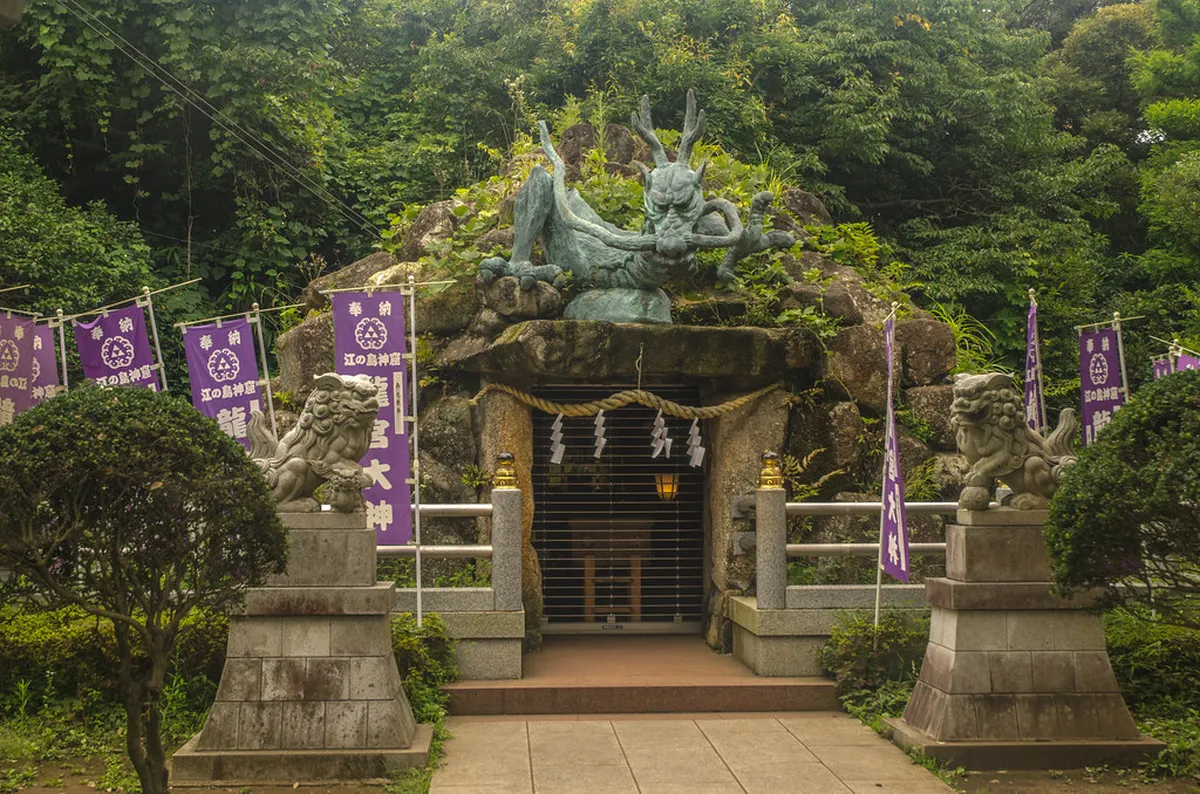
The dragon fell in love with Benzaiten and proposed immediately. She refused, appalled by his cruelty. He spent years reforming his ways, eventually turning himself to stone as proof of his devotion. Moved by his sincerity, Benzaiten forgave him and they were wed. Today the dragon is considered the island's protector, and Benzaiten — the only female among Japan's seven gods of fortune — is its patron deity. She governs music, water, knowledge, and luck, which is why so many visitors come seeking help with love, exams, and careers.
Understanding this story changes how you experience the island. The dragon lanterns lining the causeway, the coin-washing spring at Hetsumiya, the Love Bell near Okutsunomiya, and the green dragon perched over Wadatsumi-no-miya shrine all connect back to Benzaiten and her reluctant husband. The entire island is, in essence, a monument to their marriage.
Getting to Enoshima: Transportation Options
The fastest route from central Tokyo is the Odakyu Line from Shinjuku Station. Take a Rapid Express train toward Fujisawa (platforms 4–5, look for the orange Rapid Express sign), ride about one hour to Fujisawa, then transfer to a local train for three more stops to Katase-Enoshima Station. The full journey takes around 1 hour 15 minutes. A one-way ticket costs ¥630; pay with a Suica or Pasmo IC card or buy at the machines outside the Odakyu barriers.
The Odakyu Enoshima-Kamakura Free Pass is worth calculating. At ¥1,470 per adult (2026 price), it covers the Odakyu round trip from Shinjuku plus unlimited rides on the Enoden tram between Fujisawa and Kamakura. If you plan to visit Kamakura the same day or travel back via the Enoden, the pass saves money. If you are only going to Enoshima and back, two individual tickets at ¥630 each costs ¥1,260, so the pass only adds value if you board the Enoden at least once. Check current pricing on the Odakyu Railways official pass page before you travel.
Alternatively, JR Shōnan-Shinjuku Line trains run to Fujisawa Station, making this route compatible with a Japan Rail Pass. From Fujisawa, the Enoden tram is not JR-covered, but the short walk or local Odakyu train to Katase-Enoshima is easy to navigate. Katase-Enoshima Station is designed to resemble a dragon palace and is unmissable when you arrive.
Enoshima Day Pass: Is It Worth It?
The Enopass (¥1,000 per adult in 2026) bundles three paid sites: the Enoshima Escar escalators, Samuel Cocking Garden with Sea Candle observation access, and Iwaya Caves. Bought separately, those cost ¥360 (Escar) + ¥500 (Garden + Sea Candle combined ticket) + ¥500 (Caves) = ¥1,360. The pass saves ¥360 and removes the need to queue at three separate counters.
For most first-time visitors who plan to see the full island — escalators up, garden, Sea Candle, and caves — the Enopass is worth buying at the start of the day. For those skipping the caves (they are genuinely basic and crowded), the math is less compelling: escalators + garden/Sea Candle individually cost ¥860, which is still below the ¥1,000 pass price. Budget travelers comfortable with the stair climb can skip the Escar entirely and pay ¥500 at the garden entrance only.
Families with young children often find the Escar portion most useful, since the stair climb to the first shrine is steep and tiring with small kids. Visitors with mobility concerns should note that the Escar only goes upward — there are no downhill escalators anywhere on the island.
Morning: Nakamise Street and the Enoshima Shrine Complex
Aim to arrive at Katase-Enoshima Station by 10:00. Cross the road and walk about 10 minutes along the causeway — flanked by the dragon-shaped stone lanterns referenced in the founding myth — to reach the island. Benten Bridge leads you directly onto Nakamise Shopping Street, a covered arcade of souvenir shops and snack stalls. Early on weekday mornings most shops are still shuttered, which means faster passage to the shrine. On weekends the street is busy by 10:30.
At the far end of Nakamise you pass under the bronze torii gate and through the Zuishinmon, a carved wooden gate whose underside is decorated with peonies and lions. Just beyond it stands the stone Benzaiten statue carved in 1450. Take a moment to look — it depicts her seated with attendants, surrounded by the dragon who loved her.
The shrine complex divides into three sub-shrines spread up the hillside. Hetsumiya (Outer Shrine) is the first you reach, about 5 minutes from the bottom of the street. Built originally in 1620 in the style of the third Kamakura Shogun, the present structure dates to 1976 but follows the original design exactly. Before entering, use the temizuya (stone water basin): ladle water over your left hand, then your right, optionally rinse your mouth, and discard the remaining water. To make an offering inside, throw a coin into the box, bow twice, clap twice, hold your wish silently in mind, then bow once more. Next to Hetsumiya, the Ho-an-den octagonal building (¥200 entry) contains a famous nude Benzaiten statue playing a biwa — uniquely rare compared with other depictions across Japan.
Continue uphill (or take the Escar for ¥180 to the middle level) to reach Nakatsunomiya (Middle Shrine) by around 11:15. It is quieter and less visited than Hetsumiya. Look for the small stone basin to the shrine's left: pour water into the pipe opening and listen for the musical tinkling. Nearby, the seasonal camellia plantings around Nakatsunomiya Square are particularly striking in February and March, with cherry blossoms appearing around mid-February when Kawazu trees bloom earlier than the standard spring season.
Midday: Samuel Cocking Garden and Sea Candle Views
Samuel Cocking was a British merchant who arrived in Japan in the 1870s and purchased land on Enoshima when foreign ownership became legal. He spent decades importing tropical plants from across the world for this garden, and after his death the city of Fujisawa inherited and restored the property following the 1923 Great Kanto Earthquake. Entry is ¥200 for the garden alone or ¥500 for the combined garden and Sea Candle observation deck ticket. If you have the Enopass, it covers both.
The garden is worth at least 20 to 30 minutes. From February to March, 250 breeds of camellia bloom here. From May to October, Canadian crimson roses fill several beds. The Chinese-style pavilion, donated by Kunming City (Fujisawa's sister city), is a good place to sit quietly before the crowds of the afternoon arrive. Head inside by 11:40 if you want the garden to yourself.
The Enoshima Sea Candle stands roughly 60 metres tall at the garden's centre. The observation platform at the top provides 360-degree views over Sagami Bay, Fujisawa, and on clear winter mornings, a clear sightline to Mt Fuji. Mt Fuji is visible most reliably between November and March before 10:00, when haze accumulates later in the day. Sunset visits (around 16:30–17:00 in winter) are popular but busy. Arrive by 11:30 for the best combination of manageable crowds and reasonable Fuji visibility.
Lon Cafe, inside the garden, opens at 11:00 and serves French toast exclusively. Their creme brûlée French toast (around ¥1,200–¥1,500) is the bestseller. The terrace looks out toward the sea and the "Miami Beach Area" lookout — optimistic branding for a genuinely lovely coastal view. Free WiFi is available; blankets are provided for terrace seating in winter. Expect a short queue by 12:30 on weekends.
Afternoon: Okutsunomiya, Iwaya Caves, and the Love Bell
After the garden, follow the staircase path downhill toward the island's western tip. You will pass Enoshima Daishi, a Buddhist temple rebuilt in the 1990s after being destroyed during the Meiji-era separation of Shinto and Buddhism. Two six-metre Fudomyo statues guard the entrance. Step inside to see the stained-glass wall — worth the two minutes it takes even if you do not enter the main hall.
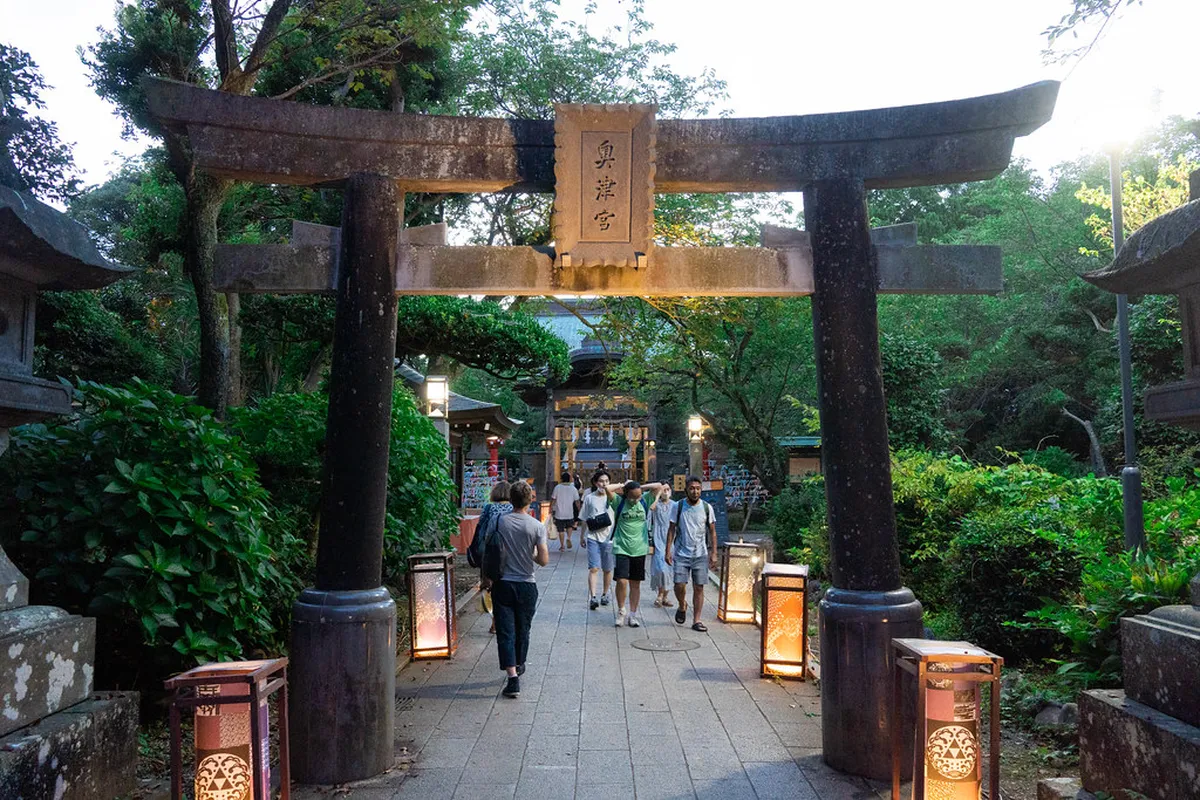
Continue down to Okutsunomiya (Inner Shrine) by around 14:00. The stone torii gate here dates to 1138, a gift from the Kamakura Shogunate. Inside, look at the ceiling for the all-seeing turtle from the Urashima Taro legend — it appears to look directly at you from every angle. The Chikara-ishi stone beside the temple weighs 320 kg and was traditionally used to test the strength of the nation's strongest men.
Past the Inner Shrine, steep stairs descend to the Chigogafuchi plateau and Iwaya Caves. The plateau is associated with a historical double-suicide love story and is considered one of the most romantic views in Kanagawa. Entry to the caves is ¥500; exploring takes about 20 minutes. The first cave contains Buddhist statues; the second holds a small pond dedicated to the dragon. Buddhist monks trained here during the Nara period, giving the caves genuine pilgrim significance. That said, if your time is short, spending 20 minutes on the Chigogafuchi rocks watching waves is equally rewarding and free.
On the way back up, take the path left at the Inner Shrine to reach the Ryuren Love Bell. A wooden platform covered in padlocks leads to the bell — ringing it is said to bring luck in love. Enoshima is one of the most popular spots in Japan for couples, and the ema wooden prayer plaques hanging near Hetsumiya are written overwhelmingly with wishes for good relationships.
Enoshima's Culinary Delights: What to Eat
Enoshima's signature snack is Tako Senbei — a whole octopus arm pressed flat between two heated plates and baked into a giant cracker. Watch it made fresh on Nakamise Street for ¥300–¥500. It is salty, chewy at the centre, and crisp at the edges. Buy one for the walk up.
The serious food is shirasu. Enoshima's fishing boats land whitebait (shirasu) fresh daily from Sagami Bay, and a bowl here is measurably fresher than anything available in Tokyo. Shirasu-don comes raw (nama-shirasu), half-raw, or boiled (kama-age), piled over warm rice. Most restaurants charge ¥1,000–¥1,800 per bowl. Enoshima-tei, located on the path between Enoshima Daishi and the Inner Shrine, serves reliable versions including an ikura-shirasu bowl with a layer of salmon roe on top. Uonemotei, one of the oldest restaurants on the island (over 140 years in business), specialises in Enoshima-don: young sardines, turban shells, and beaten egg over rice.
For visitors who do not eat seafood, Cafe Madu sits a few seconds past Enoshima-tei and serves savoury crepes, curry rice, and ramen alongside rice bowls. It is a reliable non-seafood fallback. Lon Cafe inside Samuel Cocking Garden is French toast only — good for dessert but not a full meal substitute.
Note on raw shirasu: it is only available when the fishing boats have gone out that morning. A chalkboard or sign at restaurant entrances typically indicates whether nama-shirasu is available that day. Fishing is banned on certain days (usually Mondays and some Tuesdays) — call ahead or check the island's visitor information if raw shirasu is a priority for your trip.
The Ferry Return and Practical Tips for 2026
Most visitors retrace their steps back through Nakamise Street to Katase-Enoshima Station. A quieter alternative is the Bentenmaru ferry from the pier near Iwaya Caves back to the mainland dock near the station. The ride takes only a few minutes but gives you a sea-level view of the island's cliff face, the Sea Candle tower, and the full scale of the coastline that you simply cannot get from land. Ferries run intermittently throughout the day; confirm the last departure time at the pier before committing to this return route, as the schedule shortens in winter. The fare is modest — around ¥400–¥500 one way.
Logistics worth knowing for 2026: The Enoshima Escar escalators run upward only and stop in the early evening (typically around 18:00–19:00 depending on season). Coin lockers at Katase-Enoshima Station are limited and fill quickly on weekends and holidays — arrive early or travel light. Most shops accept IC cards (Suica/Pasmo); smaller stalls and cave entry are cash-only, so carry ¥2,000–¥3,000 in coins and notes.
Weekdays are noticeably less crowded than weekends and Japanese public holidays. Summer weekends (July–August) bring beach crowds to the causeway even before the island itself gets busy. Spring (late March to early April) and autumn (October–November) offer the most comfortable walking weather. On any clear winter morning with low humidity, the Mt Fuji view from the Sea Candle is worth waking up early for.
Accessibility: The Escar covers the main uphill stretch to the garden level. Below the Escar entry point and on the descent to the caves, the path is entirely staircases with no alternative routes. Visitors using wheelchairs or pushchairs should plan their route carefully; the flat causeway and waterfront park north of the island are accessible, but the shrine complex and caves are not. The Benten Bridge crossing is flat and paved.
Frequently Asked Questions
Which Enoshima Shrine visitor guide options fit first-time visitors?
First-time visitors should prioritize a guide that offers a clear, sequential itinerary. Look for practical details on transportation, costs, and key attractions. Our guide is tailored for a comprehensive first visit to Enoshima.
How much time should you plan for an Enoshima Shrine visit?
We recommend dedicating a full day, approximately 6-8 hours, to thoroughly explore Enoshima Island. This allows ample time for the shrines, gardens, caves, and local dining. Arrive by 10 AM for a relaxed pace.
Is Enoshima Shrine worth including on a short itinerary?
Yes, Enoshima Shrine is definitely worth including, even on a short trip to Japan. It offers a distinct cultural and scenic experience easily done as a day trip from Tokyo. The island provides a refreshing contrast to city life.
How long should I spend at Enoshima Shrine?
Allow about 60–90 minutes to walk the full three-shrine route from Hetsunomiya near the entrance up to Okutsunomiya at the island's heights, including time for the wish rituals and viewpoints along the way.
Enoshima rewards the visitor who walks slowly and pays attention. The founding legend of Benzaiten and the dragon is not tourist dressing — it is woven into every arch, bell, and stone basin on the island. Follow the path from Nakamise Street through the three shrines to the plateau, eat a bowl of fresh shirasu somewhere in the middle, and take the ferry back for a view of the whole island from the water. It is a genuinely complete day.
Verify opening hours and prices on official sites before you travel — the Enopass price and Escar hours in particular are updated seasonally. All the internal links above connect to individual attraction pages if you want to research any single spot in more depth before your visit.
To verify current details, consult the Enoshima Shrine on Wikipedia and Enoshima Shrine official site.