

St. Paul's Catholic Church in Karuizawa is one of Japan's most photographed wooden churches. Designed by Czech-American architect Antonin Raymond and completed in 1935, it sits just a two-minute walk from Kyu-Karuizawa Ginza Street. Entry is free, the grounds are open during daylight hours, and the church remains an active Catholic parish — not a museum.
This guide covers practical visit logistics, what to look for architecturally, the church's history as a foreign-community landmark, and how to combine it with a morning walk through central Karuizawa in 2026.
Planning Your Visit to St. Paul's Catholic Church
The church grounds are accessible during daylight hours, typically from around 08:00 to 17:00. There is no admission gate and no ticket to purchase — simply walk in from the path that runs off Kyukaruizawa-dori. The interior of the church building itself is open to visitors when Mass is not in session, usually during morning and midday hours on weekdays.
The best time to visit is early morning on a weekday, before tour groups arrive from the Ginza shopping street. By 10:00 on summer weekends the surrounding paths fill quickly, and getting a quiet photograph of the exterior can be difficult. Karuizawa's peak season runs from late July through August; spring (late April to early June) and autumn (mid-September to early November) offer cooler temperatures and noticeably smaller crowds.
The church is located at approximately 36.354°N, 138.634°E in the Kyukaruizawa district. From Karuizawa Station's north exit, it is a flat 15-minute walk or a 5-minute bicycle ride west along the main resort road. Rental bicycles are available at several stands near the station for around ¥500–¥700 per hour in 2026. There is no dedicated parking lot; drivers visiting by car typically use the public parking near Kyu-Karuizawa Ginza and walk from there.
Opening Hours, Tickets, and Admission
Entry to the church grounds is free at all times. The exterior and gardens can be viewed whenever daylight permits. The interior of the main chapel is generally open to visitors outside of Mass times, though this can vary by season and staffing — if the door is closed, the church is in use for services or unavailable that day.
Mass is celebrated in Japanese. Weekend Masses are typically held on Saturday evenings and Sunday mornings; the exact schedule is posted at the church entrance and on the parish's local notice board. Visitors who wish to attend Mass are welcome. Dress modestly and arrive a few minutes early — the interior seats roughly 80 people and fills during summer holiday weekends.
There are no guided tour bookings, no cloakroom, and no café on-site. Plan to spend 20 to 40 minutes at the church itself; combining it with a walk along Kyu-Karuizawa Ginza Street and a stop at nearby Kumoba Pond turns the outing into a comfortable two-hour morning circuit.
What to See: Key Attractions and Highlights
The exterior is the main draw. Raymond's design uses unfinished vertical cedar planks and a steeply pitched shingled roof that recalls both a Swiss chalet and a traditional Japanese farmhouse simultaneously. The steep pitch sheds Karuizawa's heavy snowfall and the unpainted cedar weathers to a silvery grey that photographs well against the surrounding larch trees. The building measures roughly 18 metres long and sits on a small raised stone plinth.
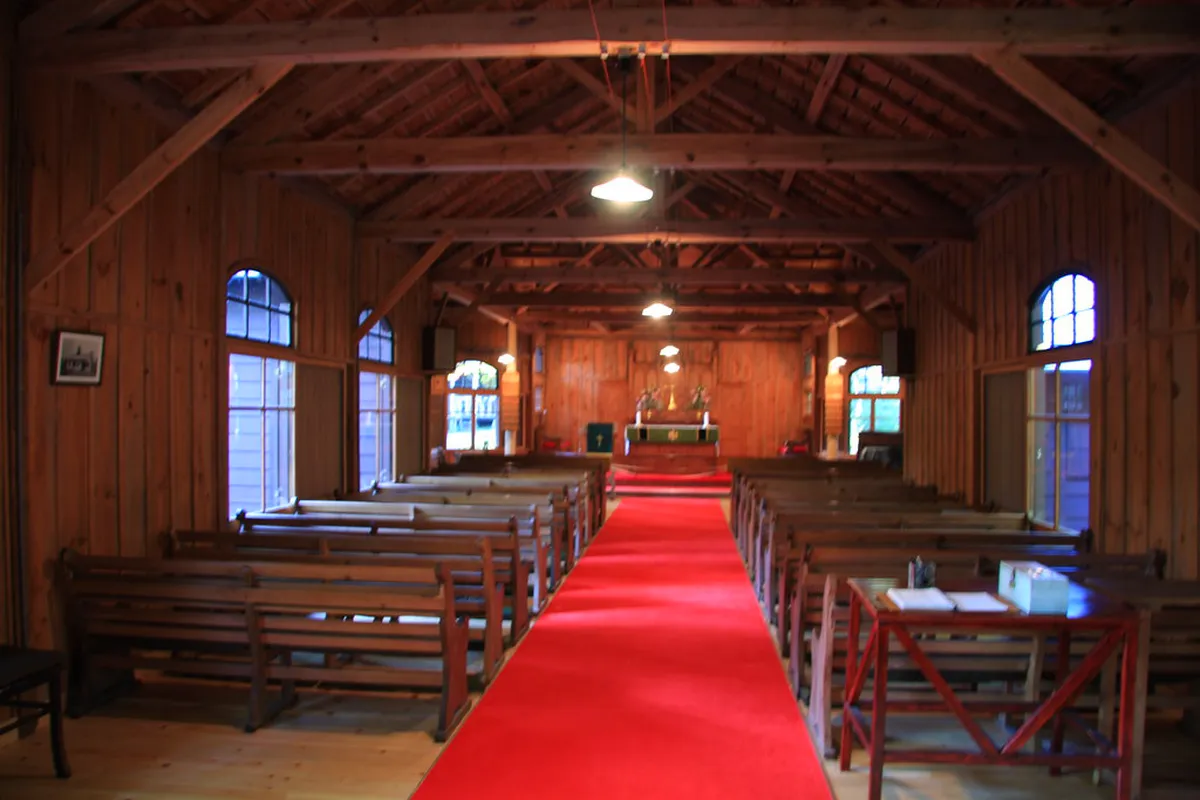
Inside, the nave is narrow and tall, lit by four elongated wooden-framed windows on each side wall. There are no elaborate decorations — the space is intentionally spare, with plain wooden pews, a simple altar, and a small stained-glass panel behind it. The wooden structural trusses are exposed, and the craftsmanship of the joinery is worth examining closely. The acoustic in the chapel is notably warm and still.
The surrounding garden path loops around the building and passes several large conifers that date to the church's original planting. A small stone cross and memorial markers stand in the garden to the east. In mid-autumn the maple trees turn red and orange, making the grounds one of the more popular foliage spots in central Karuizawa.
The History and Significance of St. Paul's
St. Paul's was built in 1935 for the foreign community that had summered in Karuizawa since the late 19th century. Canadian missionary Alexander Croft Shaw first promoted the area as a summer resort for Western residents of Tokyo and Yokohama in 1886, and by the 1920s the town had a substantial community of foreign diplomats, missionaries, and business families who needed a permanent Catholic church. Raymond — who had come to Japan in 1919 to work on Frank Lloyd Wright's Imperial Hotel — was already well established in Tokyo and took on the commission.
Antonin Raymond's significance to 20th-century Japanese architecture cannot be overstated. After parting from Wright he developed his own language that fused Modernist principles with Japanese materials and craft traditions. St. Paul's Karuizawa is one of his smaller but most cohesive works: the building is all of a piece, designed down to the door handles. Raymond later described the Karuizawa church as a building that "grew naturally from its site."
During the Second World War, foreign residents who had not been interned continued to use the church. In the postwar decades it became a gathering point for Karuizawa's international summer population as the resort town reinvented itself for Japanese domestic tourism. The church is a registered tangible cultural property in Nagano Prefecture and remains under the care of the Diocese of Saitama.
Karuizawa's Foreign Resort Heritage — What Most Visitor Guides Skip
St. Paul's is frequently described as "Antonin Raymond's church" without the context that explains why it exists at all. Karuizawa was one of the only resort towns in Meiji-era Japan that was deliberately shaped by a foreign community. Shaw's original vision attracted a tight circle of missionaries, academics, and diplomats who built summer cottages along the pine-forested lanes north of the station. That community needed not just a church but a social infrastructure — tennis courts, a library, walking paths — and many of those institutions survive today in fragmentary form.
Visiting St. Paul's without knowing this history turns it into an oddity: a Western-style wooden chapel in a Japanese mountain town. With the context, it becomes legible as the spiritual centre of a 19th-century expat enclave that shaped the entire character of the Karuizawa resort. The old mission cottages scattered in the woods around the church — several of which are still in private use — complete the picture. If you walk the lanes north of the church toward Hoshino Resort, you will pass the footprints of that original community on almost every corner.
Attending Worship and Services
Mass at St. Paul's is conducted in Japanese and is open to anyone. The parish serves both the small permanent Catholic population of Karuizawa and the larger seasonal congregation that arrives in summer. Weekend services during July and August draw considerably more attendees than off-season; arriving early is advisable in peak summer weeks.
The current Mass schedule is posted at the church entrance gate and is updated seasonally. Visitors attending as observers rather than participants are welcome to sit quietly at the rear of the nave. Photography inside during Mass is not appropriate — if you wish to photograph the interior, do so before or after the service, not during it. The etiquette is the same as any active Catholic parish anywhere in the world.
Christmas and Easter Masses are particularly well-attended and the church decorates simply but beautifully for these occasions. If you are in Karuizawa over Christmas or New Year, checking the notice board for the service schedule is worthwhile.
Accessibility Information for Visitors
The church grounds are level and the main path around the building is firm gravel. Access from the street to the main entrance is via a short stone path with no significant steps, making wheelchair access to the entrance feasible. The interior of the chapel has a small step at the threshold; the nave floor is flat wooden boarding with fixed pews.
There are no accessible toilet facilities on-site. The nearest publicly accessible toilets are in the Kyu-Karuizawa Ginza shopping area approximately 300 metres away. Given the compact scale of the site, most visitors with mobility considerations find the exterior visit straightforward; interior access depends on the threshold step. Contact the Diocese of Saitama office directly if you require specific accessibility information in advance.
Photography at St. Paul's
The exterior can be photographed freely at any time from the public path and grounds. The building photographs best in soft morning light — the western-facing main facade is front-lit in the afternoon, but the flat midday summer light flattens the cedar grain. On overcast days the silver-grey timber reads particularly well against the green canopy.
Interior photography is permitted when the church is open for general visiting and no service is in progress. Use natural light only — flash photography is discourteous in an active place of worship regardless of whether a service is underway. Tripods are generally not appropriate inside the nave given the limited space. The garden and surrounding paths are fully open for photography at all times.
Nearby Sights and Local Walking Tours
The church slots naturally into a half-day circuit of central Karuizawa. From the church, walk five minutes east to reach the start of Kyu-Karuizawa Ginza Street for coffee and a browse of the independent shops. Continue south and then west to reach Kumoba Pond, whose reflections of surrounding trees and the modest island at its centre make it a popular photography stop. The full circuit from the church to the pond and back to the station covers roughly 2.5 kilometres on flat, paved paths.
For a longer half-day, combine the church visit with a bus or taxi ride to Shiraito Falls to the west. The falls are a 20-minute bus ride from the Ginza bus stop and the surrounding forest path takes around 40 minutes to walk. The two sites — the cultural and the natural — make a balanced pairing that avoids overlap.
No guided walking tours of the church specifically are available for individual visitors. The church is compact enough that self-guided exploration is entirely sufficient. If you want architectural context, the Sezon Museum of Modern Art in the Hoshino area and the Old Mikasa Hotel (a Meiji-era Western-style wooden building) fill that role and are accessible by bicycle from the church in under 20 minutes.
Frequently Asked Questions
What are the opening hours for St. Paul's Catholic Church?
St. Paul's Catholic Church grounds are accessible during daylight hours, approximately 08:00 to 17:00. The church interior is generally open to visitors outside of Mass times. The interior is closed during services and may be closed on days with limited staffing. Check the notice board at the entrance for the current schedule.
How much does it cost to visit St. Paul's Catholic Church?
Entry to St. Paul's Catholic Church in Karuizawa is completely free. There is no admission charge for visiting the grounds or the interior during open hours. The church is an active parish, not a ticketed attraction. Donations are welcome via the collection box near the entrance.
Which st. paul's catholic church visitor guide options fit first-time visitors?
First-time visitors are best served by a self-guided visit. The church is compact and fully comprehensible without a guide. Allow 20 to 40 minutes for the grounds and interior, then walk to Kyu-Karuizawa Ginza Street for a broader sense of the historic resort area. No advance booking is required for Karuizawa.
How much time should you plan for st. paul's catholic church visitor guide?
Plan 20 to 40 minutes for the church itself. Combined with the walk to and from Kyu-Karuizawa Ginza Street and a stop at Kumoba Pond, allow two hours for a comfortable morning circuit of central Karuizawa.
St. Paul's Catholic Church is a small building with an outsized presence in Karuizawa's identity. Antonin Raymond's 1935 design remains one of the cleanest examples of his early Japanese work, and the church's roots in the town's foreign-mission summer community give it a historical depth that rewards a slow visit. Arrive early, walk the garden, look closely at the joinery, and leave time to explore the lanes around the church before the Ginza crowds arrive.
For authoritative information, refer to the St. Paul's Catholic Church on Wikipedia and St. Paul's Catholic Church official site.