Yakuoin Temple Mount Takao Travel Guide
Plan yakuoin temple mount takao with top picks, neighborhood context, timing tips, and practical booking advice for a smoother trip.
On this page
Yakuoin Temple — officially Takao-san Yakuo-in Yuki-ji — has stood on the slopes of Mount Takao since 744 AD, making it one of the oldest active Shingon Buddhist temples in the Kanto region. The mountain itself is a 10-minute walk from the cable car's upper station and sits just under an hour from Shinjuku by Keio Railways. This combination of easy access and genuine spiritual depth makes Yakuoin one of the most visited temples in Japan, welcoming millions of visitors each year.
This guide covers the temple's key halls and statues, the Tengu mythology woven into every corner of the grounds, the best seasons to visit, practical transport options, and what to do once you descend from the mountain. Whether you have half a day or a full day to spend, the information here will help you plan a focused and rewarding trip.
Must-See Yakuoin Attractions
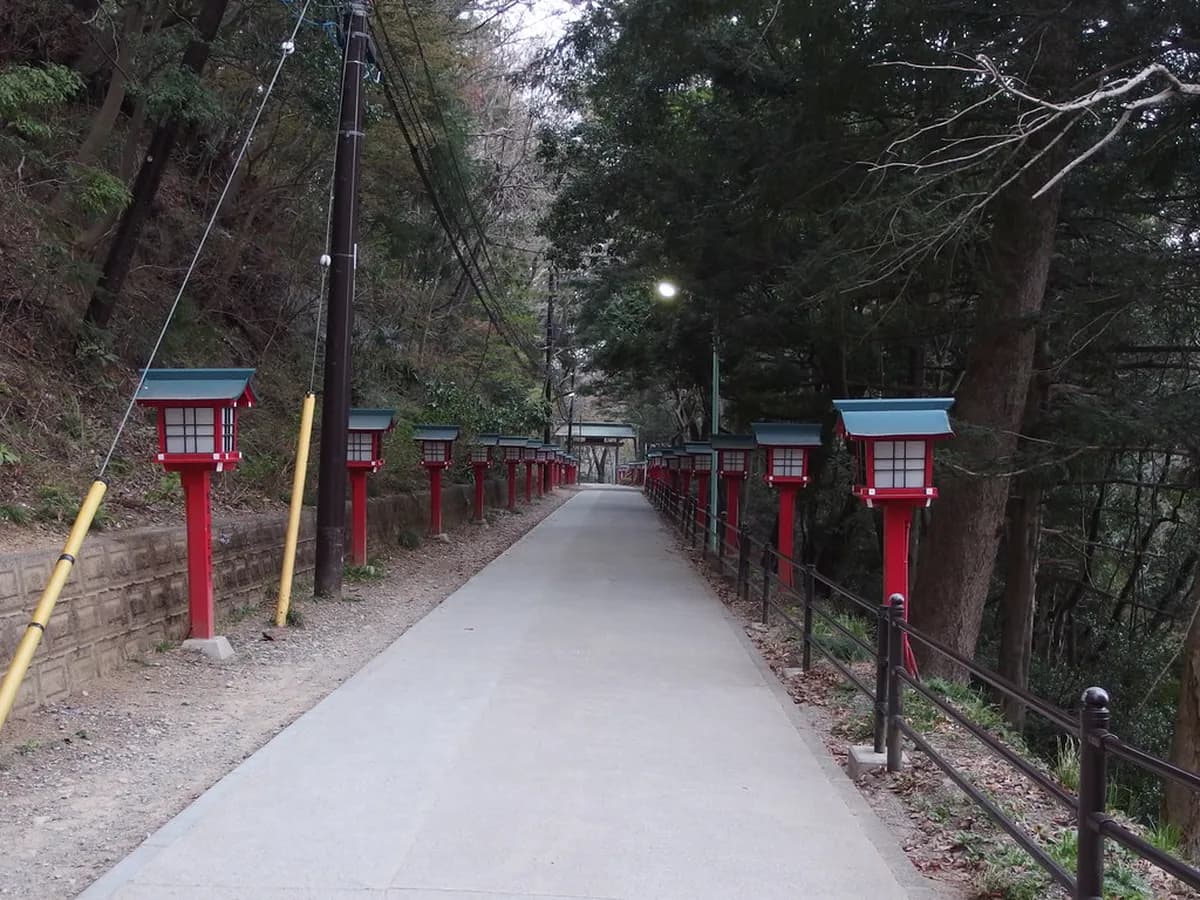
The temple complex unfolds across several levels as you climb toward the summit on Trail 1. The first major gate, Niomon, announces the sacred precinct with fierce guardian figures on either side. Past here, a row of ancient cedar trees lines the approach — the giant cedar at the front stands 47 meters tall with a trunk circumference of 5.6 meters and survived the typhoon of September 1966 that ravaged much of the area.
The Hondo (main hall) is the ritual heart of the complex, dedicated to Izuna Daigongen, a local incarnation of Fudo Myo fused with the beaked features of the smaller Tengu. Adjacent to it, the Daishido hall enshrines Kobo Daishi, the founder of Shingon Buddhism in Japan. Nearby, the golden dragon enshrined in the Kurikara-do is said to grant wishes related to enmusubi — matchmaking and relationships — which explains the long queues of visitors writing on ema wooden plaques nearby.
Behind the main hall sits the Izuna Gongen-do, the most visually striking structure on the grounds. Its elaborate painted carvings and lacquered panels draw frequent comparisons to the shrines at Nikko. Further up, a detour off the main path leads to the Busshari Stupa, a Buddhist reliquary built in a style more common to Tibet and Southeast Asia. It was constructed to house bone fragments of the historical Buddha, gifted by a Thai temple to a Japanese youth delegation in 1931. Most visitors walk straight past the turnoff and miss it entirely.
The Jizo statues dotting the paths throughout the temple are also worth pausing at. They serve as protectors of travelers and children, identifiable by the small red bibs placed on them by worshippers. Touching or rubbing certain smooth stones near the Hondo is said to transfer their spiritual merit to the person making the gesture — you will see visitors queuing to do exactly this at the round octopus-stone by the main hall.
The Tengu of Yakuoin
No feature of Yakuoin is more distinctive than its Tengu. These mythical mountain beings appear everywhere on the grounds — in the gate guardhouses, on ema plaques, carved into lintels, and as large freestanding statues. Mount Takao is considered one of the foremost Tengu sites in Japan, and the temple actively cultivates that identity.
The Tengu mythology at Yakuoin is more layered than most visitors realise. The legend dates to the 9th century when Tengu were depicted as mischievous demon-like spirits who led travellers astray in mountain forests. Over time, both Shinto and Buddhist traditions absorbed them as messengers to the gods, beings who punish evildoers and reward those who act with virtue. At Yakuoin specifically, the role is framed in this protective sense: the Tengu here chastises the evil and rewards the good.
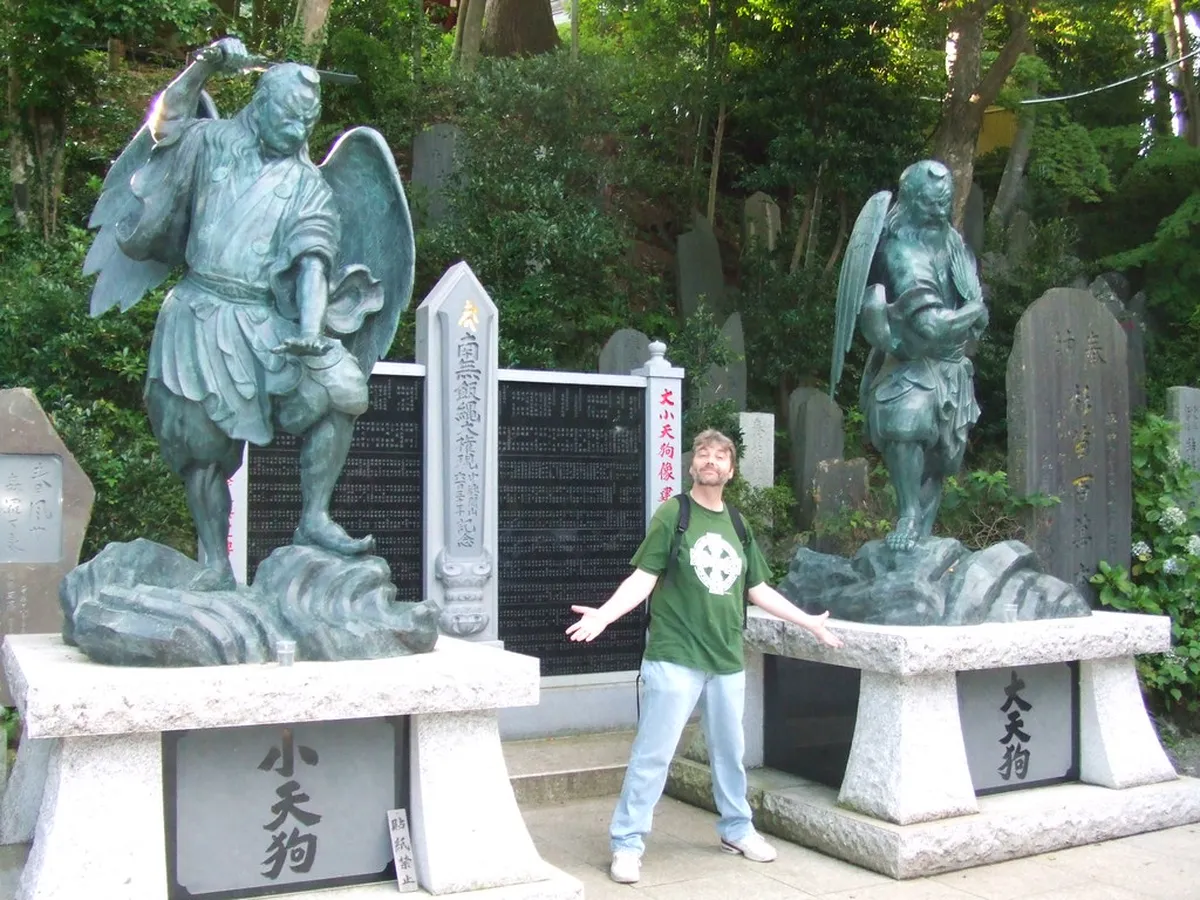
There are two distinct forms at the temple. The large Tengu with the elongated human nose represents an experienced yamabushi — a mountain ascetic who has completed years of rigorous spiritual training. The smaller crow-beaked Tengu is considered still in training, a novice on the path. Both figures stand prominently in front of the Izuna Gongen-do and appear repeatedly in smaller relief carvings across the gates and halls. Understanding this distinction gives the statues considerably more meaning than they have at first glance.
The connection between Tengu and the mountain's identity runs deep enough that the annual Hiwatarisai fire-walking ceremony in March is dedicated to Tengu's patron deity, Fudo Myo. During this ritual, Shugen-do practitioners walk barefoot across burning coals in a ceremony that traces back to the 14th-century priest Shungen Daitoku, who burned 8,000 Goma sticks on this mountain in a purification rite. This is one of the most dramatic events on the temple calendar and the least covered by general travel guides.
When to Visit Yakuoin Temple
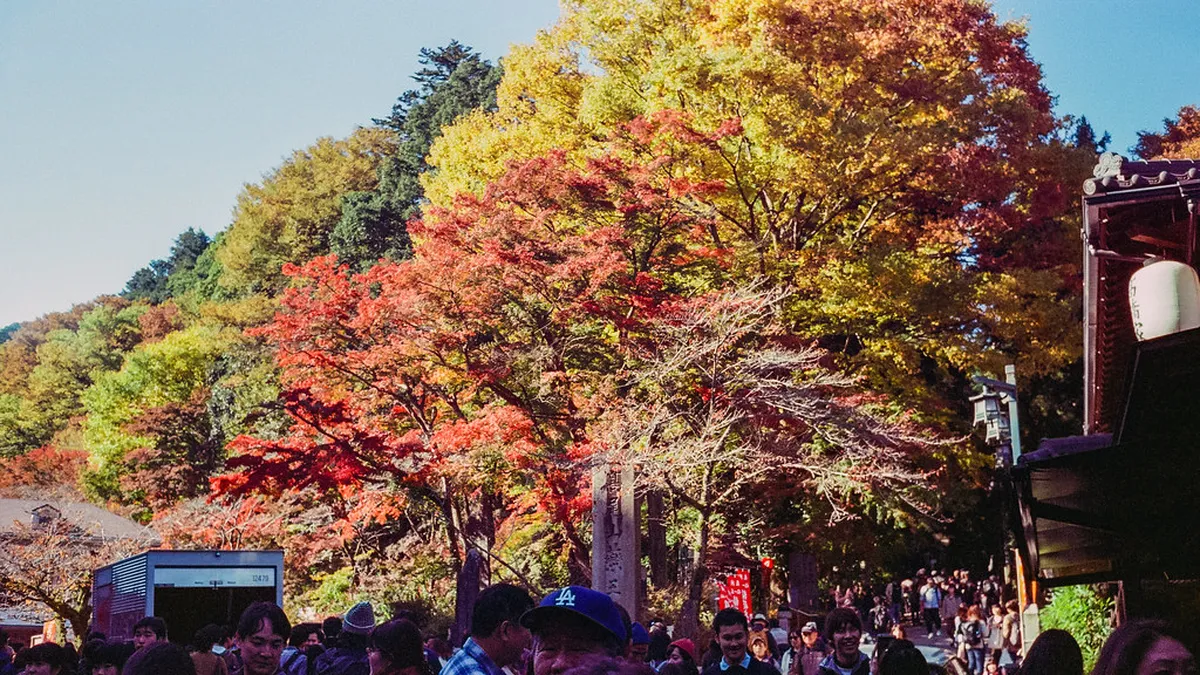
Autumn is the single most popular season, particularly November, when the mountain hosts the Momiji Matsuri maple leaf festival. The trails and temple grounds fill with visitors from across the Tokyo metropolitan area, and autumn colours on the hillside are genuinely spectacular. A mid-week visit significantly reduces crowding even at peak season — weekend visits in November can mean 10-minute waits for the cable car even in the morning.
Spring brings cherry blossoms visible from the chairlift and upper trails, typically in early April, though the timing shifts year to year. The Wakaba Matsuri in April and May marks the appearance of fresh green foliage with traditional performances at the temple. Spring is less crowded than autumn but note that Golden Week (late April to early May) draws enormous crowds — visitors arriving on a Golden Week holiday should expect packed cable cars, queues at the temple, and standing-room-only conditions at the summit viewing platform. Arriving at Takaosanguchi Station by 09:00 is the only practical mitigation.
Three specific festivals at the temple are worth planning around if your dates are flexible. Setsubun-e on 3 February marks the end of winter with a bean-throwing ceremony at Yakuoin to drive out bad luck — because Setsubun is not a national holiday, events that fall on weekdays are far less crowded. Hiwatarisai in March is the fire-walking ceremony described above, held outdoors on the temple grounds. Geikosai in January opens the year with a light-welcoming festival and prayers for peace. All three offer access to ceremonies most tourists visiting Tokyo never encounter.
Winter is the quietest season. The trails are emptier, the mountain air is clear, and on cold mornings the temple buildings can appear dusted with snow, which is rare but striking when it occurs. Summer brings the Yamayuri mountain lily and the Beer Garden near the cable car station, which runs from July to September with evening views back toward the Tokyo skyline.
Parks, Gardens, and Outdoor Spots on Mount Takao
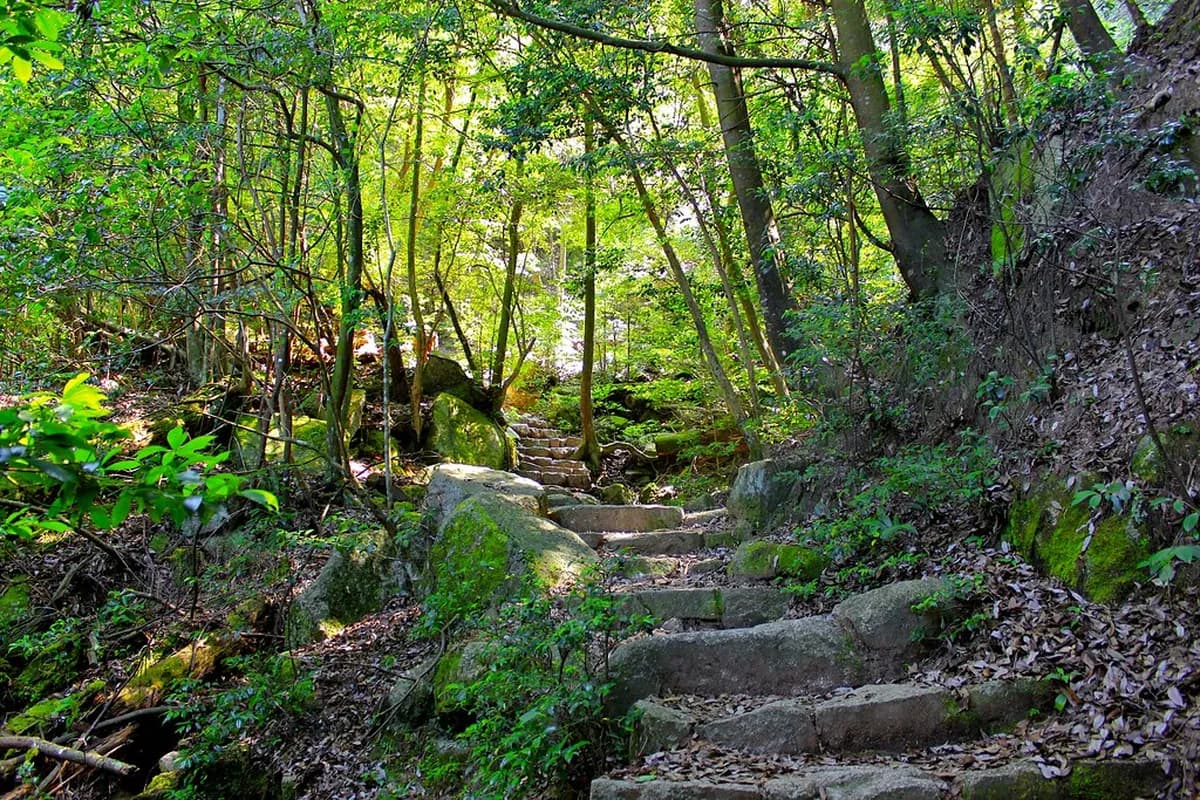
Mount Takao has eight numbered hiking trails, not just the paved Trail 1 that most visitors use. Trail 4 branches off toward the Miyama suspension bridge, the only suspension bridge on the mountain, which passes through a beech forest that is particularly vivid in early summer when the new leaves are bright green. The detour adds roughly 20 minutes to the climb and sees far fewer visitors than the main route.
On Trail 1, the path forks just past the souvenir stalls: the left branch climbs the Otoko-zaka, a stone staircase of exactly 108 steps. The number 108 carries specific meaning in Buddhism — it represents the total number of human desires and is the same count used in mala meditation beads and in New Year's bell ringings. The gentler right-hand path is the Onna-zaka slope. Both routes rejoin before the temple. Visitors with knee problems or those with young children should take the slope; the steps are steep and exposed.
From the cable car upper station it is a 15-minute walk to the temple and another 15 minutes of uphill walking from the temple to the summit. The summit itself is a wide flat area with expansive views toward Tokyo and, on clear days, Mount Fuji to the southwest. The views are best in winter when the air is clearest; summer and humid autumn days can obscure the horizon with haze. You can also explore Mount Takao Hiking Trails Travel Guide to find the route that suits your pace.
The Takao 599 Museum sits at the base of the mountain near the trail entrance. Its name refers to Mount Takao's height of 599 metres. The museum covers the mountain's biodiversity, geological history, and the spiritual traditions of Yakuoin through interactive displays. Admission is free, which makes it a practical stop if you arrive early and want context before the climb, or a shelter option on a rainy day.
Museums, Art, and Culture Around the Temple
The Takao 599 Museum near the mountain base is the most complete introduction to the area's cultural and natural context. Exhibits cover the local flora and fauna — over 1,600 plant species and 160 bird species have been recorded on the mountain — as well as the history of Yakuoin and its role as a centre of Shingon Buddhist practice in eastern Japan. Entry is free and the facility is modern, with English-language signage on key displays.
The artistic heritage of Yakuoin is embedded in the temple's architecture itself. The Izuna Gongen-do's carved and painted friezes are among the most elaborate examples of Edo-period decorative temple work in the Tokyo region. The visual vocabulary — gilded relief panels, lacquered columns, intricate bracket sets — deliberately echoes the Tosho-gu shrines at Nikko, a connection that becomes obvious once pointed out. Most visitors walk past without registering the link.
Small craft stalls near the temple sell Tengu-themed items: fans, masks, omamori charms, and wooden plaques. The omamori sold at Yakuoin specifically are considered efficacious for traffic safety, a reflection of the mountain's role as a patron site for travellers and drivers in the region. Purchasing one is a meaningful cultural exchange, not just a souvenir transaction, and directly supports the temple's maintenance.
Family-Friendly and Budget-Friendly Options
The cable car and chairlift both cover the lower half of the mountain, lifting visitors from the base to the ridgeline station midway up. Both options cost ¥490 one way or ¥950 return in 2026. You can go up on the chairlift and return on the cable car with a single return ticket, which is the most popular combination. The cable car is Japan's steepest, covering 1,000 metres from Kiyotaki station at 210 metres elevation to Takaosan station at 472 metres in about five minutes. The chairlift, open-air and dating from 1964, takes around ten minutes and offers unobstructed views of the tree-lined hillside — it is the more scenic option in foliage season.
For families, the Mount Takao Monkey Park and Wild Plant Garden sits near the upper cable car station. It offers views of Japanese macaque monkeys in a managed setting alongside exhibits on the mountain's plant life. Admission fees apply separately from the cable car. Children find the monkeys reliably engaging, and the facility is compact enough to visit in under an hour without fatigue.
Budget planning is straightforward. The train from Shinjuku to Takaosanguchi on Keio Railways costs ¥430 and takes under an hour. The 599 Museum is free. Trail 1 to the summit and back requires no entry fee at all — the cable car and chairlift are optional. Eating on the mountain is the main variable cost: small stalls sell dango (sweet rice dumplings) and snacks, while the Beer Garden near the upper cable car station runs an all-you-can-eat-and-drink buffet for about ¥3,000 per person for 90 minutes, open July to September. Bringing your own onigiri and water keeps the day very affordable.
The Mount Takao Day Trip From Tokyo Travel Guide is manageable for most ages and fitness levels. Even without strong cardio, reaching the summit takes under two hours via Trail 1, and the descent via the Onna-zaka slope is knee-friendly. The paved path from the cable car station to the temple is fully accessible for strollers on its lower sections, though the steep Otoko-zaka stairs require carrying young children.
How to Plan a Smooth Yakuoin Day
Arrive at Takaosanguchi Station no later than 09:15 on any weekend or public holiday. On weekdays outside major festivals, arriving by 10:00 is sufficient to avoid meaningful queues. The cable car and chairlift both start running at 08:00 in summer and 09:00 in winter. Getting on the chairlift heading up and the cable car heading down is a common and enjoyable combination.
Allow two to three hours for the temple complex and summit together. The temple alone warrants an hour if you explore the Busshari Stupa detour, the Izuna Gongen-do, and the smaller halls behind the main building. From the temple it is another 15 minutes of walking to the summit, where the views and a rest justify 20 to 30 minutes before the descent. The full descent on foot via the Onna-zaka slope takes 60 to 90 minutes.
Shoji ryori, the Buddhist vegetarian cuisine associated with Yakuoin's monastic tradition, is available at the temple's lodging complex for visitors who book in advance. It is one of the more under-discussed aspects of Yakuoin for travellers interested in the ascetic practice side of the mountain. The meals use seasonal local ingredients and are prepared according to Buddhist principles that prohibit meat, fish, and certain pungent vegetables. This is a genuine alternative to the beer garden and stalls for visitors with a serious interest in the temple's living traditions.
End the day at Keio Takaosan Onsen Gokurakuyu, located right next to Takaosanguchi Station. Entry costs ¥1,000 on weekdays and ¥1,200 on holidays and weekends. Towel hire is available at the desk. The facility has both indoor and outdoor baths, with outdoor tub temperatures ranging from 38°C to 44°C. The onsen stays open until 23:00, so there is no need to rush down the mountain to catch it. It is a natural alkaline hot spring — not a sento — which makes it one of the more accessible genuine onsen experiences within the Tokyo metropolitan area.
Getting to Mount Takao from Tokyo
The standard route is Keio Railways from Shinjuku Station (the Keio line departs from the basement level below the JR station concourse, not from the main JR platforms). Take the Keio Line to Takaosanguchi Station — the terminus — not Takao Station, which is one stop earlier and a longer walk from the mountain entrance. The journey takes 47 to 54 minutes and costs ¥430 in 2026. No advance booking is required; purchase an IC card top-up or a ticket at the vending machines.
The IC card (Suica or Pasmo) is the simplest option as it covers the entire journey from any Tokyo station without needing to calculate individual fares. Trains from Shinjuku to Takaosanguchi run frequently throughout the day. On autumn weekends during Momiji Matsuri, Keio runs additional direct services to handle the volume.
From Takaosanguchi Station, the entrance to the trails and the cable car ticket booth is a five-minute walk following the signs along the main road. The onsen is visible on the right side of this road, immediately adjacent to the station. The Takao 599 Museum is a further two minutes past the cable car entrance on the left. The layout is compact and requires no additional transport once you have left the train.
For the wider city context, see our complete Mount Takao tourism attractions guide.
Frequently Asked Questions
How long does it take to walk up Mount Takao?
Walking up Mount Takao to the summit typically takes less than two hours. The descent usually requires about 1 to 1.5 hours. This timeframe depends on your chosen trail and fitness level. Many visitors combine hiking with a cable car or chair lift ride for a quicker ascent.
What is the most sacred temple in Japan?
While Yakuoin Temple on Mount Takao is very significant, there isn't one single 'most sacred' temple in Japan. Important temples like Ise Grand Shrine, dedicated to Amaterasu Omikami, are considered highly sacred. Many temples hold deep spiritual importance for different reasons. Yakuoin is revered as a head temple of Shingon Buddhism.
Is Mount Takao worth visiting?
Yes, Mount Takao is definitely worth visiting for its natural beauty, spiritual significance, and accessibility. It offers stunning views, diverse hiking trails, and the historic Yakuoin Temple. The mountain also provides a refreshing escape from the city. It's a popular day trip from Tokyo.
How much is the cable car to Mount Takao?
A round-trip ticket for the Mount Takao cable car costs around 930 yen. This is approximately $8.18 USD, though currency exchange rates vary. A one-way ticket is also available at a lower price. Children's fares are typically reduced.
Yakuoin Temple rewards visitors who take the time to look beyond the main hall. The Busshari Stupa, the Tengu statues, the cedar avenue, and the seasonal festivals each add a layer that the standard cable-car-to-summit circuit misses. Plan for a full day, arrive early, and leave time for the onsen at the base — the combination of mountain, temple, and hot spring is what makes a Mount Takao trip genuinely memorable rather than just a box checked.
For tickets, hours and visitor details, see our Takaosan Yakuoin Temple Visitor Guide and Mount Takao attractions hub.
Free guide: Japan's Hidden Gems
12 under-the-radar places beyond Tokyo & Kyoto — with the best season to visit each and a local tip you won't find in the guidebooks.
You might also like


Continue reading
More guides you'll find useful