Zenko-ji Temple in Nagano City is one of Japan's most visited pilgrimage sites, drawing around 7 million visitors a year. Founded in the 7th century, it enshrines the Ikko Sanzon Amida Nyorai, believed to be Japan's oldest Buddhist image — a statue that has never been shown to the public. That hidden presence is part of what makes the temple so compelling. This guide covers access, tickets, the morning service, unique rituals, and the spiritual experiences you can only find here.
If you are planning a trip in late 2026 or early 2027, timing matters more than usual. The Gokaicho — a rare festival held once every six years — runs April 4 to June 19, 2027, when a replica of the hidden Buddha is put on public display. Planning around that window gives you access to something most visitors never see. Read on for everything you need to know.
Zenkoji Temple: History and Significance
The founding story of Zenkoji begins in 552 AD when a statue of Amida Buddha was brought to Japan as part of Buddhism's introduction. It quickly became caught in political conflict — opponents blamed it for an epidemic and threw it into a canal in Osaka. A man named Honda Zenko later heard a voice calling from the river. He retrieved the statue and carried it back to Shinano Province, what is now Nagano Prefecture. A temple was built in its honour in 642. The temple takes its name — Zenkoji — from the founder himself.
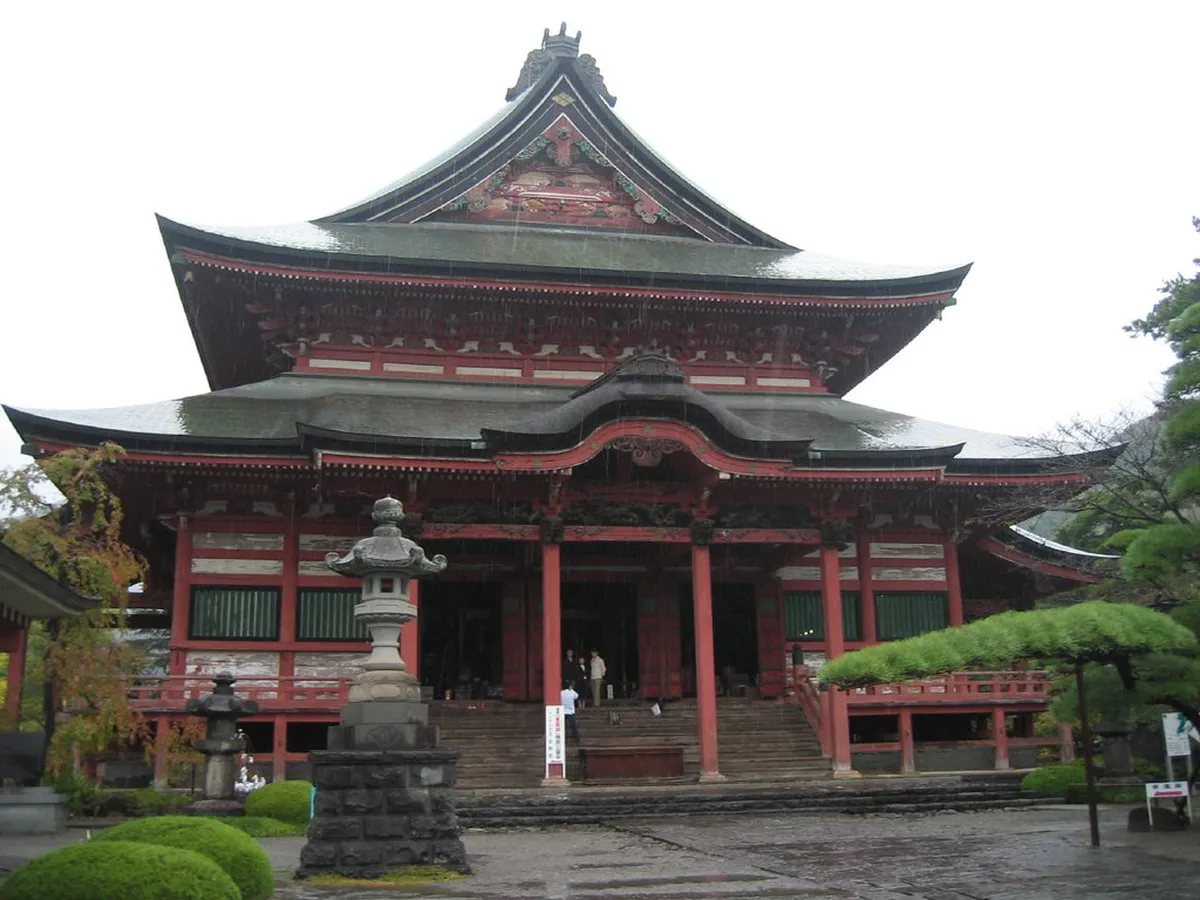
The temple has faced fires and forced relocations throughout its 1,400-year history. During the Sengoku period in 1555, warlord Takeda Shingen moved the sacred statue to Kofu to protect it during wartime conflict. What was meant to be temporary lasted over 40 years, with the statue passing through the hands of powerful warlords including Toyotomi Hideyoshi before finally returning to Zenkoji in 1598. The current Main Hall dates to 1707 and is designated a National Treasure — one of the largest wooden Buddhist structures in Eastern Japan.
What makes Zenkoji unusual among Japan's great temples is that it has never belonged to a single Buddhist sect. The sacred image predates Japan's sectarian divisions, so the temple remains non-sectarian. This history explains why the phrase "you should visit Zenkoji at least once in your lifetime" has been passed down since the Edo period. For many Japanese, the pilgrimage carries the same weight it did for those who walked for weeks to reach it.
Zenkoji: One Temple, Two Sects
Although Zenkoji is non-sectarian, its daily operations are managed jointly by two completely different Buddhist sects — the Tendai sect's Daikanjin and the Jodo (Pure Land) sect's Daihongan. This arrangement, known as "one temple, two sects," is extremely rare in Japanese Buddhism. Tendai and Pure Land hold significantly different teachings, yet they have co-governed Zenkoji for over 1,000 years.
Daikanjin oversees 25 sub-temples and is led by the Kancho, a head priest drawn from major Tendai temples. Daihongan manages 14 affiliated temples and is a nunnery — its head priest, the Zenkoji Shonin, has traditionally been a woman of noble lineage, which is itself rare among Japan's major temples. Together, the two institutions oversee 39 shukubo temple lodges around the main hall.
The morning service — Oasaji — alternates between the two head priests on a rotating basis. Each performs the ritual according to their own sect's traditions, which means the ceremony you witness depends on which institution is officiating that day. For visitors, the practical takeaway is that both Daikanjin and Daihongan are open to explore separately, each offering its own gardens, halls, and experiences.
Zenkoji: A Temple Open to All, Including Women
During Japan's medieval period, many of the country's most famous temples — including Enryakuji on Mount Hiei and Kongobuji on Mount Koya — maintained strict prohibitions against women entering. The prevailing belief was that women could not attain enlightenment in their current form. Zenkoji took a fundamentally different position from its founding. Not only did it welcome women, but its origin story is directly tied to a woman named Nyoze, whose encounter with the sacred image marked the beginning of the temple's faith community.
Daihongan, the temple's Jodo-sect institution, is itself a nunnery. Its head priest has traditionally been a woman — a remarkable fact in the context of Japanese religious history. This makes Zenkoji one of the few major Buddhist sites in Japan where female religious leadership has been continuous across centuries.
The practical result of this philosophy is that Zenkoji has always functioned as a spiritual refuge for people excluded elsewhere. Pilgrims who were turned away from other temples came here. The temple's universal salvation doctrine — that anyone who prays sincerely, regardless of gender, social status, or religious background, will be guided toward the Pure Land — remains the core of what draws people to Zenkoji today.
Planning Your Visit: Access, Hours, and Tickets
Zenkoji is straightforward to reach from Nagano Station. On foot, the walk north along Omotesando takes about 30 minutes — the approach street itself is worth the walk. By bus, take the route from Bus Stop No. 1 at the Zenkoji Exit of JR Nagano Station toward Zenkoji Daimon; from that stop it is approximately 8 minutes on foot to the main hall. By car, exit at Nagano IC on the Joshin-etsu Expressway and drive about 30 minutes to central Nagano. Parking is available in several lots near the temple at around ¥500 for 2 hours, but lots fill quickly on weekends and during festivals. Public transport is easier on busy days.
The Sanmon Gate, Sutra Repository, and museum open at 09:00 and close at 16:00. The Main Hall Inner Sanctuary opens one hour before the morning service — which begins at sunrise, as early as 05:30 in July and as late as 07:00 in January. The grounds themselves are accessible around the clock.
Ticket pricing in 2026 is as follows. The combined ticket (Main Hall inner area, underground passage, Sanmon Gate, Sutra Repository, and Museum) costs ¥1,200 for adults, ¥400 for high school students, and ¥100 for elementary school students. If you only want the Main Hall and Kaidan Meguri underground passage, that costs ¥600 for adults. The Sanmon Gate alone is also ¥600 for adults, and the Sutra Repository is ¥300. Entry to the main precinct and grounds is free. If you plan to visit more than two paid areas, the combined ticket saves money.
Allow 1.5 to 2 hours for the main hall, underground passage, and Sutra Repository. Add another 30 to 60 minutes for Omotesando browsing. If you attend the morning service, plan to arrive before sunrise. Shukubo lodging guests can join it without the early-morning logistics of commuting from elsewhere in the city.
Exploring Zenkoji's Main Attractions
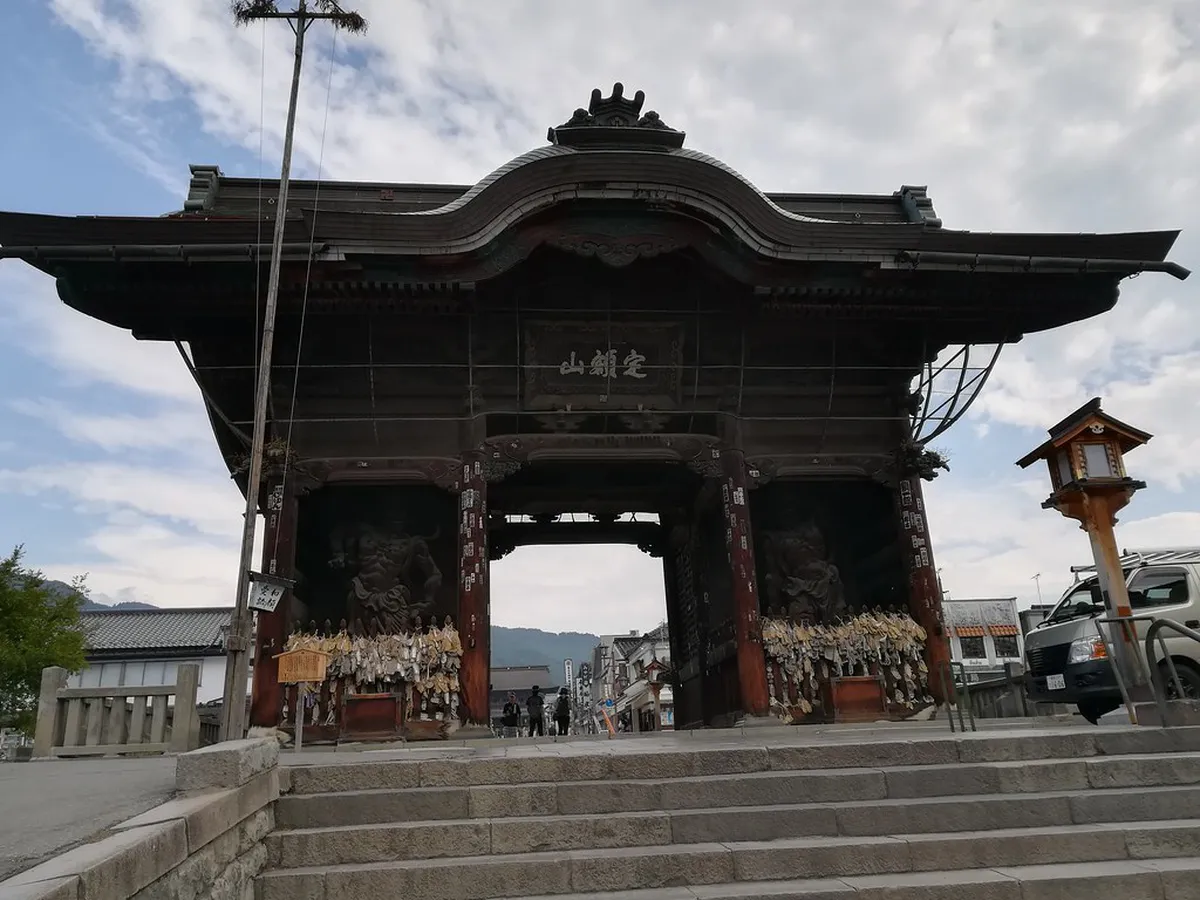
The Niomon Gate is the first major structure you pass through on the approach. Built originally in 1752 and rebuilt in 1918, it houses two guardian statues created by the renowned sculptor Koun Takamura — the same artist behind the famous Saigo Takamori statue in Ueno Park. The left statue (Agyo) has its mouth open, forming the sound "A," representing the beginning of all things; the right (Ungyo) holds its mouth closed, representing "Un" and the end. Two enormous straw sandals hang beside the gate — offerings symbolising the tradition of walking long distances to reach the temple.
The Sanmon Gate, built in 1750, hides a detail worth looking for: five pigeons are embedded within the gate's carved characters. The character for "zen" (善) is also said to resemble a cow, a reference to the saying "led by a cow to Zenkoji" — a woman who didn't believe in Buddhism once chased a cow that had stolen her cloth and ended up at the temple, where she found her faith. Climbing the gate (¥600) gives you expansive views over Nagano City.
Inside the Main Hall (Hondo), built in 1707 and a designated National Treasure, look for the Binzuru Sonja statue near the entrance. It is believed that touching the part of the statue corresponding to an ailment on your own body may bring healing. After 300 years of continuous touching, the statue has become completely smooth. Behind the altar at the rear of the hall, layers of curtains conceal the hidden Buddha — a presence you feel but cannot see.
The Kaidan Meguri underground passage beneath the Main Hall is one of Zenkoji's defining experiences. You descend into a pitch-black corridor and move forward by touching the wall. Somewhere along the route, you will encounter a metal latch — the "Key of Enlightenment" — fixed directly beneath where the hidden statue rests above. Touching it is said to create a direct connection with the Buddha and bring good fortune. The passage takes about 15 to 20 minutes and is included in the ¥600 Main Hall ticket.
The Kyozo Sutra Repository, west of the main hall, holds all 6,771 volumes of Buddhist scripture in an octagonal revolving bookcase weighing approximately 5 tons. Rotating it once clockwise is said to convey the same merit as reading all the scriptures. This is included in the ¥300 Sutra Repository ticket or the combined ticket.
Beyond the Main Hall: Spiritual Experiences and Hidden Details
The Oasaji morning service is a once-daily ritual that most visitors skip by arriving too late. The head priest — either from Daikanjin or Daihongan, on rotation — walks from their temple to the main hall just before service begins. If you line up and kneel in front of the main hall as the priest passes, they will touch your head with prayer beads. This ritual is called juzu-chodai and is one of the most direct blessings available to visitors. It takes no extra fee and requires only being there early.
At Daikanjin, three distinct meditative experiences are available beyond simply viewing the halls. Zazen seated meditation is guided by monks in a tatami-laid hall; chair options are available for those who cannot sit on the floor. Sutra copying involves grinding your own ink, then tracing a sutra with brush and paper — one copy goes to the monks, one you take home. Mawarigoma is a fire ceremony where you write wishes on wooden plaques and place them on a flame, with the smoke said to carry them to Fudo Myoo, a protective deity. Each of these experiences can be done in under an hour and offers genuine engagement with Buddhist practice rather than observation alone.
The Memorial to Lost Letters (Hagaki Jizo) is a quieter spot where visitors leave postcards and letters addressed to loved ones who have passed. The Flower Arranging Memorial honours Ikebana practitioners and the spiritual dimension of the art form, connecting the temple to Japan's tradition of finding mindfulness in beauty. The Lucky Cow statue on the grounds references the same legend as the Sanmon Gate — touching it is said to bring good fortune. These smaller sites reward visitors who take time to wander the full grounds rather than moving directly from gate to main hall and back.
The 2027 Gokaicho: Plan Ahead for a Rare Event
The hidden Buddha at Zenkoji has never been publicly displayed in the temple's entire history — not the original statue, which remains permanently sealed. But once every six years, a precise replica is placed on public view in a ceremony called the Gokaicho. The next Gokaicho runs from April 4 to June 19, 2027. For the roughly two-month window it is held, visitors can see the statue that otherwise only the priests know.
The Gokaicho draws far larger crowds than a typical visit — expect the temple and Omotesando to be significantly busier during that window, particularly on weekends and public holidays. Shukubo lodging books out weeks in advance during the festival. If your travel dates are flexible and you want to experience Zenkoji at its most spiritually charged, timing your trip for April or May 2027 is worth serious consideration.
If you are visiting in 2026 rather than 2027, the regular experience remains compelling. The hidden statue's permanent concealment is itself the point — the faith tradition holds that the act of travelling here and praying sincerely carries merit regardless of whether you can see the image. But knowing the Gokaicho is coming makes 2026 a good time to visit without the festival crowds, while 2027 offers something genuinely uncommon.
Omotesando and Nakamise Shopping Street
The Omotesando is the stone-paved main approach running from central Nagano north to Zenkoji's gates, lined with shops, restaurants, and cultural experiences. The Nakamise section closer to the temple concentrates the souvenir and food vendors. Walking the full approach from the station takes about 30 minutes; if you prefer to save time, take the bus to Zenkoji Daimon and walk the final 8 minutes from there, which puts you directly in the Nakamise section.
Oyaki — stuffed dumplings made from wheat or buckwheat dough — are everywhere on the approach. Common fillings include nozawana greens, pumpkin, dried radish, and sweet red bean. Quality and size vary considerably between stalls; prices run around ¥250 to ¥300 each. Other Nagano specialties to look for include Shinshu miso products, soba snacks, nozawana pickles, shichimi spice blends, and chestnut-based sweets. The spice shop Yawataya Isogoro on the street lets you blend your own shichimi from scratch.
Beyond shopping, the street offers hands-on cultural experiences. At Ogawa no Sho you can make oyaki yourself over a traditional irori hearth. Zenkoji Pudding hosts a matcha tea ceremony with an English-speaking guide. Galarie Ren offers bracelet-making based on Buddhist monk prayer beads. Each takes under an hour and is a practical way to engage with local crafts rather than just observing them. The street is liveliest late morning to early afternoon; weekday mornings are quieter for those who prefer a calmer experience.
Staying Near Zenkoji: Shukubo and Other Options
The 39 shukubo temple lodges surrounding Zenkoji are among the most distinctive places to stay in Nagano. Staying at one means sleeping in a traditional tatami room, eating shojin ryori — the plant-based cuisine of Buddhist monks, prepared without meat, fish, or garlic — and being positioned to attend the Oasaji morning service and juzu-chodai blessing without commuting from elsewhere. The cuisine sounds austere but relies on seasonal vegetables, tofu, and carefully prepared Japanese ingredients; it is also well-suited for vegans and vegetarians. Fuchinobo is one of the more accessible options for first-time visitors.
For a hot spring stay, Dormy Inn near Nagano Station has a rooftop natural onsen bath. Uruoikan, about 30 minutes' walk from the temple, offers tatami rooms with iron-rich brown spring water baths. Budget travellers can find affordable dormitories and private rooms at hostels like 1166 Backpackers, which are close to the Omotesando approach. Find accommodation near Zenkoji on Agoda or Booking.com.
Nearby Attractions and Day Trips from Zenkoji
Joyama Park sits immediately adjacent to the temple grounds. In spring (mid to late April) cherry blossoms cover the park; from late June to late July hydrangeas bloom in the temple garden; mid to late November brings golden ginkgo and red maple. The park also houses the Nagano Prefectural Shinano Art Museum, making it a natural extension of any morning at Zenkoji.
Jigokudani Monkey Park is the most popular day trip from Nagano, accessible by bus and a short walk. Wild Japanese macaques bathe in natural hot springs throughout the year, but the experience is most striking in winter when snow covers the ground around the pools. Allow half a day for the trip.
The Togakushi Shrine complex, set in forested mountains north of Nagano City, connects five shrines via trails lined with 400-year-old cedars. The area is also famous for Togakushi soba, made from locally grown buckwheat. The round trip takes most of a day. For something closer and more urban, the historical castle town of Matsushiro — 30 minutes by bus from central Nagano — has samurai residences, Matsushiro Castle ruins, and a WWII underground tunnel system. The town of Obuse to the east is known for its Hokusai Museum and chestnut sweets, reachable by the Nagano Electric Railway in about 30 minutes. Explore more of Nagano for the full range of options.
Zenkoji's combination of 1,400 years of unbroken history, non-sectarian openness, and genuinely immersive rituals — the dark underground passage, the morning blessing, the fire ceremony at Daikanjin — makes it one of the most substantive temple visits in Japan. Unlike many sites where you admire architecture from a distance, Zenkoji gives you things to do and experience at nearly every level of engagement, from a free stroll through the Niomon Gate to an overnight stay at a shukubo. If you are planning for 2026 or 2027, the approaching Gokaicho adds a timing dimension worth factoring in. Go in 2026 for smaller crowds; go in 2027 if seeing the replica hidden Buddha matters most.
For authoritative information, refer to the Zenko-ji Temple on Wikipedia and Zenko-ji Temple official site.