

Ouchi-juku From Aizuwakamatsu Travel Guide & Itinerary
Plan your trip to Ouchi-juku from Aizuwakamatsu with our comprehensive guide. Discover transportation, top attractions, local food, and essential tips for a memorable journey.
On this page
Ouchi-juku offers a rare step back into Japan's Edo period. This beautifully preserved post town, nestled in Fukushima Prefecture, feels wonderfully authentic. Its thatched-roof houses line a dirt road, inviting visitors to imagine life centuries ago. The village served as a vital stop on the Aizu Nishi Kaido trade route connecting Aizuwakamatsu with Nikko, and today it holds status as a designated National Important Preservation District for Groups of Historic Buildings. Unlike more crowded historical sites, Ouchi-juku retains a serene, almost untouched feel.
For visitors already in Aizuwakamatsu, this is one of the most rewarding half-day side trips in the Tohoku region. The public transport route — Aizu Railway to Yunokami Onsen Station, then the Saruyu-go shuttle bus — is straightforward and affordable. This guide covers every step: how to get there, what to see, what to eat, which season to go, and whether the JR EAST PASS is worth adding to your wallet.
Welcome to Ouchi-juku: A Glimpse into Edo-Era Japan
Ouchi-juku is a captivating village in Fukushima Prefecture, renowned for its perfectly preserved Edo-era streetscape. Walking its main thoroughfare feels like stepping directly into a historical drama. The traditional thatched-roof buildings once served as inns and shops for feudal lords and travelers using the sankin-kotai routes. This historic post town played a crucial role on the Aizu Nishi Kaido, facilitating trade and communication across the mountains.
The village's authenticity is not accidental. Residents formally agreed to three guiding principles when Ouchi-juku was designated as a National Important Preservation District in 1981: don't sell, don't rent, don't destroy. That self-imposed pact is the reason you won't find a convenience store or modern shopfront breaking the roofline. The buildings you see are inhabited, maintained, and used by the people who have always lived here — which is what separates Ouchi-juku from reconstructed heritage parks elsewhere in Japan.
Aizu is still far from the overtourism visible in Kyoto or Nara. Ouchi-juku draws a steady crowd on weekends, particularly during the snow festival and autumn foliage peak, but a weekday visit in spring or early summer can feel almost private. That combination of genuine history and manageable crowds makes the day trip from Aizuwakamatsu a genuine highlight of any Fukushima itinerary.
Getting to Ouchi-juku from Aizu-Wakamatsu: Step-by-Step
The most practical route from Aizuwakamatsu combines the Aizu Railway with the Saruyu-go shuttle bus. Total travel time is around 60 minutes each way, and total cost is under JPY 2,000 one-way. Here is each step in detail.
- Head to Aizu-Wakamatsu Station. The station is central and easily reached by local bus or a short taxi from most hotels. Aim to arrive at least 15 minutes before departure to buy tickets. The Aizu Railway counter is on the ground floor, and there are also vending machines.
- Buy an Aizu Railway ticket to Yunokami Onsen Station (湯野上温泉駅). A one-way ticket costs approximately JPY 1,050. This is a private railway line — it is not covered by the JR EAST PASS. Pay in cash at the counter or machine.
- Board the Aizu Railway Line toward Aizu-Tajima or Kinugawa Onsen. Trains run roughly once per hour. The ride takes about 40 minutes through attractive rural valleys. Yunokami Onsen Station itself is worth a moment — the station building has a traditional thatched roof, making it one of the most photogenic in Japan.
- Transfer to the Saruyu-go Bus (猿游号) at Yunokami Onsen Station. The shuttle bus connects the station directly to Ouchi-juku. A 2-day unlimited-ride ticket costs JPY 1,100 for adults (JPY 550 for children), which is worth buying even for a single day if you plan to return by bus. Cash only. The ride takes about 15–20 minutes.
- Explore the village. The bus drops you at the Ouchi-juku entrance, a short walk from the main street. Allow 2–3 hours inside the village. Check the return bus timetable before you set off — missing the last bus means a taxi back to Yunokami Onsen (approximately JPY 2,000–3,000).
| Leg | Transport | Duration | Cost (one-way) | Notes |
|---|---|---|---|---|
| Aizuwakamatsu → Yunokami Onsen | Aizu Railway (private line) | ~40 min | ¥1,050 | Runs hourly. NOT covered by JR EAST PASS. Yunokami Onsen Station has a thatched-roof building. |
| Yunokami Onsen → Ouchi-juku Entrance | Saruyu-go Shuttle Bus | 15–20 min | ¥550 (day ticket ¥1,100) | Timed to meet train arrivals. Cash only. Last bus departs Ouchi-juku at 15:12. |
| Ouchi-juku Entrance → Main Street | Walking | 5–10 min walk | Free | Slight uphill. Unpaved dirt road surface. |
Saruyu-go Bus Timetable (from Yunokami Onsen Station)
The bus runs on a schedule timed to meet arriving trains. Typical departures from Yunokami Onsen Station in the 2025–2026 season: 09:45 / 10:30 / 11:30 / 12:15 / 13:35 / 14:54. Return departures from Ouchi-juku Entrance: 10:05 / 10:50 / 11:50 / 12:35 / 13:55 / 15:12. Service may be reduced or suspended during heavy snowfall between November and March. Always confirm with the operator (Hirota Taxi) before traveling in winter. See the Ouchi-juku Bus Stop location here.
Plan your return by mid-afternoon. The last Saruyu-go bus departs Ouchi-juku at 15:12, arriving back at Yunokami Onsen by 15:30. Missing this bus means a costly taxi back to the station (¥2,000–3,000). Set a phone reminder 30 minutes before your chosen return bus departure to avoid losing track of time while exploring the viewpoint or shopping.
Other Transport Options
- Taxi from Aizuwakamatsu direct: JPY 8,000–12,000 one-way, around 45–60 minutes. Good for groups of three or four splitting the cost, or travelers with heavy luggage.
- High-Grade Taxi by Aizu Kotsu: A reservation-based charter service that covers the entire Aizu region. More comfortable than a standard taxi, with spacious vehicles and local drivers who know seasonal road conditions. Useful for a combined Aizuwakamatsu sightseeing day since you can design your own sequence of stops.
- Rental car: JPY 6,000–10,000 per day. Maximum flexibility, especially useful for adding Tonohetsuri gorge (see below) without relying on bus timings.
Getting to Ouchi-juku from Tokyo and Beyond
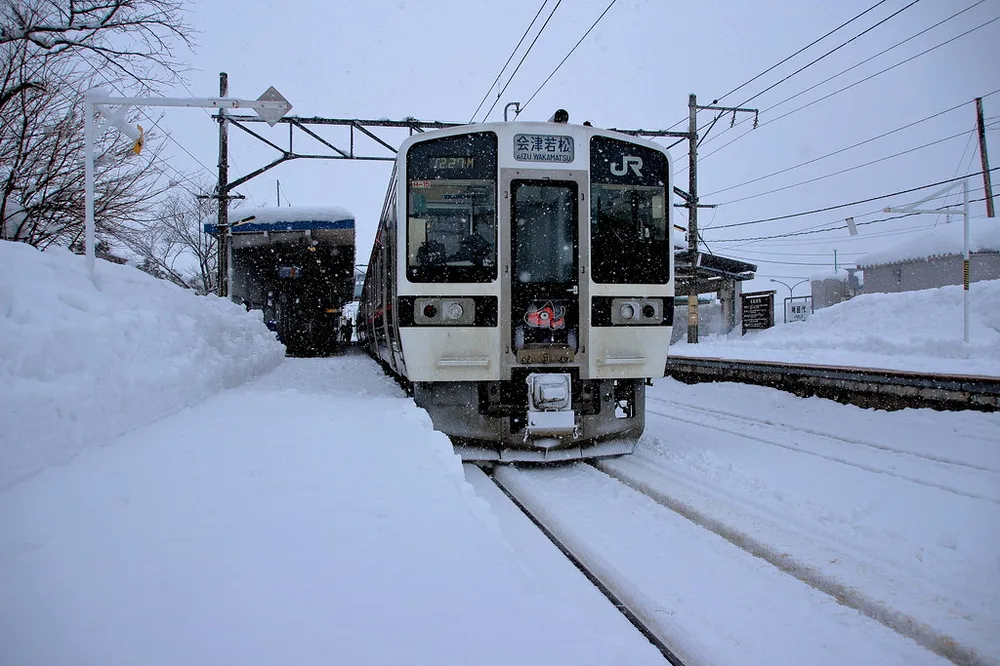
Most visitors arrive at Aizuwakamatsu by taking the Tohoku Shinkansen from Tokyo to Koriyama (approximately 80–90 minutes), then switching to the JR Ban-etsu West Line from Koriyama to Aizuwakamatsu (approximately 60–75 minutes). Both of these legs are covered by the JR EAST PASS. The total journey from Tokyo to Aizuwakamatsu without a pass costs roughly JPY 9,000–11,000 one-way.
From Fukushima City, take the JR Tohoku Main Line south to Koriyama, then the Ban-etsu West Line west to Aizuwakamatsu. From Koriyama alone the journey is about 75 minutes and costs JPY 1,170 without a pass. Both routes are JR-covered and straightforward to navigate with a standard train map or the NAVITIME app.
Is the JR EAST PASS Worth It for Your Ouchi-juku Trip?
The JR EAST PASS (Tohoku area) costs JPY 30,000 for adults (JPY 15,000 for children aged 6–11) and covers 5 consecutive days of unlimited JR East travel, including Shinkansen. It is available to temporary visitors and foreign residents with a passport. You can buy it online at the official JR-EAST Train Reservation site, at select overseas travel agencies, or at JR EAST Travel Service Centers inside Japan.
Here is the critical caveat: the pass covers the Shinkansen to Koriyama and the Ban-etsu West Line to Aizuwakamatsu, but it does not cover the Aizu Railway to Yunokami Onsen (a private line). You pay that JPY 1,050 out of pocket regardless. A standard round-trip from Tokyo to Aizuwakamatsu on JR lines costs roughly JPY 19,000–20,000. At JPY 30,000 for the pass, you break even only if you add at least one other long-distance journey. The clearest example: adding a return trip from Tokyo to Sendai (over JPY 22,000 by itself) makes the pass immediately worthwhile.
If Ouchi-juku is your only destination outside Tokyo, buy point-to-point tickets instead. If you are building a wider Tohoku loop — perhaps Sendai, Matsushima, Yamadera, and Aizuwakamatsu across 5 days — the pass pays off easily. One suggested 5-day itinerary that maximizes the pass: Day 1 Tokyo to Sendai and Matsushima Bay; Day 2 day trip to Yamadera; Day 3 travel to Aizuwakamatsu; Day 4 Ouchi-juku and Tonohetsuri; Day 5 return to Tokyo via Shinkansen.
Top Things to Do in Ouchi-juku
The main street is the obvious starting point, but there are a handful of specific spots that are worth seeking out rather than wandering past.
- The Viewpoint (Miharashidai): Climb the stone steps at the far end of the main street to reach the lookout. This is the elevated vantage point for the iconic panoramic photograph of the village — rows of thatched roofs with mountains behind them. It is especially striking with autumn foliage (late October to early November) or snow cover (January–February). Arrive before 10:00 to avoid other photographers at the railing.
- Ouchi-juku Townscape Exhibition Hall (Machinami Tenjikan): This is the restored Honjin, the former inn reserved for feudal lords and senior samurai. Inside you can see period artifacts and a traditional irori open hearth that is kept lit daily — the woodsmoke smell alone is worth the admission. Entry is JPY 250 for adults (as of 2025). Allow 20–30 minutes.
- Takakura Shrine: A short walk off the main street, this tranquil shrine is dedicated to Prince Mochihito. In the grounds stands a Japanese cedar estimated to be over 800 years old. The shrine sees very few visitors compared to the main street and offers a quieter moment during busy periods.
- Tonohetsuri gorge (add-on stop): On the return journey, consider stopping at Tonohetsuri Station — four stops before Yunokami Onsen on the Aizu Railway. The gorge features dramatic cliff formations carved by the Agano River over a million years, crossed by a suspension bridge. It takes about 30–45 minutes to walk and is designated as a National Natural Monument. The Aizu Railway ticket from Aizuwakamatsu covers the full line, so this stop costs nothing extra beyond timing.
Plan for 2–3 hours in the village proper if you want a meal, the viewpoint, and both museums. Add another hour for Tonohetsuri if you make that your return stop.
Savoring Ouchi-juku: Local Cuisine Beyond Negi Soba
Negi soba is the dish that defines Ouchi-juku for most visitors. Hand-made buckwheat noodles are served in a hot broth, and instead of chopsticks, you eat using a full stalk of negi (green onion) — which doubles as a condiment as you bite into it. Misawaya and Oku-Aizu Ouchi-juku Daikokuya are the most established restaurants for this experience. Most restaurants are open from roughly 09:00 to 16:30, though hours narrow in winter. Arrive before 11:30 or after 13:30 to avoid the peak queue.
Negi soba eating technique. The negi stalk is not a decoration — it's your utensil and your condiment. Break off a piece, bite it, then dip it into your broth before eating a spoonful of noodles. The peppery bite of the fresh leek pairs perfectly with the earthy noodles. First-time visitors often find this ritual delightfully quirky, and locals are patient with travelers learning the ropes.
The other local dishes are worth trying and rarely get the attention they deserve. Shingoro is a grilled rice cake on a skewer, coated in a sweet-savory paste made from egoma (a sesame-adjacent perilla seed) mixed with miso. Street stalls sell them for JPY 200–350 each and they are best eaten hot at the stand. Tochi-mochi is mochi made with horse chestnut flour, giving it a faintly bitter, earthy taste that pairs well with the local air. Iwana no shioyaki — river char simply salted and skewered over charcoal — appears on many menus and in front of several shops as a display fire; the fish is sourced from mountain streams in the Aizu basin.
If you stay overnight, the picture changes entirely. Accommodation at a place like Honke Ogiya includes an evening meal centered on kozuyu, a traditional Aizu clear soup made with dried scallop broth, taro, shirataki noodles, wheat gluten, shiitake, and wood ear mushrooms. The dish has deep local meaning — there was once a custom in Aizu that guests could have multiple servings of kozuyu without it being considered impolite, a quiet expression of the region's hospitality. Dinner also typically includes ayu grilled over an irori hearth and small dishes made from preserved mountain vegetables — foods that reflect the practical wisdom of surviving heavy snowfall winters. Accommodation in the village is very limited, so book at least 6–8 weeks in advance for weekend stays.
Seasonal Charms: Experiencing Ouchi-juku Year-Round
Each season delivers a genuinely different experience, and the choice affects both what you see and how crowded the village is.
Winter (December–February) is the most atmospheric. Heavy snowfall settles on the thatched roofs and turns the main street into something from an old woodblock print. The Ouchi-juku Snow Festival is held annually on the second Saturday and Sunday of February — in 2026, that falls on 7–8 February. At night, men in traditional loincloths carry a sacred flame to light hundreds of handmade snow lanterns lining the street, culminating in fireworks above the snow-covered village. It is the most-photographed event in the Aizu calendar. Winter is also the most logistically demanding season: the Saruyu-go bus schedule is reduced and can be suspended during heavy snowfall, road access by car requires snow tires, and temperatures in the village fall well below freezing after dark. Wear waterproof boots with grip, carry hand warmers, and confirm bus operation the morning you travel.
Spring (late March–May) brings cherry blossoms around the village perimeter and along the Aizu Railway route. Crowds are lighter than winter festival weekends, and the weather is mild. Summer (June–August) offers lush green scenery and the Hange Festival on 2 July each year — a procession through the village featuring participants in ancient costumes, an event tied to Takakura Shrine with over 800 years of history. Early summer weekdays are among the quietest times to visit. Autumn (late October–early November) is the busiest non-festival period, when the surrounding hills turn orange and red. This is when the viewpoint photograph looks its most dramatic, but expect weekend crowds comparable to the snow festival.
Planning Your Ouchi-juku Day Trip: Essential Tips
A day trip leaving Aizuwakamatsu by 09:00 gives you a comfortable window. The first sensible train departure typically gets you to Yunokami Onsen in time for the 09:45 or 10:30 Saruyu-go bus. That puts you in the village by 10:00–11:00, leaving time for the viewpoint, Machinami Tenjikan, a full lunch, and leisurely shopping before the 13:55 or 15:12 return bus. The last bus back from Ouchi-juku to Yunokami Onsen runs mid-afternoon, so losing track of time is the most common mistake.
- Carry enough Japanese yen cash. Many village shops and stalls are cash-only, and there is no ATM inside the village. The nearest cash machine is at the convenience store in Shimogo, several kilometers away.
- Wear comfortable walking shoes with good grip. The main street is an unpaved dirt road that becomes muddy in rain and slippery in snow.
- Pack layers. The village sits at around 650 meters elevation. Even in summer the mornings are noticeably cooler than Aizuwakamatsu city, and wind along the main street can be sharp.
- Weekday visits are markedly quieter, especially at the viewpoint and inside the Machinami Tenjikan. If your schedule allows, Tuesday to Thursday outside festival weekends is ideal.
- Winter visitors: confirm Saruyu-go bus operation by calling Hirota Taxi the morning you travel. Do not rely on online timetables during heavy snowfall weeks.
Combining Ouchi-juku with Your Aizuwakamatsu Itinerary
Aizuwakamatsu works best as a two-night base. On the first day, explore the city's core historical sites: Tsurugajo Castle and the Aizu Bukeyashiki (Samurai Residence) are both within easy reach of the station, and together they fill a comfortable morning. The afternoon can extend to the Iimoriyama and the Byakkotai Memorial, which tells the story of the young samurai who died during the Boshin War — a poignant counterpart to the castle. For those interested in local craft, a lacquerware workshop session (Hashiten Togidashi, held at venues like Tenneiji Soko in Aizuwakamatsu) adds another layer that is impossible to replicate elsewhere. The second full day is then dedicated to the Ouchi-juku day trip.
If you want to add Tonohetsuri gorge to the Ouchi-juku day, the sequence works cleanly: take the early train to Tonohetsuri, spend 45 minutes at the gorge, then reboard the train to Yunokami Onsen and transfer to the Saruyu-go bus. This adds no extra cost to your Aizu Railway ticket and only about 30 minutes to the total travel time. For a full list of day trips from Aizuwakamatsu, including options toward Bandai and Lake Inawashiro, see our dedicated guide. You can also find more ideas in our Aizuwakamatsu itinerary guide.
Frequently Asked Questions
Is the JR EAST PASS Worth It for an Ouchi-juku Trip?
The JR EAST PASS is valuable for reaching Aizuwakamatsu from Tokyo or other major cities. However, the Aizu Railway Line to Yunokami Onsen is not covered by this pass. You will need to purchase a separate ticket for this specific train segment.
How Long Do You Need in Ouchi-juku?
Most visitors find 2-3 hours sufficient to explore Ouchi-juku's main street, shops, and museum. This allows time for a meal and photography. A full day trip, including travel, is a common and enjoyable option.
Which Ouchi-juku from Aizuwakamatsu options fit first-time visitors?
The train to Yunokami Onsen, followed by the Saruyu-go bus, is ideal for first-time visitors. It is cost-effective and relatively easy to navigate. This combination offers a balanced and authentic local travel experience.
What should travelers avoid when planning Ouchi-juku from Aizuwakamatsu?
Avoid arriving late in the day, especially in winter, as bus services become less frequent. Do not rely solely on the JR Pass for the entire journey. Always verify bus schedules in advance to prevent long waits.
Visiting Ouchi-juku from Aizuwakamatsu offers a truly unique cultural experience. This journey transports you to a bygone era, far removed from modern city life. With careful planning — and the right bus timetable in your pocket — your trip will be smooth and incredibly rewarding. Whether you choose public transport or a charter taxi, the beauty of this historic post town awaits. Remember to savor the local cuisine beyond just the negi soba, and leave time for the viewpoint at dusk if you can. It truly is a highlight of the Fukushima region.
For trip-planning details, see Ouchi-juku on Wikipedia and the official Fukushima travel guide.
Free guide: Japan's Hidden Gems
12 under-the-radar places beyond Tokyo & Kyoto — with the best season to visit each and a local tip you won't find in the guidebooks.
You might also like


Continue reading
More guides you'll find useful


