

8 Things to Know for Shirakawa-go Winter Light Up 2026-2027
Plan your Shirakawa-go winter light up trip with 2026-2027 dates, reservation lottery tips, bus tour comparisons, and essential winter packing lists.
On this page
The Shirakawa-go winter light up transforms the UNESCO World Heritage village of Ogimachi into a glowing snow landscape on just a handful of evenings each January and February. Illumination runs from 17:30 to 19:30, and access after 15:00 requires a pre-booked permit — no walk-ins allowed. Planning should start at least six months in advance because every access route, from parking lotteries to commercial bus tours, sells out within hours of opening. Our best time to visit guide covers the full seasonal picture beyond the light-up dates.
This guide covers the 2026-2027 event calendar, the lottery and bus-tour options in detail, the fastest photography spots, and what to pack for temperatures that regularly hit -10°C / 14°F. Whether you are traveling from Nagoya, Takayama, or Tokyo, the logistics differ significantly and choosing the wrong route can mean missing the observation deck entirely.
Overview of the Shirakawa-go Winter Illumination
The village of Ogimachi in Gifu Prefecture is famous for its gassho-zukuri farmhouses — steep thatched roofs shaped like hands pressed together in prayer, engineered to shed several meters of mountain snow each winter. During the illumination, spotlights hit these roofs from below while warm light glows from interior windows, creating a contrast against the white snowpack that has made this one of Japan's most photographed winter scenes. The Sho-gawa River running alongside the village mirrors the golden light, adding a second layer to long-exposure shots. Visitors can explore these structures in daylight detail at the top village attractions before the evening event begins.
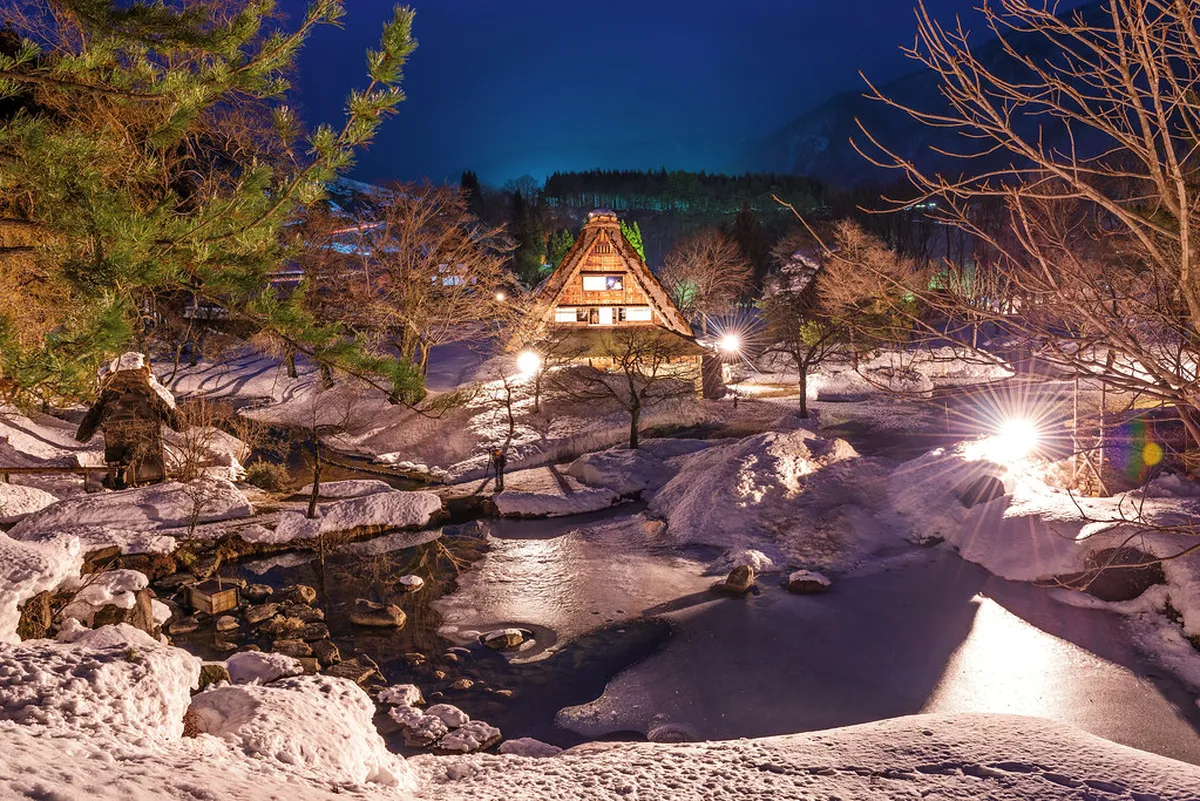
The event runs on only four to six selected evenings per season, which is what drives the intense demand. It was first organized to share the village's winter beauty while keeping disruption to permanent residents manageable. Snow depth can exceed 200 cm / 78 inches at peak season, so the roofs are never just decorative — you are watching architecture that is actively doing its job. Expect to share the experience with several hundred other visitors even on a sold-out tour night.
2026-2027 Official Event Dates and Times
For the 2026 season, confirmed Meitetsu Kanko Bus departure dates are January 12, 18, and 25, and February 1. The official village illumination runs 17:30–19:30 on each event evening. Daytime visitors without an evening reservation must clear the village by 15:00 — the gap between 15:00 and 17:30 is reserved for clearing day-trippers and staging the evening access. Check the Official Shirakawa-go Event Page each September when the full calendar for the following winter is published.
Planning your arrival around these hard cutoffs matters. Most travelers use the daytime window to walk the village, visit farmhouse interiors, and eat lunch before the 15:00 clearance. The sun sets early in the mountains and the sky turns deep blue by around 17:00, giving a narrow but spectacular window before the spotlights dominate. Most tours arrive in Shirakawa-go by mid-afternoon after a morning stop in Takayama, which lets you use the full daytime period. Read our guide on getting to Shirakawa-go from Takayama for bus schedules and journey times.
The Reservation Lottery: How to Secure Your Spot
Three separate lottery systems control evening access, and you only need to win one. The overnight farmhouse lottery opens in early October on the official village website — winning this gives you the most immersive experience and usually includes observation deck access. The parking permit lottery, also via the village site, is the option for independent drivers with private vehicles. Both lotteries are competitive; success rates are low, and the process is primarily in Japanese.
The official lottery for farmhouse stays and parking permits opens in early October and fills within days. Missing the October opening window means your only remaining options are commercial bus tours, which also sell out by late October. Set your calendar reminder now for late September to check the village event page when dates are announced.
The most practical option for international travelers is a commercial bus tour, but these also require fast action. Nohi Bus, which operates from Takayama station, typically opens phone reservations about one month before each event date. When TiptoeingWorld's writer called on the exact opening day in 2017, every seat was already gone — the line had sold out in under two hours. The same pattern holds today. Set a calendar reminder for late October and be ready to book the moment reservations open. Having a backup tour operator already bookmarked before that date is essential.
A useful planning calendar: September — official dates announced, check the village event page. Early October — overnight farmhouse lottery opens. Late October — parking lottery and most commercial bus tours open bookings. November — most tours fully booked. If you reach December without a booking, check for cancellation releases on tour operator sites.
Transport Comparison: Bus Tours from Nagoya, Takayama, and Tokyo
The three main departure cities each suit a different itinerary. Travelers based in Nagoya have the most structured option: Meitetsu Kanko Bus runs a guaranteed-departure day tour at ¥25,000 per person (tax included) that combines a morning in Takayama with the evening light-up. Buses depart from Meitetsu Bus Center 4F. Bus No. 1 meets at 09:50 and returns around 21:40. Bus No. 2 and No. 3 meet at 10:50 and return around 22:40. Bus No. 4 meets at 10:10 and returns around 22:00. The tour is departure-guaranteed with just one passenger booked, English-speaking staff are on board, and dinner in a gassho-zukuri farmhouse (mini Hida beef steak on rice with soba) is included for buses 1–3. The total duration is roughly 12 hours 40 minutes.
One practical detail that most guides omit: if you or anyone in your group cannot eat beef, book Bus No. 4 specifically. Buses No. 1–3 serve Hida beef as the set dinner inside a farmhouse; Bus No. 4 substitutes an optional set dinner at a regular restaurant, making it suitable for halal, vegetarian, or beef-free diets. This is confirmed in the Meitetsu booking terms and is a detail worth checking when booking for a group with dietary restrictions.
Travelers coming from Takayama can use Nohi Bus for the short transfer, but as noted above, those seats disappear within hours of release. From Tokyo, operators including Club Tourism and Willer Express run overnight bus-and-tour packages that include the light-up. The Tokyo route is longer — roughly six hours each way via limited express train to Matsumoto then bus — but these packages frequently include observation deck access that shorter Nagoya day tours do not. Note that the Meitetsu Nagoya tour does not include observation deck access; the tour information explicitly states that deck tickets are unavailable on their itinerary. If the Shiroyama viewpoint shot is your primary goal, a Tokyo-departing package or an overnight farmhouse stay are the routes that reliably include it.
| Operator | Departure | Price | Dinner Included | Observation Deck |
|---|---|---|---|---|
| Meitetsu Kanko Bus (No. 1–3) | Nagoya | ¥25,000 | Hida beef set | No |
| Meitetsu Kanko Bus (No. 4) | Nagoya | ¥25,000 | Optional (non-beef) | No |
| Nohi Bus | Takayama | ~¥3,000–5,000 | No | Varies |
| Club Tourism / Willer Express | Tokyo | ~¥60,000–80,000 | Yes (overnight pkg) | Yes (most packages) |
Photography Guide: Viewpoints and Blue Hour Timing
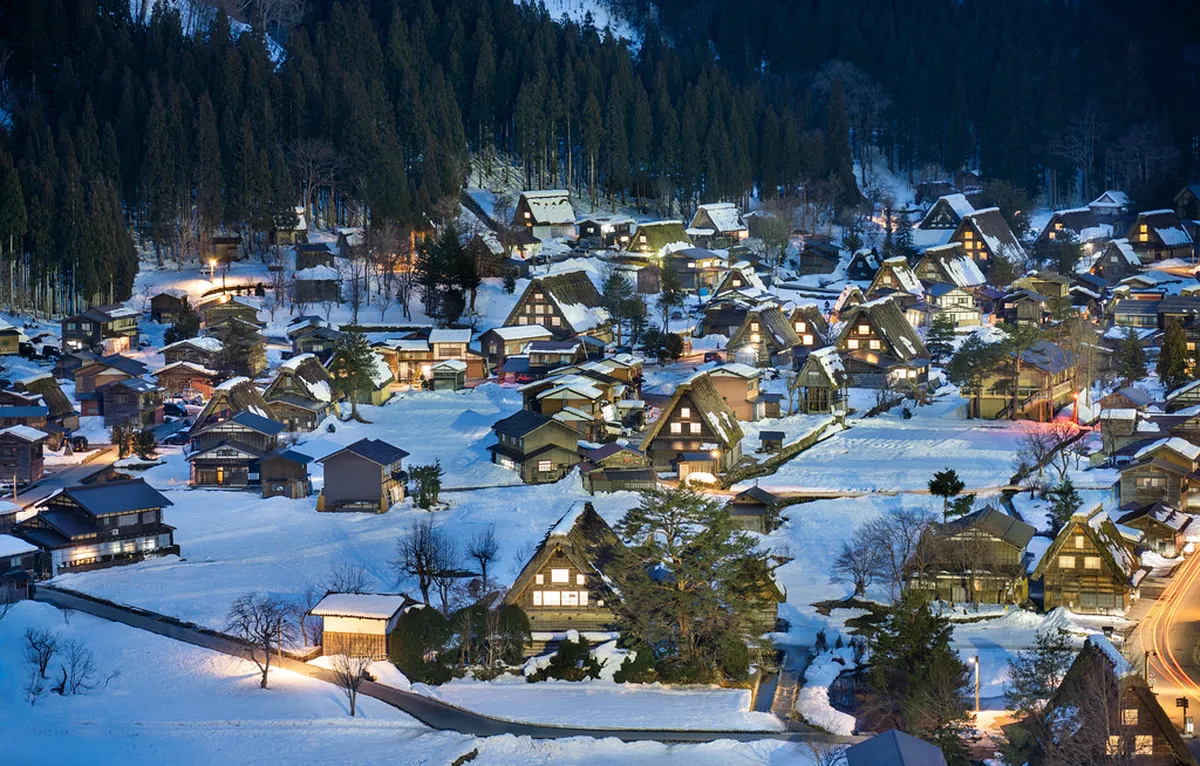
There are two distinct vantage points and they require different access routes. The Shiroyama Observation Deck sits on the hill above the village and gives the classic wide-angle view of the entire Ogimachi basin — rows of thatched roofs glowing against the dark mountain backdrop. Access during the light-up is controlled by a dedicated shuttle bus ticket, which is only available through the overnight lottery or certain tour packages (primarily Tokyo-departing ones, as noted above). The walking trail to the deck is closed on event nights for safety. If your tour does not include deck access, expect to view from village level only.
Village-level viewing is not a consolation prize. Walking the main path through the village while the snow is falling and lights glow from every window is the more atmospheric experience for most visitors. The Deai Bridge, which connects the Seseragi parking lot to the village entrance, is one of the most dramatic angles — the bridge itself is lit and the farmhouses beyond form a layered backdrop. Position yourself here just after the lights come on at 17:30 before the crowd thickens.
The blue-hour window is short but valuable. Between roughly 16:45 and 17:15 on a clear evening, the sky grades from deep blue to indigo while the village lights are beginning to warm up. This transition period — before the sky goes fully black — produces the most balanced exposures, where both the sky texture and the illuminated roofs are visible in a single frame without blowing out highlights. A tripod is essential for this; bring one even if your camera handles high ISO well, because the low-angle winter light and moving snow create conditions where a stable platform gives you options. Spare batteries are non-negotiable — cold drains them rapidly.
Accommodation: Staying in a Gassho-zukuri Farmhouse
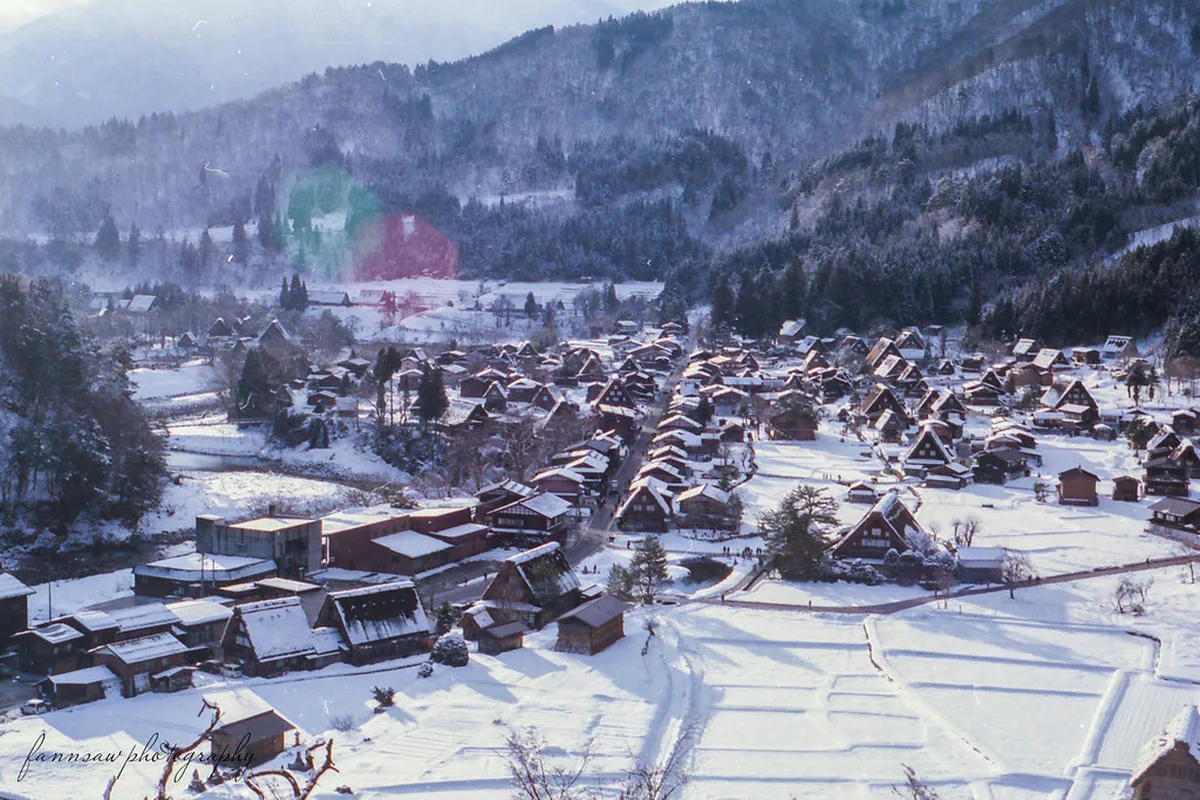
Booking an overnight stay in one of Ogimachi's working gassho-zukuri farmhouses is the highest-tier experience the event offers. Guests sleep in traditional rooms on the upper floors of centuries-old structures, with dinner and breakfast usually provided by the host family. Waking up inside the village before other visitors arrive — when fresh snow has reset the scene overnight — is an experience no day tour replicates. Most farmhouse inns (minshuku) charge between ¥15,000 and ¥25,000 per person including dinner and breakfast.
The practical catch is timing: farmhouse stays during light-up evenings are allocated through the lottery that opens in early October, and demand far exceeds supply. The village has a limited number of licensed accommodation properties, and the light-up dates fill up immediately. Apply early and apply for multiple dates if your schedule allows. If you do secure a farmhouse stay, your reservation typically includes access to the observation deck shuttle — this is what makes overnight guests the only category that reliably gets both the village atmosphere and the hilltop panorama. For more on the village layout and which farmhouses are open to visitors, see our guide to Shirakawa-go attractions.
What to Pack for Your Winter Visit
Footwear is the single most important preparation decision. The village paths become packed ice as hundreds of visitors walk the same routes, and the slope up toward the viewpoint area is steep. Standard city boots are dangerous here — several tour operators, including Meitetsu, explicitly state in their booking terms that grip-sole waterproof boots are strongly recommended. If you only have city boots, small detachable snow spikes (sold at convenience stores and outdoor shops near Takayama station for around ¥1,000–¥1,500) can attach over existing footwear and provide meaningful traction. Do not skip this step.
Temperatures drop to -10°C / 14°F or below after sunset, and the wind chill in the mountains makes it feel much colder. Plan your layers carefully and bring one spare battery inside a jacket pocket to keep it warm for your camera. The contrast between the heated bus and the outdoor cold is significant — manage your layers as you transition or you risk being miserable outdoors.
- Grip-sole waterproof boots — essential for icy paths; standard sneakers will slip on packed snow
- Thermal base layers — Heattech extra-warm or merino wool; temperatures drop to -10°C or below after sunset
- Portable hand warmers — kairo packs for pockets and spare hand warmers for camera-holding breaks
- Tripod with a ball head — required for blue-hour long exposures; carbon fiber stays lighter in the cold
- Spare camera batteries — keep one battery inside a jacket pocket to maintain warmth until needed
- Small backpack with a dry bag insert — snow can be heavy and wet; protect your camera and electronics
Plan to arrive at your departure point in layers you can remove if buses are heated. The contrast between the warm bus and the -8°C to -12°C village is significant, and managing that transition is what separates comfortable visitors from miserable ones.
Select Takayama and your winter dates in the Japan winter packing-list generator to calculate layers, snow gear and photography equipment for this route.
Gokayama: The Quieter Alternative
If you cannot secure a ticket for Shirakawa-go or simply prefer a less crowded experience, the nearby Gokayama region offers its own winter illumination events. Gokayama, which sits about 15 km north of Shirakawa-go along the Shogawa River valley, contains two UNESCO-listed hamlets — Ainokura and Suganuma — with similar gassho-zukuri architecture and far fewer visitors. Some personal travel bloggers who have done both explicitly rate Gokayama higher for photography, because you can position a tripod without negotiating around fifty other tripods.
The Gokayama illumination dates typically do not overlap exactly with Shirakawa-go's schedule, so it is worth checking both calendars when planning. Access from Takayama requires an additional connection via Johana-Fukumitsu, making it a longer trip than Shirakawa-go on its own. However, combining a daytime visit to Gokayama with an evening bus tour to Shirakawa-go on the same day is a popular itinerary among photographers. Our seasonal planning guide has more context on combining both sites in a single winter trip.
Frequently Asked Questions
Can I see the Shirakawa-go light up without a reservation?
No, you cannot stay in the village after 3:00 PM on event nights without a reservation. Access is strictly controlled via a lottery for parking and overnight stays. You must book a tour or win the lottery to see the lights.
How cold does it get during the winter illumination?
Temperatures typically range between -5°C and -12°C (10°F to 23°F) during the event. Wind chill in the mountains can make it feel much colder. Proper thermal layers and waterproof outer gear are essential for comfort.
Is the observation deck open to everyone?
Access to the Shiroyama Viewpoint is restricted during the light-up hours. Only visitors with a specific shuttle bus ticket, usually obtained through the lottery or specific tours, can go up. The walking trail is closed for safety.
The Shirakawa-go winter light up is one of Japan's most demanding events to attend and one of its most rewarding. The combination of heavy snow, century-old farmhouse architecture, and a strict access window creates a scene that exists almost nowhere else. Choose your access route carefully — the Nagoya day tour delivers a reliable, affordable evening in the village, while Tokyo packages and overnight farmhouse stays unlock the hilltop view that defines the postcard image. Be ready to book the moment reservations open in October, and check both the official village calendar and tour operator sites before those windows close. For broader Gifu region logistics, the Japan Guide resource is worth bookmarking alongside the official event page.
Free guide: Japan's Hidden Gems
12 under-the-radar places beyond Tokyo & Kyoto — with the best season to visit each and a local tip you won't find in the guidebooks.
You might also like


Continue reading
More guides you'll find useful


