Okunoin Travel Guide: Visiting Japan's Most Sacred Cemetery
Discover Okunoin, Japan's largest cemetery. Learn about Kobo Daishi's eternal meditation, the Torodo Hall of lamps, night tours, and essential visitor etiquette.
On this page
Okunoin cemetery is Japan's largest cemetery and one of its most sacred sites. Over 200,000 stone monuments line a two-kilometer forest path on Mount Koya, drawing pilgrims, monks, and travelers from across the world every year in 2026.
The site is not a place of grief. Believers come to be near Kobo Daishi, the founder of Shingon Buddhism, who is said to remain in eternal meditation deep within the forest. The atmosphere — ancient cedar canopy, drifting incense, flickering lanterns — is unlike anywhere else in Japan.
This guide covers the spiritual history, the forest walk from Ichinohashi to the mausoleum, the Torodo Hall, the best way to join a night tour, and everything you need to know about etiquette before you cross the final bridge. You can also read our full things to do in Koyasan guide to plan the rest of your visit.
The Spiritual Significance of Okunoin and Kobo Daishi
Kobo Daishi — born Kukai in 774 — founded Shingon Buddhism and chose Mount Koya as his headquarters after returning from esoteric study in Tang Dynasty China. Legend holds that he threw a ritual implement from China and declared he would build his temple wherever it landed. It was found wedged in a pine tree on what is now Koyasan, surrounded by eight mountain peaks shaped like a lotus flower.
Shingon doctrine holds that Kukai did not die. Around 835 AD, at approximately 60 years old, he entered a state of deep meditation and stopped eating and drinking. His disciples sealed his chamber and continued to bring him two meals a day, a practice that has continued without interruption for over 1,200 years. He is believed to be waiting for Maitreya, the Buddha of the Future, and when that Buddha arrives, all those resting in Okunoin will rise with him.
This theology transforms the entire cemetery. People from feudal lords to modern corporations have purchased plots here not to be memorialized, but to be physically near Kobo Daishi when he awakes. The area was designated a UNESCO World Heritage Site in 2004 as part of the Sacred Sites and Pilgrimage Routes of the Kii Mountain Range. It remains an active religious site, not a museum.
Walking the Path: From Ichinohashi to the Inner Sanctuary
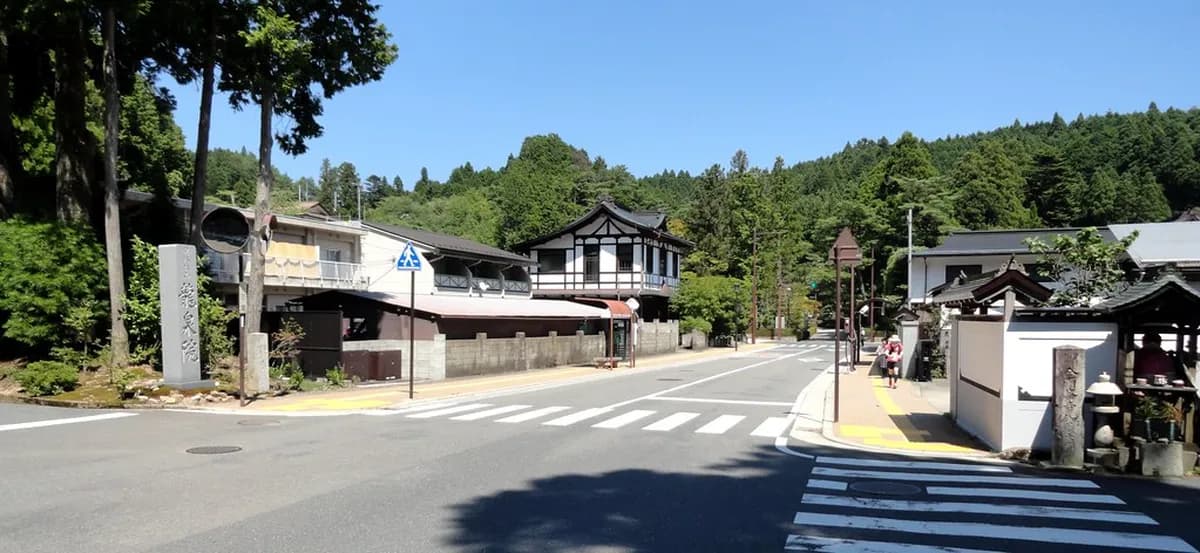
The formal entrance begins at Ichinohashi, the first bridge. Bowing before you cross is customary — this is the boundary between the ordinary world and the sacred forest. The stone path continues for roughly two kilometers through towering cedar trees, the oldest of which are over 900 years old. Light filters through the canopy in narrow beams, and moss covers nearly every surface.
The walk is not a single route but a network of branching paths and stone staircases that lead into quieter corners of the cemetery. The main trail takes 40 to 60 minutes at a moderate pace, but two hours is more realistic if you explore the side paths. There is no entrance fee for the cemetery itself.
Several landmarks mark your progress along the path. The Gokusho Offering Hall sits roughly halfway through and is lined with rows of Jizo statues in red bibs and hats — Jizo is the protector of children and travelers, and the red is said to drive away evil. Just past the hall, you will encounter the Mizumuke Jizo statues. Visitors use a wooden ladle to splash water on these figures as a prayer for deceased loved ones — a symbolic purification before approaching the inner sanctuary. our Koyasan itinerary that allocates a full morning to Okunoin will let you linger at each of these stops without feeling rushed.
- Ichinohashi Bridge — start of path, traditional entrance; bow before crossing
- Gokusho Offering Hall — midpoint; closes around 17:00; Jizo statues in red bibs
- Asekaki Jizo — the Sweating Deity shrine, said to perspire from bearing human suffering; nearby well of reflections (look in to check your longevity)
- Mizumuke Jizo — ladle-splash water offering for the deceased; marks the approach to the final bridge
- Gobyobashi Bridge — the last bridge before the mausoleum; cameras and food must be put away here
The Mizumuke Jizo water ladles are a meaningful prayer ritual for the deceased. Before you cross Gobyobashi Bridge into the inner sanctuary, take a moment with the ladle — it's a centuries-old custom that many visitors find deeply moving, and it marks your transition into the most sacred part of the forest.
The Torodo Hall (Hall of Lamps) and Kobo Daishi's Mausoleum
Once you cross Gobyobashi Bridge, the rules change. No photography. No eating. No loud conversation. The bridge is sometimes called the Bridge of Ignorance, because the belief is that by issuing forth into the vicinity of Kobo Daishi, you pass from ignorance into a world of illumination. Many visitors instinctively lower their voices before they even read the signs.
Once you cross Gobyobashi Bridge, cameras must be completely put away. Photography is strictly forbidden in the inner sanctuary, including the Torodo Hall and the mausoleum area. This rule is both a sign of respect and essential to maintaining the meditative atmosphere. Temple staff and monks take this seriously — there are no exceptions.
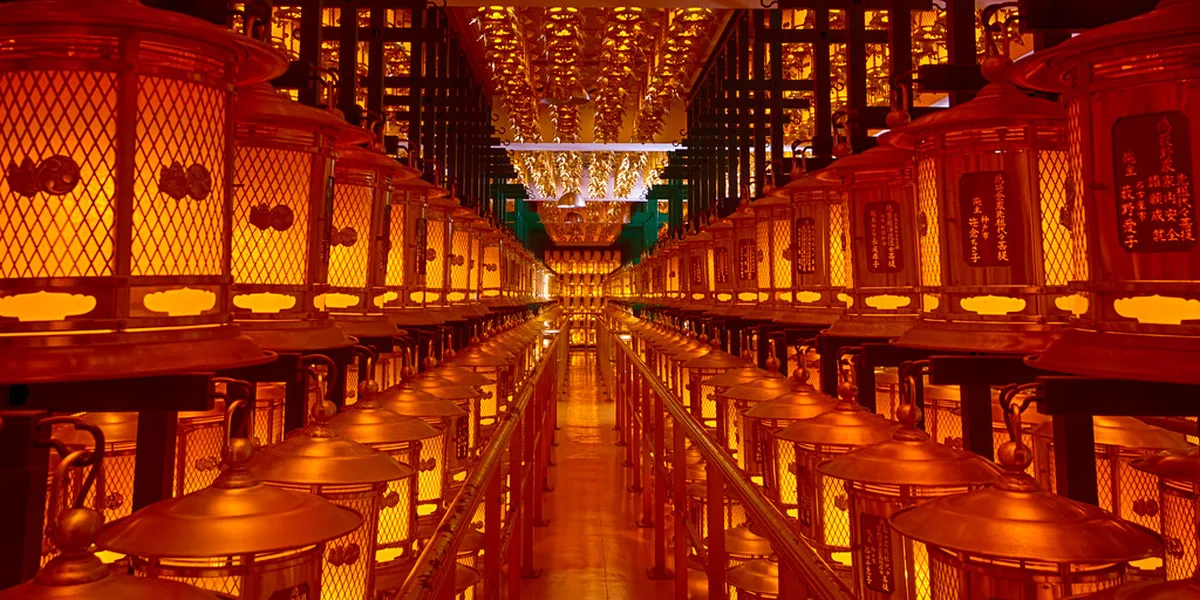
The Torodo Hall stands directly in front of the mausoleum and holds more than 10,000 lanterns donated by worshippers over the centuries. Two of those lamps are said to have been burning continuously for nearly a thousand years — one donated by Emperor Shirakawa and one by a poor woman who sold her hair to afford the offering. The hall is dimly lit, heavy with incense, and layered with the kind of quiet that takes a moment to adjust to.
Behind the Torodo Hall lies the Gobyo, the mausoleum of Kobo Daishi. Monks deliver two ritual meals here every day at 6:00 AM and 10:30 AM in a ceremony called Shojinku (also written Shojin Ryori). The procession is solemn and silent. Arriving 10 to 15 minutes early at the Gokusho hall for the morning delivery gives the clearest view. If you want to understand the food tradition behind this ritual, the guide to Koyasan food and shojin ryori covers the vegetarian temple cuisine served to both the living and the eternal meditating master.
Notable Monuments: From Samurai to Corporate Gravestones
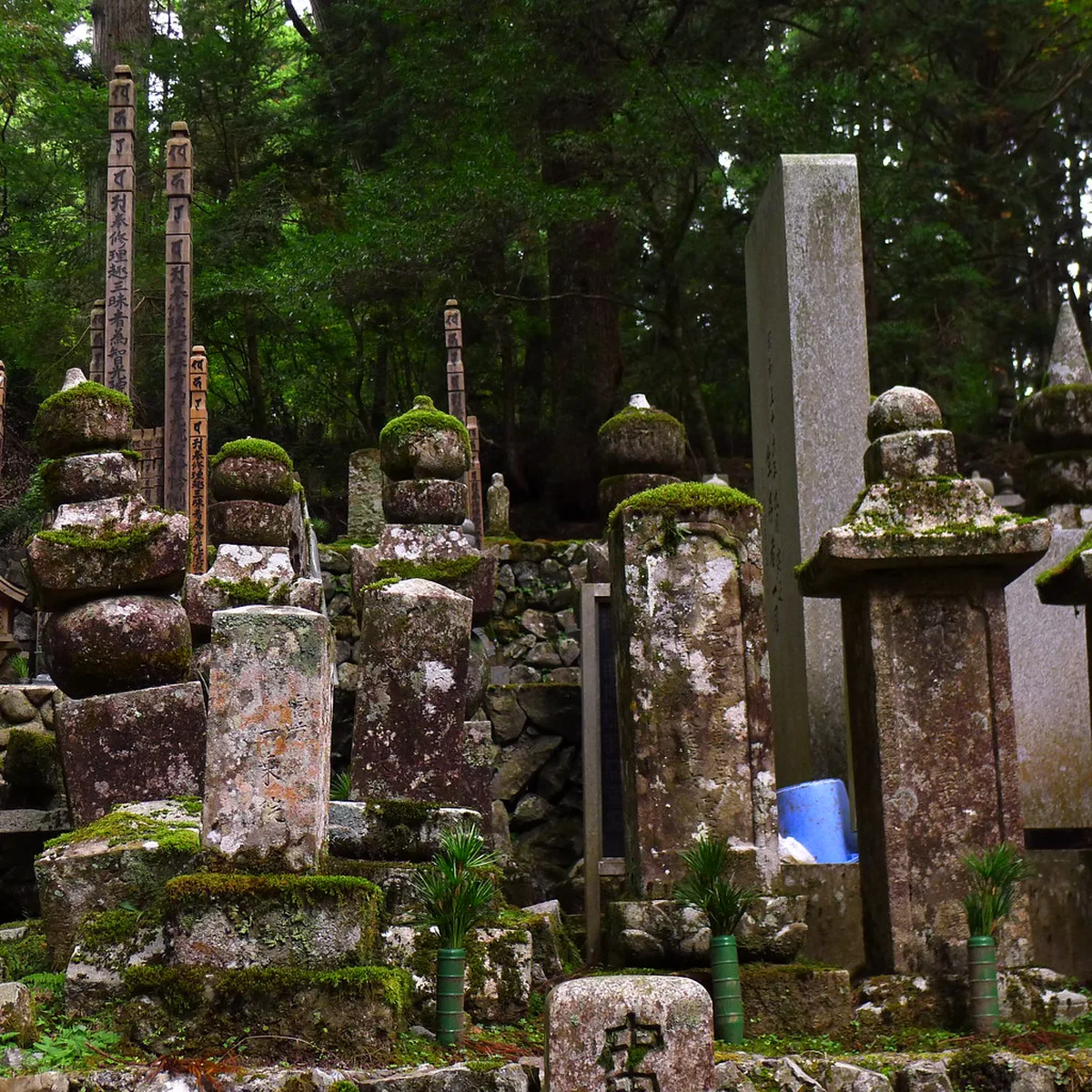
The cemetery spans over 2 square kilometers and contains an estimated 200,000 to 250,000 individual monuments. The oldest grave markers date to around 816 AD. Many of the largest stone stupas belong to famous samurai and feudal clans from the Sengoku period — the Mori clan, who controlled much of western Japan in the 16th century, have a massive communal memorial here.
Modern Japan is equally present. Nissan has purchased land for employees who die in service to the company. Panasonic's founder was born in the Wakayama prefecture and held a strong personal connection to Kobo Daishi's teachings; the company holds an annual prayer ceremony in Okunoin for all its employees. Look for the UCC Coffee monument in the shape of a coffee cup, and the memorial erected by a pest control company to honor every termite their products have exterminated. One aeronautical company even installed a rocket-shaped monument — initially rejected by the Koyasan authorities until the company argued that the rocket was built in five tiers, mirroring the structure of a classical gorinto stupa.
Pets are also buried here. Because Shingon Buddhism regards all living things as sacred, animals have always had a place in Okunoin. These details collectively explain why the path never feels repetitive. Every fifty meters, something unexpected appears.
The Mound of the Nameless: Okunoin's Forgotten Spirits
Near the mausoleum, in an area that most visitors walk past without noticing, stands the Muenbotoke — the Mound of the Nameless. Over the past few decades, cemetery workers have collected every small gravestone found discarded or abandoned along the ground and stacked them into a single large stupa. Some stones are centuries old and worn completely smooth. The names, if there ever were any, are gone.
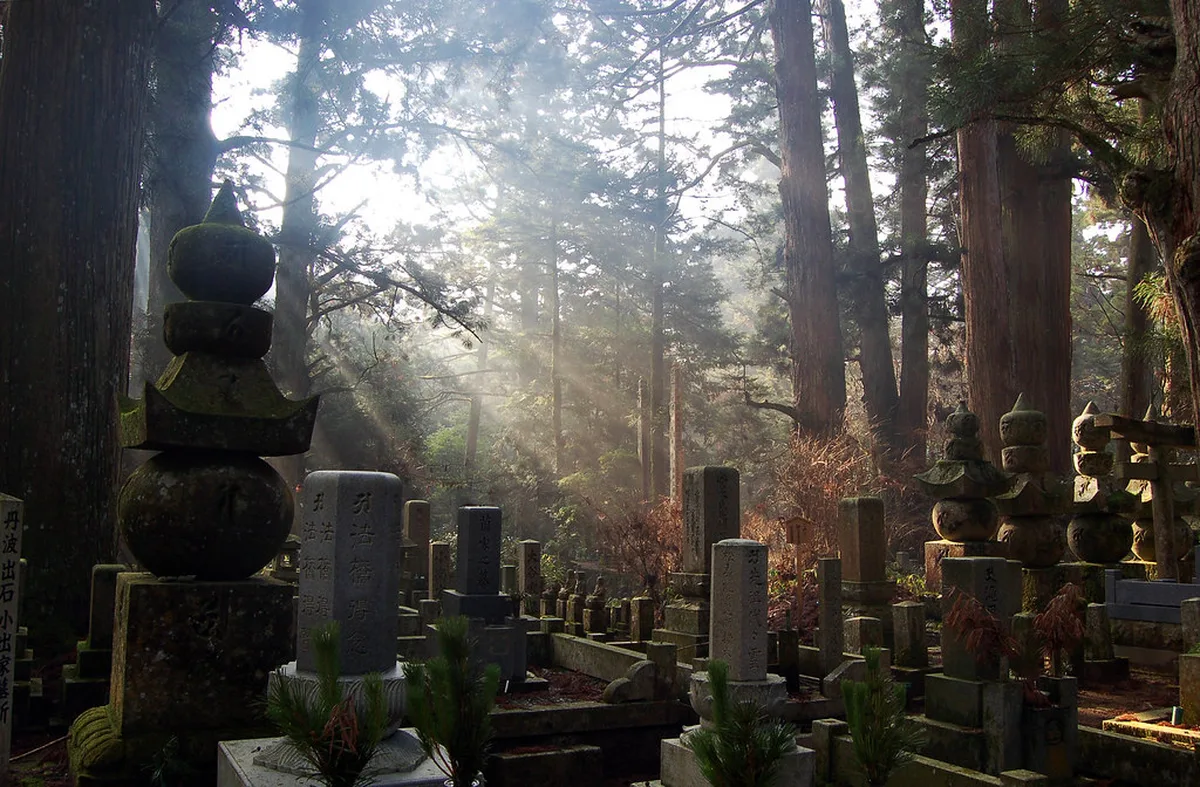
The statues are gradually dressed in bibs by monks, bringing them into the community of the remembered. It is one of the few places in the cemetery where the scale of historical time becomes physically legible — thousands of lives compressed into a single cairn. No guidebook lists it as a major attraction, but it is quietly one of the most affecting things you will see in the forest.
This detail also illustrates something essential about Okunoin: the emphasis is not on individual glory but on collective proximity to Kobo Daishi. A forgotten stone in a stack is still closer to the mausoleum than any grave outside these forests.
Experiencing Okunoin at Night: Monk-Led Tours
The forest is open 24 hours, but visiting after dark is a fundamentally different experience. Stone lanterns along the path cast a low amber glow. The cedar trunks disappear into the darkness above. The 200,000 stone markers that felt ancient in daylight become something quieter and stranger at night.
Organized evening walks are led by monks, typically English-speaking guides from temples like Ekoin. These tours run most evenings and last roughly two hours, covering the full path from Ichinohashi to the mausoleum. Guides share the philosophical dimensions of the site — questions about the shape of the mind, the meaning of light and shadow on the lanterns, and the specifics of Kobo Daishi's meditation — rather than a rote recitation of historical facts. The experience is widely considered one of the most atmospheric activities in Japan.
Booking the shukubo temple stay at Ekoin or one of the other shukubo (temple lodgings) is the most practical way to join an evening tour. Night tours are typically arranged through the temple where you are staying. Bring a small flashlight, wear warm layers — temperatures on the mountain drop sharply after sunset even in summer — and expect the tour to end well before the Gokusho hall closes at 17:00 for the outer grounds (the path itself stays open).
Essential Visitor Information: Etiquette and Access
Getting to Mount Koya from Osaka takes roughly 90 minutes. The Nankai Koya Line runs from Namba Station to Gokurakubashi (meaning "Paradise Bridge"), where a cable car climbs the final stretch to the plateau. Most visitors arrive from Osaka on this route. From Kyoto, see the guide on traveling from Kyoto to Koyasan for train and bus options.
The cemetery is free to enter and open around the clock. The Gokusho Offering Hall closes around 17:00. The Torodo Hall has limited visiting hours in the afternoon; check current times before your trip as these shift seasonally. The meal ceremonies at 6:00 AM and 10:30 AM are the two daily rituals worth timing your visit around.
Etiquette in the outer cemetery is relaxed — photography is permitted, voices can be normal, and you may wander freely. Everything changes at Gobyobashi Bridge. At the bridge and beyond, observe the following:
- Put your camera away before crossing — photography is strictly forbidden past the bridge
- No food or drink in the inner sanctuary
- Bow when crossing each bridge to honor the spirits within
- Speak quietly or not at all near the Torodo Hall and mausoleum
- Do not enter marked restricted areas around the mausoleum structure
- Dress modestly; remove hats when entering the hall
For the best seasonal conditions, visit during autumn (late October to mid-November) for the red maple leaves against the gray stone, or check the best season to visit guide for cherry blossom and snow conditions by month.
Frequently Asked Questions
Can you take photos inside Okunoin?
Photography is allowed along the forest path but strictly forbidden beyond the Gobashio Bridge. This includes the Torodo Hall and the Mausoleum area. Please respect these rules to maintain the sacred atmosphere of the inner sanctuary for all visitors.
What is the best time to see the monk meal ritual?
The ritual meal delivery happens daily at 6:00 AM and 10:30 AM. Arriving 15 minutes early at the Gokusho offering hall gives you the best view. It is a quiet, solemn ceremony that highlights the living tradition of Koyasan.
How long does it take to walk through Okunoin?
A leisurely walk from the Ichinohashi entrance to the Mausoleum takes about 40 to 60 minutes. This allows time to view the monuments and take photos along the path. Many visitors spend two hours total exploring the various side paths and monuments.
Okunoin is not a destination you rush. The forest path rewards slowness — a pause at the Asekaki Jizo, a moment at the water ladles, a quiet minute in front of a gravestone for someone whose name you will never know.
The combination of ancient theology, feudal history, and thoroughly modern corporate gravestones makes it unlike any other place in Japan. Plan two to three hours for the walk, time one visit for early morning to watch the meal ceremony, and consider staying overnight in a shukubo temple to access the evening tours. The details in this guide will help you arrive prepared and leave with something more than photographs.
Free: The Mount Kōya Essentials guide
Top things to do, where to stay, a perfect day plan, getting around, and the best time to go — a Mount Kōya mini-guide you can take offline.
You might also like

Continue reading
More guides you'll find useful