Danjo Garan Travel Guide: 8 Things to Know About the Sacred Site
Plan your visit to Danjo Garan with our guide to the Konpon Daito, Kondo, and the spiritual history of Kobo Daishi's sacred mandala in Koyasan.
On this page
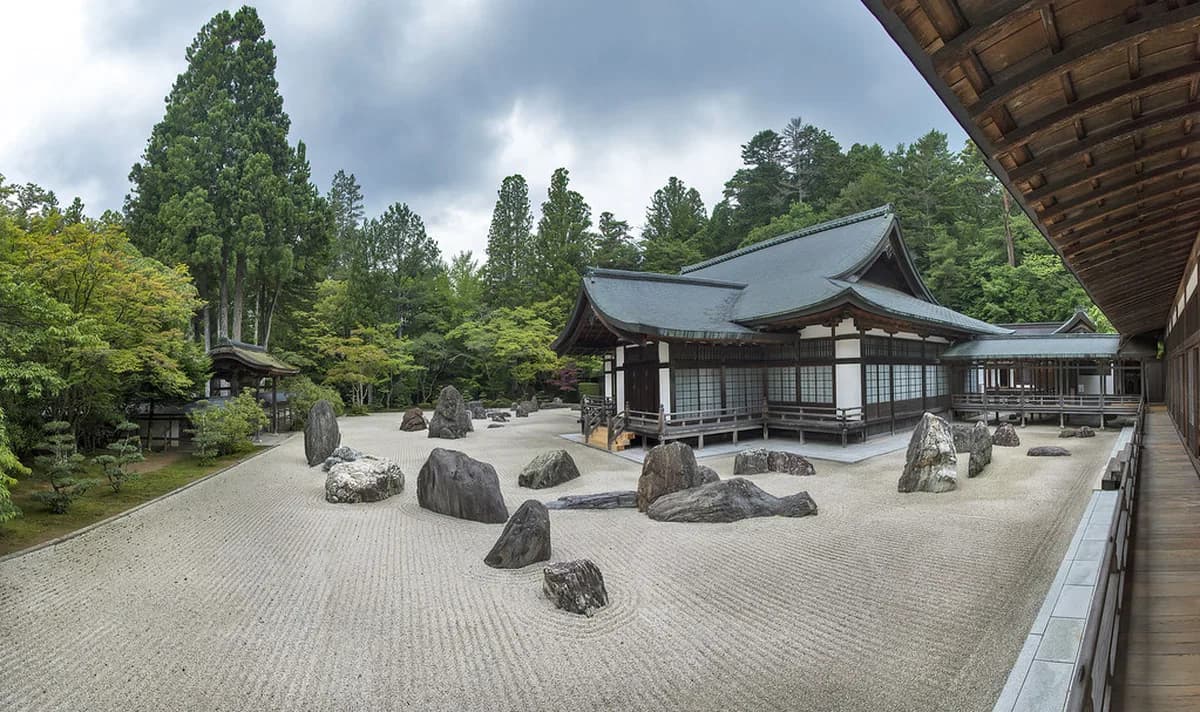
Danjo Garan complex serves as the spiritual center of Koyasan, where Kobo Daishi first established Shingon Buddhism in Japan. This sacred temple complex acts as a physical representation of the cosmic world through its unique architecture and layout. Visitors often find a deep sense of peace while walking among the towering pagodas and ancient cedar trees.
The site stands as one of the two most important locations on the mountain alongside the famous Okunoin cemetery. While Okunoin cemetery represents the realm of the dead, this complex focuses on the teachings and enlightenment of the living. Understanding the history here provides a foundation for any our Koyasan itinerary you plan to follow.
The Idea Behind Danjo Garan: A Physical Mandala
The name itself carries meaning that most visitors miss. In Buddhism, dan refers to a sacred altar or ritual platform, while jo means "upper" or "holy place." Garan derives from the Sanskrit word sangharama, meaning monastery or temple complex. Together, "Danjo Garan" translates to a sacred temple complex established on a high and holy place — which is exactly what Kobo Daishi intended when he selected Mount Koya in the 9th century.
The layout of the complex mirrors the Womb Realm Mandala of Esoteric Buddhism. Kobo Daishi designed the placement of every hall and pagoda to help practitioners visualize Buddhist truths in three dimensions rather than on flat paper. Each step through the grounds is intended as a meditative act, with the Konpon Daito pagoda at the geometric center of the mandala, just as Dainichi Nyorai sits at the center of the cosmic order. The cardinal alignment of the primary buildings reinforces this symbolism: this is not an architectural accident but a deliberate spiritual map you walk through.
Exploring the site during the best season to visit — spring for cherry blossoms or autumn for crimson maples — makes it easier to appreciate these spatial relationships. The lighter crowds of early morning give you time to stand in silence and absorb the geometry of the place before tour buses arrive by 10:00.
History and the Vision of Kobo Daishi
Kobo Daishi, also known as Kukai, traveled to China in 804 to study Esoteric Buddhism under the master Huiguo in Chang'an. After Huiguo passed the full transmission of Shingon teachings to Kukai, he returned to Japan and received imperial permission from Emperor Saga to build a mountain training center. He chose this high basin because the surrounding eight peaks resembled the petals of a lotus flower — a natural mandala. Construction of Danjo Garan began in 816 CE.
Over the centuries the site has suffered repeated fires from lightning strikes and civil conflict. Yet each time, the Japanese rebuilt the structures to maintain Kobo Daishi's 9th-century vision. The current Konpon Daito dates to 1937 after the previous pagoda burned in 1843. The Kondo was rebuilt in 1932. Despite these restorations, the ritual calendar has continued unbroken for over 1,200 years — monks still gather in the same halls for the same ceremonies Kobo Daishi prescribed. Staying at the shukubo temple stay allows you to hear the morning chanting that begins at 06:00 each day.
Highlights of Danjo Garan: Konpon Daito and Kondo
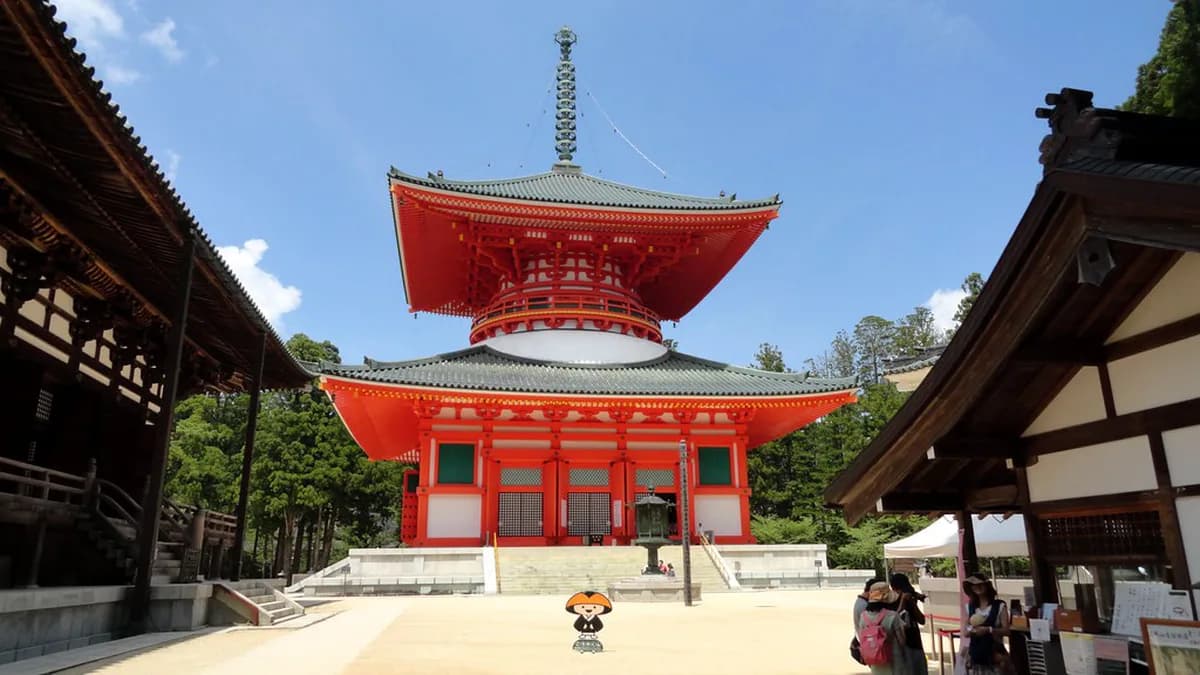
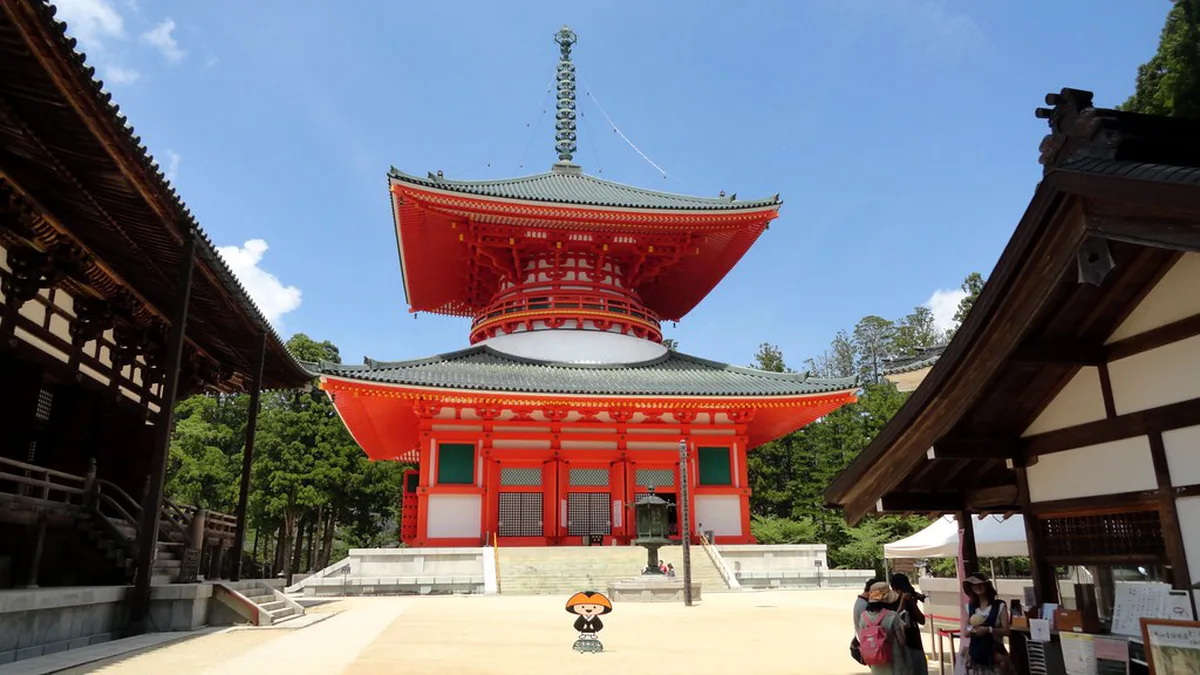
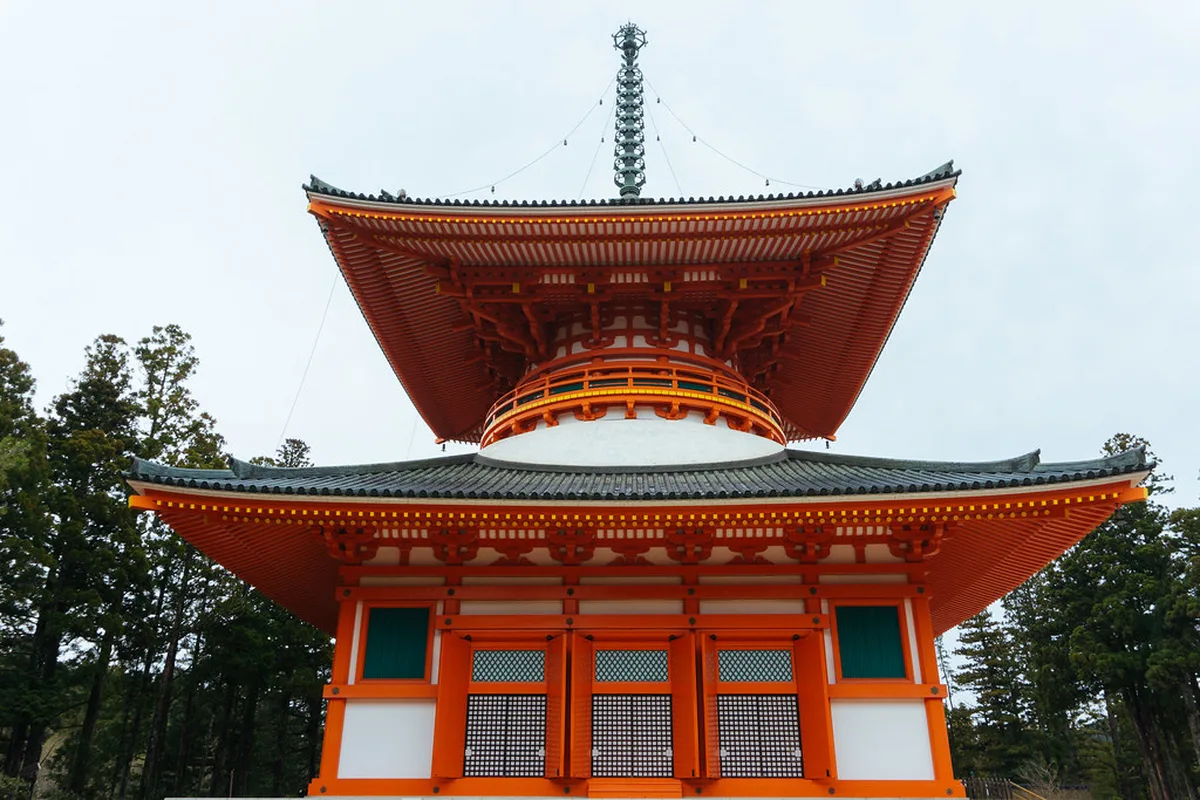
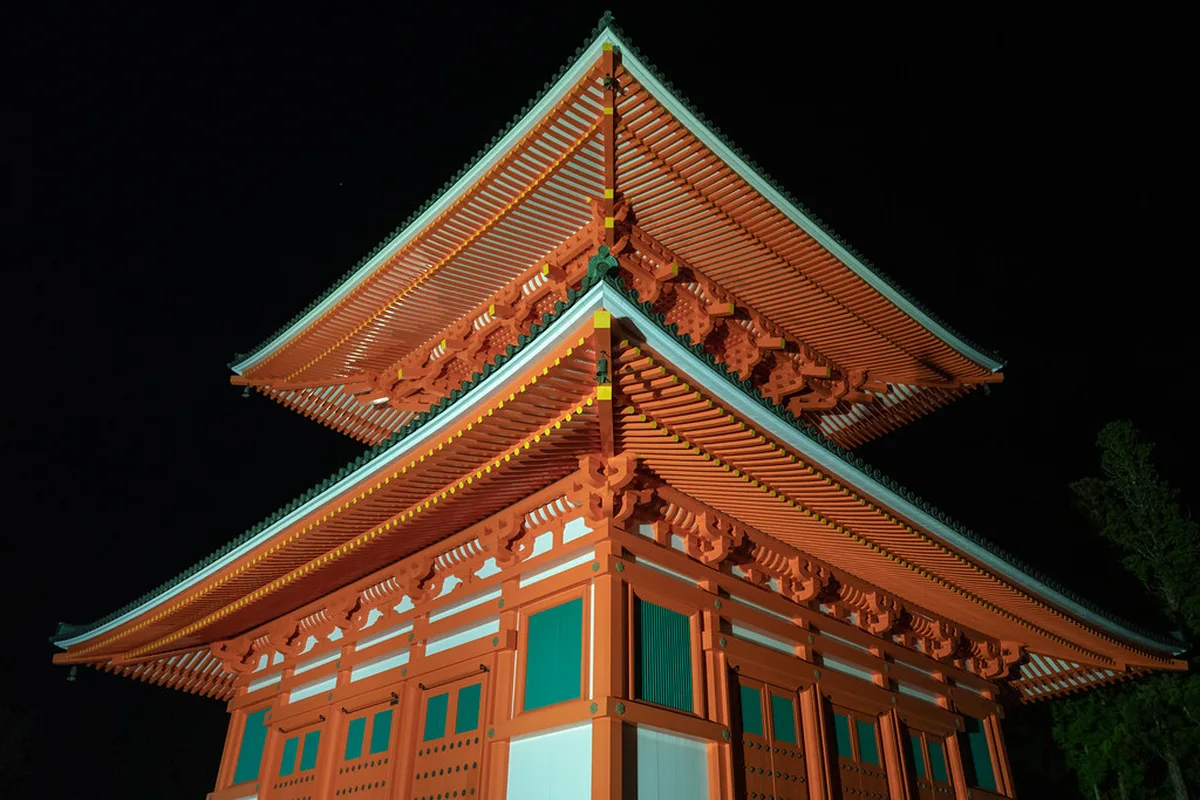
The Konpon Daito is a massive two-tier pagoda standing 49 meters high — the most iconic landmark in the complex and Japan's first Shingon-style great pagoda. Painted in brilliant vermilion, it dominates the treeline and was designed by Kobo Daishi himself to represent Dainichi Nyorai, the central Buddha of Shingon cosmology. Visitors can enter the interior to see a central statue of Dainichi Nyorai surrounded by sixteen deities of the Diamond Realm Mandala — a fully three-dimensional representation of the esoteric universe. Photography is not permitted inside the pagoda. Entry costs 500 yen.
The Kondo, or Main Hall, sits to the west of the Daito and serves as the primary location for major religious ceremonies. This wooden building enshrines Yakushi Nyorai, the Buddha of Medicine and Healing, whose position in the Eastern Pure Land aligns with the mandala symbolism throughout the complex. Visitors are welcome during opening hours, though certain areas are restricted to monks in active training and quiet is strictly expected. The hall's current structure dates to 1932 but retains the same solemn atmosphere as its predecessors. Entry also costs 500 yen.
The Miedo Hall sits nearby and is dedicated entirely to Kobo Daishi himself — it houses a seated statue of the master and is said to be the site where he lived and meditated. The simple cypress-bark roof blends into the forest. The hall opens only on special occasions, but even viewing the exterior is worthwhile. Together these three buildings form the spiritual core of the complex; the other structures radiating outward complete the mandala pattern Kobo Daishi envisioned for the mountain.
Lesser-Known Structures Worth Seeking Out
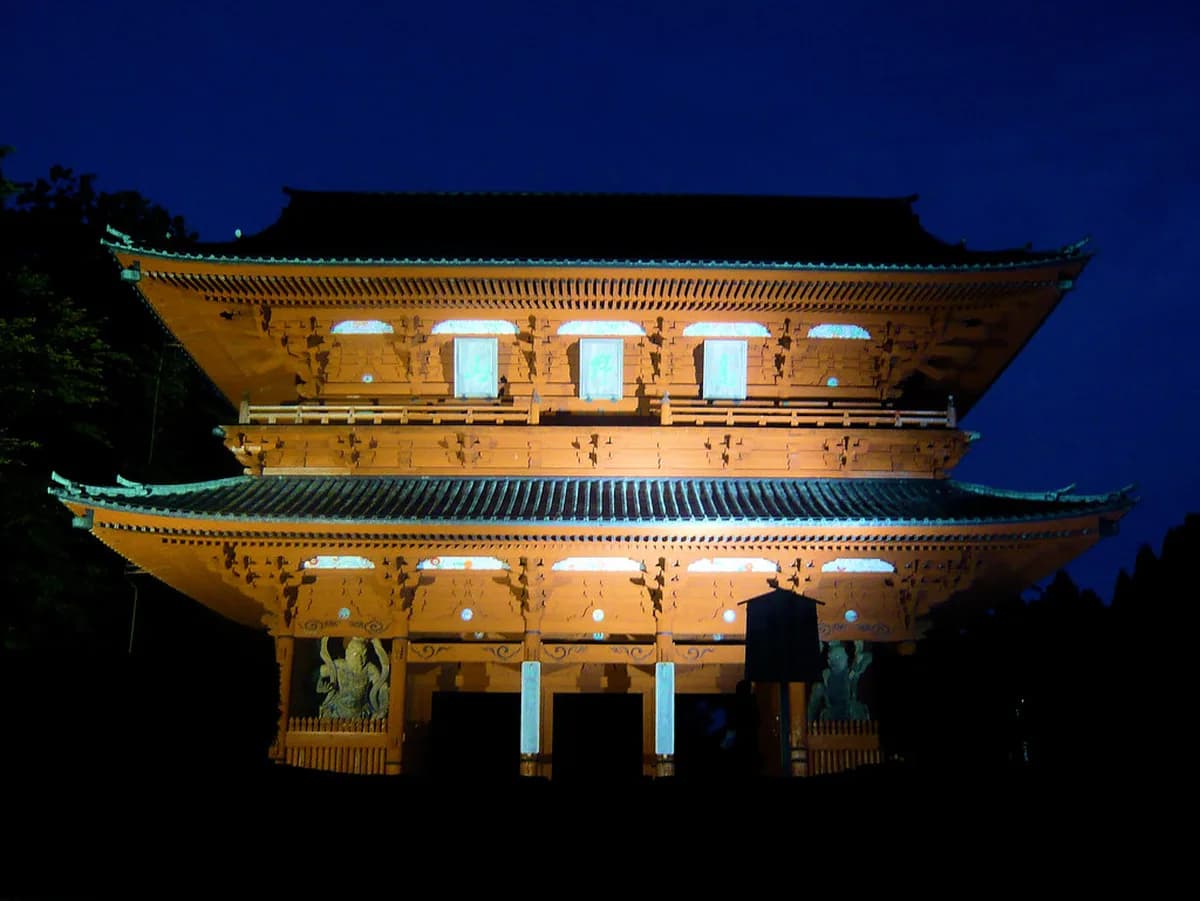
Most visitors walk straight to the Konpon Daito and miss several structures that reward a slower pace. The Chumon Gate is the formal entrance to the inner Garan precinct. Originally built in 816 alongside the complex, it burned down in 1843 and stood absent for over 170 years. It was finally rebuilt and dedicated in 2015 to mark Koyasan's 1,200th anniversary. Inside the gate stand the original Four Heavenly Kings — Jikokuten, Tamonten, Zochoten, and Komokuten — whose statues survived the 1843 fire and were returned to their posts after reconstruction.
The Sankosho Pine is a single tree that carries the founding legend of the entire mountain. When Kobo Daishi was still in China, he threw a three-pronged vajra (a ritual implement) into the sky and prayed it would land on the ideal site for his monastery. When he arrived at Koyasan years later, he found the vajra caught in this very pine. The tree is also botanically unusual: while ordinary Japanese black pines grow needles in pairs, this specimen produces clusters of three needles — the "sankosho" (three-pronged) pattern that mirrors the vajra. You will find it near the Miedo Hall.
The Great Bell of Danjo Garan has rung without interruption since the era of Kobo Daishi, though it has been recast several times. The current bell dates to 1547 and was once the fourth-largest in Japan, earning the nickname "Koya Shiro." It rings five times daily: 04:00, 13:00, 17:00, 21:00, and 23:00. If you are staying overnight on the mountain, the deep pre-dawn toll at 04:00 carries across the entire cedar forest and is one of the most memorable sounds in Japanese travel. The East and West Pagodas, positioned symmetrically to reinforce the mandala layout, and the serpentine Jabaru-michi path connecting the Garan to Kongobu-ji temple are also worth a slow walk, particularly in autumn when the maple leaves turn.
Temple Etiquette at Danjo Garan
Danjo Garan is an active training site for Shingon monks, not a heritage museum. That distinction shapes how visitors are expected to behave. Speak quietly throughout the complex, particularly inside the Kondo and near the Miedo Hall where monks may be chanting or meditating. Switch your phone to silent before entering any hall. Photography is prohibited inside both the Konpon Daito and the Kondo — the restriction is posted clearly, and staff will ask you to put cameras away if you forget.
Dress modestly: shoulders and knees covered is the general expectation, especially if you plan to enter the halls during a ceremonial period. Remove your shoes when indicated at thresholds. If you encounter a monk performing a ritual, stand to the side and allow the ceremony to proceed without interruption. There is no requirement to participate in prayers, but bowing slightly when passing the main altar is a respectful gesture that local visitors consistently make.
The grounds are open around the clock, which makes early morning or late evening visits possible. These quieter windows are also when you are most likely to witness monks in the course of their daily practice — a far more authentic experience than the midday crowds. According to Japan National Tourism Organization, Koyasan as a whole asks visitors to approach the mountain with the mindset of a pilgrim rather than a tourist.
Danjo Garan Visitor Information: Hours and Fees
The outer grounds are open 24 hours a day, so a night walk through the cedar-lined paths is always possible. The Konpon Daito and Kondo open at 08:30 and close at 17:00 daily. Arriving before 09:00 gives you the most peaceful experience before tour groups arrive from Osaka. Most visitors spend 60 to 90 minutes exploring the full complex at a relaxed pace; allow two hours if you want to enter both major halls and walk the Jabaru-michi path.
Entry to the grounds is free. The Konpon Daito costs 500 yen per adult, and the Kondo costs an additional 500 yen. A combined ticket covering multiple things to do in Koyasan is available at the site and can reduce the per-entry cost. The official address is 132 Koyasan, Koya Town, Wakayama Prefecture (Google Maps). Check for any seasonal closures or 2026 price adjustments before you go — Koyasan's UNESCO World Heritage status occasionally triggers access changes during peak pilgrimage periods.
Getting to Danjo Garan
Once you are in Koya town, the complex is easy to reach. From the Koyasan Cable Car station (Koyasan Station), board any Nankai Rinkan Bus heading toward the town center or toward Okunoin. Ride for approximately 16 minutes and alight at the Kondo-mae stop. This puts you directly in front of the Chumon Gate entrance to Danjo Garan. The Kondo-mae stop is also served by buses running the return route, so you can continue onward to Okunoin or circle back to the cable car station easily.
If you are enjoying a Koyasan day trip and prefer to walk, the route from the Senjuinbashi intersection takes roughly 10 minutes on a mostly flat path through small temple gardens and souvenir shops. Clear English signage points the way from every major landmark. Driving visitors will find parking near the Kondo. The site is accessible to most mobility levels once you are inside the mountain village.
How to Get to Koyasan
The standard route begins at Namba Station in Osaka via the Nankai Electric Railway. The Limited Express Koya train runs to Gokurakubashi Station, the end of the line, in about 80 minutes. From there, a five-minute cable car ride climbs the steep mountainside to Koyasan Station at 867 meters elevation. Travelers coming from Kyoto should take the JR Osaka Loop or Midosuji subway line to Namba, then transfer onto Nankai.
Using a Nankai All Line 2-Day Pass (KKday) covers the Limited Express, the cable car, and the local Nankai Rinkan Buses within the mountain village. For most travelers coming from Osaka on a two-day visit, the pass pays for itself by the end of day one. Buy it at Namba Station or online before departure to avoid the queue at the ticket counter.
Frequently Asked Questions
What is the significance of Danjo Garan in Shingon Buddhism?
Danjo Garan is the first temple complex built by Kobo Daishi on Mount Koya. It serves as the training ground for monks and a physical representation of the Womb Realm Mandala. This site is considered the heart of Shingon Buddhist teachings in Japan. Learn more about its role in our things to do in Koyasan guide.
How much does it cost to enter Danjo Garan?
Entry to the temple grounds is free for all visitors. However, entering the Konpon Daito Pagoda or the Kondo Main Hall costs 500 yen each. Combined tickets are available if you plan to visit multiple historical sites on the mountain. Prices are subject to change, so check official sources for 2026 updates.
How do you get to Danjo Garan from the Koyasan cable car?
Take a Nankai Rinkan Bus from the cable car station toward the town center. Get off at the Kondo-mae bus stop, which is located directly at the entrance. The bus ride takes approximately 10 to 15 minutes depending on traffic. Walking from the station is not recommended due to the steep, winding roads.
What is the difference between Danjo Garan and Okunoin?
Danjo Garan is the center for active religious training and symbolizes the world of the living. Okunoin is a massive cemetery and the site of Kobo Daishi's eternal meditation, representing the spiritual realm of the deceased. Both sites are essential for understanding the full scope of Koyasan's sacred atmosphere.
A visit to Danjo Garan offers a rare glimpse into the architectural and spiritual foundations of Japanese Buddhism. The vibrant pagodas and quiet halls provide a powerful contrast to the modern world. Whether you are a history buff or a spiritual seeker, this site leaves a lasting impression on every traveler.
Give yourself at least 90 minutes to explore the grounds and enter the main buildings. Combining this visit with an overnight stay in a local temple deepens the connection to the mountain's energy — and means you will be there when the Great Bell rings at 04:00. Start planning your journey today to experience the timeless beauty of Kobo Daishi's vision.
The interior of the Konpon Daito pagoda houses a stunning three-dimensional representation of the Diamond Realm Mandala with a central statue of Dainichi Nyorai and sixteen attendant deities. Entry costs 500 yen but is absolutely worth it for those seeking deeper spiritual insight into Shingon cosmology. Photography is not permitted inside, so take a moment to observe the intricate details with your own eyes.
Several lesser-known structures reward slow exploration: the Sankosho Pine near the Miedo Hall, which grows needles in three-pronged clusters reflecting the vajra throwing legend, and the Great Bell that has rung continuously since Kobo Daishi's era. The Chumon Gate, rebuilt in 2015 after standing absent for 170 years, houses the original Four Heavenly Kings statues that survived the 1843 fire.
| Structure | What It Is | Note |
|---|---|---|
| Konpon Daito | Great Pagoda | 49 meters tall, vermilion-painted, first Shingon-style pagoda in Japan. Built 1937; entry 500 yen |
| Kondo | Main Hall | Wooden structure enshrining Yakushi Nyorai (Buddha of Medicine). Rebuilt 1932; entry 500 yen |
| Miedo Hall | Kobo Daishi Memorial Hall | Houses seated statue of Kobo Daishi; opens only on special occasions |
| Chumon Gate | Formal Entrance | Rebuilt 2015 after 170-year absence; holds original Four Heavenly Kings statues |
| Sankosho Pine | Sacred Tree | Three-needled pine where Kobo Daishi's vajra supposedly landed; symbolizes founding legend |
| Great Bell (Koya Shiro) | Bell Tower | Cast 1547, rings five times daily (04:00, 13:00, 17:00, 21:00, 23:00); one of Japan's largest |
Free: The Mount Kōya Essentials guide
Top things to do, where to stay, a perfect day plan, getting around, and the best time to go — a Mount Kōya mini-guide you can take offline.
You might also like

Continue reading
More guides you'll find useful