Kusatsu Onsen Public Baths Travel Guide
Plan kusatsu onsen public baths with top picks, neighborhood context, timing tips, and practical booking advice for a smoother trip.
On this page
Kusatsu Onsen is one of Japan's most celebrated hot spring towns, nestled in Gunma Prefecture at 1,200 metres above sea level. Its acidic sulfur waters are prized for therapeutic properties and flow in one of the highest natural volumes anywhere in Japan. This guide covers every public bath worth visiting in 2026, plus etiquette, tattoo policies, transport, and how to stretch your budget with the right bath pass.
The town's central landmark, the Yubatake hot water field, channels scalding spring water through seven wooden conduits that cool it naturally to bathing temperature without adding cold water. That same water feeds the three main paid bathhouses and dozens of free footbaths spread across town. Understanding how the water system works helps you choose between the different bath facilities and plan your day efficiently.
The Three Main Public Baths
Kusatsu has three paid day-use bathhouses, each drawing water from a distinct spring source and offering a different atmosphere. Visiting all three in one trip is called yumeguri (bath-hopping), and a combined pass makes it practical. Each bath charges separately without the pass, so comparing the options upfront saves both money and time.
Goza no Yu sits directly in front of the Yubatake and reproduces the communal bath atmosphere of the Edo to Meiji periods (1603–1912). Its cedar "tonton-buki" roof and plastered walls are immediately recognisable. Two baths run simultaneously — Ki no Yu using Yubatake source water and Ishi no Yu using Bandai source water — letting you compare both spring types side by side. A yukata rental is available at the counter if you want to stroll the town in traditional robes. Winter operating hours run 08:00–21:00, with last admission at 20:30. Check the Goza no Yu website for current pricing and seasonal hour changes.
Otaki no Yu uses the rarer Nukawa spring, known locally as "beauty water" for its soft, gentle quality compared to Kusatsu's typically sharp acidic water. Its signature feature is the traditional Awaseyu bathing method — a sequence of pools arranged from cooler to hotter, allowing the body to acclimatise without mixing in cold water. The facility also has an open-air bath with a waterfall view and private baths rentable for 2,000 yen per hour with no occupancy limit. On the second and fourth Saturdays of each month, "Shirakudaku Day" is held: the water turns a cloudy white, considered the finest expression of the Nukawa spring. Operating hours are 09:00–21:00, last admission 20:00.
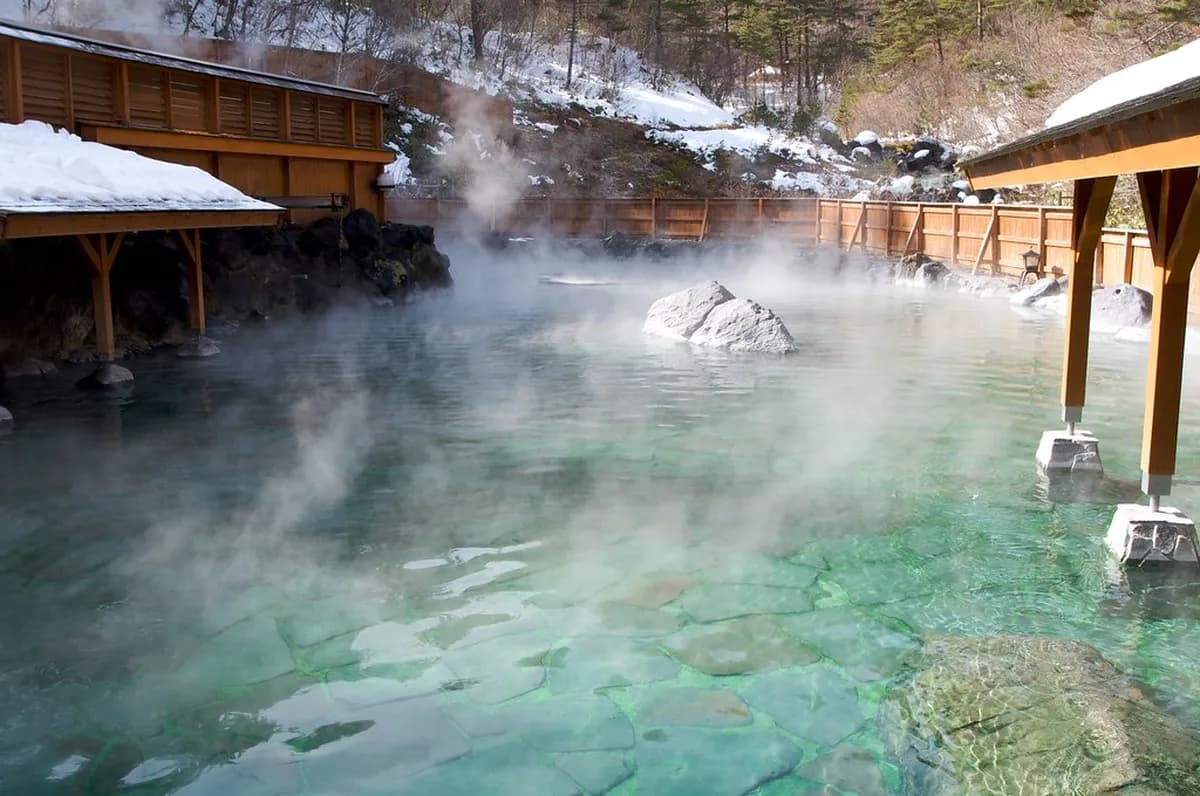
Sainokawara Rotenburo is one of Japan's largest outdoor hot spring baths, at 500 square metres across the men's and women's sections. Set deep inside Sai no Kawara Park and surrounded by forest, the pool registers cooler temperatures near the edges — useful if you find Kusatsu's water too intense. Every Friday from 17:30 to 20:00 is Mixed Bathing Day, open to couples, families, and married pairs wearing bathing garments (exceptions apply on certain festival dates). Winter hours run 09:00–20:00, last admission 19:30. More details at the Sainokawara onsen website.
The Three-Bath Pass: Best Value for Bath-Hoppers
If you plan to visit all three paid bathhouses, the "Choi-na Three Bath Tour Pass" (ちょいな三湯めぐり手形) costs 2,100 yen for adults and 1,050 yen for children. Without it, the total entry for all three facilities is 2,900 yen for adults — a saving of 800 yen. The pass has no expiry date, so you do not need to complete all three baths in a single day.
The pass is sold at the front desk of any of the three facilities. After you present it at each bath, staff stamp it. When you finish the third bath, you receive an original sticker; visitors who request it also get a printed certificate recognising them as a "Three Bath Tour Master." It is a minor detail, but a tangible souvenir for first-timers.
A practical note on sequencing: visit Goza no Yu first while you are still fresh and want to see the Yubatake area. Do Otaki no Yu mid-day for the Awaseyu temperature sequence. Save Sainokawara Rotenburo for late afternoon — if your visit falls on a Friday, you arrive in time for Mixed Bathing Day at 17:30, which is not replicable at the other two baths.
Free Public Bathhouses
Kusatsu maintains several free public bathhouses run by the local municipality. These are genuine neighbourhood baths used by residents and are smaller and quieter than the paid facilities. Etiquette is identical to any public onsen: wash thoroughly at the shower stations before entering the communal tub.
Jizo no Yu stands two minutes on foot from the Yubatake and opens from 08:00 to 22:00 — the longest hours of any free bath in town. Its central location makes it easy to slot between sightseeing. Chiyo no Yu is the smallest of the free bathhouses, open 09:00–17:00, and offers an intimate, low-crowd experience. Both are free of charge, though a small voluntary donation box is typically present at the entrance.
Free footbaths are scattered around the Yubatake perimeter and inside Sai no Kawara Park. These are open-air foot soaking stations with no time limit and no fee. A 15-minute footbath between bathhouses is a good way to rest legs and keep body temperature stable, particularly useful during winter when walking between baths in cold air.
Bathing Etiquette: What to Know Before You Enter
Japanese public baths follow a set of shared rules that keep communal spaces clean and comfortable for everyone. First-time visitors who understand these before arriving avoid awkward moments at the entrance.
- Wash your entire body at the shower stations before entering the communal tub. Soap and shampoo are provided at most facilities; confirm at the counter if unsure.
- Do not submerge your towel in the bathwater. Fold your small towel and place it on your head or leave it outside the tub.
- Remove all jewellery before bathing. Kusatsu's acidic water can tarnish metals and is abrasive on sensitive skin.
- Enter quietly, keep voices low, and avoid splashing. The bath is a shared relaxation space, not a swimming pool.
- Limit time in the tub to 15–20 minutes per session, then cool down before re-entering. Kusatsu's water is exceptionally hot and acidic — overexposure causes skin irritation, especially for those unaccustomed to sulfuric baths.
Kusatsu's spring water has a pH of around 2, one of the most acidic of any major Japanese onsen resort. This acidity is what gives the water its reputed bactericidal and skin-smoothing properties, but it also means that minor open cuts, recent shaving, or sunburned skin will sting. Most regular bathers spend 20–30 minutes per bath before switching facilities, which is a sensible pace across town.
Tattoo Policy at Kusatsu's Public Baths
Kusatsu is one of the most tattoo-inclusive hot spring destinations in Japan. The town's three main day-use public baths — Sai no Kawara Open-Air Bath, Otaki no Yu, and Goza no Yu — all accept guests with tattoos. This is not the case in most major onsen towns, making Kusatsu a genuine option for tattooed travellers who want access to communal public baths.
Individual ryokan with shared indoor baths are a different matter. Some properties restrict tattooed guests from the communal facility, even if the three main day-use baths permit it. The safest approach is to confirm directly with the ryokan when booking. Alternatively, book a room with a private open-air bath attached, which sidesteps the communal policy entirely.
Private bath rentals at Otaki no Yu are available for any guest at 2,000 yen per hour with no occupancy limit — this is also the most practical option for tattooed guests staying at a ryokan whose communal bath has restrictions. Book by phone when you arrive in town rather than assuming walk-in availability during peak season.
Yubatake: The Heart of the Town
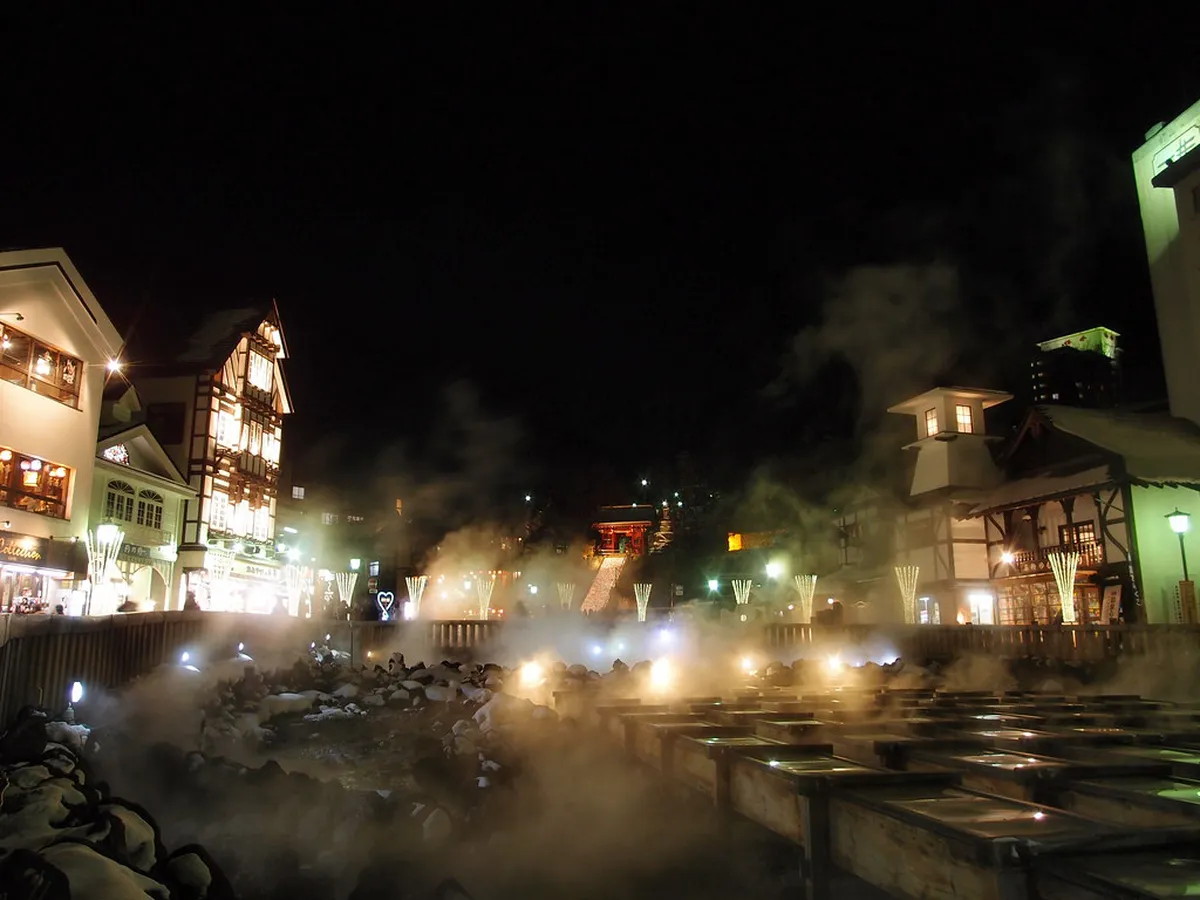
The Yubatake is the symbolic and functional centre of Kusatsu Onsen. Spring water ranging from 50°C to 90°C flows through seven wooden channels that stretch across a wide open field, cooling the water passively without any dilution before it is distributed to the bathhouses. The field continuously emits steam, creating the sulfuric atmosphere that defines Kusatsu's streetscape.
By day the water appears emerald green from the mineral content. After dark, lighting turns the steam purple and the channels glow — the night view draws as many visitors as the daytime spectacle. Free footbaths line the perimeter of the Yubatake and are open year-round. Shops selling onsen manju, onsen tamago, and Kusatsu glass souvenirs cluster along the two main streets that converge on the field.
The Yubatake is the logical starting point for a bath-hopping day. Goza no Yu is directly adjacent. Netsu no Yu, where the Yumomi show takes place, is a two-minute walk. Sai no Kawara Park and its rotemburo are a 10-minute walk north. Knowing the geography saves time and makes the circuit feel natural rather than rushed. Read more in the full guide to Kusatsu Onsen Travel Guide.
Yumomi and Dance at Netsu no Yu
The Yumomi and Dance show at Netsu no Yu is one of Kusatsu's most distinctive cultural experiences. Performers use wooden boards roughly 180 cm long to rhythmically stir the scalding spring water while singing traditional Kusatsu folk songs. The practice dates to the Edo period (1603–1868), developed specifically because Kusatsu's water is too hot to bathe in without cooling and cannot be diluted with cold water without weakening its medicinal properties.
Shows run six times daily. During winter (December to February), morning performances are at 10:00, 10:30, and 11:00, with afternoon shows at 15:30, 16:00, and 16:30. Admission is 700 yen for adults and 350 yen for elementary school students. Tickets are sold at the venue from 30 minutes before each show; reservations are not accepted. Popular sessions sell out, so arrive early.
On select days, a Yumomi Experience session runs from 11:30 to 12:50 for 300 yen per person (elementary school students and older). Participants take a turn with the wooden boards under instruction. It is a hands-on alternative if you prefer participation over watching — check the day's schedule at the Netsu no Yu entrance when you arrive. More detail on the Yumomi Show at Netsu no Yu.
Getting to Kusatsu from Tokyo
Three routes connect central Tokyo to Kusatsu, each with a different balance of cost, travel time, and convenience.
- Limited Express "Kusatsu/Shima" from Ueno Station to Naganohara-Kusatsuguchi, then a JR bus for approximately 25 minutes to the town centre. Total journey around 3 hours, approximately 6,000 yen one way. No transfer to Shinkansen required; the train ride through Gunma's mountain scenery is enjoyable.
- Hokuriku Shinkansen from Tokyo Station to Karuizawa, then transfer to a highway bus. Around 2 hours 30 minutes total, approximately 8,500 yen. Faster but more expensive; the Karuizawa connection allows a brief stop on the way.
- Express bus (Joshu Yumeguri-go) from Tokyo Station or Busta Shinjuku, direct to Kusatsu Onsen. Around 4 hours, from approximately 3,500 yen one way. The most economical option and convenient because it stops in the town centre without a bus transfer. Additional express bus routes depart from Shibuya, Yokohama, Omiya, Ikebukuro, and Kichijoji.
Cash is the dominant payment method in Kusatsu. Most restaurants, souvenir shops, and smaller bathhouses do not accept credit cards. ATMs are available at the convenience stores in town, but there are few of them. Withdraw sufficient cash before leaving Tokyo or at Naganohara-Kusatsuguchi station. For seasonal timing, see the guide to the Best Time To Visit Kusatsu Onsen Travel Guide.
Volcano Alert and Current Safety Status (2026)
Since August 2025, Japan's Meteorological Agency has maintained an eruption alert at Level 2 for Mount Kusatsu-Shirane, specifically around the Yugama Crater. The crater area itself is a restricted zone and cannot be visited. Part of the Shiga Kusatsu Kogen Road (National Route 292) remains closed to traffic as a precaution.
Kusatsu Onsen town is located more than approximately 5 kilometres in a straight line from the Yugama Crater. The mayor of Kusatsu Town has formally confirmed that the hot spring town, its bathhouses, and all standard tourist areas are safe and unaffected. Onsen bathing, the Yubatake, Sai no Kawara Park, and all three main public baths operate normally.
Travellers arriving by car from the Shiga Kogen side need to plan a detour route as Route 292 is closed on the Shiga Kogen approach. Those arriving from Tokyo by train or bus via Naganohara-Kusatsuguchi are not affected — that access route does not use the closed section. Check current road conditions with your accommodation if you are driving from Nagano Prefecture.
Private Hot Springs and Ryokan Stays
Private onsen rooms and reservable private baths are the best option for couples, families, groups with tattoos, or anyone who prefers not to use communal facilities. Kusatsu has a range of accommodation covering both historic small ryokan and modern resort hotels, so the choice depends on budget and the type of bathing access you want.

Rooms with private open-air baths allow guests to soak at any hour without time pressure or shared space concerns. These are the most sought-after room types in Kusatsu and book quickly around autumn leaf season (mid-October to mid-November) and winter weekends. Book several weeks ahead for these periods.
If a private room bath is out of budget, Otaki no Yu's private bath rental (2,000 yen per hour, no occupancy cap, barrier-free and wheelchair accessible) fills the same need as a day-use option. Telephone reservations are accepted. For accommodation options, Where To Stay In Kusatsu Onsen Travel Guide covers the full range from budget to ryokan.
Frequently Asked Questions
Which kusatsu onsen public baths options fit first-time visitors?
First-time visitors should prioritize Goza no Yu for its traditional charm and central location. Sainokawara Rotenburo offers a scenic outdoor experience amidst nature. Both provide excellent introductions to Kusatsu's bathing culture.
How much time should you plan for kusatsu onsen public baths?
Plan to spend at least 30 minutes to an hour at each public bath. This allows for a relaxing soak and time to enjoy the surroundings. Allocate more time for larger baths like Sainokawara Rotenburo for a full experience.
What should travelers avoid when planning kusatsu onsen public baths?
Avoid rushing your bathing experience; onsen are for relaxation and healing. Do not forget to properly wash before entering the bath, as this is crucial etiquette. Also, avoid bringing large towels into the bathing area itself.
Is kusatsu onsen public baths worth including on a short itinerary?
Yes, absolutely. Even on a short itinerary, visiting at least one or two public baths is highly recommended. It offers a core Kusatsu experience and deep relaxation. A Kusatsu Onsen From Tokyo Travel Guide can be managed effectively.
Kusatsu Onsen provides an unparalleled hot spring experience in Japan. Its three main paid bathhouses, free municipal baths, and outdoor rotemburo cover every preference and budget. The Choi-na Three Bath Tour Pass at 2,100 yen makes visiting all three paid facilities straightforward and saves money over individual entry.
Understanding the tattoo policy, the bathing etiquette, and the current volcano situation removes the main sources of pre-trip uncertainty. Transport from Tokyo is direct and well-served by both train and express bus. Arrive prepared, and the baths themselves do the rest.
For tickets, hours and visitor details, see our Kusatsu Onsen Ski Resort Visitor Guide & 2-Day Itinerary and Kusatsu Onsen attractions hub.
Free guide: Japan's Hidden Gems
12 under-the-radar places beyond Tokyo & Kyoto — with the best season to visit each and a local tip you won't find in the guidebooks.
You might also like


Continue reading
More guides you'll find useful