12 Best Free Things to Do in Hakodate: Budget Guide (2026)
Explore the best free things to do in Hakodate, from hiking Mount Hakodate to Goryokaku Park. Save money with our expert budget travel guide to this Hokkaido gem.
On this page
Hakodate is one of Japan's most walkable cities, and a remarkable share of its best experiences cost nothing. This port city on Hokkaido's southern tip carries centuries of international history in its steep hillside streets, red-brick waterfront, and volcanic mountain backdrop. While many visitors assume the famous night view requires a ropeway ticket, the reality is that you can fill three full days here without paying a single entry fee. Our editors have reviewed every neighborhood in 2026 to compile this guide to the city's best zero-cost attractions.
Whether you are arriving via the Hokkaido Shinkansen or traveling from Sapporo to Hakodate, the city rewards slow exploration on foot. The Hakodate Morning Market alone is worth a full morning. Deciding how long to spend in Hakodate you need often comes down to how deeply you want to explore the coast, the slopes, and the history. Check the Hakodate weather before heading to exposed outdoor spots like Tachimachi Cape or the mountain trail.
Hike Mount Hakodate for Iconic City Views
Mount Hakodate's summit view is consistently ranked among the top three night views in Japan, and you do not need the ropeway to reach it. A well-maintained hiking trail climbs 334 metres from the base, taking roughly 60 to 90 minutes at a steady pace. The path is paved in sections, clearly signposted, and open daily from late April through early December. The ropeway costs ¥1,800 (about $12) for a round trip; the hike costs nothing.
Start your ascent 90 minutes before sunset. By the time you reach the summit, the city lights are just beginning to flicker on across the narrow neck of the Hakodate Peninsula, with Hakodate Bay to the west and the Tsugaru Strait to the east. The hiking trail also passes through patches of woodland that the ropeway skips entirely, giving birdwatchers a quieter, more varied experience. Bring a windbreaker regardless of the season — the exposed summit can be significantly colder than the city below.
The trail is moderate, not technical. Anyone with basic fitness can complete it. Winter conditions close the hiking route, but the ropeway continues to operate; if you visit between December and late April and want the view for free, the Shirotai Ranch observation deck (covered below) is your best alternative.
Explore the Grounds of Goryokaku Park
Goryokaku is the only Western-style star-shaped fort in Japan, designed in 1855 by Takeda Ayasaburo based on French military engineering. The park grounds are free to enter year-round, open from 05:00 to 19:00 (18:00 from November to March). Over 1,600 cherry trees ring the moat, making this the city's top hanami spot every May. In late October, the maple trees along the ramparts turn vivid orange and crimson.
The adjacent Goryokaku Tower charges ¥1,200 ($8) for the bird's-eye view of the fort's star geometry. You can skip the tower entirely. Walking the elevated outer ramparts on foot gives you a clear sense of the fort's scale at ground level, and the Former Magistrate's Office reconstruction inside the grounds explains the Boshin War history well enough without needing the tower's viewing platform. Most visitors find the ground-level perspective more atmospheric anyway.
From the park, the tram stop Goryokaku-koen-mae is a short walk north, placing this attraction neatly on the route between the city centre and the Yunokawa Onsen district. Plan to spend at least 90 minutes here during cherry blossom season; off-season, a 45-minute stroll covers the main ramparts and inner grounds comfortably.
Experience the Hakodate Morning Market (Asaichi)
The Hakodate Morning Market opened just after World War II and now spans more than 250 stalls selling fresh Hokkaido crab, sea urchin, scallops, and the city's signature squid products. Entry is free. The market sits a one-minute walk from JR Hakodate Station and operates from 05:00 to 14:00 (06:00 to 14:00 in winter). The energy peaks before 09:00 when vendors are restocking and the fishermen's deliveries come in.
Walking the outdoor alleys costs nothing, and many vendors offer small samples of dried squid, seasonal fruit, or seaweed to draw customers in. Hakodate has the nickname "Squid City" for good reason — the stalls sell ikameshi (squid stuffed with rice), surume (sun-dried squid), and shredded saki-ika in forms you will not find easily elsewhere in Japan. The indoor Donburi Avenue alley is where the paid seafood bowl restaurants concentrate, but browsing is free and the aromas alone justify the visit.
Look for the small squid-fishing pool near the market entrance. Children pay to fish; watching the spectacle is entirely free. The market is also where most visitors first notice Hakodate's strong fishing-town character, which sets it apart from Sapporo's more urban feel.
Wander the Historic Slopes of Motomachi
Motomachi was the first district opened to foreign residents after Hakodate's port welcomed international trade in 1854. The resulting streetscape is unlike anywhere else in Hokkaido: Russian Orthodox domes, Anglican spires, a Roman Catholic tower, and former consulate buildings cluster on steep slopes overlooking the bay. All of these exteriors are free to photograph and admire. Several of the historic buildings charge small admission fees for interior access — typically ¥300 to ¥500 — but the architecture is most impressive from the street.
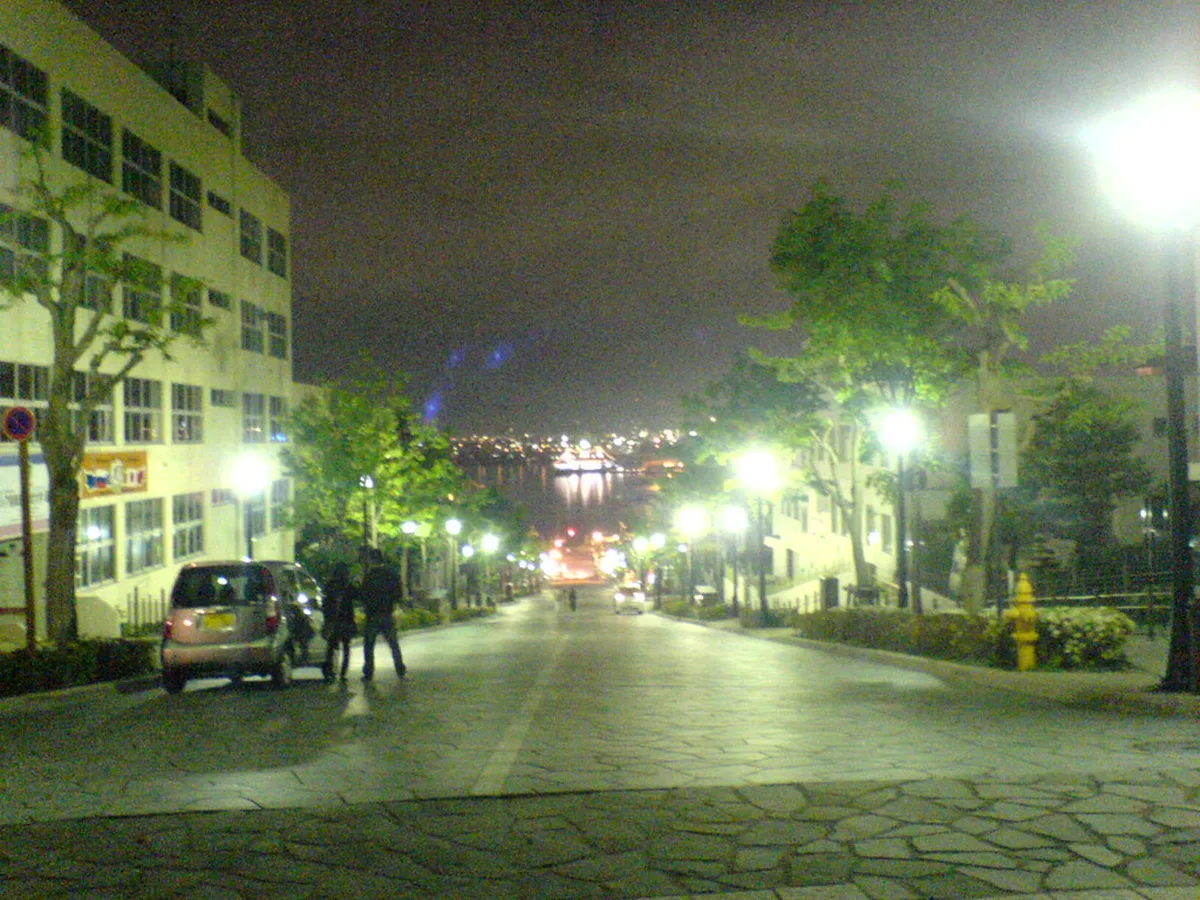
The key street for photography is Hachiman-zaka, a wide cobblestone slope that frames a perfect view of the waterfront and the Red Brick Warehouses at the bottom. It appears on countless travel posters and is best shot in the golden hour before sunset. From the top of Motomachi, you can walk to the Old Public Hall of Hakodate Ward, whose yellow exterior is visible from the harbour, and then follow the slope down to the waterfront in under 20 minutes on foot.
The Hakodate Orthodox Church — with its distinctive green copper domes — is the most photographed building in the district. The Motomachi Roman Catholic Church and Hakodate Anglican Church (St. John's) are clustered within a five-minute walk of each other at the top of the slope. All three exterior grounds are open and free. For a practical free walking route: start at Hachiman-zaka, walk uphill to the Anglican Church, cross to the Orthodox Church, continue to the Old British Consulate garden, then descend back toward the waterfront via the Roman Catholic Church. The full circuit takes about 45 minutes without stops.
The Hakodate tram system offers a ¥600 day pass that covers all lines—one of the best free-itinerary deals in the city. Motomachi is a quick walk uphill from the Jujigai tram stop, making it easy to chain together Motomachi, Goryokaku Park, and the Red Brick Warehouses on a single circuit.
Visit the Kanemori Red Brick Warehouses
The Kanemori complex along the Hakodate waterfront dates to the late 1880s, when the city's trading boom filled these brick buildings with goods moving through the port. They have since been converted into a shopping, restaurant, and entertainment district. Browsing the various halls — including Bay Hakodate and History Plaza — is free. The warehouses are open daily from approximately 09:30 to 19:00, with some restaurant tenants staying open later.
The wooden boardwalks between the buildings offer some of the best waterfront photography in the city, particularly in the hour before sunset when the brick glows orange. The harbour view from here includes Hakodate Bay's fishing fleet and the distant outline of Mount Hakodate. During December, the Christmas Fantasy illuminations turn this stretch of waterfront into one of the most atmospheric free light displays in Hokkaido.
Lucky Pierrot, the Hakodate-only burger chain with its theatrical themed interiors, has a branch inside the warehouse complex. The Chinese Chicken Burger costs under ¥500 ($3.50) and is as close as Hakodate gets to a must-eat street food item. It is not free, but it is one of the cheapest satisfying meals in the city. Check the what to eat in Hakodate for more budget dining context.
Take in the Ocean Air at Tachimachi Cape
Tachimachi Cape sits at the southeastern tip of the Hakodate Peninsula, where steep cliffs drop into the Tsugaru Strait. On clear days the view extends across the water to the Shimokita Peninsula in Aomori Prefecture. The lookout is free, and the approach passes through a quiet hillside cemetery that adds an unexpectedly contemplative mood to the walk. It is about 15 minutes on foot uphill from the Yachigashira tram stop, the southern terminus of tram line 2.
The cape also marks the start of several coastal walking trails that loop around the base of Mount Hakodate. If you combine the trail with the mountain hike, Tachimachi makes a natural midway stop — the path between the cape and the mountain base takes about 30 minutes through scrubby coastal vegetation. Winds here are strong most of the year. Bring a windbreaker even in July.
Relax at the Yunokawa Onsen Footbath
Yunokawa is one of Hokkaido's oldest onsen districts, with records of the hot springs being used as far back as 1653. The free public footbath called Yukura no Sato sits immediately beside the Yunokawa-Onsen tram stop at the eastern end of tram line 2. It is open daily from 09:00 to 21:00 and uses the same natural chloride-rich spring water that fills the area's full-service ryokan baths. Bring a small towel — nothing is provided at this outdoor facility.
Soaking here for 15 minutes after a long walking day is a genuine reset. The water temperature runs around 40–42°C, which is warm enough to draw out fatigue without being overwhelming. Full onsen baths at the surrounding hotels typically cost ¥1,000 to ¥1,500 for day use; the footbath is a workable free alternative for those who prefer to skip the full experience.
Nearby, the Hakodate Tropical Botanical Garden is worth a short detour, particularly in winter (December to May) when Japanese Macaques — snow monkeys — bathe visibly in the garden's outdoor hot spring pool. There is an admission fee for the indoor greenhouses, but the monkey spectacle in winter can sometimes be seen from outside the fence at the garden perimeter, making it a free bonus if you time your Yunokawa visit for the colder months.
Yunokawa Onsen's free footbath is open daily 09:00–21:00, so a quick soak is a perfect reset between walking routes. In winter, time your visit to the Hakodate Tropical Botanical Garden to catch the snow monkeys bathing in the outdoor hot spring pool—free to watch from the perimeter, no admission fee needed.
Plan Your Free Day Around the Tram Network
No SERP guide maps this explicitly, but the Hakodate tram system is the most efficient free-itinerary-planning tool in the city. There are only two lines — the 2 and the 5 — and they share the same track from Yunokawa in the east to Jujigai in the centre, where they split: line 2 continues south to Yachigashira (for Tachimachi Cape) and line 5 heads northwest to Hakodate Dock. A one-day tram pass costs ¥600 (about $4), less than a single roundtrip on most routes.
A practical free-attractions circuit using the tram: start at Yunokawa-Onsen (footbath), ride west to Goryokaku-koen-mae (park grounds), continue to Jujigai and transfer to line 5 toward Hakodate Dock (closest stop for the Red Brick Warehouses and the morning market at the station), then ride back to Jujigai and take line 2 south to Yachigashira for Tachimachi Cape. Motomachi is a short walk uphill from the Jujigai/Suehiro-cho area. This circuit covers six of the twelve free attractions on this list without needing a taxi or rental car.
Single fares are ¥210 to ¥250 per ride depending on distance. If you are making three or more trips across the day, the ¥600 day pass pays for itself. The drivers are helpful with first-time riders — you take a numbered ticket when boarding and pay the displayed fare when you exit.
| Attraction | Area | What's Free | Best Time |
|---|---|---|---|
| Mount Hakodate Trail | Southeast peninsula | Hiking trail to summit; city views at night | April–December; 90 min before sunset |
| Goryokaku Park | Central | Park grounds, ramparts, exterior views | May for cherry blossoms; October for maples |
| Hakodate Morning Market | Near Station | Browsing, vendor samples, atmosphere | Before 09:00; 05:00–14:00 daily |
| Motomachi District | Uphill from Jujigai | Street photography, church exteriors, slopes | Golden hour before sunset |
| Red Brick Warehouses | Waterfront | Boardwalks, exterior browsing, harbour views | Hour before sunset; December for lights |
| Tachimachi Cape | Southeast tip | Cliff views, coastal outlook | Clear days; bring windbreaker |
| Yunokawa Onsen Footbath | Eastern (Tram line 2) | Natural hot spring soak | 09:00–21:00 daily; winter for snow monkeys |
| Shirotai Ranch | North (30 min by taxi) | Free observation deck, city views | November–April (hiking trail closed) |
| Miharashi Park (Kosetsu-en) | North (30 min by bus) | Garden grounds, stone paths, tea houses | October–November for maple illuminations |
| Daimon Yokocho | Near Station | Alleyway atmosphere, retro Showa-era setting | 17:00 onwards; warm lighting |
Shirotai Ranch, Miharashi Park, and More Free Viewpoints
The Shirotai Ranch observation deck is known among locals as the "Back Night View" because it looks north across the narrow isthmus from a completely different angle than the famous Mount Hakodate summit. You see the city's distinctive neck shape — the thin strip of land connecting the mountain peninsula to the wider Hokkaido mainland — spread out below you, often with far fewer people than the main summit. The deck is free to access and is particularly valuable between mid-November and late April when the hiking trail on Mount Hakodate is closed. It requires a car or taxi, about 30 minutes from the city centre, as no direct public transit serves the ranch road.
Miharashi Park, also called Kosetsu-en, is the only nationally designated cultural property garden in Hokkaido, blending Japanese and Western landscaping styles on a hillside north of the city. It is free to enter year-round and is famous for its maple trees during the autumn illumination season. Traditional tea houses and winding stone paths make it a genuinely relaxing half-hour stop. It is about 30 minutes by bus from Hakodate Station.
The Hakodate City Chiiki Koryu Machizukuri Center deserves a mention for anyone interested in architecture. This community hub is housed in the former Hakodate branch of the Marui Imai Department Store, built in 1923. It contains one of the oldest manually operated elevators still in use in the Tohoku and Hokkaido region, which staff will demonstrate on request. Entry is free, the centre is open daily 09:00 to 21:00, and it stocks free city maps and event listings near the entrance — useful for discovering seasonal free events during your visit.
Daimon Yokocho and Free Evening Atmosphere
Daimon Yokocho is Hakodate's only yatai village — 26 tiny bars and restaurants packed into a lantern-lit alleyway a few minutes' walk from Hakodate Station. Eating and drinking cost money, but walking through the atmospheric passageways to soak up the retro Showa-era ambience is entirely free. Most stalls open around 17:00 and stay busy past midnight. The scale of the place is intimate enough that the warm light and cooking smells hit you from the entrance, making it worth a 10-minute loop even if you do not stop to eat.
For free entertainment tied to the calendar: the Hakodate Port Festival in August runs a massive outdoor parade that costs nothing to watch. In winter, the Motomachi slopes and harbour area are lit up each evening with free illumination displays. The Christmas Fantasy event at the Red Brick Warehouses draws large crowds to its outdoor light installations at no charge.
Budget Travel Tips for Hakodate
Beyond the free attractions, a few practical habits will keep costs down across your stay. The ¥600 tram day pass is the single best value purchase in the city, covering every major free attraction reachable by public transit. Hokkaido's tap water is high quality — carry a refillable bottle and skip the convenience store drinks entirely. For lodging, the guesthouse and business hotel strip around Hakodate Station puts you within walking distance of the market and the tram network simultaneously.
Use the JR Hokkaido Rail Info site to confirm train schedules if you are arriving from Sapporo or planning a day trip to Onuma Park. The Hakodate Official Travel Guide website lists seasonal free events and temporary exhibitions that do not make it into standard travel guides. Both sites are updated regularly and are the most reliable sources for current opening hours, especially for smaller sites like the Machizukuri Center or Miharashi Park.
Skip the Goryokaku Tower (¥1,200) in favour of the park ramparts, and skip the Mount Hakodate Ropeway (¥1,800 roundtrip) in favour of the hiking trail. Those two decisions alone save you ¥3,000 per person — roughly the cost of a decent seafood lunch at the morning market, which is a far more memorable use of the money.
Frequently Asked Questions
Is the Mount Hakodate hike difficult for beginners?
The hike is moderate and takes about 60 minutes. The trail is well-marked and paved in sections, making it accessible for anyone with basic fitness. It is much easier than many mountain trails in Japan.
Can you get free food samples at Hakodate Morning Market?
Yes, many vendors offer small tastes of dried squid, seasonal fruit, or seaweed to attract customers. While not a full meal, it is a great way to sample local flavors. Always be polite when accepting samples.
Where are the free footbaths in Hakodate?
The main free footbath is located in the Yunokawa Onsen district, right next to the tram stop. It is open to the public daily and uses natural hot spring water. Remember to bring your own towel.
Hakodate proves that you don't need a massive budget to experience the best of Hokkaido's culture and scenery. By focusing on the free hiking trails, historic walking districts, and public parks, you can see the city's most iconic sights for zero cost. The money you save on admission fees can be better spent on the city's incredible local food or a comfortable place to stay. I hope this guide helps you enjoy the 'starry' views and salty air of Hakodate without stressing over your travel expenses.
Free: The Hakodate Essentials guide
Top things to do, where to stay, a perfect day plan, getting around, and the best time to go — a Hakodate mini-guide you can take offline.
You might also like



Continue reading
More guides you'll find useful