

Kawagoe Day Trip From Tokyo Travel Guide
Plan your 1-day Kawagoe day trip from Tokyo. Discover Little Edo, candy alleys, and historic temples with our practical timing and cost guide.
On this page
Kawagoe sits just 30 to 45 minutes north of Tokyo, yet it feels like a different century. Known as "Little Edo," the city preserves a dense cluster of clay-walled merchant warehouses, feudal-era temples, a 16-metre bell tower, and a laneway of retro candy shops — all compact enough to cover in a single day. This guide gives you the transport options, a walk-friendly itinerary, and the practical details competitors routinely skip.
If you are already planning time in the capital, pair this with our our complete Tokyo itinerary for a natural day-two extension, or browse the full the best things to do in Tokyo list for what to see before and after your Kawagoe trip.
How to Get to Kawagoe from Tokyo
Three train companies serve Kawagoe, and each drops you at a different station. The fastest option is the Tobu-Tojo Line from Ikebukuro Station: express trains reach Kawagoe Station in about 30 minutes, with a one-way fare of ¥490 (approx €3.00). If you are coming from Shinjuku, the Seibu Kawagoe Rail Pass costs ¥700 (approx €4.30) for a round-trip and is available to foreign passport holders. It covers Seibu-Shinjuku, Takadanobaba, or Ikebukuro to Hon-Kawagoe Station, with travel time around 45 minutes on the Koedo Limited Express (add ¥600 for reserved seating) or up to 75 minutes on local trains. JR pass holders can take the JR Kawagoe Line from Shinjuku, a direct rapid in about 55 minutes.
From Shibuya, use the Fukutoshin Express Metro Line, which runs through to Kawagoe-shi Station in roughly 44 minutes for ¥630. From Tokyo Station, transfer to Ikebukuro on the Marunouchi Line, then switch to the Tobu-Tojo Line — total time just under an hour, total cost around ¥700.
Which station to exit at — and why it matters
Kawagoe has three separate stations served by different companies, and choosing the wrong one adds 10 to 15 minutes of walking. Hon-Kawagoe Station (Seibu) is the closest to the historic Kura no Machi warehouse district, Toki no Kane bell tower, and Candy Alley — exit here if you want to dive straight into the old town. Kawagoe Station (Tobu/JR) is about a 20-minute walk from the warehouse district but is 10 minutes closer to Kita-in Temple if you plan to start there. Kawagoe-shi Station (Tobu) sits in between and is the least useful arrival point for tourists. The practical default: arrive at Hon-Kawagoe, walk south to Kita-in first, then loop back through the old town to finish at Candy Alley or Hikawa Shrine, and return from either Hon-Kawagoe or Kawagoe Station.
Kawagoe is flat and compact — the entire tourist circuit is roughly 6 km. The loop bus (Koedo Navigo) runs the main route every 15 minutes and covers most sights for a flat fare of ¥200 per ride. Day passes for the bus are available at the tourist information centre next to Kawagoe Station for ¥500.
Kawagoe Discount Passes Worth Knowing
The Seibu Kawagoe Rail Pass is the most useful for visitors based in Shinjuku or Ikebukuro. At ¥700, it covers unlimited travel on the Seibu lines for the return journey and comes with shopping discounts at select stores in the warehouse district. It is available online or at Seibu station ticket counters, and you need to show a foreign passport to purchase it.
If you take the Tobu-Tojo Line from Ikebukuro, the Tobu Kawagoe Pass (¥950) covers the round-trip train plus unlimited rides on the Tobu bus network in Kawagoe, making it a strong value if you plan to use the loop bus multiple times. Both passes are available on the day of travel — no advance booking needed. JR pass holders have no special Kawagoe-specific discount, so they are better off buying a basic IC card fare-as-you-go.
Things to Do in Kawagoe
Kawagoe rewards a slow, counter-clockwise loop starting at the temples to the east, moving north to the castle palace, swinging west through the warehouse district, and finishing south near the station. Most visitors find four to five hours sufficient for the core circuit. Budget an extra hour if you add Hikawa Shrine or the Seven Lucky Gods Pilgrimage.
Plan to arrive by 09:00 or 10:00 to reach Kita-in Temple before the tour groups. The warehouse district and Candy Alley hit peak congestion between 12:00 and 14:00, especially on weekends. Shops and stall vendors along Kurazukuri Street and Kashiya Yokocho generally open around 10:00 and begin closing by 17:00. The bell tower rings at 06:00, 12:00, 15:00, and 18:00 — if your schedule lines up, lingering near Toki no Kane for the 15:00 ring is worth a few extra minutes.
Kita-in Temple and Its Neighbours
Kita-in Temple is the oldest and most significant site in Kawagoe. The complex traces its origins to around 830 AD, and after a fire destroyed much of it in 1638, the ruling Shogun Tokugawa Iemitsu donated original buildings from Edo Castle to rebuild it — structures that survived the Great Kanto Earthquake of 1923 precisely because they were in Kawagoe rather than Tokyo. Today those buildings are registered Important Cultural Properties. Entry to the main hall and inner gardens costs ¥400 (approx €2.50), and the grounds are open daily from 08:50 to 16:30.
The most memorable feature is the 540 Gohyaku Rakan statues — stone disciples of Buddha, each with a distinct expression. Because Japan was closed to the outside world when the statues were commissioned, the sculptors felt free to carve unconventional, playful faces rather than solemn religious figures. No two are the same. Daikokuten, one of the Seven Lucky Gods, is enshrined here — a fact relevant if you plan the full pilgrimage.
Two minutes' walk from Kita-in sits Nakain Temple, part of the same three-temple complex. The gardens contain weeping cherry trees and rare Taiwan cherry blossoms (kanhizakura), spectacular in mid-March. Kawagoe Naritasan Temple is another five minutes east and enshrines Ebisuten, another of the Seven Lucky Gods. If you are not doing the pilgrimage circuit, a 20-minute walk through this cluster still rewards the detour. On the longer walk to Kita-in from Kawagoe Station, drop into Kawagoe Hachimangu Shrine to see its 1,000-year-old sacred gingko tree, extraordinary in autumn gold.
Kawagoe Castle Honmaru Palace
Heading north from Kita-in, a 10-minute walk brings you to Honmaru Goten — the sole surviving remnant of Kawagoe Castle. The castle itself was founded in 1457, but the Great Fire of Kawagoe in 1893 razed most of it. The current building dates to 1848 and functions as a small history museum. Mannequin dioramas recreate scenes of feudal lords in council, giving a concrete sense of how Kawagoe operated as an Edo-period power centre. Entry is ¥100 (approx €0.60).
Manage expectations: this is a single palace building and a few grassy moat remnants, not a full castle complex. The visit takes 20 to 30 minutes. It is most worthwhile for travellers with a strong interest in feudal history, or families looking to break up the walk between temples and the warehouse district. The surrounding Honmaru Goten park is pleasant and free, with cherry blossoms in late March.
The Edo-Era Warehouse District: Kurazukuri Street and Toki no Kane
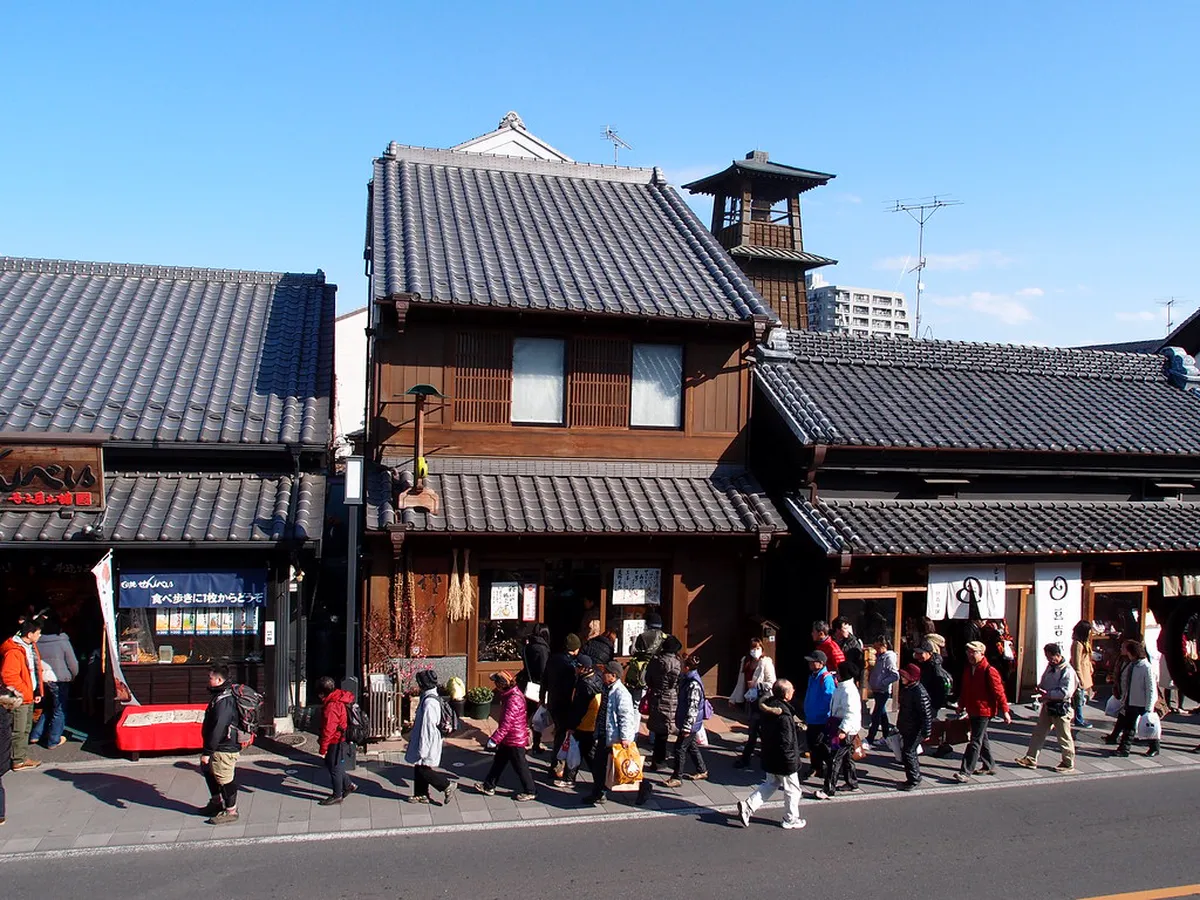
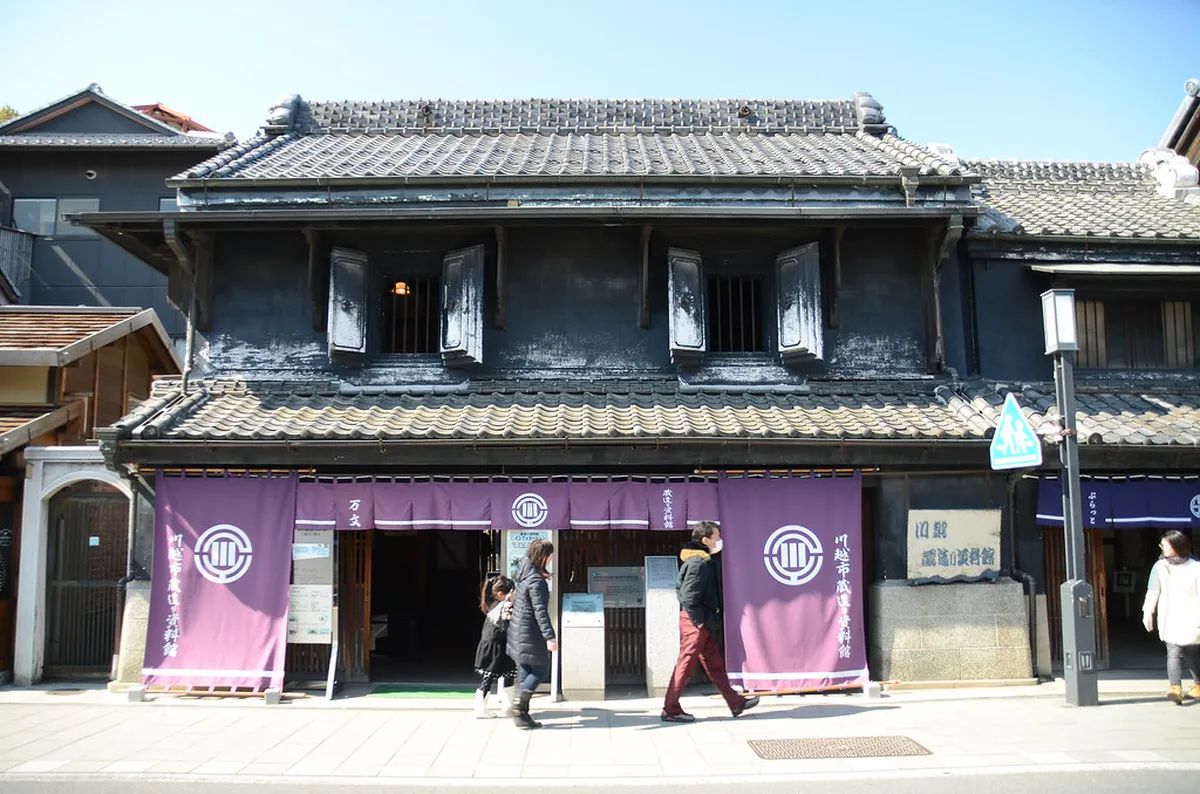
The heart of Kawagoe's visual identity is the Kurazukuri warehouse district — a street lined with over 200 clay-walled storehouses. The style emerged after the Great Fire of 1893, when merchants rebuilt in fireproof kurazukuri (clay and tile) construction. The warehouses survived subsequent disasters that levelled Tokyo, which is why Kawagoe is sometimes compared to Kurashiki in Okayama as one of the last intact examples of this building type in Japan. Today most buildings house shops and restaurants selling local crafts, pottery, and character goods — including a Studio Ghibli store and a Snoopy Village.
At the centre of the district stands Toki no Kane, the 16-metre wooden bell tower that has marked the hours in Kawagoe since the 17th century. The current tower was rebuilt after the 1893 fire and its 700 kg bell still rings four times daily. It is free to view and photograph from the street. Look for the decorative manhole covers around the district featuring the tower's silhouette — a nice detail that costs nothing and is completely overlooked by most visitors.
Within the warehouse district, the Osawa House (Osawa Residence) is the oldest kurazukuri in Kawagoe, built in 1792 and registered as an Important Cultural Property. The Kawagoe Matsuri Kaikan (festival museum) nearby houses the towering festival floats used each October — worth a quick visit even if you miss the actual Kawagoe Festival, which draws close to a million visitors annually and ranks as one of the three great Kanto festivals. Entry to the museum is ¥300 (approx €1.90).
Candy Alley (Kashiya Yokocho)
Kashiya Yokocho — Penny Candy Alley — is a short laneway west of Kurazukuri Street lined with around 20 traditional dagashiya (old-school candy shops). The alley supplied sweets to all of Japan after the Great Kanto Earthquake disrupted supply chains in 1923, and at its peak hosted over 70 stalls. It has been recognised by the Ministry of Environment as one of Japan's 100 Scent Sceneries. Shops open around 10:00 and most are cash-only, so carry small yen notes.
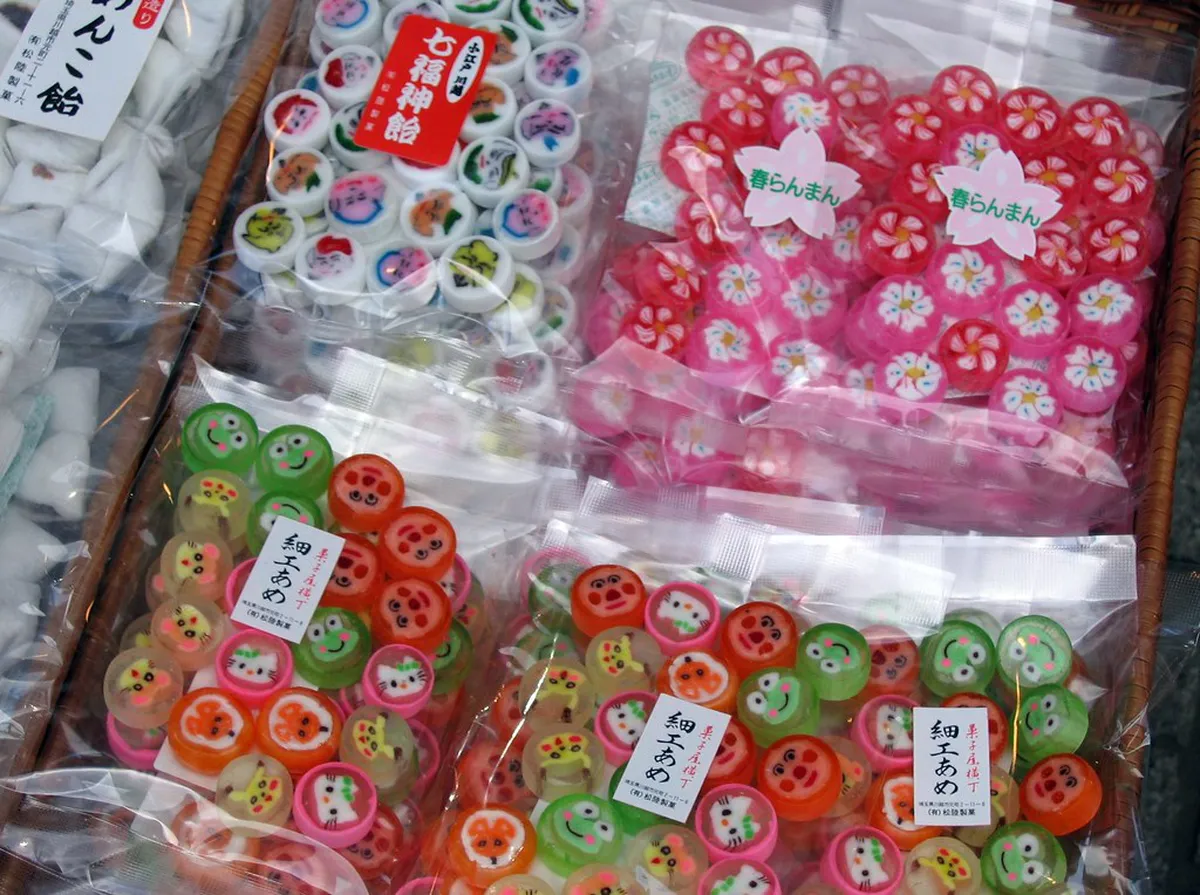
Kawagoe is famous for its purple sweet potatoes, and Candy Alley is the best place to try them in multiple forms: sweet potato ice cream, purple potato chips, fried chips on sticks, and metre-long packaged specimens that are genuinely absurd souvenirs. Dango, senbei, and Fugashi bread are also sold here. Budget around ¥600 to ¥1,000 for a generous snack tour of the alley. The crowds peak between 12:00 and 14:00 on weekends — arrive before 11:00 or after 15:00 for a calmer experience.
Taisho Roman-dori and Renkeiji Temple
South of the warehouse district, heading back toward the stations, is Taisho Roman Yume Street (Taisho Roman-dori). While Kurazukuri Street channels the Edo period, this block reflects the Taisho Era (1912–1926) — Art Deco facades, stained-glass windows, and angular concrete columns. The name "Roman" is short for the Japanese word for "romantic," and "yume" means dream. It was a popular backdrop for period films. Local shops include a stationery store, textile sellers, and old-school kissaten coffee shops. Shimano Coffee Taishō-kan is a good stop for a melon soda and caramel pudding at around ¥700.
Just off the southern end of the route is Renkeiji Temple. Founded in 1549, it enshrines Fukurokuju — god of fortune, longevity, and happiness — one of the Seven Lucky Gods of Kawagoe. Outside spring cherry blossom season it is quieter than Kita-in, which makes it a pleasant final temple stop before heading to the station. There is also a healing statue said to address illness and injury. Entry is free.
Hikawa Shrine and Kumano Shrine
Kawagoe Hikawa Shrine Wind Chime Festival: 2026 Visitor Guide is about 15 minutes north of the warehouse district and is the most atmospherically distinct stop on the circuit. Around 1,500 years old, it enshrines five deities including two married pairs — a rarity in Japan that draws visitors praying for love and marriage. The east entrance is marked by the largest wooden torii gate in Japan, at 15 metres. From June to September the shrine hosts the Enmusubi Furin Festival, during which 2,000 coloured glass windchimes hang from a lattice tunnel. Entry to the grounds is free; the lucky-fish omikuji fortune fishing costs ¥300.
Kumano Shrine sits about 18 minutes' walk from Renkeiji Temple along Taisho Roman-dori, and is worth the detour if you have time. The shrine's motif is Yatagarasu, the three-legged crow — a symbol of guidance in Shinto. The pebble path leading to the main hall is walked barefoot to stimulate acupressure points; there are boards in English explaining the practice. The shrine dates to the 16th century and is smaller and less crowded than Hikawa, with a distinct character. Omikuji fortune slips here are organised by blood type, which is unusual even by Japanese shrine standards.
What to Eat in Kawagoe
Street food is the practical lunch choice on a day trip. Along Kurazukuri Street and Candy Alley you can graze on mitarashi dango, pickled cucumber skewers, sweet potato chips, and fried senbei from Okakidokoro Terakoya Honpo (from ¥200 — they look like yakitori but are rice crackers). Budget around ¥1,500 (€9.50) for a varied street-food lunch. Note that popular soba restaurants around the temple area sometimes queue 60 to 90 minutes at peak times on weekends, so street food is the faster option if time is tight.
For a sit-down option, Kawagoe has several traditional ryotei that offer surprisingly affordable lunch sets under ¥2,000 (€12.50). Matcha cafés are plentiful — Matcha Arata near Kurazukuri Street is a popular choice for iced matcha latte (¥1,000). Café & Bar Kingyotei serves goldfish-themed taiyaki stuffed with sweet potato for a very Kawagoe combination. If you are staying until evening, the outdoor Crea Mall between the stations has izakaya and yakitori restaurants that open as the day fades — a good place to eat before boarding the train back to Tokyo.
The Kawagoe Seven Lucky Gods Pilgrimage
Kawagoe's Seven Lucky Gods Pilgrimage (Shichifukujin Meguri) connects seven temples on a 6 km walking route, each enshrining one of the Lucky Gods: Daikokuten at Kita-in, Ebisuten at Naritasan, Bishamonten at Myozenji, Jurojin at Tennenji, Fukurokuju at Renkeiji, Hoteison at Kenryuji, and Benzaiten at Myoshoji. There is no mandatory order — most walkers incorporate the route into a general sightseeing loop rather than treating it as a separate pilgrimage. The full circuit adds roughly two to three hours to a standard visit.
The pilgrimage is most popular in January during the Hatsudaishi New Year Daruma Market at Kita-in, when Kawagoe residents buy daruma dolls to set intentions for the year ahead. Outside January it is low-key and crowd-free. Picking up a dedicated Shichifukujin stamp card at Kita-in or the tourist information centre costs around ¥200 and provides the clearest map of all seven temples. It is a good option for travellers who enjoy structured walking routes or want a reason to see quieter temples beyond the main circuit.
Kimono Rental and Craft Workshops
Renting a kimono in Kawagoe transforms the warehouse district photo experience considerably. Rental prices range from ¥3,500 to ¥6,000 per person, including dressing assistance. Popular shops include Kimono Rental Wargo and Koedo Vivian; both are located near the warehouse district. Weekend slots fill quickly, so book at least one week in advance through each shop's website. Most rentals run for a full day with return by closing time, typically 17:30.
Several warehouses on Kurazukuri Street offer pottery and glass-blowing workshops running about 60 minutes each, costing around ¥3,000 per person. Candy-making classes at some Kashiya Yokocho shops are also available. These specialist workshops require advance reservation — slots are limited to four to six participants. They are worth considering if you have children or want a hands-on activity beyond sightseeing.
Is Kawagoe Worth a Day Trip from Tokyo?
Kawagoe is one of the most accessible traditional-Japan experiences from Tokyo, and it is genuinely different from Kyoto or Nikko. The warehouse district has a merchant-town texture that Kyoto's temple circuit does not provide, and the 30-minute journey from Ikebukuro means it is viable even on a tight itinerary. The combination of temples, street food, candy shops, and shrine rituals — all within a flat 6 km loop — makes it practical for families, solo travellers, and first-time visitors to Japan alike.
It can get crowded. Kurazukuri Street on a weekend afternoon in October (during the Kawagoe Festival) or in spring cherry-blossom season reaches Kyoto-level congestion. A weekday visit in any season is noticeably calmer. Four to five hours is enough to cover the core sights without rushing; six hours allows the full loop including Hikawa Shrine and a sit-down lunch. Most shops close by 17:00, so there is no reason to stay past early evening unless you want dinner at Crea Mall before the train back.
Pair this with our broader Kawagoe tourism attractions guide for the full city overview.
Frequently Asked Questions
How do I go from Tokyo to Kawagoe?
Take the Tobu-Tojo Line from Ikebukuro for the fastest 30-minute trip. Alternatively, use the Seibu-Shinjuku Line from Shinjuku for a 45-60 minute journey. Both options offer affordable round-trip passes for tourists.
How much time do I need in Kawagoe?
Most visitors need about 4 to 6 hours to see the main sights. This allows time for temple visits, warehouse street walking, and a leisurely lunch. We suggest arriving by 10:00 AM to finish by late afternoon.
Kawagoe is a rewarding destination for anyone visiting the Kanto region. It provides a rare glimpse into Japan's architectural and culinary history. Enjoy the unique atmosphere of Little Edo on your next trip from Tokyo.
For tickets, hours, and visitor details, see our Kawagoe attractions hub and Toki-no-Kane bell tower.
Free: The Tokyo Essentials guide
Top things to do, where to stay, a perfect day plan, getting around, and the best time to go — a Tokyo mini-guide you can take offline.
You might also like


Continue reading
More guides you'll find useful


