12 Essential Tips and Things To Do In Kawagoe (2026)
Discover the best things to do in Kawagoe, Japan's 'Little Edo.' Includes top attractions, kimono rentals, sweet potato snacks, and Tokyo transport tips.
On this page
Known as "Little Edo," Kawagoe is one of the most rewarding day trips from Tokyo. The city's black-walled clay warehouses, centuries-old shrines, and sweet potato street stalls occupy a compact heritage zone that most visitors cover comfortably on foot in four to five hours. This 2026 guide covers everything you need from train options and discount passes to the best spots for kimono photos.
Most travelers find that a Kawagoe Day Trip From Tokyo Travel Guide delivers an Edo-period atmosphere without the long Shinkansen ride to Kyoto. The city preserved its merchant quarter while Tokyo modernized, creating a time-capsule feel just 30 minutes from Ikebukuro. Plan to arrive before 10:00 and you will have the stone-paved lanes largely to yourself. Follow this Kawagoe Itinerary: The Ultimate 1-Day Guide to Little Edo to hit the major sights in the right order.
Key Takeaways
- Best Overall: Strolling the Kurazukuri Warehouse District (free, iconic atmosphere)
- Best for Families: Kashiya Yokocho Candy Alley for nostalgic sweets and fun snacks
- Best Rainy-Day: Kawagoe Matsuri Museum to see festival floats indoors
- Best Free Activity: Visiting the 1,500-year-old Hikawa Shrine and its massive torii gate
- Pro Tip: Arrive before 10:00 to enjoy the streets before the largest crowds arrive
Is Kawagoe Worth a Day Trip from Tokyo?
Kawagoe is one of the best alternatives for travelers who cannot reach Kyoto during a short Japan itinerary. The Kurazukuri district packs a dense concentration of Edo-style buildings into a zone that takes about 20 minutes to walk end-to-end. Compared to Kamakura, which is primarily about the giant Buddha and coastal temples, Kawagoe offers a fuller townscape experience with better street food.
The city is also genuinely affordable. Most attractions are free or cost under ¥400, and a full day of sightseeing — including lunch, snacks, and a museum — typically comes to under ¥5,000 per person. Families will enjoy the nostalgic Candy Alley, history enthusiasts will appreciate the direct ties to the Tokugawa Shogunate, and photographers will find strong compositions around every corner of the warehouse district.
The main caveat is crowd timing. Weekend afternoons between 11:00 and 14:00 draw large tour groups that make the main street difficult to photograph. A weekday visit, or arriving before 10:00 on any day, transforms the experience. Plan to spend at least five hours here for a satisfying trip.
How to Get to Kawagoe from Tokyo
Three train lines connect central Tokyo to Kawagoe, each serving different neighborhoods. The fastest option is the Tobu Tojo Line from Ikebukuro Station, which reaches Kawagoe Station in about 30 minutes on an express train. Travelers from Shinjuku or Shibuya can transfer to the Tobu line at Ikebukuro, adding roughly 20 minutes to the journey.
The Seibu Shinjuku Line runs from Seibu-Shinjuku Station to Hon-Kawagoe Station in 45 to 60 minutes. Hon-Kawagoe is actually closer to the heritage zone than the main JR Kawagoe Station, saving you about 10 minutes of walking through modern shopping streets. Travelers with a Japan Rail Pass can use the JR Kawagoe Line from Shinjuku, but it is generally the slowest option and the pass does not cover the private Tobu or Seibu lines.
A one-way ticket without a discount pass costs between ¥480 and ¥980 depending on your starting station. Trains run every 10 to 15 minutes throughout the day, so there is no need to time your departure precisely. Check the Kawagoe City Official Tourism site for any temporary track maintenance that might affect weekend schedules.
Use Kawagoe Discount Passes to Save Money
Two dedicated passes cover the round-trip journey and extras within Kawagoe. The Seibu Kawagoe Pass covers round-trip travel from Seibu-Shinjuku and costs ¥950. The Tobu Kawagoe Discount Pass starts from ¥1,000 for the standard version and ¥1,340 for the premium version that adds unlimited rides on the Koedo Loop Bus, which stops at every major shrine and temple.
Here is how to choose between them:
- Starting from Ikebukuro → use the Tobu Discount Pass. The premium version pays for itself if you take two or more bus rides.
- Starting from Shinjuku or west Tokyo → use the Seibu Kawagoe Pass. It is the cheapest round-trip option from that side of the city.
- Using a Japan Rail Pass → buy a standard IC card ticket one-way and use Suica or Pasmo for local buses.
Both passes are available only to foreign tourists and require your passport at the station counter. They also include small discounts of ¥50 to ¥100 at participating museums and shops in the warehouse district. Purchase them at the ticket offices inside Ikebukuro or Seibu-Shinjuku Stations before boarding.
Stroll the Kurazukuri Warehouse District
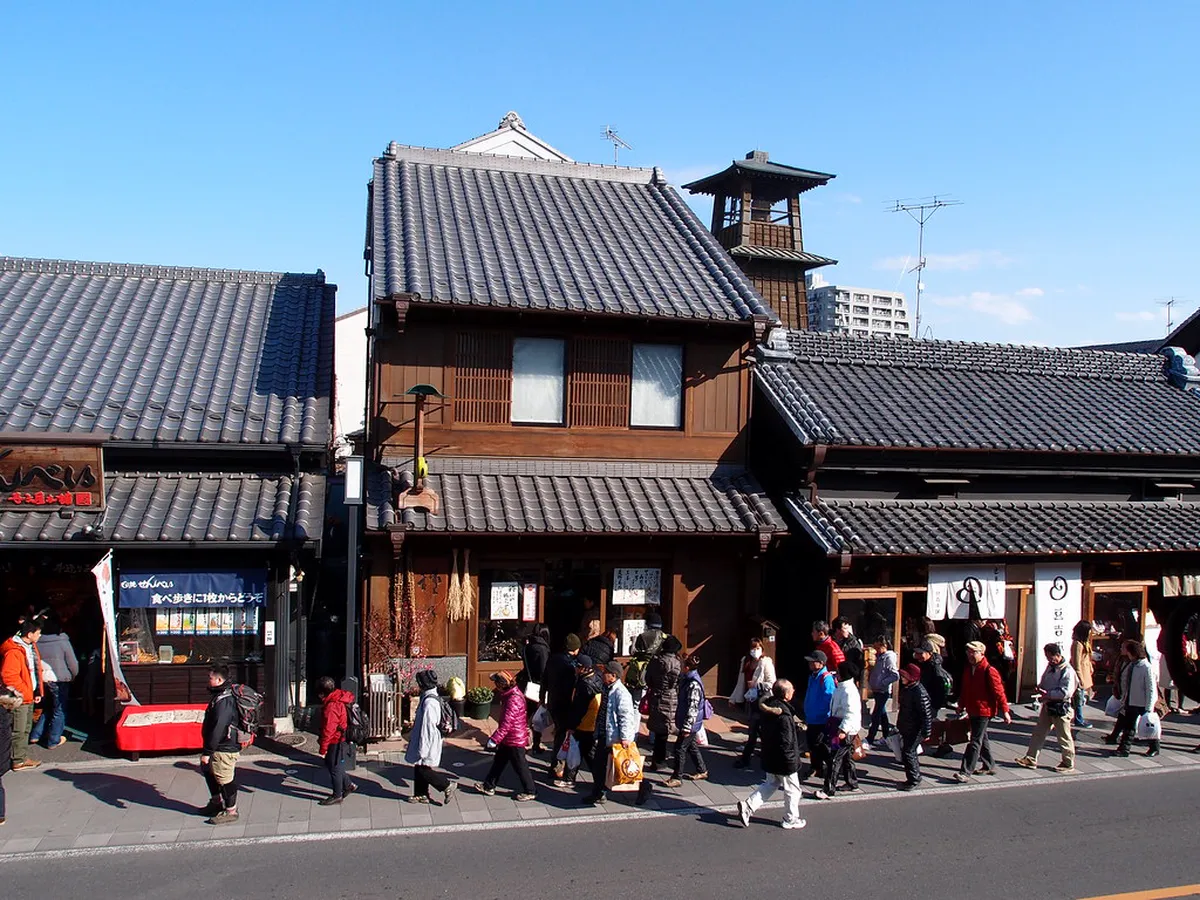
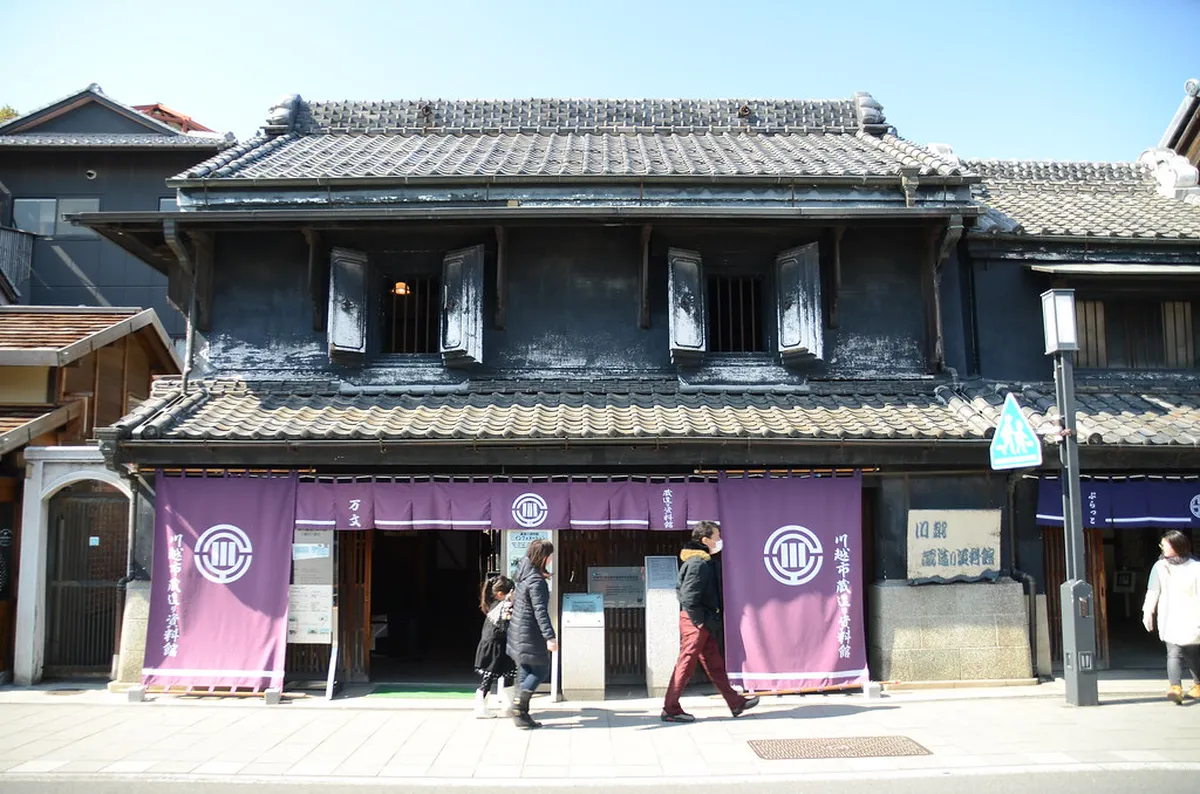
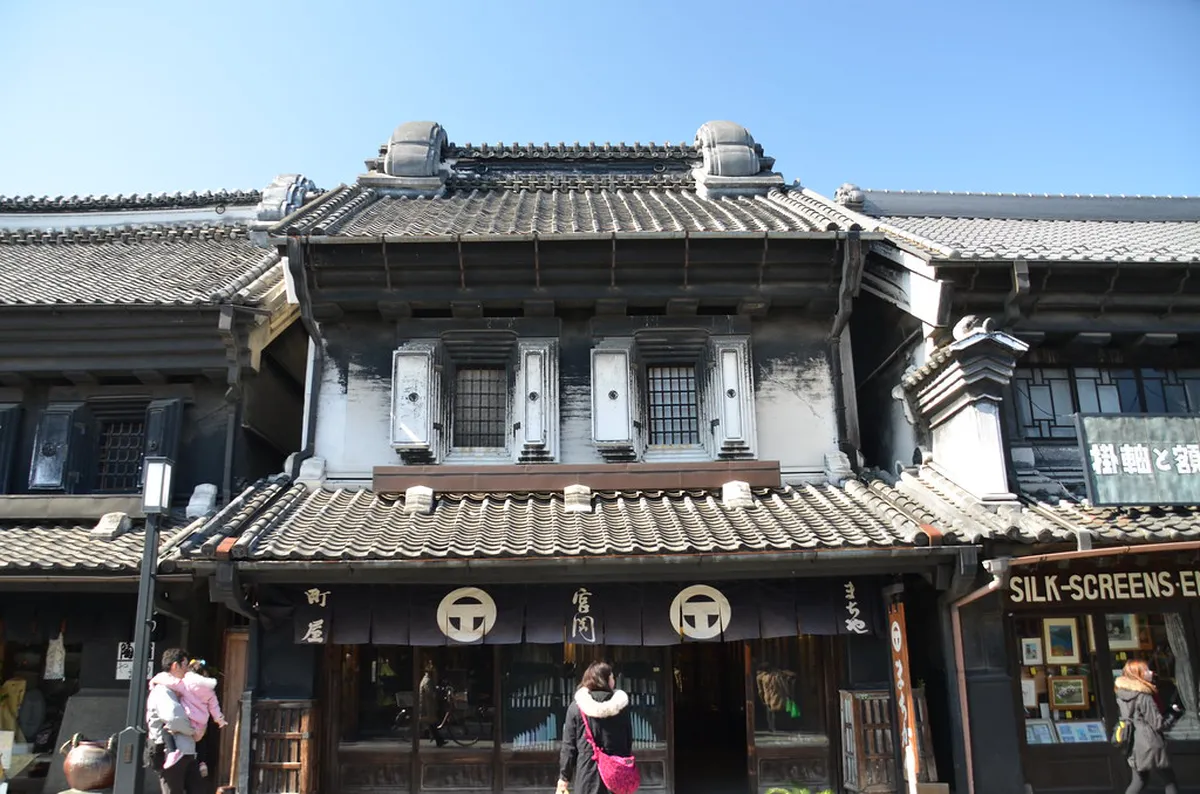
The Kurazukuri warehouse district is the architectural heart of Kawagoe and the first stop on any visit. The black-walled clay storehouses lining this 400-meter stretch of road were built by wealthy Edo-period merchants who could afford the expensive construction as fire insurance. When a great blaze tore through the city in 1893, these thick clay walls survived while the surrounding wooden buildings burned — proof of their original purpose.
Today the buildings house boutique shops, cafes, and local food stalls. Walking the street is free and most shops open from 10:00 to 17:00. Arrive before 10:00 to photograph the architecture before the tour buses pull in. The Kurazukuri Warehouse Street is also notable for its decorative roof tiles, each featuring family crests and mythological figures that were a mark of merchant prestige.
The side streets parallel to the main strip are quieter and equally photogenic. A few steps off the main road you will find private residences and small workshops still operating in traditional buildings. This is the part of Kawagoe that most visitors miss by sticking to the tourist-facing main street.
Hear the Toki no Kane Bell Tower
The Toki no Kane is Kawagoe's most recognized landmark and the city's unofficial clock. The 16-meter wooden tower has marked the hours since the early Edo period. The current structure was rebuilt in 1894 after the Great Fire destroyed the original, and its 700-kilogram bell still rings four times each day.
Bell ringing times: 06:00, 12:00, 15:00, and 18:00. The sound has been designated as one of Japan's 100 Soundscapes, a government recognition of culturally significant sounds worth preserving. Plan your visit to arrive around 5 to 10 minutes before one of these times. The tower is open for exterior viewing 24 hours and is free to visit.
For the classic photo angle, stand on the narrow side street directly north of the bell tower rather than facing it from the main road. This perspective captures the full height of the structure with the old warehouse rooflines in the foreground. The 18:00 chime is especially atmospheric as shop lanterns begin to glow along the surrounding streets.
Visit Kitain Temple's 500 Rakan Statues
Kitain Temple holds a distinction unique in the Kanto region: several of its buildings are original structures relocated from Edo Castle in the 17th century. When fire destroyed most of the temple complex in 1638, the Tokugawa Shogun ordered palace buildings transported from Tokyo along the Arakawa River to help rebuild. Those rooms survived the 1923 Great Kanto Earthquake that later destroyed much of what remained at Edo Castle itself.
The Kitain Temple grounds are free to enter. A paid inner area (¥400) gives access to the relocated palace rooms and the famous Gohyaku Rakan field — 540 stone statues representing the disciples of Buddha who reached nirvana. Each statue was carved between 1782 and 1825 and has a distinct facial expression, ranging from serene to playful to grief-stricken. Local folklore says that if you visit at night and feel the face of a statue, the one you find will resemble someone you love.
Allow at least 45 minutes for the temple grounds. The complex is a 10-minute walk from Hon-Kawagoe Station and is quieter than the main warehouse strip, making it a good first stop before the crowds build. The attached Naritasan Temple, a short walk away, is also worth a brief detour.
Find Romance at Kawagoe Hikawa Shrine
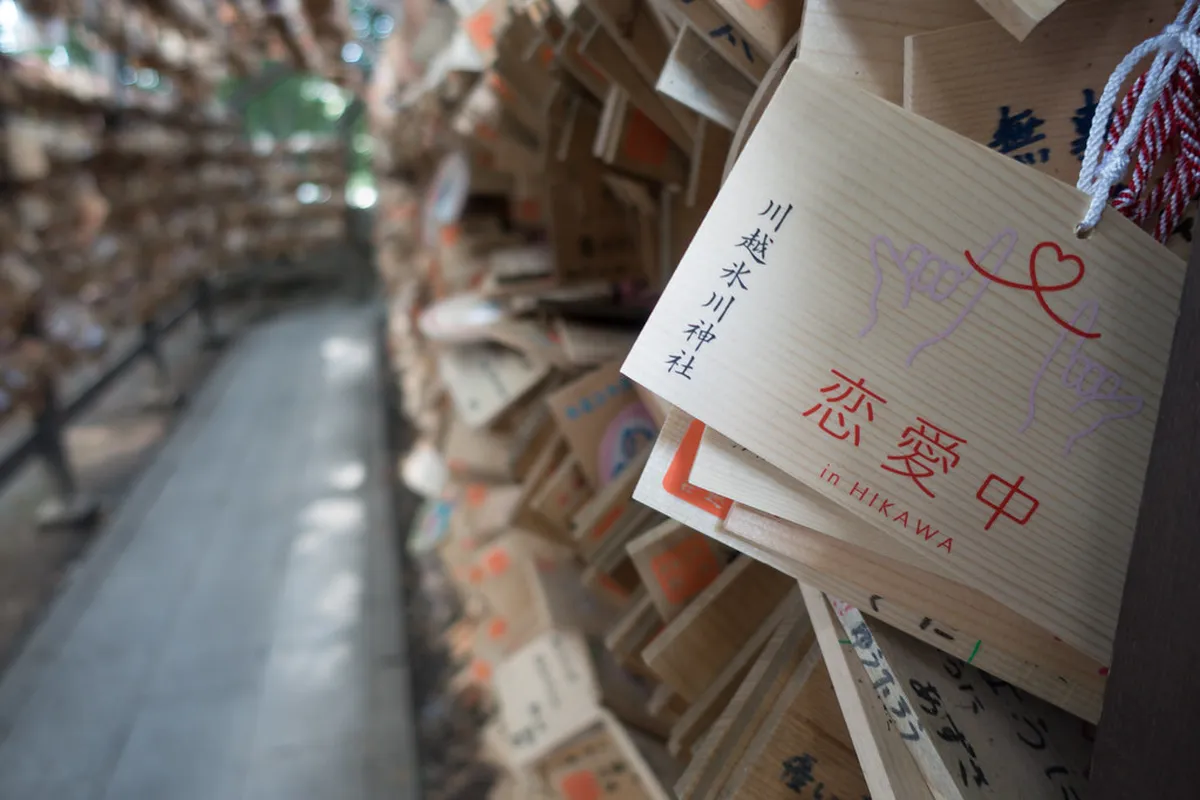
Kawagoe Hikawa Shrine is 1,500 years old and one of the few shrines in Japan to enshrine two married couples among its five deities. This rare pairing makes it the city's most popular destination for couples seeking blessings in love and marriage. The shrine is free to enter and open daily from 09:00 to 17:00.
The Kawagoe Hikawa Shrine Wind Chime Festival: 2026 Visitor Guide is best known for two experiences. First, the east entrance is marked by a 15-meter vermilion wooden torii gate — the largest wooden torii in Japan — which frames a memorable approach lined with spinning pinwheels. Second, the omikuji fortune-fishing ritual lets you use a small rod to catch a tai (sea bream) fish-shaped fortune from a large tub: red fish for luck in the coming year, pink fish for luck in love. The ritual costs ¥300.
From late July to early September, the shrine hosts the Enmusubi Furin Wind Chime Festival. More than 2,000 glass wind chimes are suspended across a lattice tunnel, and visitors can write wishes on small wooden cards to attach to them. The evening illumination after 17:00 is especially beautiful and worth staying for if your schedule allows.
Snack Through Kashiya Yokocho (Candy Alley)
Kashiya Yokocho translates to "Candy Shop Alley" and has been a hub of traditional sweet-making since the early Meiji period. At its Taisho-era peak there were over 70 shops along this stone-paved lane. Roughly 20 remain today, most family-run for several generations and still producing sweets by hand. The Ministry of Environment has listed the alley as one of Japan's 100 Scent Sceneries — a designation for places worth protecting for their sensory character alone.
Entry is free. Most individual snacks cost between ¥100 and ¥500. Look for the following specific items: fugashi (a long, brown-sugar coated wheat puff that is a Kawagoe signature), senbei rice crackers, manju steamed buns, and dagashi — a category of cheap, retro-style Japanese sweets that many adults find nostalgic. A full bag of mixed snacks typically costs around ¥600.
Candy Alley sits adjacent to the Old Town just off the main Kurazukuri street. It gets very crowded on holiday weekends between 11:00 and 14:00. Visiting in the morning or on a weekday makes the experience far more pleasant.
Rent a Kimono for the Day
Kawagoe's heritage streetscape is one of the best backdrops in eastern Japan for kimono photography. Dozens of rental shops operate in and around the warehouse district, offering everything from a basic plan to a full package with accessories and hair styling. Kawagoe Koto is one of the most competitively priced shops, with standard plans from under ¥2,500. Higher-end shops charge ¥4,000 to ¥5,000 for more elaborate garments and full hair styling for women.
A Kawagoe Kimono Rental: 1-Day Little Edo Itinerary typically includes the garment, dressing assistance, and a locker for your modern clothes. Most shops require return of the garment by 17:00 or 17:30. Book at least three days in advance on weekends for the best selection, or walk in on a weekday morning. If you plan to wear a kimono, start at the rental shop first thing and build your itinerary around the 17:00 deadline.
For photo spots, head straight to the Hikawa Shrine's east entrance — the vermilion torii gate and rows of pinwheels create a striking foreground. The black clay walls of the Kurazukuri district provide a strong contrast with bright kimono colors. The quiet side streets around Kitain Temple are less photographed and equally good. Note that traditional sandals (zori) can be tiring over long distances, so keep your walking route tight and manageable.
Try Local Sweet Potato and Eel Specialties
Kawagoe's culinary identity rests on two ingredients: sweet potato and grilled eel. The city has cultivated sweet potatoes since the Edo period, and the range of products made from them today is remarkable. Look for imo soft-serve ice cream (purple sweet potato flavor), imo koishi steamed buns filled with sweet potato and red bean paste, and the signature osatsu chips — enormous thinly-sliced sweet potato chips sold for about ¥600 per bag near the Bell Tower.
For a more adventurous find, the 11 Essential Kawagoe Street Food Stops and Tips scene includes sweet potato beer made by the local Coedo Brewery. Their "Beniaka" amber lager is brewed with roasted Kawagoe sweet potatoes and has a mild, earthy sweetness. It is available at multiple shops and restaurants throughout the heritage district.
For lunch, grilled unagi (eel) has been a Kawagoe specialty since the Edo period due to the city's proximity to local rivers. A set meal at a top-rated unagi restaurant costs between ¥3,500 and ¥5,500 per person. These restaurants do not typically accept advance reservations for small groups during peak lunch hours, so put your name on the waiting list as soon as you arrive in town and browse the nearby shops while you wait.
Join the Kawagoe Matsuri and Local Festivals
The Kawagoe Matsuri is held annually on the third Saturday and Sunday of October. This is one of the largest Edo-style festivals in the Kanto region, designated as a National Important Intangible Folk Cultural Property. Massive two-story floats called dashi are paraded through the narrow streets to flute and drum music. The centerpiece is the Hikkawase ritual where two floats come face-to-face and their musicians compete in an improvised musical battle — a tradition dating back over 360 years.
If you visit outside October, the city runs a strong calendar of smaller events. In summer, the Hikawa Shrine's Enmusubi Furin Wind Chime Festival runs from late July to early September (see the Hikawa section above). Spring brings the Koedo Kawagoe Spring Festival with outdoor performances in the heritage district. In January, the Hatsudaishi New Year's Daruma Market at Kitain Temple draws local families buying good-luck Daruma dolls for the new year.
Smaller monthly markets fill the gaps: a flea market at Renkeiji Temple on the 8th of each month and one at Kitain Temple on the 3rd. These are excellent for vintage kimonos, old coins, and antique ceramics at reasonable prices. Always check the local festival calendar if your visit falls on a weekend, as pop-up events are common throughout the year.
Relax at a Kawagoe Foot Bath Cafe
After several hours on stone-paved streets, Tsubakiya offers one of the more distinctive rest stops in the city. This foot bath cafe is set inside a beautifully renovated traditional building with a small manicured Japanese garden at the back. The concept is simple: soak your feet in warm water while drinking tea and eating a seasonal sweet. It is a genuine local experience rather than a tourist novelty.
A session costs around ¥1,800 and includes your drink, a small sweet, and a private towel. The foot baths are wooden tubs maintained at a steady temperature. During busy weekends, the 30-minute time limit is strictly enforced to manage the waiting list. Leave your name at the front if the cafe is full and use the time to browse the nearby shops along the main street.
Tsubakiya is located within a kimono shop on the main Kurazukuri street. It is a practical midday stop before you head out to the Hikawa Shrine and the outlying parts of the heritage district. The quiet garden setting makes it one of the best places in Kawagoe to review photos, look at your map, and plan the second half of the afternoon.
Walk Taisho Roman-dori on the Way Back
Taisho Roman-dori — also written Taisho-Roman yume-dori (Dream Street) — is the underrated architectural bonus at the end of a Kawagoe visit. This short commercial street connects the heritage zone to Hon-Kawagoe Station and is lined with buildings from the Taisho period (1912–1926). Unlike the Edo-style clay warehouses, these facades show Art Deco influences: stained-glass windows, angular concrete columns, and decorative brickwork that look nothing like what you saw earlier in the day.
Most visitors walk through it quickly while heading for the station, but it is worth slowing down. The street was a popular backdrop for Japanese period films and still has a distinct early 20th-century atmosphere. Several good cafes and small restaurants here are less crowded and less expensive than the tourist-facing spots on the main Kurazukuri street — a solid option for a final snack or drink before the train.
If you time your walk back along Taisho Roman-dori around 17:30 to 18:00, the lanterns on the storefronts begin to glow as the sun sets. Combined with a final pass by the lit-up Toki no Kane bell tower nearby, it makes for one of the most atmospheric endings to a day in Kawagoe.
Essential Logistics for Your Kawagoe Visit
Kawagoe is compact and walkable. The furthest attraction — Hikawa Shrine — is about 25 to 30 minutes on foot from Hon-Kawagoe Station, or one bus ride if you have the premium Tobu pass. Most of the heritage zone is concentrated within a 15-minute walk of the Toki no Kane Bell Tower, which makes a useful central landmark for navigation.
Carry cash. Many smaller candy stalls, temple admission counters, and street food vendors still do not accept cards. ¥3,000 to ¥5,000 in cash covers snacks, museum entry, and incidentals for most visitors. The tourist information centers at Kawagoe Station and Hon-Kawagoe Station both provide free English-language maps — pick one up on arrival to navigate the smaller side streets efficiently.
Most shops and restaurants in the heritage district close by 17:00. Plan to have lunch on the main Kurazukuri street between 11:30 and 13:00, and finish your main sightseeing loop before 16:00 so you have time for the foot bath cafe, Taisho Roman-dori, and a final pass by the illuminated Bell Tower before heading back.
Planning meals as well as sights? Our What to Eat in Kawagoe guide covers the local dishes, dining districts and meal budgeting this page leaves out.
Going deeper on this theme? Our 6 Best Kawagoe Festivals and Events in 2026 (Full Calendar) guide covers it in detail, with the practical planning this page leaves out.
Frequently Asked Questions
Is Kawagoe a good day trip from Tokyo?
Yes, Kawagoe is an excellent day trip because it is only 30-60 minutes from Tokyo by train. It offers a unique Edo-period atmosphere that contrasts sharply with the modern city. Most visitors find the combination of history, street food, and shrines very rewarding.
How much does it cost to go to Kawagoe from Tokyo?
A round-trip train ticket typically costs between 950 JPY and 1,500 JPY depending on the line. Using a discount pass like the Seibu Kawagoe Pass for 950 JPY is the most cost-effective option. Budget an additional 3,000 JPY for lunch and snacks.
What is Kawagoe famous for?
Kawagoe is famous for its Kurazukuri warehouse architecture, the Toki no Kane bell tower, and sweet potato specialties. It is also known for the Kitain Temple and the annual Kawagoe Matsuri festival. Many call it 'Little Edo' for its preserved historical character.
Kawagoe remains one of the most rewarding day trips for anyone looking to experience Japan's traditional merchant culture. Whether you are snacking on sweet potato chips near the Bell Tower or watching the 18:00 chime as lanterns glow along the warehouse street, the city delivers a sense of discovery that feels earned rather than staged. Use this guide to navigate the best of "Little Edo" during your 2026 visit to the Kanto region.
Explore More Kawagoe Guides
Deep-dive guides for every part of a Kawagoe day trip — the Little Edo landmarks, what to eat, cultural experiences, and how to plan your visit from Tokyo.
Landmarks & Districts
- Kawagoe Kurazukuri Warehouse Street: 8 Things to Know
- Toki No Kane Bell Of Time Kawagoe Travel Guide
- Shops in Kashiya Yokocho Candy Alley Kawagoe
- 6 Essential Things to See at Kita-in Temple Kawagoe
Food & Drink
Culture & Experiences
- Kawagoe Hikawa Shrine Wind Chime Festival: 2026 Visitor Guide
- Kawagoe Kimono Rental: 1-Day Little Edo Itinerary
Planning Your Visit
For tickets, hours, and visitor details, see our Kawagoe attractions hub, Kurazukuri warehouse district, Toki-no-Kane bell tower and Kita-in temple.
Free guide: Japan's Hidden Gems
12 under-the-radar places beyond Tokyo & Kyoto — with the best season to visit each and a local tip you won't find in the guidebooks.
You might also like


Continue reading
More guides you'll find useful