Shimanami Kaido Lunch Stops for Cyclists
Where to eat on the Shimanami Kaido in 2026: 10 island-by-island lunch stops for cyclists, from Setoda's lemon dishes to Hakata salt ramen.
On this page
Last updated August 2026, this guide answers where to eat on the Shimanami Kaido island by island, from the ferry crossing at Onomichi to the final climb into Imabari. Riders covering the full 70km route typically spend 7 to 10 hours in the saddle, and food shows up on a schedule set by kitchen hours rather than convenience. The richest concentration of lunch options sits around Setoda on Ikuchijima, roughly the route's halfway point, with strong secondary clusters on Hakatajima and Oshima near the Kurushima Kaikyo Bridge.
Planning Where to Eat on the Shimanami Kaido: Cyclist Logistics
Kitchens along the Shimanami Kaido keep short hours built around fishing and farming schedules, not tourist convenience. Most lunch counters open around 11:00 and stop serving by early-to-mid afternoon. A route sheet that circles a promising restaurant can lead to a locked door on the wrong day. Treat where to eat on the Shimanami Kaido as a set of fixed waypoints, planned the same way you would plan a ferry connection. This guide focuses on lunch-hour logistics. The Shimanami Kaido food guide covers snacks and dinner across the same six islands.
- Mukaishima warm-up: the first island is flat and mostly without dedicated restaurant stops. Grab coffee or a pastry in Onomichi, known for its café culture, before the short ferry crossing.
- Ferry to Mukaishima: the crossing from Onomichi costs around ¥110 with a bicycle and takes about 5 minutes. Most riders use it instead of the narrower road bridge.
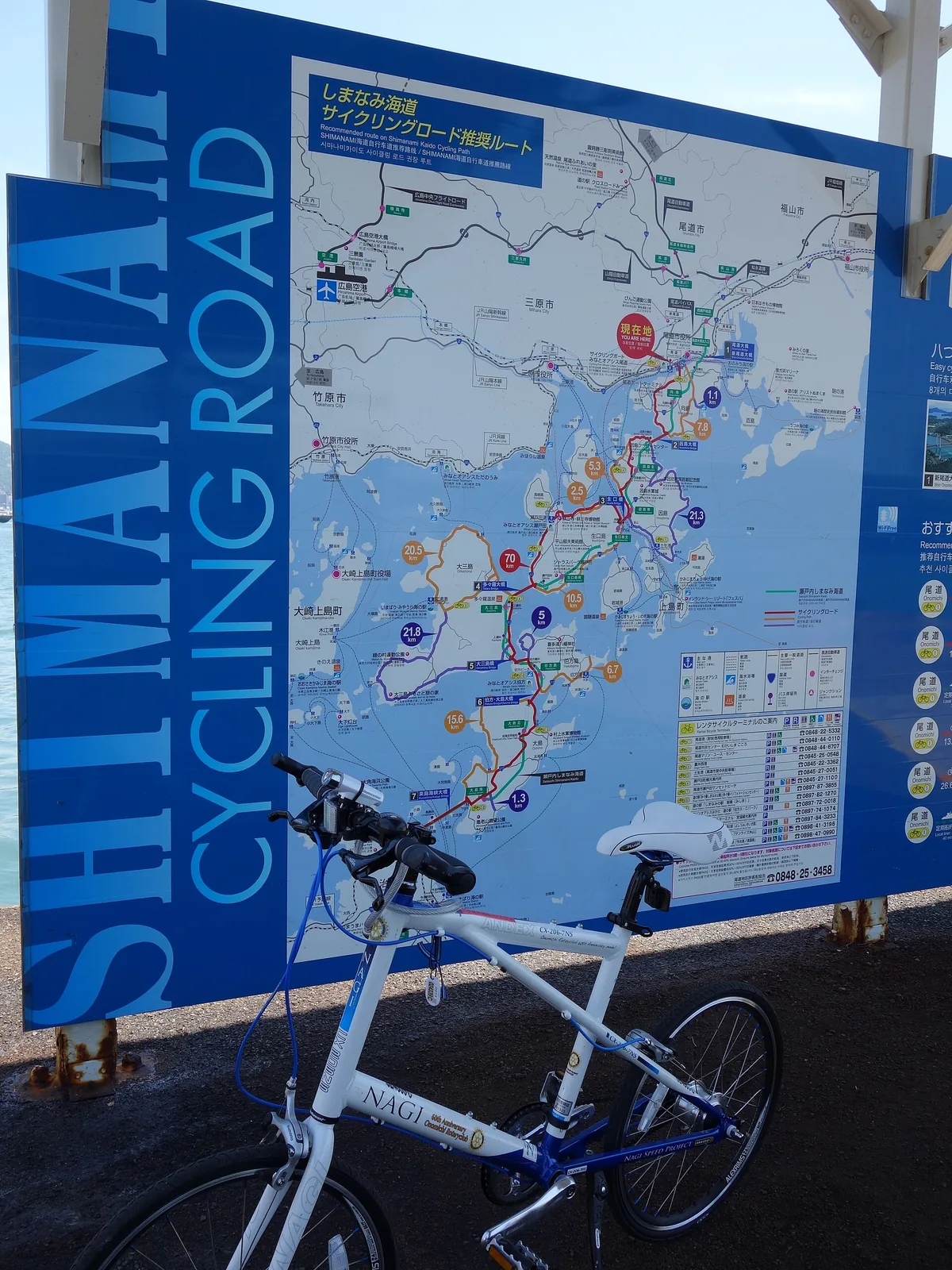
- Blue Line vs. detours: most food stops sit directly on the Blue Line, the main route's signage system. A few, like Shima de Cafe on Yuge Island, require leaving the 70km path via the separate Yumeshima Kaido bridges.
- Cycle Oasis signage: many cyclist-welcoming businesses along the route carry Cycle Oasis markers for parking, air pumps, and restrooms. Look for it when choosing a lunch stop in full riding kit.
- Cash on hand: smaller island diners, vending machines, and ferry counters run more on cash than card. Keep coins and small notes ready, even at bigger cafés that do take cards.
- Bridge tolls: bicycle crossings on the Shimanami Kaido are toll-free through March 31, 2028 under the current promotion, so cyclists do not need to budget bridge-toll cash for this period.
- Backup snacks: most kitchens stop serving by early afternoon, so keep a spare onigiri or energy bar from a convenience store or bakery in case a planned stop is shut when you arrive.
The 10 Best Places to Eat on the Shimanami Kaido
These ten stops move island by island from Innoshima to Oshima, in roughly the order you would reach them riding from Onomichi. Group them loosely by traveler type. Pace-setters want fast, high-calorie fuel. Gourmet explorers are chasing destination seafood. Café-hoppers prioritize scenery and citrus sweets. Every entry below lists confirmed hours, prices, or specialties, so it slots directly into a route sheet.
The Onomichi-Mukaishima ferry costs ¥110 with a bicycle, and card access at smaller island counters is inconsistent—budget cash not just for meals but for ferry and bridge entry itself.
- Hassaku-ya — Citrus Mochi Near Ohamasaki Park (Innoshima)
- Hassaku-ya sells hassaku daifuku, mochi stuffed with Innoshima's own hassaku citrus, near Ohamasaki Park.
- It works as a quick eat-in-hand stop rather than a sit-down meal, useful early in a one-day ride.
- Innoshima is the hassaku's birthplace, developed here in the late 19th century.
- In-oko Okonomiyaki Shops — Innoshima-Style Okonomiyaki (Innoshima)
- More than 20 okonomiyaki shops cluster around Innoshima's Habu area, serving In-oko, the local style built on udon noodles instead of soba.
- Ueda Okonomiyaki is known for a loaded Deluxe In-oko with pork, squid, and mochi, open 11:00–17:00 and closed Thursdays.
- Mikan no Hana sits closest to the main cycling route, near Oyamajinja Shrine, and suits groups better than the smaller Habu Shopping Street shops.
- Shimanami Roman — Lemon Pork Bowl at Setoda Port (Ikuchijima)
- Directly in front of Setoda Port, Shimanami Roman serves a Lemon Pork Bowl made from branded pork raised on lemon-supplemented feed from neighboring Iwagijima.
- Hours run 10:00–17:00, until 21:00 on Fridays and Saturdays, with Wednesdays closed.
- For more citrus dishes in this stretch of Ikuchijima, see the Setoda Lemon Food Guide: Lemon Cakes, Gelato & Curry on Ikuchijima.
- Dolce — Setouchi Lemon Gelato in Setoda (Ikuchijima)
- Dolce serves gelato made with local citrus in Setoda, the recognized halfway point of the 70km route.
- Ikuchijima grows more than a quarter of Japan's lemons, so the lemon flavor here draws on fruit grown minutes away.
- For other citrus desserts along the route, see the Shimanami Kaido gelato guide.
- Shiomachitei — Cyclist Café in an Edo-Period House (Ikuchijima)
- On Shiomachi Shopping Street, Shiomachitei occupies a restored Edo-period building with a dirt-floor area where a road bike can be wheeled inside rather than left on the street.
- Current published hours are 11:00–16:00 on Sunday, Tuesday, Thursday, and Friday; it is closed Monday, Wednesday, and Saturday. Confirm the schedule before building a ride around it.
- For more cyclist-friendly cafés like this, see the Shimanami Kaido cycling cafés guide.
- Yoshikawa — Seafood Rice Bowl Near Miyaura Port (Omishima)
- Yoshikawa keeps a live fish tank near Miyaura Port on Omishima. Its signature seafood rice bowl gets a raw egg yolk stirred in at the table.
- Hours run 11:00–14:30 with irregular holiday closures, and a bicycle rack in the parking lot makes this an easy mid-route stop.
- Oyamazumi Shrine and its treasure hall are a short ride away. See the Shimanami Kaido attractions guide for detour options.
- Akakichi Sushi — Michelin-Cited Sushi in Hakata-cho (Hakatajima)
- Michelin has cited Akakichi Sushi as one of its most remote starred restaurants, run by chef Junji Akase with seafood sourced around the island and from Tokyo's Toyosu market.
- It runs primarily as a dinner spot. Lunch is possible only by advance phone reservation, so confirm current booking policy before planning around it.
- For more sea bream and other Setouchi seafood, see the Shimanami Kaido Seafood Guide: BBQ, Sushi, and Island Specialties.
- Sanwa — Hakata Salt Ramen in Kinoura (Hakatajima)
- Sanwa builds its Hakata Salt Ramen on a 17-ingredient broth seasoned with local sea salt, a direct way to replace sodium lost over a long ride.
- Hours run 11:00–19:00, until 17:00 on Wednesdays, closed Sundays, with the ramen set around ¥1,000–¥1,500.
- The shop started in 1971 as Sanwa Shokudo, after the island's original saltworks closed, and has served shipyard workers since.
- Noshima Suigun — Seafood Bowls and BBQ Near the Pirate Museum (Oshima)
- Run by the local fisheries cooperative near Miyakubo Fishing Port, Noshima Suigun serves sea bream rice bowls plus a build-your-own seafood BBQ on a deck over the water.
- Hours run 9:00–15:00, closed Mondays, with typical prices around ¥1,000–¥2,000.
- It sits across from the Murakami Kaizoku (Pirate) Museum, so it pairs well with a museum stop.
- Kameyama Goya — Mountain-Path Café With a Bridge View (Oshima)
- Kameyama Goya sits on the main route between Yoshiumi Iki-iki Kan and Imabari, reached by a 1-to-2-minute walk up a marked path from its bike rack.
- The wooden cabin café serves green curry, lu rou fan, and pho depending on the season, open 11:00–17:00 but only Friday through Sunday.
- The reward for the short walk is a direct view of the Kurushima Kaikyo Bridge, the last major crossing before Imabari.
Timing Your Lunch Stop: One-Day vs. Overnight Rides
Riders covering the Shimanami Kaido in one day usually spend 7 to 10 hours in the saddle, stops included. That pace puts Setoda on Ikuchijima, roughly the 40km halfway point, right around midday. Setoda's cluster of Shimanami Roman, Dolce, and Shiomachitei is the natural lunch window for a single-day crossing from Onomichi. Riders pushing straight through without stops can finish in around 4 hours. That pace skips lunch, though, turning the crossing into a point-to-point sprint rather than a food-focused ride. Early arrivals reaching Setoda before 11:00 should hold off on lunch, since most kitchens there don't open until then. A coffee stop is a better use of the wait than standing outside a closed restaurant. Two-day riders get a different lunch map. Splitting the route at Omishima or Setoda for an overnight stay shifts day one's meal to or before Setoda. Day two's lunch then moves toward Hakatajima or Oshima. Sanwa's salt ramen or Noshima Suigun's seafood bowls suit a late-morning start on day two, before the final push over the Kurushima Kaikyo Bridge into Imabari.
The 70km route's standard 7-to-10-hour pace reaches Setoda by midday, but slower entries might arrive after restaurants like Yoshikawa close lunch service at 14:30, despite following the route at a reasonable speed.
Quick Comparison: Where to Eat on the Shimanami Kaido by Island
Use this table to match an island to a specialty and a realistic arrival window, then confirm current hours before committing to one stop, since small shops adjust days and hours more often than chain restaurants do.
| Island | Recommended Stop | Specialty | Hours / Closed Days | Best For |
|---|---|---|---|---|
| Innoshima | Hassaku-ya | Hassaku citrus mochi | Daytime, check locally | Quick snack |
| Innoshima | Ueda Okonomiyaki (In-oko) | Innoshima-style okonomiyaki | 11:00–17:00, closed Thu | Hearty lunch |
| Ikuchijima | Shimanami Roman | Lemon Pork Bowl | 10:00–17:00, closed Wed | Rice bowl lunch |
| Ikuchijima | Dolce | Setouchi lemon gelato | Daytime, check locally | Afternoon dessert |
| Ikuchijima | Shiomachitei | Café menu | 11:00–16:00 Sun/Tue/Thu/Fri; closed Mon/Wed/Sat | Café break, indoor bike parking |
| Omishima | Yoshikawa | Seafood rice bowl | 11:00–14:30, irregular holidays | Sit-down seafood |
| Hakatajima | Akakichi Sushi | Michelin-cited sushi | Dinner nightly; lunch by reservation | Splurge, book ahead |
| Hakatajima | Sanwa | Hakata salt ramen | 11:00–19:00, closed Sun | Hearty lunch |
| Oshima | Noshima Suigun | Sea bream bowl, seafood BBQ | 9:00–15:00, closed Mon | Group seafood BBQ |
| Oshima | Kameyama Goya | Asian café menu | 11:00–17:00, Fri–Sun only | Scenic café break |
Mistakes to Avoid When Eating on the Shimanami Kaido
Most dining problems on the Shimanami Kaido come from timing, not from a shortage of good restaurants. These are the recurring ones worth planning around.
- Assuming every shop is open every day: Shiomachitei currently serves on Sunday, Tuesday, Thursday, and Friday only, while other small operators follow their own schedules. Check each venue on the day rather than relying on a general area timetable.
- Arriving after 14:00 expecting a hot lunch: several kitchens on the route, including Yoshikawa, stop serving in early-to-mid afternoon even if the shop stays open later.
- Skipping a cash reserve: card acceptance is inconsistent at smaller island counters and ferry ticket windows. Keep coins and small notes on hand.
- Treating a detour island as a quick stop: Yuge Island, reached off the main route via the Yumeshima Kaido bridges, adds real time to a lunch plan. Budget for it separately rather than squeezing it into a tight schedule.
- Underestimating the bridge ramps: the approach ramps on the Tatara and Kurushima Kaikyo bridges are graded gently, but they still add up over a 70km day. Running low on calories mid-bridge is a worse problem than running low on gelato.
Yoshiumi Iki-iki Kan: Seafood BBQ Before Kurushima Kaikyo Bridge
Yoshiumi Iki-iki Kan is a roadside station on Oshima near the Kurushima Kaikyo Bridge approach. It is a useful final substantial food stop before riding into Imabari. Unlike a fixed-menu ramen shop, its seafood area lets riders choose local fish and shellfish for a charcoal grill meal.
The stop suits cyclists who reach Oshima too late for an early lunch on Hakatajima. It also works well for groups, since each person can select a different item. The roadside-station format makes it simpler than a reservation-only seafood restaurant.
- Use it as a meal stop before the final bridge crossing.
- Look for seasonal Setouchi seafood rather than assuming one item is always available.
- Pair the stop with the nearby bridge viewpoints, but allow time for grilling and ordering.
Check the day’s seafood counter and operating hours before relying on it. Availability changes with the catch, weather, and season.
How This Guide Was Verified
Food availability, access details, seasonal rules, and the time-sensitive claims in this guide were checked on August 22, 2026 against the official sources below. Independent restaurant menus, prices, opening days, and sell-outs can change, so confirm the operator's same-day notice before making a special trip.
Frequently Asked Questions
What is the best area to eat lunch on the Shimanami Kaido?
Setoda on Ikuchijima has the densest cluster of lunch stops, roughly at the 40km halfway point of the route. Shimanami Roman, Dolce, and Shiomachitei sit within a few minutes of each other there.
Are restaurants on the Shimanami Kaido open every day?
No. Closures vary by shop: for example, Shiomachitei currently serves on Sunday, Tuesday, Thursday, and Friday and closes on the other three days. Confirm each venue's same-day schedule before planning a route around it.
Do travelers need cash to eat on the Shimanami Kaido?
Carrying cash helps. Smaller island diners, vending machines, and the Onomichi-Mukaishima ferry counter, which runs about ¥110 with a bicycle, can be less card-friendly than restaurants in Onomichi or Imabari.
Can a one-day ride include a proper lunch, or is overnight better?
A one-day ride works for lunch if it's timed around Setoda, about 3 to 4 hours in from Onomichi. Riders who overnight near Omishima or Setoda get a more relaxed lunch window on both days, with day two's meal typically falling on Hakatajima or Oshima.
Is Akakichi Sushi worth planning around on Hakatajima?
It's worth planning around rather than dropping into without notice. Michelin has cited it as one of its most remote starred restaurants, but it runs mainly as a dinner spot and takes lunch guests only by advance phone reservation.
What happens if a planned lunch stop turns out to be closed?
Keep a backup snack from a convenience store or bakery for exactly this reason. Most islands have more than one option nearby, so a closed door usually means riding a short distance further rather than going without lunch.
Free guide: Japan's Hidden Gems
12 under-the-radar places beyond Tokyo & Kyoto — with the best season to visit each and a local tip you won't find in the guidebooks.
You might also like


Continue reading
More guides you'll find useful