

Osechi Ryori Guide: Japan's New Year Food, Explained
What osechi is, what each dish symbolizes, when it's eaten during san-ga-nichi, and how travelers in Japan can see or try it over New Year.
On this page
Last updated September 2026, osechi is the layered, cold-served food eaten across Japan during the first days of January. Each dish inside carries its own wish, from black soybeans for health to lotus root for a clear view ahead. This guide explains what osechi means and how a traveler in Japan over New Year can see or taste it.
What Is Osechi?
Osechi ryori is the set of dishes prepared before December 31 and eaten cold over the opening days of January. The custom ties to an old belief that cooking, using knives, and other household chores should pause during the New Year. Cooks solved that problem with sugar, vinegar, and soy sauce, methods that let food sit without refrigeration for several days. Traditionally, the first portion was offered to Toshigami-sama, the New Year deity, on a household altar before the family ate. These dishes are packed into stacked lacquered boxes called jubako, and each item inside is chosen for a symbolic meaning rather than flavor alone. Oshogatsu, the broader New Year holiday, is built around this pause, a deliberate quiet stretch after months of work.
Osechi dishes must be prepared before December 31 to stay fresh through the no-cooking san-ga-nichi period, making advance ordering from stores the simplest option for travelers.
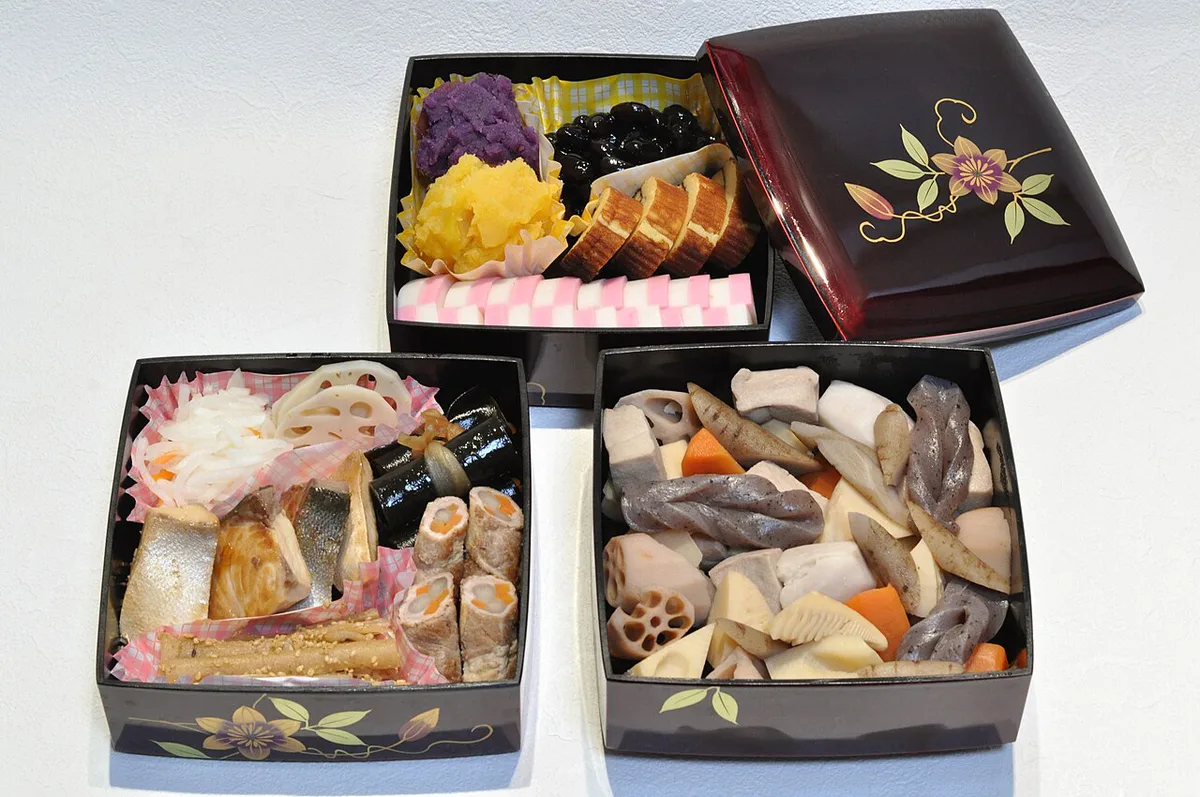
Osechi Dish Symbolism at a Glance
Every osechi box mixes sweet, salty, and vinegared dishes, and each one carries a specific wish for the year ahead. Many of the wordplay-based meanings below repeat across different households, even though exact recipes vary. The table below covers the dishes most consistently named across Japanese food sources, the ones most likely to appear in a jubako, homemade or store-bought.
| Dish | Symbolism |
|---|---|
| Kuro-mame (black soybeans) | Health and diligence, from a pun on mame meaning hardworking |
| Kazunoko (herring roe) | Fertility and many descendants, from the sheer number of eggs |
| Tazukuri (candied dried sardines) | A bountiful harvest, from the fish's historical use as fertilizer |
| Datemaki (sweet rolled omelet) | Knowledge and scholarship, from its scroll-like shape |
| Kamaboko (red-and-white fish cake) | The New Year sunrise, from its color and half-circle shape |
| Kuri kinton (chestnut and sweet potato) | Wealth and financial luck, from its golden color |
| Kohaku namasu (red-white pickled daikon and carrot) | Celebration and purification, from the red-and-white pairing |
| Konbu maki (kelp rolls) | Joy, from a pun on yorokobu, meaning to rejoice |
| Renkon (lotus root) | A clear view of the year ahead, from the holes in each slice |
Jubako: The Tiered Boxes and What They Represent
Jubako are the stacked lacquered boxes that give osechi its recognizable look. Traditional sets run to two to four tiers, and the boxes stay stacked and covered between meals so the food keeps for several days. Some households organize the tiers by course, function first. Others read the same stack symbolically, tier by tier. Either reading points to the same idea: stacking dishes stacks up good fortune for the year ahead. Modern jubako sometimes swap lacquer for disposable trays, especially in smaller households.
- Top tier: appetizers, read symbolically as heaven
- Second tier: vinegared, grilled, or skewered dishes, read as earth
- Third tier: simmered vegetables, read as humanity
- Fourth tier, when present: additional dishes, read as fuku, or blessings
Ozoni and Otoso: What Osechi Is Served With
Osechi rarely appears alone at the New Year table. Ozoni, a soup built around mochi rice cakes, is the near-universal companion dish, though broth and ingredients vary widely by household and region. Kansai households often lean toward a white miso broth with round mochi, while Kanto households tend toward a clear soy-based broth with square mochi. Otoso, a spiced New Year sake believed to ward off sickness for the year ahead, is another common accompaniment, traditionally poured in a set order among family members. Together, osechi, ozoni, and otoso make up the core of a New Year's Day meal in many households.
When Osechi Is Eaten: San-ga-nichi and the New Year Calendar
San-ga-nichi covers the first three days of January. Osechi is built to last across all three days without reheating or fresh cooking. Older customs held that lighting a stove or picking up a knife during this window invited bad luck for the coming year. This belief also explains why osechi leans cold, salty, sweet, or vinegared rather than freshly cooked. Many businesses traditionally stayed closed through san-ga-nichi. Closures have loosened over recent decades. Hours can still shrink around January 1 to 3. Check the Japan National Tourism Organization site for current holiday dates before relying on shops or restaurants. That kind of check matters most for a January trip to Japan, when many calendars shift around the holiday. Oshogatsu, the broader New Year holiday, commonly runs three to five days start to finish. Sequencing a New Year visit around wider New Year customs benefits from that timing, including the household deity Toshigami-sama and entrance decorations set out to welcome the year.
Can Travelers Try or Buy Osechi in Japan?
Seeing or tasting osechi does not require a Japanese host family. Department stores and supermarkets across Japan sell pre-ordered jubako boxes each December, ranging from single-tier sets to elaborate multi-tier spreads. Convenience store chains, including 7-Eleven locations, also stock smaller osechi sets and individual dishes in the weeks before New Year, a lower-commitment way to sample a few items. Hotels and ryokan running New Year packages often build a jubako course into the stay, folding the cost into the room rate rather than a separate purchase. A smaller number of restaurants serve osechi-style set menus around January 1 to 3, though seating fills early given how few restaurants stay open through san-ga-nichi. None of these options require advance knowledge of Japanese osechi customs, though a pre-ordered department-store box gives the clearest sense of a full traditional spread. Pre-ordered boxes are typically paid for in advance, so review paying for purchases in Japan before placing a department-store or hotel order.
| Access option | Convenience | Authenticity | Cost note |
|---|---|---|---|
| Department store pre-order | Book weeks ahead; pick up in late December | Closest to a full traditional jubako spread | Priced as a premium, multi-tier set |
| Convenience store (e.g., 7-Eleven) | Walk-in, no reservation needed | Individual dishes rather than a full box | Lowest-commitment option, priced per item |
| Hotel or ryokan New Year stay | Built into a booked stay | Hosted, often elaborate presentation | Folded into the room rate, not itemized |
| Restaurant set menu | Limited seating during san-ga-nichi; book ahead | Chef-prepared, but not always a full jubako | Priced as a set menu with other courses |
Regional and Modern Variations
Osechi is not identical from region to region. In Kanto, the Tokyo area, the three anchor dishes are typically kuro-mame, kazunoko, and tazukuri. Kansai, the Kyoto and Osaka area, keeps kuro-mame and tazukuri as staples too, but tataki gobo, simmered burdock root, often takes the third anchor spot instead of kazunoko. Neither version is more correct than the other; the difference reflects centuries of separate regional cooking traditions. Kyoto's official travel guide covers more of how the old capital marks the New Year season. Modern osechi has also drifted toward convenience, shown below. Not every region treats osechi as obligatory, either. Some communities keep the custom lighter than the elaborate department-store spreads suggest. Treat any single claim about one town's practice as worth confirming locally rather than assuming it holds nationwide.
- Single-portion boxes sized for one person
- Themed sets aimed at younger shoppers, including character and anime tie-ins
- Supermarket trays that let a household mix individual dishes instead of buying a full multi-tier set
- Non-Japanese-style sets, including Chinese, French, Korean, and Western-influenced osechi sold alongside traditional boxes
Mistakes to Avoid When Planning a Trip Around Osechi
A few planning mistakes come up often around osechi and the New Year holiday. Catching them early keeps a January trip to Japan from running into closed doors or an empty table. A little advance planning avoids most of them.
- Assuming every shop and restaurant is open during san-ga-nichi. Hours often shrink January 1 to 3, so confirm anything essential in advance.
- Missing the pre-order window for department-store or supermarket osechi. Boxes are typically ordered in December, well before New Year's Eve.
- Confusing osechi with ozoni. Osechi is the cold, boxed dish set. Ozoni is the separate mochi soup served alongside it.
- Treating New Year as an ordinary travel week. Domestic transport can book up early even while some shops run quieter hours, so weigh that trade-off against other good times to visit Japan.
How Osechi Fits Into a Japan New Year Trip
Osechi is just one piece of a longer New Year sequence in Japan. The lead-up starts on New Year's Eve in Japan, when families finish cooking and settle in to watch the year turn. On January 1, many people follow osechi with hatsumode, the first shrine or temple visit of the year. Tokyo's Meiji Jingu draws large early-January crowds for it. Kyoto's Fushimi Inari Taisha does too. A full Hatsumode: A Traveler's Guide to Japan's New Year Shrine Visit covers timing and etiquette for that visit in more depth. Around January 11, some households and martial arts clubs hold kagami biraki, breaking open the mochi offering set out earlier in the season. Building a trip around these customs works best as part of a wider New Year in Japan itinerary. A general Japan Travel Guide: Plan Your Trip with Expert Tips & Itineraries can help fill in the logistics outside the holiday itself. Since early January is cold across most of the country, a Japan Packing List: Seasonal & Essential Travel Guide is worth checking before departure. None of these customs require insider access, and a visitor who plans around san-ga-nichi and hatsumode can experience most of Japan's New Year season firsthand.
Kagami biraki happens around January 11, extending New Year celebrations well beyond the core three to five day oshogatsu window.
Frequently Asked Questions
What is osechi ryori and why is it eaten on Japanese New Year's Day?
Osechi ryori is the set of cold, preserved dishes eaten over the first days of January in Japan. It's prepared in advance so cooking can pause during san-ga-nichi, the New Year's first three days. Each dish is chosen for a symbolic wish, such as health, wealth, or a good harvest.
What do the different dishes in an osechi box symbolize?
Each dish inside a jubako carries its own meaning. Kuro-mame, black soybeans, stand for health and hard work. Kazunoko, herring roe, represents a wish for many children. Tazukuri, candied dried sardines, symbolizes a bountiful harvest. Kuri kinton, a sweet chestnut and potato mash, stands for wealth, since its color reads as gold.
What is a jubako box, and why is osechi served in tiers?
A jubako is a stacked, lacquered box similar in shape to a bento box. Osechi is packed into two to four tiers, sometimes more, so food layers by dish type. The stacking itself carries meaning. Kasaneru, the act of layering, is read as stacking good fortune for the year ahead.
Can visitors to Japan see or try osechi during a trip?
Yes. Department stores and supermarkets sell pre-ordered jubako boxes each December. Convenience stores stock smaller sets and individual dishes for a lower-commitment taste. Hotels and ryokan running New Year packages often build osechi into the stay. A handful of restaurants also serve osechi-style menus around January 1 to 3.
Why do many stores and restaurants close during the first days of the New Year in Japan?
The custom traces back to san-ga-nichi, when cooking, using knives, and other household chores were traditionally avoided. Businesses historically closed so staff could observe the same quiet stretch. This pattern has loosened in recent decades, though hours can still shrink around January 1 to 3, so confirm current opening times before relying on them.
What is the difference between osechi and ozoni?
Osechi is the array of cold, preserved dishes packed into a jubako box. Ozoni is a separate hot soup built around mochi rice cakes, served alongside osechi rather than inside the box. Broth and ingredients in ozoni vary by household and region, unlike the more standardized dishes in osechi.
Is osechi the same everywhere in Japan?
No. Kanto, the Tokyo area, typically anchors its osechi around kuro-mame, kazunoko, and tazukuri. Kansai, the Kyoto and Osaka area, commonly swaps in tataki gobo, simmered burdock root, in place of kazunoko. Some communities also treat the custom more loosely than the elaborate department-store spreads suggest, so treat any specific regional claim as worth confirming locally.
What should travelers know about ordering osechi in advance?
Department stores and supermarkets typically open osechi pre-orders in the fall and close them in December. Popular multi-tier sets can sell out before New Year's Eve, so ordering earlier improves the odds of getting a specific set. Confirm pickup dates directly with the retailer, since collection windows are usually tight in the final days of December.
Do all households in Japan still make osechi from scratch?
Fewer than in the past. Pre-made osechi from department stores, supermarkets, and convenience stores has become common alongside homemade versions. Many households now mix approaches, buying some dishes and preparing others by hand.
Free guide: Japan's Hidden Gems
12 under-the-radar places beyond Tokyo & Kyoto — with the best season to visit each and a local tip you won't find in the guidebooks.
You might also like


Continue reading
More guides you'll find useful


