

Nozawa Onsen Public Baths: The Complete Guide to All 13 Sotoyu
Everything to know about Nozawa Onsen public baths: all 13 free sotoyu, etiquette, hours, and how to cook onsen-tamago eggs at Ogama and Yurari.
On this page
Last updated September 2026, this guide covers the Nozawa Onsen public baths that anchor daily life in the village. Thirteen free, community-run sotoyu sit along the onsen streets, open to residents and visitors alike. Neighborhood groups called Yunakama clean and heat each bathhouse, so etiquette matters as much as picking a favorite.
The 13 Sotoyu: Nozawa Onsen's Public Baths Explained
Nozawa Onsen has run on 13 public sotoyu since the Edo period (1603-1868), each tied to a historic neighborhood within the onsen district. Local residents formed the Yunakama, or bath-friends system, to share the cost of heating, cleaning, and repairing every building. Visiting several bathhouses in one trip is called sotoyu meguri, a bath-hopping pilgrimage locals have practiced for generations. Every sotoyu also draws its water the same way, piped directly from a spring source rather than blended in a tank or delivered by truck, a method called intou. Villagers still fund and maintain each building today, so the baths function as a shared neighborhood resource that happens to welcome visitors too.
Onsen Etiquette Before You Soak
Sotoyu supply neither towels nor toiletries, so bring a small towel plus shampoo and soap, or buy a basic onsen kit in the village before the first soak. Rinse thoroughly at the taps and buckets along the changing-room wall until every trace of soap is gone, because the shared tub is for soaking, not washing. Tubs typically run 40°C to 55°C, and some of the spring sources feeding the system run hotter still. Ease in slowly rather than stepping straight in, and expect the first few minutes to feel more intense than a standard hotel bath.
While typical tubs run 40°C to 55°C, some spring sources exceed this—Taki-no-yu reaches 78°C—so test water carefully and use the stirring oar if too hot.
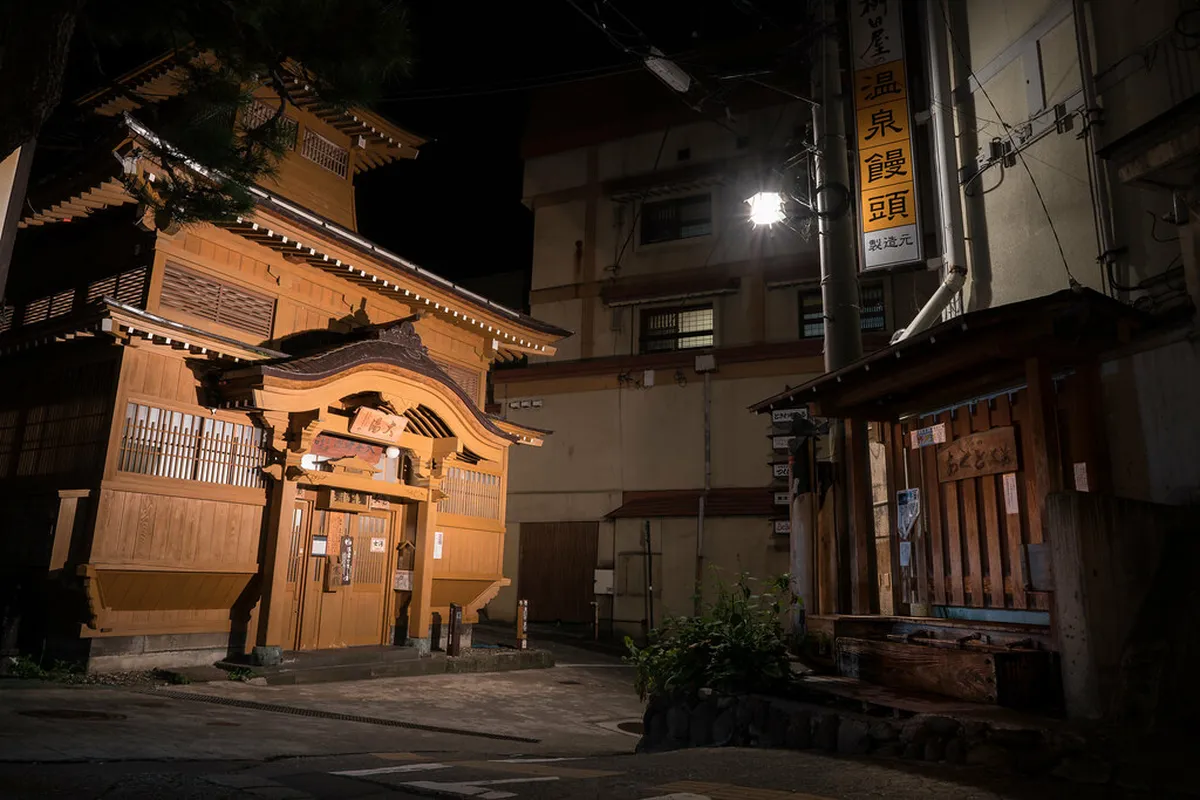
- Test the water first, then use the wooden stirring oar (yumomi) to circulate a too-hot tub rather than reaching straight for the cold tap.
- Add cold water only if the tub is genuinely too hot to use. Turn the tap off the moment it feels tolerable, since leaving it running dilutes the mineral water for everyone else.
- Keep your towel out of the bathwater. Rest it on the edge, a shelf, or folded on your head instead.
- Wipe down with your towel before stepping back onto the wooden changing-room floor, so the next bather isn't dealing with puddles.
First-Timer Favorites: Oyu and the Central Baths
Oyu sits at the center of the onsen street and functions as the village's symbol, with Edo-era wooden architecture. It's the only one of the 13 sotoyu with a footbath out front. Local tradition holds that its simple sulfur water eases digestive complaints, rheumatism, and general fatigue, a claim rooted in generations of use rather than clinical testing. Kawahara-yu sits just downstream and draws a similar riverside crowd. Its higher temperature and gypsum-salt-sulfur water make it a popular early-morning stop, especially in summer. Both are easy first stops: central, well signed, and busy enough that a newcomer rarely bathes alone while learning the routine.
The Largest and Quietest Sotoyu
Nakao-no-yu holds the largest wooden bathhouse structure in the village, drawing its water from the Ogama source like several other sotoyu. Its gypsum-salt-sulfur water is traditionally associated with easing skin conditions and rheumatism. Local lore even credits it with helping recovery from mercury exposure, a legacy of the area's mining-era folk remedies. Anyone who feels cramped in a smaller tub should start here, since the extra floor space makes it easier to keep distance from other bathers. Yokochi-no-yu sits underground beneath the Yokochi crossing and draws from the Asagama source, which keeps it quieter simply because fewer visitors notice the entrance. Akiha-no-yu, near the tranquil Ibanoyama Bunko park, sees a similar trickle of visitors and makes a calm stop away from the busier central baths.
All 13 Sotoyu at a Glance
The remaining bathhouses round out the full sotoyu meguri route, each drawing from its own spring source with its own local reputation. Posted hours vary by building, so confirm the sign at the door rather than assuming village-wide timing.
| Bathhouse | Highlight | Located Near |
|---|---|---|
| Oyu | Village symbol; only sotoyu with a footbath; Edo-era architecture | Central onsen street |
| Kawahara-yu | High-temperature morning soak, popular in summer | Riverside, just downstream of Oyu |
| Nakao-no-yu | Largest wooden bathhouse in the village | Near the Ogama source |
| Shin-yu | Known for yuno-hana mineral flowers; closes earlier, 6:00 AM-7:00 PM | Entrance to Tsutsujiyama Park |
| Kumanotearai-yu | Bear-discovery legend; traditionally used for burns and cuts | Near the village center |
| Taki-no-yu | High-temperature 78°C source; access currently limited to village guests | Near the Asagama source, upstream |
| Yokochi-no-yu | Underground bathhouse beneath the Yokochi crossing | Yokochi crossing |
| Juodo-no-yu | Two-story bathhouse, water from two sources | Opposite Enma-do Hall |
| Matsuba-no-yu | Named for an old archery-range legend | Matsuba inn district |
| Kamitera-yu | Traditionally used for cuts, burns, and skin conditions | Just downhill from Shin-yu |
| Shinden-no-yu | Longest hours, 5:00 AM-11:00 PM; built at the end of the Edo period | Opposite Nishinomiya Shrine |
| Akiha-no-yu | Quiet, park-adjacent | Near Ibanoyama Bunko park |
| Asagama-no-yu | Draws from the Asagama source | Asagama Street |
The Ogama Cooking Onsen and Onsen-Tamago
Ogama is the village's open-air communal kitchen and its hottest spring, channeling water near 90°C through five stone pools, according to the resort's official site. It sits just above the main street, Oyu-dori, and just below the entrance to the Yu-road travellator. Villagers still use it for washing, soaking vines, and boiling vegetables and eggs, especially the local leaf vegetable, Nozawa-na. Access stays restricted to community members, so visitors should observe from a safe distance rather than approach the pools. Mornings tend to offer the best view of the activity. Tourists who want to cook their own onsen-tamago should head to Yurari, a terrace-like mini-onsen-hiroba connected to Ogama by a short alley. It houses one of the village's public footbaths plus a tub for boiling pre-purchased eggs. The site is listed as closed during the winter months, so check current signage before planning an egg-cooking stop around the coldest weeks.
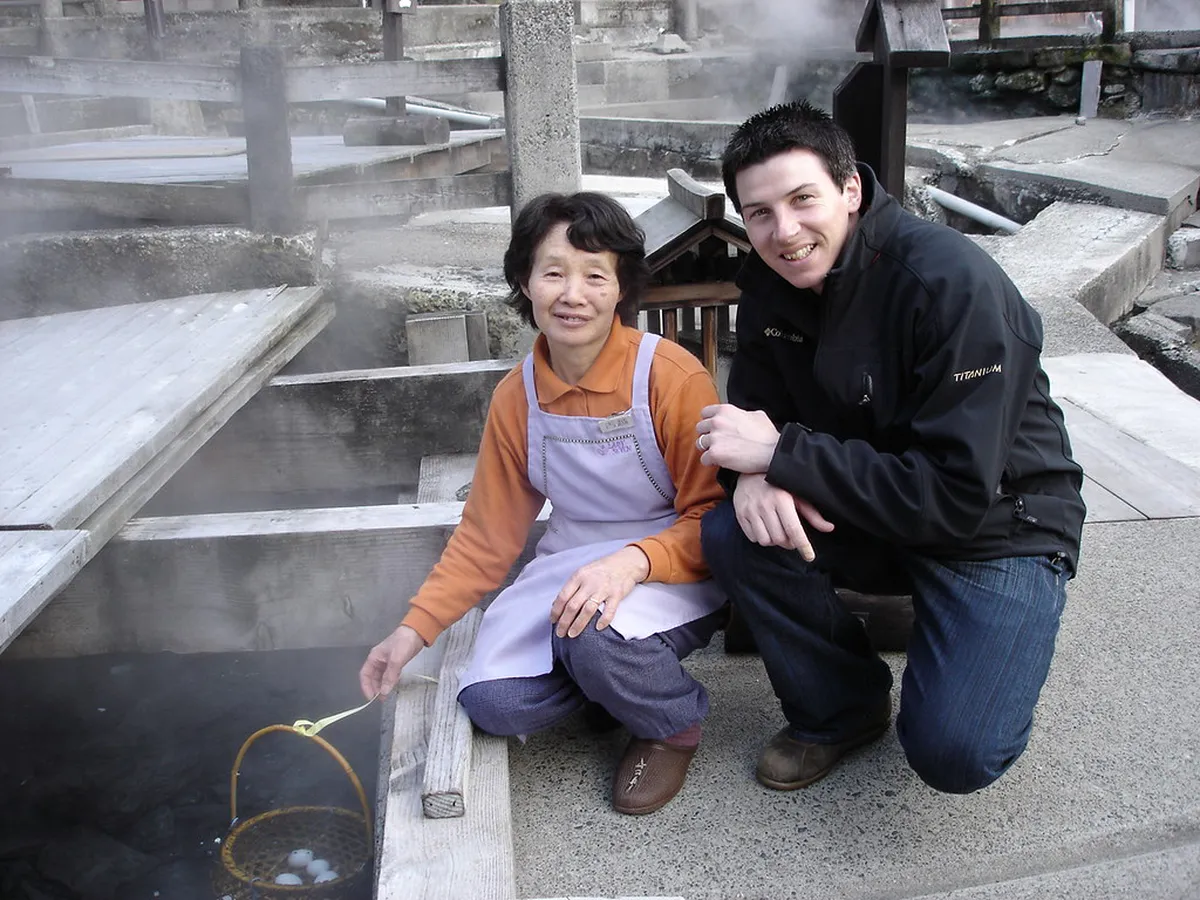
- Buy raw eggs and a mesh cooking bag from a shop near Ogama or Yurari; many sell both together.
- Lower the bag into a marked cooking tub. The water runs around 65°C to 68°C, the band that sets a true onsen-tamago.
- Wait about 20 minutes. At that heat, the yolk firms near 65°C while the white stays softer, fully solidifying closer to 80°C, so the yolk ends up firmer than the white.
- Cook only at posted public stations, since Ogama itself stays villager-only. Besides Yurari, look for signed tubs at Kamitera-yu, Kumanotearai-yu, Matsuba-no-yu, and Juodo-no-yu.
Hours, Costs, and When to Go
Most sotoyu run from early morning to around 11:00 PM in winter, per current village guidance, though each bathhouse posts its own hours at the entrance. A few keep different schedules worth planning around. Entry is free at every sotoyu, with no ticket, reservation, or fixed admission fee, unlike a paid day-use onsen or hotel spa elsewhere in Japan. Instead of a set price, most bathhouses keep a saisen-bako donation box by the entrance. Leaving a coin or two helps the neighborhood Yunakama cover heating and upkeep, and it's treated as good manners rather than optional. The busiest stretch runs in late afternoon, once skiers and snowboarders finish a day on the Nozawa Onsen ski slopes and head straight for a soak. A quieter tub is easier to find shortly after the morning opening, or later in the evening. Mid-January overlaps with the Dosojin Matsuri. Held every year from January 13 to 15, it's one of the village's central traditional events, according to Nozawa Onsen's official portal. The Nozawa Onsen Fire Festival Guide: Dates, Rules & Stay Requirements covers the full schedule and where to watch.
| Bathhouse | Typical Hours | Note |
|---|---|---|
| Shin-yu | 6:00 AM – 7:00 PM | Closes earlier than most other sotoyu |
| Taki-no-yu | 5:00 AM – 8:00 PM (Apr–Nov); 6:00 AM – 9:00 PM (Dec–Mar) | Access currently limited to village guests; confirm locally |
| Shinden-no-yu | 5:00 AM – 11:00 PM | One of the longest windows in the village |
| Most other sotoyu | Roughly 6:00 AM – 11:00 PM in winter | Exact hours posted at each entrance |
Where to Stay and How to Get Around
Many ryokans and guesthouses sit within a few minutes' walk of at least one sotoyu, so weigh proximity to a favorite bathhouse when comparing options in the Nozawa Onsen Hotels: Where to Stay by Neighborhood (2026) guide. The Yu-road travellator, a moving walkway just below Ogama, offers an easier way to cover the village's uphill stretches without a long walk. That keeps the whole onsen district walkable even after a soak. For the wider village, from temples to viewpoints, the 9 Best Things to Do in Nozawa Onsen (2026 Guide) guide rounds out a full itinerary. There's no dedicated parking at the public baths, so arriving by car means leaving the vehicle at lodging and walking into the village. Full transit and driving directions live in the getting to Nozawa Onsen guide.
Extending the Trip Across Nagano
Nagano Prefecture, once known as Shinshu, brands itself an onsen kingdom. The region counts roughly 236 onsen areas and 1,043 spring sources, according to the resort's own site. Mineral water flows through the prefecture at about 133,787 liters per minute, across eleven different spring types. Nozawa Onsen also sits within easy day-trip range of other 11 Best Things to Do in Nagano, Japan (2026 Guide). Many travelers add a stop at Jigokudani Snow Monkey Park Travel Guide to see the snow monkeys. For broader regional snow planning, the 10 Best Things to Do in Nagano in Winter (2026) covers conditions across the prefecture. Beyond the Dosojin Matsuri, the Nagano festivals and events guide tracks other seasonal celebrations region-wide. Nagano Prefecture's own tourism office also promotes the region's wider onsen culture for travelers building a longer itinerary.
Nagano Prefecture has 1,043 spring sources, so Nozawa Onsen's 13 sotoyu—while abundant for a single village—represent just one focused cluster within the region's extensive network.
Mistakes to Avoid
A few small missteps stand out among first-time visitors to the sotoyu, and each is easy to avoid once you know the local norm.
- Taking a towel into the bathwater. Keep it on the edge, on a shelf, or folded on your head instead.
- Lathering up inside the tub itself. Wash and rinse fully at the taps first; the shared pool is for soaking, not scrubbing.
- Skipping the donation box. A coin covers a share of the Yunakama's heating and cleaning costs.
- Cooling a tub with a long blast of cold water instead of the stirring oar, then walking away with the tap still running.
- Approaching Ogama's pools, or ignoring a posted villagers-only sign at a cooking station. Observe from the designated viewing distance instead.
Frequently Asked Questions
Are the public baths in Nozawa Onsen really free?
Yes, entry to all 13 sotoyu is free, and none require a ticket or reservation. Most keep a saisen-bako donation box by the door, and leaving a coin helps the neighborhood Yunakama group cover heating and maintenance.
What should a first-time visitor bring to a sotoyu?
Bring a small towel, shampoo, and soap, since the bathhouses supply neither. A basic onsen kit is also available to buy in village shops before the first soak.
Can visitors cook their own onsen-tamago?
Yes, at signed public stations rather than at Ogama itself, which stays villager-only. Buy eggs and a mesh bag from a village shop near the onsen district. Then lower them into a marked cooking tub for about 20 minutes. Options include Yurari, Kamitera-yu, Kumanotearai-yu, Matsuba-no-yu, and Juodo-no-yu.
Is Taki-no-yu open to all visitors?
Current listings show access limited to guests staying within the village, unlike most of the other sotoyu. Policies can shift between seasons, so confirm the current rule locally before building a visit around it.
What time of day has the shortest wait at the baths?
Late afternoon gets busiest, once skiers and snowboarders finish on the slopes and head straight for a soak. Visiting shortly after the morning opening, or later in the evening, usually means a quieter bathhouse.
How late do the public baths stay open?
Most sotoyu run from early morning to around 11:00 PM in winter, though each bathhouse posts its own hours at the entrance. Shin-yu closes earlier, at 7:00 PM, while Shinden-no-yu stays open until 11:00 PM.
What does the water smell and feel like?
Most sotoyu draw sulfur-bearing spring water, so a faint mineral smell is normal and not a sign of anything wrong. Expect a silky, slightly slick feel on the skin rather than the chlorine tang of a swimming pool.
Free guide: Japan's Hidden Gems
12 under-the-radar places beyond Tokyo & Kyoto — with the best season to visit each and a local tip you won't find in the guidebooks.
You might also like


Continue reading
More guides you'll find useful


