

The Tokyo Metropolitan Government Building in Shinjuku has two free observatories on the 45th floor, 202 metres up, and no reservation is needed. The South Observatory is open 9:30–22:00 and the North Observatory 9:30–17:30, with last entry 30 minutes before closing; the South closes on the 1st and 3rd Tuesdays, the North on the 2nd and 4th Mondays. It is the best free high-level viewpoint in central Tokyo: its twin towers rise above west Shinjuku, and a dedicated observatory elevator runs from the 1st floor of Main Building No. 1. On a clear winter morning you can trace the skyscrapers toward Mount Fuji; after dark the foreground becomes a grid of Shinjuku lights.
Unlike Tokyo Skytree, Tokyo Tower, or Shibuya Sky, the observatories charge no admission and require no timed ticket. That makes this an easy weather-dependent addition to the complete Tokyo attractions guide: check visibility, walk over from Shinjuku Station, and change plans without losing a prepaid slot.
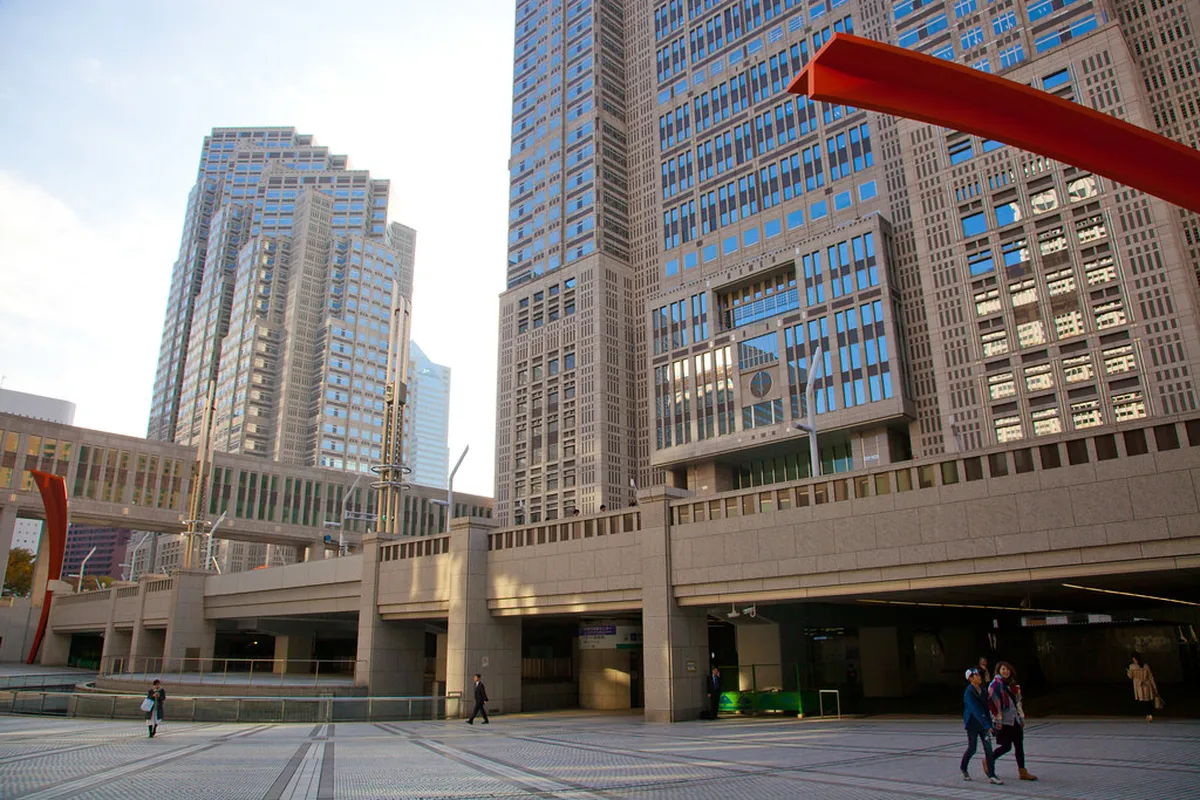
Observatory Hours and Closed Days (2026)
The South Observatory is open 9:30–22:00 and the North Observatory 9:30–17:30, and last entry to either deck is 30 minutes before closing. Each deck closes on two fixed days a month, so on any given day at least one is normally open, and when the South deck is closed the North deck stays open until 22:00.
| Observatory | Hours | Last entry | Regular closed days |
|---|---|---|---|
| South | 9:30–22:00 | 21:30 | 1st and 3rd Tuesday |
| North | 9:30–17:30 (until 22:00 on South closed days) | 17:00 (21:30 on South closed days) | 2nd and 4th Monday |
When a closed day falls on a public holiday, the deck opens and closes on the following day instead; that is why the South Observatory closed on Wednesday 4 November 2026 after the Culture Day holiday, and the North Observatory closes on Tuesday 24 November after the Labor Thanksgiving Day holiday. For the rest of 2026 the official calendar lists the South deck closed on 1 and 15 December and the North deck on 14 and 28 December. Both decks close for the year-end and New Year period (29–31 December and 2–3 January) and on building inspection days; on 1 January 2027 both are scheduled to open 7:30–17:30. Bad weather can close the decks at short notice, and the Tokyo Metropolitan Government posts these changes on its official observatory X account, so check the official observatory page and its monthly calendar on the day.
North or South Observatory?
Go to the South Observatory for evening and night views, because it stays open until 22:00, while the North Observatory closes at 17:30 except on the South deck's closed days. The two towers follow different calendars, and both give broad views, but open sides and temporary restrictions can change. Check the official observatory notice on the day you visit rather than relying on an old timetable.
Security screening happens before the dedicated elevator. Large luggage slows the process and is awkward on a busy deck, so use a station locker first; the observatory rules ask you to keep strollers and suitcases with you at all times. The observatories include seating, labelled skyline diagrams, a café and shop (CAFE&SHOP SOCOCOCO) in the North Observatory and a gift shop (TOKYO Mikke!) in the South Observatory. There is no outdoor roof area: every view is through glass.
Do You Need to Book the Tokyo Metropolitan Government Building?
No. Entry to both observatories is free and first come, first served: the Tokyo Metropolitan Government does not accept advance or group reservations, and there is no ticket to buy. The official page says visitors typically queue 20–30 minutes before entering, with the wait varying by weather and time of day, so allow extra time around sunset and on weekends. Weekdays, it also publishes a Japanese-only observatory information line (03-5320-7890, 10:00–17:00) for questions about opening days.
Best Time for the View
For Mount Fuji, choose a clear morning from December through February, when the official observatory page says Fuji is visible on more days, and arrive near opening. The mountain sits southwest of Shinjuku and often disappears behind haze by afternoon. For city lights, arrive 30 to 45 minutes before sunset; you will see the urban scale in daylight and stay as the towers illuminate.
Glass reflections are strongest at night. Wear dark clothing, press the camera close to the window without touching it, and turn off flash. Tripods, monopods, reflectors and blackout cloths are not allowed, and you may not fix a camera in place. If cloud hides the horizon, the free price still makes the closer view over Shinjuku worthwhile, but save a paid observation deck for a clearer day.
Night Projection Mapping
The TOKYO Night & Light projection mapping is screened every evening except in stormy weather, on the east wall of Main Building No. 1; on 17 November 2026 the official timetable lists shows every 30 minutes from 17:30 to 21:30. Watch it from Citizens' Plaza (Tomin Hiroba) at ground level, not from the observatory. Programs change through the year (a new one starts on 20 November 2026) and cancellations are announced on the project's official channels, so check the official TOKYO Night & Light timetable before making a special trip.
A practical evening sequence is Shinjuku Gyoen or central Shinjuku in late afternoon, the observatory around sunset, then the projection show at plaza level. Continue to Golden Gai or Omoide Yokocho for dinner rather than crossing the city again.
How to Get There
Tochomae Station on the Toei Oedo Line connects directly to the building, and it is about a 10-minute walk from the West Exit of JR Shinjuku Station or from Nishi-Shinjuku Station on the Tokyo Metro Marunouchi Line. From JR Shinjuku, follow signs through the underground passages and allow a little extra time, because the station complex is larger than the map suggests. On weekdays the Toei bus Tocho loop runs from the Shinjuku Station West Exit underground bus stop to the Tocho Daiichi Honcho stop. The observatory elevator starts on the 1st floor of Main Building No. 1, not the assembly building across the plaza; on weekends and public holidays the 2nd-floor entrance is shut, so use the 1st-floor main entrance.
Travelers with wheelchairs or strollers can use step-free routes and the building's elevators (ask the security staff), but station exits vary. Tochomae is usually simpler than navigating the full Shinjuku interchange. The complex is an active government workplace, so stay within visitor areas and follow security instructions.
What to Pair with the Observatory
- Shinjuku Gyoen: gardens and seasonal foliage, about 25 minutes on foot.
- Shinjuku Golden Gai: tiny bars east of the station; go after dark.
- Omoide Yokocho: compact yakitori alleys beside the west side of Shinjuku Station.
- Tokyo Opera City: galleries, concert halls, and restaurants one stop away at Hatsudai.
Frequently Asked Questions
Is the Tokyo Metropolitan Government Building observatory free?
Yes. Public observatory admission is free, although visitors pass through security before the elevator.
Can you see Mount Fuji?
Yes on clear days, especially winter mornings. Summer humidity and afternoon haze often hide it.
Do you need a reservation?
No. Advance and group reservations are not accepted; you simply queue, usually for 20–30 minutes. Check the official calendar for closed days.
Which observatory is open at night?
The South Observatory, open until 22:00 (last entry 21:30). The North Observatory closes at 17:30, except on the South deck's closed days, when it stays open until 22:00.
Is the observatory open in November 2026?
Yes, on most days. The official calendar lists the South Observatory closed on 4 and 17 November and the North Observatory on 9 and 24 November 2026.


